152mm OF-25 High-Explosive Projectile
Ordnance Overview
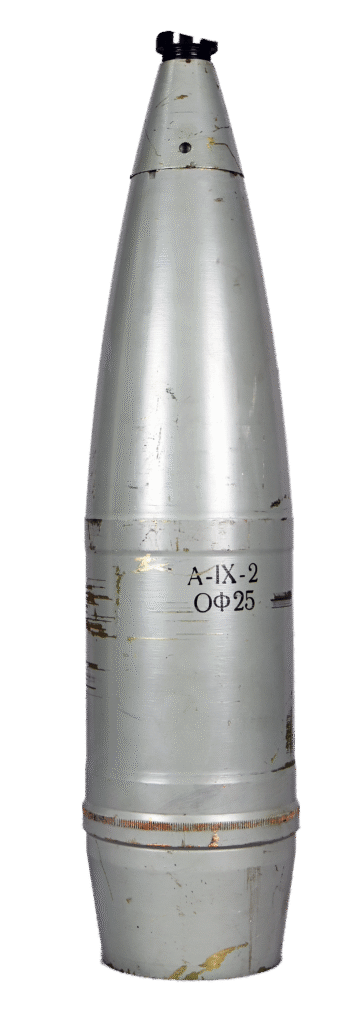
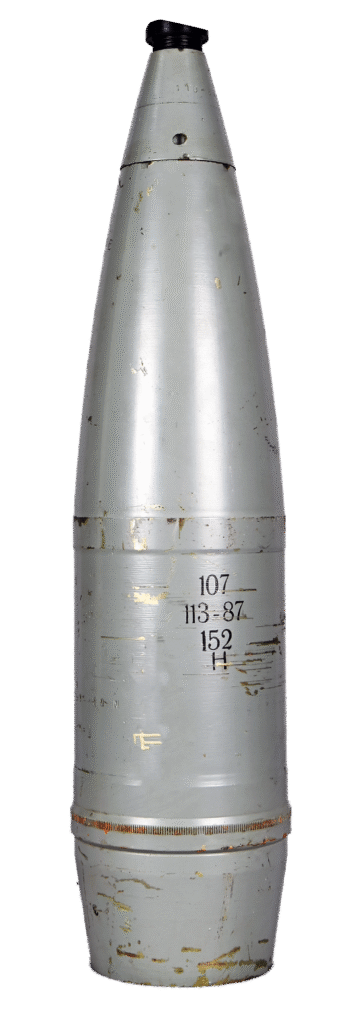
The OF-25 is a Soviet-designed 152mm high-explosive fragmentation (HE-FRAG) artillery projectile developed for use with 152mm towed and self-propelled howitzers. This round represents the standard HE projectile for one of the most widely distributed artillery calibers in the world, designed to deliver devastating blast and fragmentation effects against personnel, light vehicles, and field fortifications. The OF-25 is compatible with legendary artillery systems including the D-20 towed howitzer, 2S3 Akatsiya self-propelled howitzer, and 2S19 Msta self-propelled howitzer, making it a cornerstone of Soviet/Russian artillery doctrine for over six decades.
Country/Bloc of Origin
- Country: Soviet Union (USSR)
- Development Period: Late 1940s to early 1950s
- Military Bloc: Warsaw Pact
- International Distribution: Exported globally and license-produced by numerous countries including China, India, Bulgaria, Poland, Yugoslavia, Egypt, and North Korea
- Current Users: Russia, China, India, Iran, Syria, North Korea, and over 50 other nations operating Soviet-designed 152mm artillery systems
Ordnance Class
- Type: Artillery projectile (howitzer ammunition)
- Primary Role: High-explosive fragmentation anti-personnel and anti-materiel
- Secondary Role: Destruction of field fortifications, light structures, and suppression fire
- Delivery Method: Indirect fire from 152mm howitzers (towed and self-propelled)
- Classification: High-angle fire, ballistic trajectory projectile with explosive payload
Ordnance Family/Nomenclature
Official Designations
- Soviet/Russian: OF-25 (ОФ-25 in Cyrillic)
- GRAU Index: 3OF25
- Complete Round Designation: 53-OF-25 (including propellant charge)
- NATO Stock Number: Various NSNs depending on importing country
- NATO Reporting Classification: Standard 152mm HE-FRAG (no specific NATO reporting name)
Related Variants and Improvements
- OF-45: Improved HE-FRAG round with extended range (late Soviet era)
- OF-540: Modern enhanced fragmentation variant
- 3OF39 “Krasnopol”: 152mm laser-guided projectile (same caliber, different design)
- 3OF64: Latest generation base-bleed extended range HE-FRAG
- Chinese Type 152-I: Chinese license-produced equivalent of OF-25
Compatible Artillery Systems
The OF-25 was designed for and remains compatible with:
- D-20 (152mm towed gun-howitzer): Primary platform, introduced 1955
- 2S3 Akatsiya (152mm SPH): Self-propelled version, introduced 1971
- 2S19 Msta-S (152mm SPH): Modern SPH, introduced 1989
- D-1 (152mm howitzer): Older system, limited compatibility
- ML-20 (152mm gun-howitzer): WWII-era system, some variants compatible
Ammunition System Family
The OF-25 is part of the complete 152mm ammunition suite that includes:
- OF-25/OF-45 series (HE-FRAG rounds)
- BP-540 series (HEAT anti-tank rounds)
- 3OF39 Krasnopol (laser-guided precision rounds)
- Illumination and smoke projectiles
- Practice rounds (inert projectiles)
Hazards
Primary Hazards
Explosive Blast
- Contains approximately 5.5-6.0 kg of TNT equivalent high explosive
- Lethal blast radius: 10-15 meters
- Casualty radius: 50-70 meters in open terrain
- Severe overpressure hazard in confined spaces or trenches
- Can collapse light structures and damage reinforced positions
Fragmentation
- Steel body designed to fragment into approximately 2,500-3,500 lethal fragments
- Effective fragmentation radius: 30-40 meters
- Dangerous fragmentation extends to 150-200 meters
- Fragments retain lethal energy at distances up to 300 meters in some conditions
- Fragment size ranges from <1 gram to 50+ grams
- High-velocity fragments can penetrate sandbags, wooden structures, and light armor
Impact Sensitivity (Unfired Rounds)
- Unfired projectiles mechanically safe when properly transported and stored
- Fuzes have safety mechanisms preventing accidental detonation
- Rough handling can damage fuze mechanisms, increasing misfire risk
Impact Sensitivity (UXO)
- Fuze armed after firing – extremely dangerous as unexploded ordnance
- May detonate if moved, vibrated, or subjected to temperature changes
- Some fuzes have long-delay or deterioration-induced sensitivity
Environmental and Degradation Risks
- Propellant Degradation: Modular charges can deteriorate, causing erratic burning and pressure spikes
- Explosive Stability: TNT filling generally stable but can degrade in extreme heat or moisture exposure
- Corrosion: Steel projectile body susceptible to rust, which can affect fuze threading and body integrity
- Fuze Deterioration: Mechanical fuzes can corrode or freeze, leading to duds or unpredictable function
- Cold Weather: Propellant burn rates affected by extreme cold, reducing range
Special Hazards
- Weight: Complete round weighs approximately 43-48 kg (projectile ~43.5 kg, charges variable)—manual handling injury risk
- Propellant Handling: Modular propellant charges present fire risk and must be kept away from ignition sources
- Toxic Combustion Products: Firing produces toxic gases including carbon monoxide and nitrogen oxides
- Booby Trap Potential: UXO may be booby-trapped by enemy forces—treat all UXO as potentially armed with anti-handling devices
Unexploded Ordnance (UXO) Considerations
- Dud Rate: Approximately 2-8% depending on fuze type, manufacturing quality, and storage conditions
- UXO Danger Zone: Minimum 500-meter evacuation radius for suspected 152mm UXO
- Long-Term Hazard: UXO can remain dangerous for decades; WWII-era 152mm rounds still pose threats today
- Movement Risk: Any movement of armed UXO can cause detonation—stabilize in place and mark for EOD
- Environmental Exposure: Degraded fuzes may become more sensitive over time, particularly in contaminated soil or water
CRITICAL SAFETY RULE: Only trained and certified Explosive Ordnance Disposal (EOD) personnel should approach, identify, or neutralize 152mm UXO. Maintain minimum 500-meter standoff and report to military or civilian authorities immediately.
Key Identification Features
Dimensions
- Caliber: 152.4mm (6.0 inches)
- Projectile Length: Approximately 540-560mm (21.3-22.0 inches) depending on variant
- Projectile Weight: Approximately 43.5-43.8 kg (95.9-96.6 lbs)
- Diameter: 152.4mm at widest point (driving band)
- Diameter at Base: Approximately 145mm (base taper)
- Explosive Fill Weight: 5.5-6.0 kg (12.1-13.2 lbs) TNT equivalent
Physical Characteristics
Shape and Profile
- Elongated ogive (pointed) nose for ballistic efficiency
- Cylindrical body with slight taper toward base
- Prominent copper driving band (rotating band) positioned approximately 100mm from base
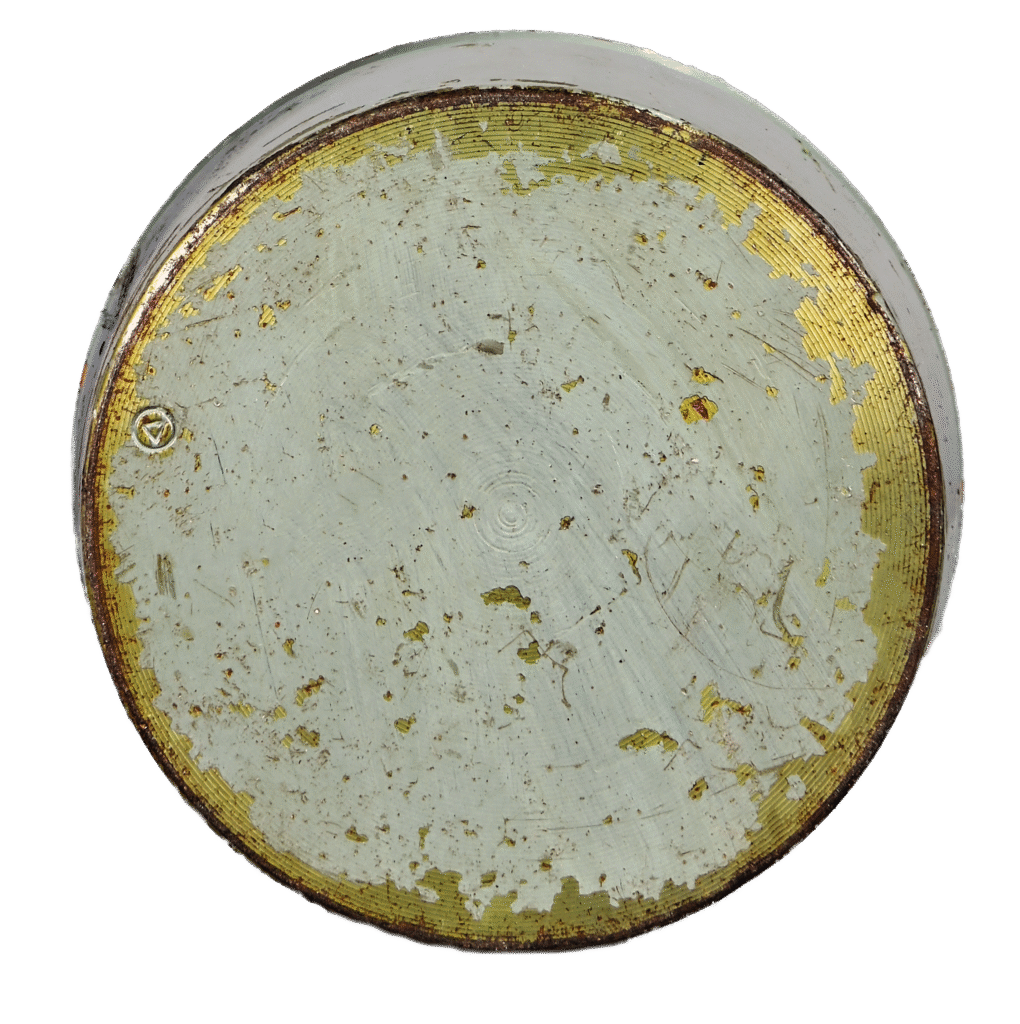
- Flat base with central fuze well (base-detonating fuzes) or streamlined boat-tail on some variants
- Overall streamlined profile optimized for high-angle trajectories
Color Schemes and Markings
- Body Color: Olive drab (OD green), dark gray, or yellow-green paint (varies by era and manufacturer)
- Nose Marking: Black band or black nose tip indicating HE-FRAG content
- Stenciling: Lot numbers, manufacturing codes, and date stamps in Cyrillic or Latin characters
- Example: “OF-25” or “ОФ-25” stenciled on body
- Year of manufacture (e.g., “1989”)
- Factory code (numerical or letter codes)
- Color Coding: Yellow or white bands may indicate explosive type or special handling requirements
- Base Markings: Manufacturing plant identifier, additional lot information
Distinctive External Features
- Copper Driving Band: Prominent copper alloy rotating band, approximately 20-30mm wide
- Fuze Well: Threaded nose cavity for point-detonating fuze (visible if fuze removed or damaged)
- Base Fuze Well: Some variants include base-detonating fuze well at projectile base
- Body Thickness: Relatively thin-walled steel (4-6mm) compared to armor-piercing projectiles
- Surface Texture: Smooth painted finish when new; field-recovered rounds often show rust and paint loss
- Weight Distribution: Forward center of gravity due to explosive fill in front two-thirds of body
Material Composition
- Projectile Body: Medium-carbon steel, heat-treated
- Driving Band: Copper alloy (typically 90% copper, 10% zinc)
- Fuze: Steel and brass mechanical components with aluminum or plastic parts in modern variants
- Explosive Fill: TNT (trinitrotoluene), TNT/RDX mixtures, or Composition B depending on production era
- Base Plug: Steel or brass base closure with threading for fuze (if base-fuzed)
Propellant Charges (When Found with Projectile)
- Configuration: Modular cloth bag charges or combustible case charges
- Number of Charges: Typically 1-7 modular increments for range adjustment
- Color: Off-white, tan, or green cloth bags
- Markings: Charge weight, type, and lot number stenciled on bags
- Full Charge Weight: Approximately 3.5-5.0 kg depending on charge configuration
Variant Identification
- OF-25 (original): Standard body, single fuze well (nose)
- OF-45: Extended ogive, streamlined base, base-bleed assembly visible at base
- OF-540: Similar to OF-25 but with modernized markings and improved manufacturing
Fuzing Mechanisms
The OF-25 can be fitted with multiple fuze types depending on tactical requirements, manufacturing era, and availability. Understanding fuzing is critical for both employment and EOD operations.
Primary Fuze Types
1. V-429 Point-Detonating Fuze (Standard)
- Function: Impact-activated, point-detonating, super-quick
- Era: 1950s-1980s standard fuze
- Installation: Threaded into nose fuze well
2. VM-429 Multi-Option Fuze
- Function: Selectable point-detonating or point-detonating with delay
- Options: Super-quick (instantaneous) or 0.05-second delay for concrete/earth penetration
- Installation: Nose fuze well
3. V-90 Time Fuze
- Function: Mechanical clockwork time fuze for airburst
- Setting: Manually set before loading based on time-of-flight calculations
- Installation: Nose fuze well
- Use: Anti-personnel effects, suppression, or ranging
4. RGM-2 Electronic Time Fuze (Modern)
- Function: Electronic time fuze set via inductive setter on gun
- Capability: Precise airburst timing for optimized fragmentation
- Installation: Nose fuze well
- Era: 1990s-present on modern artillery systems
5. AM-25 Base-Detonating Fuze
- Function: Backup detonation system; functions if nose fuze fails
- Installation: Base fuze well (on compatible variants)
- Purpose: Increase reliability, reduce dud rate
Arming Sequence and Safety Mechanisms
Pre-Firing State
- Fuze mechanically safed with multiple interlocks:
- Striker Safety: Spring-loaded striker held away from detonator by safety pins
- Creep Spring: Prevents arming until sufficient acceleration forces occur
- Arming Vane/Rotor: Mechanical component must rotate to align detonator (blocked until firing)
- Safety clips or pins prevent accidental fuze installation or removal
Firing and Arming Process
- Setback (Acceleration): Upon firing, extreme acceleration (15,000-25,000 G) compresses setback spring
- Creep Distance: Setback force drives arming mechanism but remains locked for initial flight phase
- Arming Vane Rotation: Air resistance spins arming vane, rotating detonator rotor into alignment (requires 50-200 meters flight distance)
- Centrifugal Safety: Projectile rotation (spin from rifling) releases final safety interlock via centrifugal force
- Armed State: After 2-5 seconds of flight (200-500+ meters), all safeties released—striker aligned with detonator, ready to function
Multiple Safety Features:
- Most fuzes have 3-4 independent safety mechanisms that must all release before fuze can function
- Prevents detonation from drops, rough handling, or premature function in gun barrel
Triggering Methods by Fuze Type
Point-Detonating (V-429, VM-429 Super-Quick Mode)
- Activation: Direct impact with target surface crushes nose fuze body
- Striker Movement: Crush inertia drives striker into stab-sensitive detonator
- Function Time: Virtually instantaneous (<0.001 seconds)
- Effect: Surface burst, maximum fragmentation and blast in open terrain
Point-Detonating with Delay (VM-429 Delay Mode)
- Activation: Impact activates delay element (0.05-second delay train)
- Function: Projectile penetrates 20-50cm into soil, concrete, or masonry before detonating
- Effect: Enhanced cratering, bunker penetration, reduced fragmentation danger to friendly forces in assault
Time Fuze (V-90 Mechanical)
- Activation: Clockwork mechanism started by setback force
- Timing: Runs for pre-set duration (typically 0.5-30 seconds)
- Function: Detonates projectile at predetermined time after firing
- Effect: Airburst above target area for maximum anti-personnel fragmentation
Electronic Time Fuze (RGM-2)
- Activation: Electronic timer activated by setback force
- Programming: Time-to-function set by gun’s inductive fuze setter before firing
- Precision: Accurate to within 0.01 seconds
- Function: Airburst at precise altitude for optimized effects
Base-Detonating (AM-25)
- Primary Role: Backup if nose fuze fails
- Activation: Impact or detonation wave from nose fuze
- Function: Ensures main explosive charge detonates even if nose fuze is dud
Detonation Sequence
Standard Point-Detonating Function:
- Impact crushes nose fuze body or activates impact sensor
- Striker driven into stab-sensitive primary detonator (e.g., lead azide)
- Detonator creates shock wave initiating booster charge (e.g., tetryl or RDX)
- Booster detonates main explosive fill (TNT or Composition B)
- Explosive converts to rapidly expanding high-pressure gases (detonation velocity ~6,900 m/s for TNT)
- Projectile body fragments into thousands of pieces, accelerated radially outward at 1,500-2,500 m/s
- Blast wave propagates from detonation point creating overpressure hazard
Time/Airburst Function:
- Time fuze reaches preset interval
- Fuze fires detonator electrically (electronic) or mechanically (clockwork)
- Booster and main charge detonate as above
- Fragments disperse downward and outward in cone pattern
- Airburst maximizes fragment coverage of target area while minimizing ground cratering
Self-Destruct or Self-Neutralization Features
Standard OF-25 (V-429, VM-429 Fuzes):
- No self-destruct mechanism
- Failure Rate: Approximately 2-5% dud rate depending on fuze condition, manufacturing quality, and impact conditions
- UXO Hazard: Duds remain dangerous indefinitely until neutralized by EOD
Modern Variants (RGM-2 Electronic Fuzes):
- Self-Destruct: Some electronic fuzes include self-destruct function
- Timing: Activates if projectile exceeds maximum expected flight time (typically 90-120 seconds)
- Purpose: Reduces UXO contamination of battlefield
- Reliability: Not 100% effective—duds still occur
Anti-Handling Devices
- Standard OF-25: Not equipped with anti-handling or anti-disturbance devices
- Field Modification Risk: Enemy forces may booby-trap UXO with improvised anti-handling devices
- EOD Approach: Assume all UXO may be booby-trapped; use remote methods when possible
History of Development and Use
Development Timeline and Motivations
Post-WWII Soviet Artillery Modernization (1945-1950)
The OF-25 emerged from the Soviet Union’s comprehensive post-World War II artillery modernization program. While the Soviets had fielded effective 152mm systems during the war (notably the ML-20 gun-howitzer), post-war analysis revealed opportunities for improvement:
- Ammunition Standardization: WWII-era 152mm ammunition lacked standardization, with multiple incompatible projectile designs
- Range and Accuracy: Post-war developments in ballistics and propellant chemistry enabled extended range designs
- Manufacturing Efficiency: Simplified projectile designs could reduce production costs while maintaining effectiveness
- NATO Threat Assessment: Anticipated conflicts with NATO forces required artillery capable of massing devastating firepower
Design and Development (1948-1952)
Soviet ammunition design bureaus, building on WWII experience, created the OF-25 with several key objectives:
- Compatibility: Design compatible with existing 152mm guns (ML-20, D-1) and new developments (D-20)
- Lethality: Optimize fragmentation patterns and blast effects against NATO-style dispersed infantry tactics
- Reliability: Improve fuzing reliability to reduce dud rates below WWII levels (which sometimes exceeded 10%)
- Manufacturability: Design for mass production using Soviet industrial capabilities
- Modular Charges: Develop compatible modular propellant system for precise range control
Design Features:
- Streamlined ogive for flat trajectory and range
- Thin-walled body maximizing explosive fill while maintaining structural integrity
- Copper driving band for consistent engagement with rifling
- Multiple fuze options (point-detonating, time, delay) for tactical flexibility
Testing and Standardization (1952-1955)
Extensive testing at Soviet proving grounds validated the OF-25’s performance:
- Fragmentation pattern analysis against troop concentrations
- Penetration tests against field fortifications
- Accuracy testing at various ranges and charges
- Cold-weather and extreme climate testing
- Quality control procedures for manufacturing
Official Adoption: The OF-25 was formally adopted into Soviet service circa 1953-1955, coinciding with introduction of the D-20 152mm gun-howitzer.
Initial Deployment and First Combat Use
Operational Deployment: Mid-1950s
- Initial issue to Soviet artillery regiments equipped with D-20 howitzers
- Gradual replacement of older WWII-era 152mm ammunition stocks
- Distribution to Warsaw Pact allies throughout late 1950s and 1960s
- Export to friendly nations including China, North Korea, Egypt, Syria
First Known Combat Use: 1960s While exact first combat use is difficult to verify due to classification, documented employment includes:
- Vietnam War (1965-1975): North Vietnamese forces used Soviet-supplied D-20 howitzers with OF-25 ammunition
- Six-Day War (1967): Egyptian and Syrian forces employed 152mm artillery against Israeli positions
- Yom Kippur War (1973): Extensive use by Egyptian and Syrian artillery in opening bombardments
Documented Major Conflicts:
Soviet-Afghan War (1979-1989)
- Massive employment by Soviet artillery units
- Used extensively in fire support for ground operations in mountainous terrain
- Challenges: High dud rates in rocky terrain; time fuzes difficult to set accurately at high altitudes
- Tactical lessons: Effective against fortified positions; less effective against dispersed mujahideen fighters
Iran-Iraq War (1980-1988)
- Both sides employed 152mm artillery with OF-25 ammunition in devastating artillery duels
- Millions of rounds fired during 8-year conflict
- UXO from this conflict continues to cause casualties today
- Demonstrated effectiveness in attritional warfare and trench fighting
First Chechen War (1994-1996)
- Russian forces used massive artillery bombardments including OF-25 rounds
- Urban combat revealed limitations: difficulty engaging high-angle targets in cities
- High collateral damage led to international criticism
- Highlighted need for precision alternatives
Second Chechen War (1999-2009)
- Continued heavy use with some improvements in targeting procedures
- Introduction of early precision-guided variants (Krasnopol) on same 152mm platform
Syrian Civil War (2011-Present)
- Extensive documented use by Syrian government forces
- Human rights organizations documented widespread use against civilian areas
- Demonstrates OF-25’s continued frontline service despite age
Russo-Ukrainian War (2014-Present)
- Heavy employment by both Russian and Ukrainian forces
- Largest artillery conflict since WWII
- Demonstrates continued relevance of conventional tube artillery
- UXO contamination of vast areas
- Some reports of poor ammunition quality (high dud rates) from older stockpiles
Evolution and Improvements Over Time
First Generation: OF-25 (1953-1970s)
- Original design with TNT filling
- V-429 point-detonating fuze standard
- Basic manufacturing tolerances
- Focus on mass production and reliability
Second Generation: OF-25M and OF-45 (1970s-1980s)
- OF-25M: Modernized variant with improved explosive composition (TNT/RDX mixtures)
- OF-45: Extended-range variant with:
- Streamlined base design
- Improved ballistic coefficient
- Range increase of 15-20%
- Introduction of base-bleed technology in some variants
- Improved manufacturing quality control
- Enhanced fuze options including VM-429 multi-option fuze
Third Generation: OF-540 and Modern Variants (1990s-2000s)
- OF-540: Modernized HE-FRAG with:
- Optimized fragmentation pattern (computational design)
- Improved explosive formulations
- Better environmental stability and shelf life
- Enhanced safety features
- Introduction of electronic time fuzes (RGM-2)
- Improved quality control reducing dud rates
- Better propellant chemistry for consistent performance
Fourth Generation: Base-Bleed and Precision Guidance (2000s-Present)
- 3OF64: Latest conventional HE-FRAG with base-bleed extended range
- 3OF39 “Krasnopol”: Laser-guided precision variant (different design but same caliber)
- Integration with modern fire control systems
- Digital fuze setters for precise airburst capability
Parallel Development: Chinese and Other Variants
- China developed domestic 152mm ammunition with varying degrees of Soviet influence
- Indian OFHE Mk1 based on OF-25 design with local improvements
- East European variants with minor modifications
Production Numbers and Distribution
Production Scale
Exact production figures remain classified, but estimates suggest:
- Soviet/Russian Production: Tens of millions of rounds produced from 1953-present
- Peak Production: 1970s-1980s during Cold War buildup
- Current Production: Continues in Russia at reduced peacetime rates; increased dramatically due to Ukraine conflict
- Chinese Production: Millions of rounds of domestic variants
- Licensed Production: Bulgaria, Poland, Yugoslavia, India, Egypt produced significant quantities
Manufacturing Facilities:
- Multiple Soviet ammunition plants (specific facilities classified)
- Chinese ordnance factories (various locations)
- Licensed facilities in Warsaw Pact countries
- Current Russian production at modernized Soviet-era plants
Global Distribution
The OF-25 and variants have been distributed to over 60 countries across six continents:
Major Users:
- Russia: Primary user; maintains millions in active and reserve stockpiles
- China: Extensive stockpiles of domestic variants
- India: Large operator of Soviet and licensed 152mm systems
- Syria: Extensive use of Soviet-supplied ammunition
- Iran: Significant stocks, some domestic production capability
- North Korea: Large stockpiles, some domestic production
Regional Distribution:
- Eastern Europe: All former Warsaw Pact states
- Middle East: Syria, Iraq, Egypt, Libya, Yemen, Algeria
- Asia: China, India, Vietnam, North Korea, Afghanistan
- Africa: Angola, Ethiopia, Mozambique, Libya, Algeria
- Latin America: Cuba, Nicaragua (limited quantities)
Current Status
Operational Status: Active Worldwide
- Remains standard HE-FRAG ammunition for 152mm artillery in Russian and many other militaries
- Continuous production for new manufacture and reserve stock replacement
- Being supplemented but not replaced by modern variants in advanced militaries
- Developing nations continue to rely on OF-25 as primary HE round
Stockpile Estimates:
- Russia: Millions of rounds in active service; tens of millions in long-term storage (estimates vary)
- China: Extensive stockpiles of domestic production
- Global: Estimated 50-100 million rounds in various conditions worldwide
- Ukraine Conflict Impact: Russian expenditure estimated at 10,000-20,000 rounds per day at peak intensity (2022-2023), drawing down stockpiles
Quality Concerns:
- Age of stockpiles raises reliability questions
- Reports of increased dud rates from decades-old ammunition
- Some countries facing ammunition shortages despite large nominal stockpiles
- Quality of ammunition from 1950s-1970s production runs degrading
Replacement Timeline:
- Not considered obsolete; continues to meet most operational requirements
- Modern variants (OF-540, 3OF64) supplement rather than replace OF-25 in many arsenals
- Precision-guided alternatives (Krasnopol) too expensive for mass use
- Expected to remain in service through at least 2040s-2050s in many countries
Impact on Warfare Tactics and Doctrine
Soviet/Russian Artillery Doctrine
The OF-25 is central to Soviet/Russian artillery doctrine emphasizing:
- Mass Fires: Overwhelming target areas with high volumes of fire rather than precision
- Combined Arms: Artillery as primary killing arm, with infantry and armor exploiting suppression
- Standardization: OF-25’s compatibility with multiple gun systems simplified logistics
- Tactical Flexibility: Multiple fuze options allowed engagement of varied targets
Tactical Applications:
Counter-Battery Fire:
- Used to suppress enemy artillery positions
- Time fuzes or airburst for maximum effect against unprotected crews
Preparation Fires:
- Massive pre-assault bombardments to destroy defenses
- Soviet doctrine called for hundreds of guns firing simultaneously
- OF-25’s fragmentation ideal for clearing trenches and fighting positions
Interdiction:
- Targeting rear-area targets: supply depots, reserves, command posts
- Disrupting enemy logistics and reinforcement
Close Support:
- Supporting assaults with “rolling barrage” advancing ahead of friendly troops
- Danger-close engagements using precise charge control
Counter-Mobility:
- Cratering roads and terrain using delay fuzes
- Destroying bridges and infrastructure
Lessons from Modern Conflicts:
Urban Warfare (Chechnya, Syria):
- Devastating but indiscriminate in civilian areas
- High collateral damage led to international condemnation
- Limitations in precision drove development of guided alternatives
- Highlighted need for better target identification
UXO Legacy:
- Conflicts using OF-25 left extensive UXO contamination
- Dud rates of 2-8% mean thousands of unexploded rounds in former conflict zones
- Long-term humanitarian impact from UXO clearance requirements
- Economic impact on post-conflict reconstruction
Modern Warfare Implications:
- Ukraine conflict demonstrates continued dominance of tube artillery in high-intensity warfare
- Counter-battery radar and drone observation changed artillery tactics
- Need for dispersion and rapid displacement to avoid counter-battery fire
- Integration with UAVs for targeting improved effectiveness dramatically
Influence on Western Doctrine:
- NATO studied Soviet artillery doctrine extensively during Cold War
- Influenced development of Western counter-battery tactics and systems
- Drove development of precision alternatives (Excalibur, BONUS) to achieve effects with fewer rounds
- Highlighted trade-offs between volume of fire and precision
Technical Specifications
Explosive Fill
- Type: TNT (trinitrotoluene) in early production; TNT/RDX mixtures or Composition B in later variants
- Weight: 5.5-6.0 kg (12.1-13.2 lbs) depending on specific variant
- Filler-to-Weight Ratio: Approximately 12.6-13.8% (typical for artillery projectiles)
- Detonation Velocity: ~6,900 m/s (TNT); ~7,600 m/s (Composition B)
- Relative Effectiveness Factor (TNT = 1.00): 1.00 (TNT); 1.35 (Composition B)
Ballistic Performance
From D-20 Towed Gun-Howitzer:
- Muzzle Velocity: 655 m/s (maximum charge); variable with reduced charges
- Maximum Range: 17,400 meters (charge 5); up to 24,000m with extended-range variants (OF-45)
- Minimum Range: Approximately 4,000 meters (charge 1)
- Rate of Fire: 4-5 rounds per minute (sustained); 8 rounds per minute (first minute)
- Accuracy (CEP): 0.2-0.5% of range (varies with charge, range, conditions)
- Example: 35-87 meters CEP at 17.4km range
- Time of Flight: ~40 seconds at maximum range
From 2S3 Akatsiya Self-Propelled Howitzer:
- Muzzle Velocity: Similar to D-20 (655 m/s maximum)
- Maximum Range: 17,300 meters (standard); 20,500m with OF-45
- Rate of Fire: 4 rounds per minute (sustained); 10 rounds in first minute
- Ammunition Capacity: 46 rounds onboard
From 2S19 Msta-S Self-Propelled Howitzer:
- Muzzle Velocity: 810 m/s (maximum charge, modern propellant)
- Maximum Range: 24,700 meters (OF-45); 29,000m with base-bleed rounds
- Rate of Fire: 7-8 rounds per minute (sustained); 12 rounds in first 2 minutes
- Ammunition Capacity: 50 rounds onboard
- Modern Fire Control: Digital ballistic computer improves accuracy significantly
Fragmentation Characteristics
Fragment Production:
- Total Fragments: Approximately 2,500-3,500 individual fragments
- Effective Fragments: ~1,500-2,000 fragments >1 gram weight
- Fragment Weight Distribution:
- <1g: ~40% of fragments (numerous but limited range)
- 1-5g: ~35% of fragments (primary lethal hazard)
- 5-15g: ~20% of fragments (extended range, high lethality)
- 15g: ~5% of fragments (can exceed 50g, rare but dangerous)
Fragment Velocity:
- Initial Velocity: 1,500-2,500 m/s at detonation (varies with fragment size)
- Retained Velocity: Fragments lose energy rapidly; heavy fragments travel farther
Penetration Capability:
- Steel Plate: Fragments can penetrate 4-8mm mild steel at close range (0-50m)
- Wood: Penetration of 150-250mm pine at close range
- Sandbags: Penetration through 2-3 layers at close range
- Brick Wall: Penetration of 10-15cm common brick
- Body Armor: Defeats most soft body armor; some fragments stopped by hard plates
Fragmentation Pattern:
- Surface Burst: Roughly circular pattern with forward bias (60° cone)
- Airburst: Downward cone pattern optimized for area coverage
- Impact Angle Effect: Oblique impacts create asymmetric patterns
Terminal Effects by Range
Point-Detonating (Surface Burst):
- 0-15m: Near-certain lethality from combined blast and fragmentation
- 15-30m: High probability of casualty (fragmentation primary hazard)
- 30-50m: Moderate casualty probability (fragment density decreasing)
- 50-100m: Low casualty probability (scattered fragments, reduced energy)
- 100-200m: Minimal hazard (occasional fragment injuries possible)
Airburst (Time Fuze, 15-20m Height of Burst):
- 0-40m horizontal radius: High casualty probability (optimized fragmentation cone)
- 40-80m: Moderate casualty probability
- 80-150m: Low casualty probability from falling fragments
Penetration Effects (Delay Fuze):
- Earth/Soil: Penetrates 0.5-1.5 meters before detonation (varies with soil type)
- Concrete: Penetrates 20-40cm reinforced concrete
- Brick Masonry: Penetrates 40-60cm brick wall
- Sandbags: Penetrates 1.5-2.5 meters of sandbag fortification
- Effect: Cratering, bunker penetration, reduced fragmentation (absorbed by penetration medium)
Operating Parameters
Environmental Specifications:
- Storage Temperature Range: -50°C to +50°C (-58°F to +122°F)
- Firing Temperature Range: -40°C to +50°C (-40°F to +122°F)
- Humidity Tolerance: Sealed rounds resistant to moisture; opened propellant charges must be protected
- Altitude Compensation: Reduced range and altered trajectories at high altitude (affects Afghan War operations)
Shelf Life and Storage:
- Nominal Shelf Life: 15-25 years under proper controlled storage
- Extended Storage: Some ammunition from 1960s-1970s still in inventory (reliability questionable)
- Storage Conditions: Climate-controlled magazines preferred; field storage degrades reliability
- Inspection Requirements: Periodic visual inspection and test firing from aged lots
Propellant Charges:
- Type: Nitrocellulose-based tubular propellant in modular cloth bags
- Charge Increments: Typically 5-7 modular charges (varies by gun system)
- Charge Weight Range: 0.8 kg (minimum) to 5.0 kg (maximum) total
- Burn Rate: Progressive burning for consistent pressure curves
- Degradation: Propellant degradation primary cause of long-term ammunition failure
Deployment Methods
Handling and Loading:
- Crew Requirements: Typically 6-man crew for towed systems; 4-6 for SPH
- Manual Loading: Two-man lift required for safe handling of 43.5 kg projectile
- Loading Sequence:
- Inspect projectile and fuze
- Set fuze (time fuzes require manual setting; electronic fuzes use inductive setter)
- Ram projectile into chamber
- Select appropriate propellant charge
- Insert and ram propellant charge
- Close breech
- Fire
Mechanical Loading (SPH):
- 2S3 Akatsiya: Semi-automatic loading tray assists crew
- 2S19 Msta: Automated projectile and charge handling (crew supervises)
Fire Missions:
- Direct Fire: Rarely used (emergency anti-tank or bunker-busting)
- Indirect Fire: Standard employment mode using forward observers or UAV spotting
- Fire for Effect: Sustained bombardment after ranging adjustments
- Time on Target: Multiple guns coordinating for simultaneous impact
Comparative Performance
vs. NATO 155mm M107 HE:
- OF-25 (152mm): 5.5-6.0 kg explosive; 43.5 kg projectile
- M107 (155mm): 6.9 kg explosive; 43.2 kg projectile
- NATO round has more explosive despite similar weight (thinner walls)
- Range comparable (M107: ~18km from M114 howitzer)
- Fragment count similar (M107: ~2,000 fragments)
vs. Soviet 122mm OF-462:
- OF-25 significantly more powerful
- 152mm provides ~100% more explosive fill than 122mm (2.7 kg)
- Used in different tactical roles (122mm for lighter, more mobile missions)
vs. Modern Precision Alternatives (Excalibur, Krasnopol):
- OF-25: Area saturation, large volumes, low cost per round
- Precision rounds: Pinpoint accuracy, reduced collateral, very high cost
- Trade-off: 100+ OF-25 rounds cost equals 1 precision round
- Complementary rather than replacement relationship
Frequently Asked Questions
Q: How does the OF-25 compare to modern precision-guided artillery like the M982 Excalibur in terms of effectiveness?
A: The OF-25 and Excalibur represent fundamentally different approaches to artillery fire—area saturation versus precision engagement. The OF-25 achieves effects through volume of fire: a battery of six guns can deliver 24-30 OF-25 rounds per minute onto a target area, creating overlapping blast and fragmentation zones that are highly lethal to dispersed personnel and unarmored vehicles within several hundred meters of impact points. However, accuracy is limited—Circular Error Probable (CEP) of 35-87 meters at maximum range means many rounds miss the aim point, requiring large numbers to ensure hits. The Excalibur, by contrast, achieves sub-10-meter CEP at all ranges up to 40+ km, allowing a single round to destroy a point target with high confidence. Cost is the critical trade-off: one Excalibur round costs approximately $68,000-112,000 (depending on variant), while an OF-25 costs roughly $300-800. This means you could fire 85-373 OF-25 rounds for the cost of one Excalibur. Tactically, this drives different employment: OF-25 for suppressing area targets, enemy concentrations, or targets where precision isn’t critical (pre-planned fires on grid coordinates); Excalibur for high-value point targets, danger-close fires, or situations demanding minimal collateral damage. The Ukraine conflict has demonstrated that both have roles—Russia fires tens of thousands of OF-25-type rounds for suppression and attrition, while Ukraine uses limited Excalibur stocks for precision strikes on command posts, ammunition depots, and artillery positions where the guaranteed first-round hit justifies the cost.
Q: What factors contribute to the OF-25’s dud rate, and how dangerous are unexploded 152mm rounds?
A: The OF-25’s dud rate—typically 2-8% depending on ammunition age, storage conditions, and fuze type—results from several failure modes. Mechanical fuze failures are most common: the V-429 and VM-429 fuzes use complex mechanical systems with dozens of moving parts (springs, rotors, strikers, detonators) that can fail if manufacturing tolerances are off, if corrosion seizes components, or if the fuze experiences excessive setback forces that damage delicate mechanisms. Impact conditions matter critically—soft soil or mud can fail to generate sufficient crush force to initiate the fuze, while impacts at very shallow angles may not align the striker properly. Propellant issues cause another failure mode: degraded or inconsistent propellant can produce erratic pressures and velocities that prevent proper fuze arming (too little acceleration fails to arm the fuze; too much can damage it). Environmental degradation is increasingly problematic with decades-old stockpiles—moisture infiltration can corrode fuze components or contaminate explosives, while temperature cycling can crack fuze bodies or propellant grains. Unexploded 152mm rounds are extremely dangerous for multiple reasons: (1) The fuze may be partially armed—any disturbance could complete the arming sequence and cause detonation; (2) Degraded fuzes can become more sensitive over time as corrosion or chemical changes affect sensitive components; (3) The 5.5-6.0 kg explosive fill creates a 10-15 meter lethal radius—enough to kill anyone nearby; (4) The projectile’s weight (43.5 kg) makes it difficult to move, increasing likelihood of dropping or jarring it; (5) Some fuzes have anti-disturbance features that may activate if the round is moved. EOD procedures for 152mm UXO require remote methods whenever possible—typically controlled detonation in place rather than attempting transport. The Iran-Iraq War’s 152mm UXO continues to kill civilians decades later, demonstrating the long-term hazard.
Q: Why did the Soviets choose 152mm caliber for their standard heavy artillery instead of NATO’s 155mm?
A: The Soviet adoption of 152mm caliber—and their retention of it even as NATO standardized on 155mm—reflects historical, doctrinal, and practical factors dating to Imperial Russia. The 152mm caliber originated in Tsarist Russia in the late 19th century, based on contemporary French 152.4mm (6-inch) artillery designs. When the Soviets inherited this industrial base after the 1917 Revolution, they retained 152mm tooling, manufacturing expertise, and existing stockpiles rather than retooling to a different caliber—a massive undertaking for an industrially developing nation. By World War II, 152mm was deeply embedded in Soviet doctrine and industry, with legendary guns like the ML-20 demonstrating effectiveness. Post-war, when NATO selected 155mm as their standard (influenced by US preference), the Soviets had no incentive to change: (1) Switching would require retooling hundreds of factories producing guns, ammunition, and components; (2) Existing stockpiles of millions of 152mm rounds would become obsolete; (3) The Warsaw Pact’s standardization on 152mm meant allies would face similar conversion costs; (4) Ballistically, 152mm and 155mm are nearly identical in performance—the 3mm difference is negligible; (5) Soviet doctrine emphasized quantity and simplicity over interoperability with Western forces, making NATO compatibility irrelevant. Practically, maintaining 152mm ensured the Soviets couldn’t use captured NATO ammunition (and vice versa), which was seen as an acceptable trade-off. The decision proved sound—152mm remains effective today, and modern Russian 152mm systems like the 2S19 Msta match or exceed Western 155mm capabilities. The caliber difference has become a diplomatic issue only recently, as Ukraine operates both Soviet 152mm and NATO 155mm guns, complicating logistics.
Q: How is the OF-25 employed in modern counter-battery fire, and what makes it effective (or limited) in that role?
A: Counter-battery fire—using artillery to target enemy artillery positions—is one of the OF-25’s primary roles, but modern warfare has dramatically changed the effectiveness equation. Traditionally, counter-battery worked through sound ranging or flash spotting to locate enemy guns, then massing fires to destroy or suppress them before they could displace. The OF-25 was well-suited to this: its 5.5 kg explosive charge and extensive fragmentation could disable unprotected gun crews and damage equipment within 30-40 meters, while airburst fuzing (V-90 time fuzes) maximized area coverage. A battalion-level time-on-target fire mission could put 30-50 OF-25 rounds into a 200×200 meter grid square within 10-15 seconds, creating near-certain kills on stationary artillery. However, modern counter-battery radar systems like the US AN/TPQ-36 or Ukrainian Zoopark-1M have revolutionized the equation—they detect artillery projectiles in flight, backtrack their trajectories mathematically, and provide firing solutions within 15-40 seconds of the enemy’s first round. This means responding with OF-25 fire is now a race: by the time ranging rounds land and corrections are made, enemy guns may have already displaced. The OF-25’s limitations become critical: (1) Time-of-flight at maximum range (~40 seconds) gives the enemy nearly a minute to shoot and scoot; (2) CEP of 35-87 meters at long range means many rounds miss, requiring large volumes for effect; (3) Time fuzes must be manually set based on calculations, slowing response. Modern doctrine addresses this with “mixed missions”—some OF-25 for suppression, combined with precision rounds (Krasnopol, Excalibur) for guaranteed hits, and rapid-firing systems like MLRS for immediate saturation. The Ukraine conflict demonstrates both effectiveness and limits: Russian forces fire thousands of OF-25 rounds in counter-battery but struggle with Ukrainian mobility and counter-battery radar, while Ukrainian forces use NATO systems with faster response times and better accuracy. The OF-25 remains useful—its low cost allows high volumes—but is increasingly supplemented by faster, more precise systems.
Q: What are the challenges of manufacturing and quality-controlling artillery ammunition like the OF-25, and how do they affect reliability?
A: Manufacturing artillery ammunition to military specifications requires extraordinary precision across dozens of components, and quality control challenges directly drive the 2-8% dud rate seen with OF-25 rounds. The projectile body must be machined to tolerances of ±0.1-0.2mm in critical dimensions—too loose and the driving band doesn’t engage rifling properly (affecting accuracy and velocity); too tight and chamber pressures spike dangerously. The steel body must be heat-treated to exact specifications: too soft and it fragments prematurely or deforms under acceleration; too hard and it shatters unpredictably. The driving band copper alloy must be precisely formulated (typically 90% Cu, 10% Zn) and swaged onto the projectile at exact depth and pressure—variation affects how the projectile engages rifling and thus affects range and accuracy by hundreds of meters. Explosive filling presents its own challenges: the TNT or Composition B must be melted, poured into the projectile cavity, and allowed to solidify without voids (air pockets), which create unpredictable detonation characteristics. Modern practice uses vacuum-assisted or melt-pour techniques, but older ammunition often has voids. The fuze is the most complex component—30-50 precision parts that must function reliably under 15,000-25,000G acceleration, spinning at high RPM, and then detect impact with sub-millisecond timing. Each spring must be precise tension, each bearing must be frictionless, each detonator must be identical in sensitivity. Quality control requires statistical sampling (destructive testing of sample lots), X-ray inspection of explosive fill, fuze function testing, and proof firing. Soviet-era manufacturing often struggled with consistency—reports from various conflicts note that dud rates varied significantly by manufacturing plant and production year, with some 1960s-1970s batches showing 10-15% failure rates while modern production achieves 2-3%. Environmental factors compound manufacturing issues: decades of storage cause explosive crystallization, propellant degradation, metal corrosion, and spring weakening. This is why modern militaries periodically cull aged stockpiles and why Russia’s massive artillery expenditures in Ukraine have reportedly included significant dud rates from older lots.
Q: How does the tactical employment of the OF-25 differ between towed artillery (D-20) and self-propelled systems (2S19 Msta)?
A: While the OF-25 projectile remains identical, the delivery platform fundamentally changes tactical employment and effectiveness. The D-20 towed howitzer offers simplicity and low cost but imposes severe tactical constraints: deployment requires 15-25 minutes to unlimber, emplace, level, and prepare fire data; displacement after firing (critical for counter-battery survival) requires 10-15 minutes. This makes the D-20 suitable for prepared defensive positions, pre-planned fires, or situations where counter-battery threat is minimal. Crew exposure is significant—the gun has minimal armor protection, making crews vulnerable to counter-battery fragmentation. Ammunition supply requires external vehicles driving forward to the gun position, exposing logistical tail. Rate of fire is limited by crew physical endurance (manually handling 43.5 kg projectiles repeatedly). These constraints drive doctrinal employment: D-20 batteries typically fire from concealed positions using forward observers, execute fire missions, then potentially displace to alternate positions—but displacement is slow enough that counter-battery radar often enables effective response fires. The 2S19 Msta self-propelled howitzer transforms the tactical picture: deployment from march to first shot takes 2-3 minutes (fold stabilizers, orient gun, program fire control computer); displacement after firing takes 30-90 seconds (raise stabilizers, button up, move). This “shoot and scoot” capability dramatically improves survivability against counter-battery fire—the vehicle can move 500-1,000 meters to a new firing position in the time an enemy counter-battery mission arrives at the previous location. Armor protection (15-20mm on hull, less on turret) defeats small-arms and shell fragments. Automated ammunition handling improves rate of fire to 7-8 rounds/minute sustained (vs 4-5 for D-20) and reduces crew fatigue. Onboard ammunition (50 rounds) enables independent operation without immediate resupply. Digital fire control computes firing solutions faster and more accurately. These advantages enable different tactics: 2S19 batteries conduct more aggressive missions—raids on enemy positions, rapid harassment fires, quick response to fire requests—knowing they can engage and evade before counter-battery fires arrive. The trade-off is cost and complexity: a 2S19 costs perhaps 50-100x more than a D-20, requires more maintenance, and consumes more fuel. This is why Russia retains large numbers of both types—D-20s for prepared defensive fires and low-threat environments where cost matters; 2S19s for maneuver warfare and counter-battery duels where survivability is critical. Ukraine conflict footage shows both employed extensively, with different tactical patterns.
Q: What are the environmental and humanitarian impacts of extensive OF-25 use in conflicts, and how are they addressed post-conflict?
A: The OF-25’s extensive use in modern conflicts creates severe long-term environmental and humanitarian consequences that persist decades after fighting ends. Unexploded ordnance (UXO) is the primary issue: with dud rates of 2-8%, a campaign involving 100,000 rounds (modest by historical standards—single battles in Ukraine involve this many) leaves 2,000-8,000 unexploded 152mm projectiles scattered across the battlefield and surrounding areas. Each is a potential fatality waiting for an unwitting farmer, child, or reconstruction worker. The Iran-Iraq War’s 152mm UXO still kills 20-30 people annually decades later. UXO clearance is extraordinarily expensive and slow—professional EOD teams can clear perhaps 1-10 hectares per day depending on contamination density, at costs of $300-3,000 per hectare. Heavily impacted areas may have 100-500 UXO items per square kilometer, meaning years of clearance work. Beyond UXO, explosive residue contamination affects soil and groundwater: TNT and RDX (explosive components) are toxic and carcinogenic, leaching into soil and eventually aquifers. High-intensity artillery zones show elevated explosive residue for decades. Heavy metals from projectile fragments (lead from fuzes, copper from driving bands, steel oxidation products) accumulate in soils, particularly in concentrated impact areas. Fragmentation debris creates physical hazards—sharp steel fragments in agricultural fields damage machinery and injure people. The psychological impact on civilian populations is profound: fear of UXO restricts land use, slows agricultural recovery, and creates persistent anxiety. Children are particularly vulnerable—curious about unfamiliar objects, less aware of dangers. Post-conflict mitigation involves: (1) Systematic UXO surveys using metal detectors, ground-penetrating radar, and trained dogs; (2) Marking of contaminated areas with warnings; (3) Explosive Ordnance Disposal by trained military or civilian teams; (4) Community education on UXO recognition and avoidance; (5) Soil remediation in severely contaminated areas (expensive and rare); (6) Long-term medical surveillance for explosive exposure effects. International efforts by organizations like MAG (Mines Advisory Group) and HALO Trust conduct UXO clearance, but funding is limited and work is dangerous—EOD personnel fatalities occur regularly. The economic impact is staggering: Ukraine’s post-conflict UXO clearance is estimated at $10-50 billion depending on conflict duration and intensity. This creates moral arguments for developing lower-dud-rate munitions or precision alternatives that reduce the UXO burden, though cost factors continue to favor cheaper conventional rounds like OF-25 despite the downstream humanitarian costs.
Q: How do modern fire control systems and digital technologies improve the effectiveness of “dumb” rounds like the OF-25 compared to Cold War-era employment?
A: While the OF-25 projectile itself remains mechanically unchanged from Cold War designs, modern digital fire control systems, ballistic computers, and sensor integration have dramatically improved its combat effectiveness, partially closing the gap with expensive precision-guided munitions. Cold War-era employment relied on manual calculations: fire direction centers used maps, slide rules, firing tables, and manual computation to determine gun elevation, traverse, and charge based on target location, range, meteorological conditions, and powder temperature. This process took 5-15 minutes per fire mission and introduced significant error potential—human calculation mistakes, outdated meteorological data, map reading errors. First-round hit probability against point targets was low (perhaps 5-10% at maximum range), requiring extensive ranging fires and corrections consuming ammunition and time while telegraphing the gun position. Modern systems revolutionize this process: ballistic computers like those in the 2S19 Msta integrate GPS positioning (gun knows its exact location), digital maps, meteorological sensors (wind speed/direction, temperature, humidity, barometric pressure—all updated continuously), gun barrel wear data (affecting velocity), ammunition lot variation data, and automated trajectory calculations. Target coordinates from forward observers, UAVs, or counter-battery radar feed directly into the fire control computer, which calculates firing solutions in seconds rather than minutes. Automated fuze setters program electronic time fuzes (RGM-2) to precise airburst heights calculated for specific target types—trenches get low airburst (15m), area targets get higher (30-40m). GPS positioning enables more accurate plotting and responsive fires—batteries can accept fire missions while moving, calculate solutions, occupy firing positions, and execute within 2-3 minutes. Drone integration is transformative: UAVs provide real-time video of impact areas, enabling fire adjusters to see exactly where rounds land and make immediate corrections. Whereas Cold War fire missions might require 10-20 rounds to “find” a target, modern systems often hit within 2-3 rounds. The cumulative effect is dramatic: first-round hit probability improves perhaps 3-5x, time-to-first-shot decreases 5-10x, and ammunition consumption for equivalent effects decreases 50-70%. The OF-25’s inherent dispersion (CEP ~50m at long range) remains a physical limit that computers can’t overcome, but modern systems ensure that dispersion is centered on the target rather than offset due to calculation errors. Network integration creates “smart artillery systems using dumb rounds”—multiple batteries coordinate time-on-target fires with all rounds impacting simultaneously, overwhelming enemy’s ability to take cover between rounds. Counter-battery integration means detected enemy artillery is engaged within 1-2 minutes. The Ukraine conflict demonstrates this: Ukrainian forces using Western fire control systems achieve significantly better effectiveness from old Soviet 152mm guns and OF-25 ammunition than Russian forces using less sophisticated systems, despite identical projectiles. This explains why militaries continue investing in OF-25 ammunition even as precision rounds exist—proper employment with modern fire control makes “dumb” rounds effective enough for most missions at 1/100th the cost of smart rounds.
SAFETY WARNING: All information provided is for educational and identification purposes only. Unexploded or abandoned ordnance should never be approached or handled by untrained personnel. If you encounter suspected military ordnance, maintain a safe distance of at least 500 meters, do not disturb the item, and immediately contact local law enforcement or military explosive ordnance disposal (EOD) units. Attempting to move, disarm, or investigate ordnance can result in severe injury or death.