DM 61 German Fragmentation Grenade
Ordnance Overview
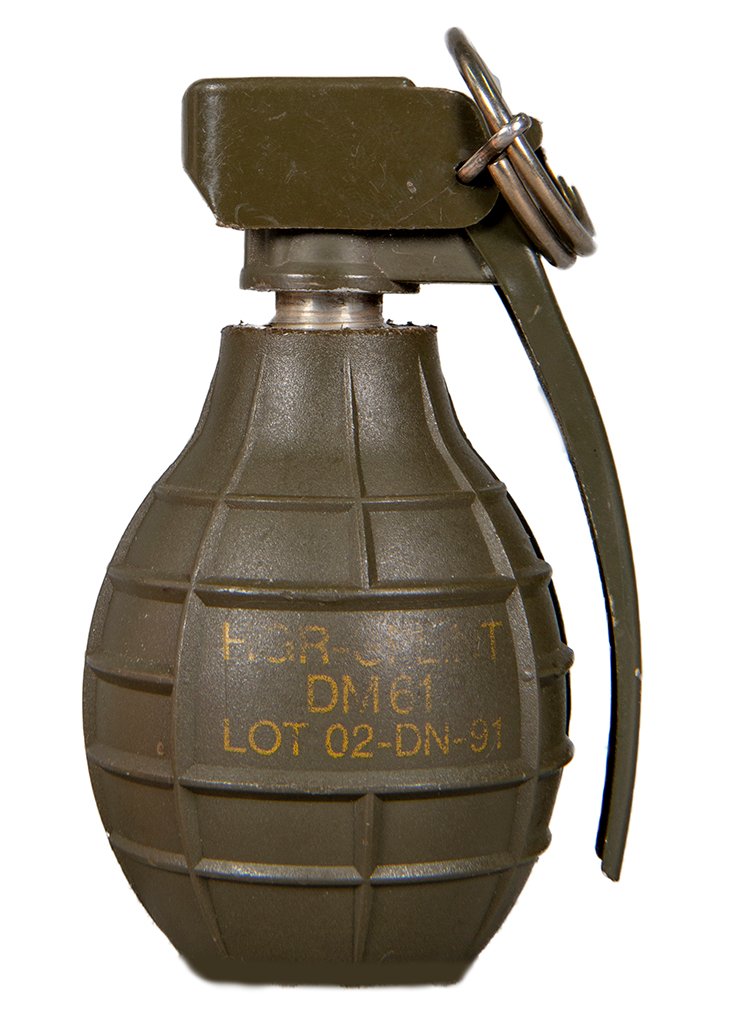
The DM 61 is a German fragmentation hand grenade that represents a refinement of defensive grenade design principles developed throughout the Cold War era. Featuring a spherical body with an internal fragmentation liner, the DM 61 delivers effective anti-personnel capability while incorporating modern safety mechanisms. This grenade is designed primarily as a defensive weapon, intended for use from covered positions due to its significant fragmentation radius that exceeds practical throwing distance. The DM 61’s distinctive design and reliable fuzing system made it a standard issue item for the Bundeswehr (German Armed Forces) and influenced grenade development across NATO forces.
Country/Bloc of Origin
- Country: Federal Republic of Germany (West Germany)
- Primary Manufacturer: Various German defense contractors including Diehl Defence and RUAG Ammotec
- Development Period: Late 1970s to early 1980s
- Service Entry: 1983
- NATO Member: Yes
- Current Status: In active service with German forces and select export customers
The DM 61 was developed as part of the Bundeswehr’s ongoing modernization program during the Cold War, designed to replace or supplement earlier grenade models with improved safety features and more consistent fragmentation patterns.
Ordnance Class
- Primary Classification: Defensive fragmentation hand grenade
- Weapon Type: High explosive (HE) fragmentation munition
- Target: Personnel in the open or in light cover
- Delivery Method: Hand-thrown
- Operational Role: Area denial, defensive position support, bunker/building clearing
- Effective Use: From protected positions due to large danger radius
The “defensive” classification indicates that the fragmentation radius exceeds the maximum throwing distance, requiring the user to take cover after throwing. This contrasts with “offensive” grenades designed for use while advancing in the open.
Ordnance Family/Nomenclature
Official Designations:
- DM 61: Deutsche Munition 61 (primary German military designation)
- M DM 61: Alternative format sometimes seen in documentation
Related Grenades in German Service:
- DM 51: Predecessor model with similar defensive characteristics
- DM 41: Offensive grenade with concussion effect and reduced fragmentation
- DM 71: Practice version (inert) for training
- HG 85: Swiss derivative with similar design principles
NATO Recognition:
- NSN (NATO Stock Number): 1330-12-177-4562
- Recognized across NATO forces as a standard defensive grenade
- Referenced in NATO standardization agreements (STANAGs) for grenade specifications
Common Names:
- “German Defensive Grenade”
- Simply “DM 61” in operational contexts
- “Fragmentation Ball” (informal soldier terminology)
Marking Variations:
- May be marked “DM61” (no space)
- Early production marked as “HGR DM 61” (Handgranate)
- Practice grenades marked “ÜB DM 71” (Übungsgranate – training grenade)
Hazards
The DM 61 presents significant hazards that must be understood by anyone who might encounter one:
Primary Hazards:
Fragmentation:
- Fragment Count: Approximately 3,000-4,000 high-velocity fragments
- Fragment Material: Pre-formed steel fragments from internal liner
- Fragment Weight: 0.3-3.0 grams each
- Fragment Velocity: 1,200-1,500 meters per second initially
- Lethal Radius: 10-15 meters
- Danger Radius: 30-50 meters (fragments can cause injury)
- Maximum Fragment Range: 200+ meters (low probability but possible)
Blast Overpressure:
- Peak overpressure at 5 meters: >100 kPa (potentially lethal in enclosed spaces)
- Blast wave can cause lung damage, eardrum rupture, traumatic brain injury
- Significantly enhanced in enclosed spaces (buildings, bunkers, trenches)
- Secondary effects: can destabilize structures, shatter glass, dislodge objects
Thermal Effects:
- Brief but intense heat flash at detonation point
- Can ignite flammable materials in immediate vicinity
- Not typically a primary hazard but can cause fires in suitable conditions
Sensitivity and Handling Risks:
Fuze Sensitivity:
- Low-order detonation of fuze train (burn time) begins immediately upon striker release
- Cannot be “uncocked” once fuze lever is released
- Fumble or drop after lever release results in detonation after delay expires
- Moisture or aging can affect fuze reliability (may burn faster or slower than designed)
Degradation Over Time:
- Explosive fill remains potent for decades but can become more sensitive
- Fuze components can corrode, potentially shortening or eliminating delay
- Body corrosion weakens structure, potentially affecting fragmentation pattern
- Springs and mechanical components may fail unpredictably after years of storage
Special Hazards:
Enclosed Space Multiplication:
- Blast effects multiply dramatically in buildings, bunkers, vehicles
- Fragments ricochet multiple times, filling entire space
- Overpressure reflects off walls, intensifying effect
- Can be lethal to everyone in a small enclosed space regardless of distance from grenade
Secondary Fragmentation:
- Objects struck by grenade fragments become projectiles themselves
- Glass, wood splinters, stone chips, metal fragments from environment
- Increases effective danger area in built-up environments
Booby-Trap Configuration:
- Grenades can be rigged as booby-traps with tripwires replacing safety pins
- May be concealed in vehicles, doorways, or attached to movable objects
- Can be daisy-chained to set off multiple grenades simultaneously
UXO (Unexploded Ordnance) Considerations:
- Dud Rate: Modern grenades have very low failure rates (<1%) but UXO can occur
- Degraded Fuzes: Age and environmental exposure can make duds unpredictable
- Partial Function: Grenade may have burned fuze but failed main charge (extreme hazard)
- Body Integrity: Corroded bodies may fragment abnormally or fail to contain explosion
- Movement Sensitivity: UXO grenades should never be moved; fuze may complete initiation
Environmental Factors:
- Water: Can corrode body and fuze; waterlogged grenades are unpredictable
- Fire: Heat can cook-off grenades, causing mass detonation of stocks
- Freezing: Extreme cold can make explosive materials more shock-sensitive
- Age: All components degrade; grenades over 30 years old should be considered potentially unstable
⚠️ CRITICAL SAFETY WARNING: The DM 61’s danger radius (30-50 meters) exceeds the maximum throwing distance (30-35 meters) for most users. It is designed for use from protected positions only. Even in the open, users are at risk from their own grenade. Unexploded DM 61 grenades should NEVER be approached or handled. They remain fully lethal and can detonate without warning.
Key Identification Features
Physical Dimensions:
- Diameter: 60mm (2.36 inches)
- Height: 115mm (4.53 inches) including fuze assembly
- Body Diameter: 60mm (perfectly spherical main body)
- Weight: 460 grams (16.2 oz) total
- Explosive Weight: 165 grams (5.8 oz) TNT/RDX composition
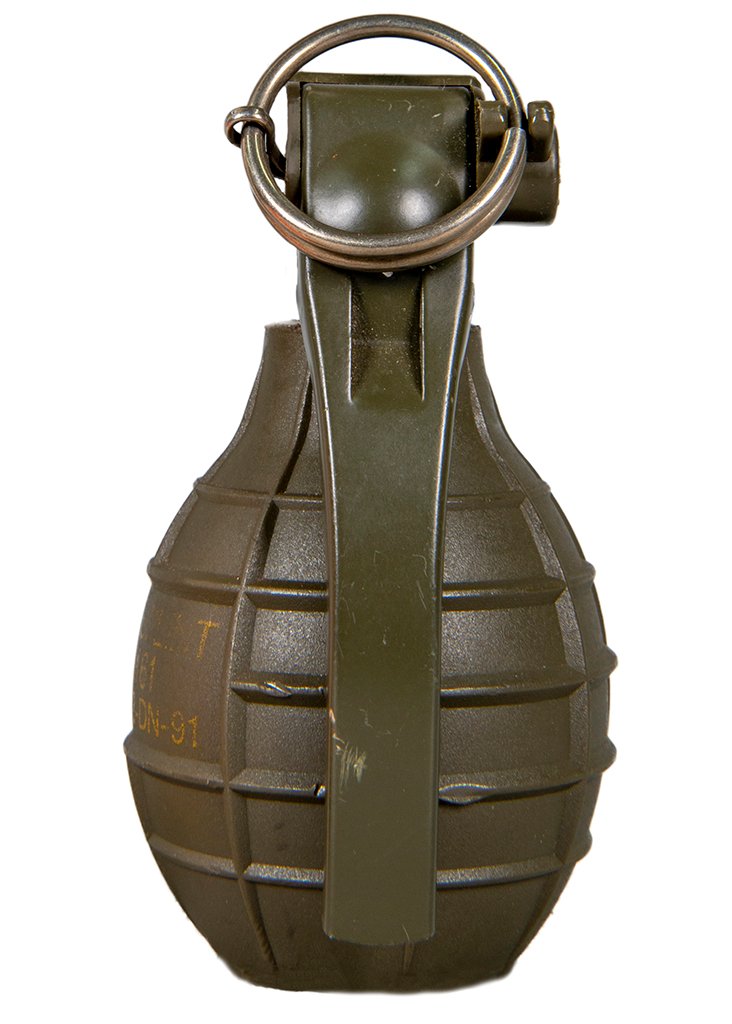
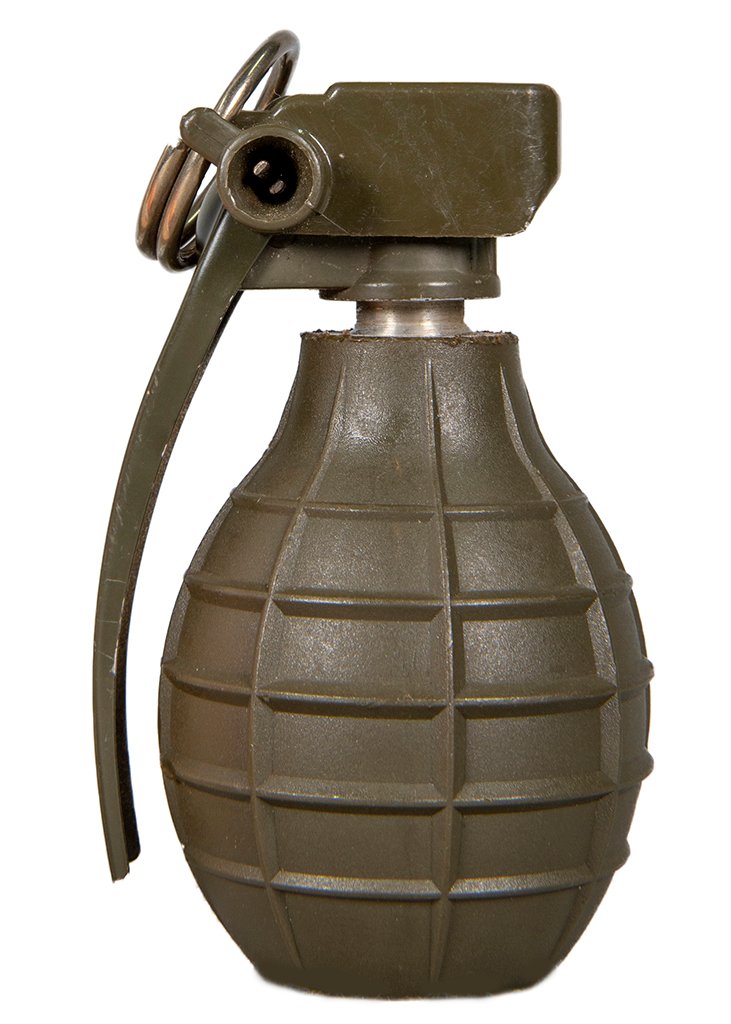
Shape and Profile:
- Overall Shape: Spherical main body with cylindrical fuze assembly on top
- Body Profile: Perfectly round/spherical fragmentation body
- Fuze Housing: Cylindrical projection from top of sphere
- Safety Lever: Metal spoon that curves around fuze housing
- Base: Slightly flattened bottom for stability
Color Schemes and Markings:
Standard Combat Grenades:
- Body Color: Olive drab green (RAL 6003 or similar)
- Fuze Color: Same olive drab green or slightly darker
- Base Plate: May be darker green or black
- Markings Color: White or yellow stenciled letters/numbers
Training Grenades (DM 71):
- Body Color: Light blue or blue-gray
- Markings: “ÜB” (Übung = training/exercise) in white
- Clear Differentiation: Training grenades easily distinguished by color
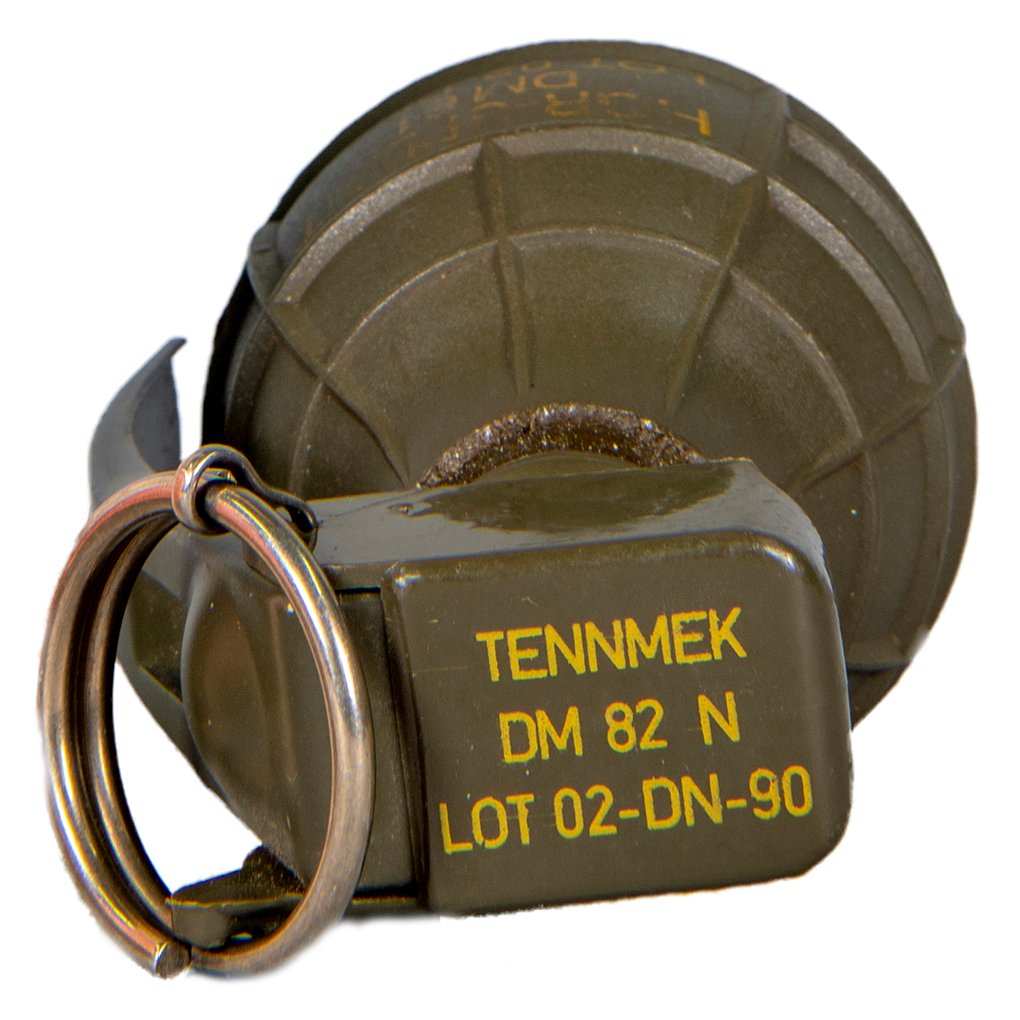
Standard Markings:
- “DM 61” stenciled on body
- Lot number and manufacturing date code
- “MINE” or explosion symbol warning
- Manufacturer mark (varies by production facility)
- Weight and explosive type (when marked)
Distinctive Features:
Fuze Assembly:
- Prominent cylindrical fuze housing protruding from top
- Pull-ring with attached safety pin (typically 2-3cm diameter)
- Safety lever (spoon) held against fuze by safety pin
- Striker mechanism visible when safety lever is examined
- Some versions have secondary safety clip on fuze
Body Construction:
- Outer Shell: Thin pressed steel (2-3mm thickness)
- Internal Liner: Segmented fragmentation sleeve (not visible externally)
- Seam: Visible equatorial seam where body halves join
- Base Plate: Threaded or pressed base plate, sometimes removable
- Surface: Smooth exterior (no external serrations or segmentation)
Safety Pin and Ring:
- Safety pin typically 2-3mm diameter steel wire
- Pull ring 2-3cm diameter for easy grasping
- Pin passes through fuze housing and safety lever
- May have colored tag (white, yellow, or colored string) for visibility
- Ring may have manufacturing or lot markings
Unique Identifiers:
- Serial numbers typically stamped on base or fuze assembly
- Manufacturing date codes (format: MM-YY or similar)
- Inspection stamps from quality control
- Manufacturer symbols or logos
- NATO stock number may be marked on packaging, not always on grenade itself
Material Composition:
- Body: Cold-rolled steel, painted
- Fragmentation Liner: Notched or scored steel, precision-formed
- Fuze Housing: Machined steel or aluminum alloy
- Safety Components: Spring steel (lever and striker spring)
- Base Plate: Heavy steel or brass
Weight Distribution:
- Slightly top-heavy due to fuze assembly
- Center of gravity approximately at equator
- Good balance for throwing accuracy
- Spherical shape provides aerodynamic stability in flight
Field Identification Indicators:
When Encountered in the Field:
- Distinctive spherical body shape (unlike cylindrical grenades)
- Smooth exterior surface (no pineapple pattern)
- Green color in military service, blue for training
- May be covered in tape, cloth, or other field modifications
- Often carried in purpose-designed pouches on combat webbing
- May show wear patterns from handling and carrying
Condition Assessment:
- Fresh paint: Recently manufactured or refinished
- Rust/corrosion: Age and exposure (increases unpredictability)
- Dents or damage: Handle with extreme caution
- Loose components: Indicates degradation or prior rough handling
Similar-Looking Grenades:
- Swiss HG 85: Nearly identical appearance
- Some Eastern Bloc grenades: Similar spherical design but different dimensions
- Training grenades: Blue instead of green (but still dangerous if live)
Fuzing Mechanisms
The DM 61 uses a time-delay burning fuze system, typical of modern military grenades but with some distinctive German engineering characteristics:
Primary Fuze System:
Type: Pyrotechnic time-delay fuze (burning fuse)
Components:
- Striker Mechanism: Spring-loaded firing pin
- Primer: Percussion-sensitive primer composition
- Delay Element: Precisely manufactured pyrotechnic delay train
- Detonator: Primary explosive detonator
- Booster: Intermediate explosive booster charge
- Main Charge: TNT/RDX fragmentation charge
Fuzing Sequence in Detail:
1. Safe State (Before Use):
- Safety pin passes through fuze body and safety lever
- Safety lever held against fuze housing by safety pin
- Striker spring compressed but blocked by safety lever
- Grenade can be dropped, roughly handled without risk (pin installed)
- Some variants include secondary safety clip for additional security
2. Armed State (Pin Removed, Lever Held):
- User removes safety pin by pulling ring
- Safety lever still held manually by user’s grip
- Striker remains compressed by lever
- Grenade is now one step from activation
- Can still be made safe by reinserting pin (if available and user is trained)
- Critical moment: Accidental release of lever will initiate fuzing
3. Initiation (Lever Released):
- User throws grenade, releasing safety lever
- Striker spring drives firing pin into primer
- Primer composition ignites instantly
- Pyrotechnic delay train begins burning
- Point of no return: Cannot be stopped or neutralized
4. Delay Burn (3.5-4.5 seconds):
- Delay train burns at controlled rate (approximately 1cm per second)
- Total delay: 3.5-4.5 seconds (specified as 4 seconds ±0.5 sec)
- Burn is steady and consistent under normal conditions
- Not affected by impact, water immersion (for short duration), or environmental factors under most circumstances
5. Detonation:
- Delay train reaches detonator
- Detonator initiates
- Booster charge amplifies detonation
- Main charge detonates
- Total sequence from lever release to detonation: 4 seconds nominal
Safety Mechanisms:
Primary Safety – Safety Pin:
- Prevents accidental release of safety lever
- Must be actively removed before throwing
- Once removed, grenade is armed when lever releases
- Standard military protocol: don’t remove pin until ready to throw
Secondary Safety – Safety Lever:
- Spring-loaded lever must be released to activate fuze
- Provides mechanical barrier between striker and primer
- Allows user control: pin can be removed while lever is held safely
- “Dead man’s switch” – continues to function even if user is incapacitated after removal
Optional Safety – Safety Clip:
- Some DM 61 variants include wire safety clip
- Additional mechanical block preventing accidental pin removal
- Typically removed during preparation for combat
- Not present on all production variants
Reliability Features:
Delay Consistency:
- Precision-manufactured delay element for consistent timing
- Manufacturing tolerance: ±0.5 seconds
- Quality control testing for every production lot
- Minimal variation under normal environmental conditions
All-Weather Performance:
- Sealed fuze design prevents moisture intrusion
- Functions in rain, snow, extreme cold (tested to -40°C)
- Heat-resistant up to +60°C
- Brief water immersion does not affect fuzing (grenade will function underwater)
Environmental Resistance:
- Vibration-resistant during transport and handling
- Shock-resistant to drops from normal heights (when safety pin installed)
- Corrosion-resistant materials in fuze mechanism
- Long storage life (20+ years when properly stored)
Failure Modes and Malfunctions:
Short Delay (Premature Detonation):
- Cause: Defective delay element, damage, or extreme age
- Risk: Grenade explodes sooner than expected
- Result: Catastrophic injury to user and nearby personnel
- Probability: Very low (<0.1%) in quality-controlled stocks
Long Delay:
- Cause: Degraded delay compound or manufacturing defect
- Risk: Grenade takes longer to detonate (5-7+ seconds)
- Result: Enemy has more time to evade or throw back
- Probability: Low but higher than short delays
Complete Failure (Dud):
- Cause: Primer failure, severed delay train, degraded detonator
- Risk: Grenade does not explode at all
- Result: UXO hazard
- Probability: <1% in modern production, higher in aged stocks
Partial Function:
- Cause: Delay train burns but detonator fails
- Risk: Grenade may function as incendiary (burning but not exploding)
- Result: Unpredictable; may eventually detonate or burn out
- Extreme Hazard: Never approach grenade that should have exploded
High/Low Angle Throwing:
- Grenade fuzing is not affected by throw angle or velocity
- Works identically whether thrown high arc, low/flat, or rolled
- Delay remains constant regardless of grenade orientation
Impact Sensitivity:
- Fuze does NOT function on impact
- Striking hard surfaces does not detonate grenade
- Only the time delay will cause detonation
- Exception: Severe damage to fuze body might cause malfunction
Water Considerations:
- Brief immersion: Grenade will function normally
- Extended submersion: May affect delay timing after several minutes
- Underwater detonation: Blast and fragmentation patterns change significantly
- Waterlogged grenades: Unpredictable; may have shortened delays
Age and Storage Effects:
Proper Storage (Climate-Controlled Magazine):
- Expected service life: 20-30 years
- Delay timing remains consistent
- Degradation is slow and predictable
- Regular inspection protocols maintain reliability
Improper Storage or Field Conditions:
- Temperature extremes accelerate degradation
- Humidity causes corrosion of fuze components
- Age beyond 30 years: significantly increased malfunction risk
- Visible corrosion: treat as unpredictable
No Self-Destruct Feature:
- DM 61 does NOT include self-destruct or self-neutralization
- Dud grenades remain fully hazardous indefinitely
- All DM 61 grenades must be accounted for and recovered
- Training areas may contain numerous dud grenades (extreme hazard)
Manufacturer Quality Control:
- Every production lot tested for timing consistency
- Sample grenades from each lot functioned for verification
- Statistical process control ensures <1% failure rate
- Lot tracking allows recall of defective batches
Field Modifications:
- Military personnel may tape fuze lever for additional security during patrol
- Tape must be easily removed for rapid employment
- Never modify or attempt to repair damaged grenades
- Damaged grenades should be turned in for disposal
History of Development and Use
Pre-DM 61 Context:
The DM 61’s development must be understood within the context of German grenade evolution and Cold War defensive requirements:
Post-WWII Era (1945-1960s):
- West Germany initially used surplus Allied and captured grenades
- Bundeswehr established in 1955, required modern indigenous ordnance
- Early Cold War grenades included:
- M24 derivatives (WWII stick grenade descendants)
- DM 51: First major post-war German defensive grenade (1960s)
- Various NATO-supplied grenades
DM 51 Experience:
- Effective defensive grenade but had design limitations
- Safety mechanism improvements desired
- Fragmentation patterns could be more consistent
- Manufacturing processes could be optimized
Development Context (1970s-1980s):
The DM 61 development program began in the mid-1970s with several driving factors:
Tactical Requirements:
- Need for reliable defensive grenade for trench and bunker warfare
- Urban combat scenarios (Berlin Wall crisis tensions)
- Standardization across NATO forces
- Improved safety for troops carrying grenades in vehicles and during maneuvers
Technical Goals:
- More consistent fragmentation pattern than DM 51
- Enhanced safety features to reduce accidents
- Simplified manufacturing for cost reduction and rapid wartime production
- Longer shelf life with reduced maintenance requirements
- Better performance in environmental extremes
Development Timeline:
- 1975-1977: Initial concept studies and requirement definition
- 1977-1979: Prototype development and testing
- 1979-1981: Extensive field trials with Bundeswehr units
- 1981: Production contract awarded
- 1982: Pilot production and training program development
- 1983: Official adoption as DM 61, entered Bundeswehr service
- 1984-1985: Phased replacement of older grenade stocks
- Mid-1980s: Export approvals for NATO allies
Design Innovations:
The DM 61 incorporated several improvements over its predecessor:
- Fragmentation Liner: Internal pre-formed fragmentation sleeve provided more consistent fragment size and distribution
- Spherical Body: Better aerodynamics and more predictable throwing characteristics than cylindrical designs
- Enhanced Safety: Improved safety lever retention and more reliable fuze mechanism
- Simplified Manufacturing: Fewer components, easier to produce in quantity
- Quality Control: Advanced testing protocols ensured batch consistency
Initial Deployment (1983-1990):
Bundeswehr Integration:
- Issued to infantry, mechanized infantry, and special forces
- Standard load: Two defensive grenades per soldier in combat configuration
- Extensive training programs on safe handling and employment
- Integration into urban and defensive warfare doctrine
NATO Adoption:
- Several NATO partners evaluated DM 61
- Some procurement by allied forces
- Featured in NATO standardization discussions
- Training exchanges demonstrated German grenade tactics
Cold War Service:
- Stockpiled for potential conflict with Warsaw Pact
- Positioned at forward defense positions in West Germany
- Regular training exercises along Inner German Border
- Never used in actual combat during Cold War period
Post-Cold War Era (1990-2000s):
Operational Deployments:
Balkans Conflicts (1990s):
- German forces deployed to former Yugoslavia
- DM 61 saw limited use in peacekeeping and stabilization operations
- Some combat employment in defensive postures
- Training exercises with partner forces
Afghanistan (2001-2021):
- Bundeswehr forces extensively deployed to Afghanistan
- DM 61 used in compound clearance and defensive operations
- Proved effective in confined spaces and defensive positions
- Supplemented by offensive grenades for patrol operations
Counter-Terrorism and Training:
- Widely used in counter-terrorism and special operations training
- Urban warfare training centers across Germany
- International military training programs
- Police special forces trained with inert versions
Evolution and Variants:
DM 71 Training Grenade:
- Inert training version for handling and throwing practice
- Blue body for clear identification
- Simulated weight and balance identical to live grenade
- Critical safety training tool
Export Variants:
- Some production for select allied nations
- Minor modifications for specific customer requirements
- Generally maintains standard design characteristics
Modernization Programs:
- Ongoing improvements to fuze reliability
- Updated manufacturing processes for cost reduction
- Enhanced quality control measures
- Extended shelf-life studies
Combat Experience and Lessons Learned:
Afghanistan Operations:
- Confirmed effectiveness in enclosed spaces (compound clearance)
- Danger radius in open terrain proved accurate in combat
- Safety features reduced fratricide and accidents
- Fragmentation patterns performed as designed
Urban Training:
- Extensive urban warfare training validated defensive use doctrine
- Confirmed necessity for cover when employing
- Demonstrated effectiveness in multi-story building clearance
- Reinforced importance of proper fusing and delay understanding
Current Status (2020s):
German Service:
- Remains in active service with Bundeswehr
- Standard issue defensive grenade for infantry forces
- Stockpiles maintained at operational and reserve levels
- Periodic replacement of aged stocks
- Expected to remain in service through 2030s
International Presence:
- In service with several NATO and partner nations
- Training stocks in many allied countries
- Continuing production for replacement and export
- Considered reliable and proven design
Production and Availability:
- Multiple manufacturers maintain production capability
- Annual production for replacement and export
- Modern manufacturing processes have reduced costs
- Quality control maintains high standards
Comparison to Modern Alternatives:
The DM 61 competes with several modern grenades:
- M67 (US): Similar defensive capability, different fuze design
- L109A1 (UK): More compact, different fragmentation pattern
- F1 (France): Similar spherical design, comparable performance
- V40 (Netherlands): Mini-grenade concept, smaller but safer for offense
The DM 61 holds its own due to:
- Proven reliability record
- Established manufacturing base
- Extensive training and documentation
- Cost-effectiveness
- NATO interoperability
Legacy and Influence:
Impact on Grenade Design:
- Demonstrated viability of spherical defensive grenade design
- Influenced other NATO forces’ grenade programs
- Contributed to safety standards for modern grenades
- Example of successful Cold War-to-modern transition of ordnance
Training Impact:
- Shaped German military grenade employment doctrine
- Influenced NATO urban warfare tactics
- Training protocols became models for other forces
- Safety record improved with lessons learned
Production Numbers:
- Exact production figures classified
- Estimated several million units produced since 1983
- Continuous production for replacement and export
- Significant stockpiles maintained for wartime surge
Future Outlook:
The DM 61 is expected to remain in service for the foreseeable future:
- No immediate replacement program planned
- Modernization of fuzing systems under consideration
- Possible integration of electronic safety devices in future variants
- Will likely serve into the 2030s-2040s with periodic upgrades
The grenade represents mature, proven technology that continues to meet military requirements cost-effectively, explaining its longevity in service.
Technical Specifications
Explosive Characteristics:
Main Charge:
- Type: TNT/RDX composite (Composition B or similar)
- Weight: 165 grams (5.8 oz)
- Ratio: Typically 60/40 or 50/50 RDX/TNT
- Detonation Velocity: Approximately 7,800 m/s
- Brisance: High (suitable for fragmentation generation)
Alternative Explosive Fills:
- Some production lots may use:
- Pure TNT (less common, lower performance)
- Enhanced RDX compositions (improved fragmentation)
- Composition A3 or A5 in some variants
Explosive Performance:
- TNT Equivalency: 165g Composition B ≈ 200-220g TNT equivalent
- Blast Pressure: Peak overpressure >100 kPa at 5 meters
- Blast Impulse: Sufficient for lethal effect in enclosed spaces
Fragmentation Characteristics:
Fragment Generation:
- Method: Internal pre-formed fragmentation liner with controlled break pattern
- Total Fragments: Approximately 3,000-4,000 pieces
- Fragment Material: Medium-carbon steel, hardened
- Fragment Shape: Irregular cubes and rectangles, some near-spherical
Fragment Specifications:
- Weight Range: 0.3g to 3.0g (majority 0.5-1.5g)
- Dimensions: 2-8mm typical size
- Initial Velocity: 1,200-1,500 m/s
- Velocity at 10m: 800-1,000 m/s
- Velocity at 25m: 400-600 m/s
Fragment Distribution:
- Pattern: Near-uniform spherical distribution
- Density: Highest fragment density between 5-15 meters
- Coverage: 360° horizontal, approximately 160° vertical (less coverage directly above/below)
Lethality Zones:
Casualty Radius Definitions:
- Certain Lethality: 5-8 meters (multiple severe wounds probable)
- High Lethality: 8-15 meters (single or multiple lethal wounds likely)
- Injury Zone: 15-30 meters (wounds probable but may not be immediately lethal)
- Danger Zone: 30-50 meters (injury possible, lethality unlikely)
- Maximum Fragment Range: 200+ meters (low probability, reduced velocity)
Enclosed Space Effects:
- Lethality multiplied significantly in buildings, bunkers, vehicles
- Blast overpressure reflects and intensifies
- Fragments ricochet, increasing total fragment passages
- Entire room may be lethal zone regardless of size
Fuze Specifications:
Delay Timing:
- Nominal Delay: 4.0 seconds
- Manufacturing Tolerance: ±0.5 seconds (3.5-4.5 seconds)
- Burn Rate: Approximately 1.0 cm/second
- Consistency: >95% of grenades function within specification
Fuze Components:
- Striker Spring Force: Sufficient for reliable primer ignition in all conditions
- Primer Composition: Lead styphnate or similar percussion primer
- Delay Composition: Proprietary pyrotechnic mixture (likely barium chromate/metallic fuel)
- Detonator: PETN or RDX-based primary explosive (approximately 0.5g)
- Booster: Small secondary charge to ensure main charge initiation
Reliability Statistics:
- Function Rate: >99% (less than 1% duds)
- Delay Consistency: >95% within ±0.5 second tolerance
- All-Weather Performance: Proven from -40°C to +60°C
- Storage Life: 20-30 years with proper storage
Physical Specifications:
Dimensions (Detailed):
- Body Diameter: 60mm (2.36 inches) – precise sphere
- Overall Height: 115mm (4.53 inches) including fuze assembly
- Fuze Housing Length: 55mm (2.17 inches) above body
- Safety Lever Length: 90mm (3.54 inches)
- Pull Ring Diameter: 25-30mm (1.0-1.2 inches)
Weight Distribution:
- Total Weight: 460 grams (16.2 oz)
- Body Weight: 130 grams (shell and fragmentation liner)
- Explosive Weight: 165 grams
- Fuze Assembly: 120 grams
- Other Components: 45 grams (base plate, etc.)
Materials:
Body Construction:
- Outer Shell: Cold-rolled steel, 2-3mm thickness
- Surface Treatment: Phosphate coating for corrosion resistance
- Paint: Polyurethane enamel, olive drab (RAL 6003)
- Shell Halves: Deep-drawn and welded or crimped at equator
Fragmentation Liner:
- Material: Medium-carbon steel (0.4-0.6% carbon)
- Thickness: 3-4mm
- Pattern: Precision-scored in square or diamond pattern
- Treatment: Heat-treated for optimal fragmentation characteristics
Fuze Assembly:
- Housing: Machined aluminum alloy or steel
- Safety Components: Spring steel
- Fasteners: Corrosion-resistant steel
- Seals: Rubber or synthetic o-rings
Environmental Specifications:
Operating Temperature Range:
- Minimum: -40°C (-40°F)
- Maximum: +60°C (+140°F)
- Storage: -50°C to +70°C (short-term)
Environmental Resistance:
- Humidity: Sealed against moisture intrusion (95%+ RH)
- Immersion: Functions after brief water immersion (<5 minutes)
- Salt Spray: Passes MIL-STD-810 salt fog testing
- Sand/Dust: Sealed fuze mechanism prevents intrusion
Altitude Performance:
- Functions normally at sea level to high altitude (tested to 4,000m+)
- No significant change in performance with air pressure variation
Throwing and Employment Specifications:
Throwing Characteristics:
- Average Throw Distance: 30-35 meters (trained soldier)
- Maximum Throw Distance: 40-45 meters (athletic individual)
- Minimum Practical Distance: 25 meters
- Flight Time (30m throw): Approximately 1.5-2.0 seconds
- Total Time to Detonation: 5.5-6.0 seconds after pin removal (including flight)
Throwing Stability:
- Spherical shape provides excellent aerodynamic stability
- Center of gravity near geometric center (good balance)
- Minimal tumbling in flight
- Predictable impact point
User Safety Margin:
- With 30m throw and 4-second delay:
- Grenade lands and rolls ~1-2 seconds before detonation
- User should be in cover or prone before detonation
- Danger radius (30m) may overlap with throw distance (safety concern)
Recommended Employment:
- Use from cover: Always throw from protected position
- Immediate cover: Drop prone or seek hard cover after throwing
- Minimum distance: Never throw at targets closer than 25 meters without hard cover
Storage and Logistics:
Packaging:
- Primary: Individual fiber containers with cushioning
- Secondary: Wooden or metal ammunition cans (typically 25-50 per can)
- Markings: Clear labeling with lot number, date, contents
- Moisture Protection: Sealed containers with desiccant
Storage Requirements:
- Temperature-controlled magazines: Optimal storage
- Maximum stack Height: Regulated by safety distance rules
- Inspection Frequency: Annual visual inspection minimum
- Rotation: FIFO (First In, First Out) to prevent aging
Shelf Life:
- Manufacturer Specification: 20 years minimum
- Extended Storage: Can exceed 30 years with proper storage
- Degradation Indicators: Visible corrosion, weight loss, abnormal sounds when shaken
Transport:
- Classification: 1.1D (Mass explosion hazard)
- UN Number: UN 0284
- Compatibility Group: D (secondary detonating explosive substances)
- Transport Quantity: Limited by vehicle type and regulations
Disposal:
Authorized Disposal Methods:
- Open Burning/Open Detonation (OB/OD) at approved ranges
- Contained detonation in explosive chambers
- Demilitarization at approved facilities
- Never: Field expedient disposal, burial, abandonment
Disposal Safety:
- Requires trained EOD personnel
- Minimum safe distance: 500+ meters
- Environmental considerations required
- Proper documentation and reporting
Frequently Asked Questions
Q: Why is the DM 61 classified as a “defensive” grenade when grenades are typically thought of as offensive weapons?
A: The defensive vs. offensive classification refers to how the grenade must be used tactically, not its purpose. A “defensive” grenade like the DM 61 has a fragmentation radius (30-50 meters) that exceeds the maximum distance most soldiers can throw it (30-35 meters). This means the user is inside the danger zone of their own grenade and must throw from behind cover – a typical defensive posture where you’re fighting from a prepared position, trench, or building. In contrast, “offensive” grenades (like the German DM 41) produce primarily blast effects with minimal fragmentation, allowing soldiers to throw them and then immediately advance toward the target, since the danger radius is smaller than throwing distance. The DM 61’s heavy fragmentation makes it devastating against personnel but requires the thrower to take cover immediately, hence its defensive classification. It’s designed for scenarios where you’re holding ground, not advancing.
Q: How does the internal fragmentation liner work differently from the external serrations (pineapple pattern) seen on grenades like the American M67?
A: The DM 61’s internal fragmentation liner represents a more modern approach to fragment generation. The external serrations or “pineapple” pattern on grenades like the WWII-era Mk 2 were intended to create pre-fragmentation, but research showed these external patterns don’t actually control fragmentation much – the grenade body tends to break along natural stress lines rather than along the serrations. The DM 61 uses an internal steel sleeve with precisely scored or notched patterns. This liner is engineered to break into fragments of controlled size and mass distribution when the explosive detonates. The result is more consistent fragmentation (3,000-4,000 fragments in a predictable size range of 0.3-3.0g) compared to the random fragmentation of smooth or serrated external shells. The DM 61’s smooth external shell is easier to manufacture, less likely to snag on equipment, and the internal liner does the actual work of creating uniform, lethal fragments. This design philosophy has been adopted by many modern grenades because it produces more reliable and predictable casualty effects.
Q: What should you do if you pull the pin on a DM 61 but then realize you shouldn’t throw it—can you make it safe again?
A: Yes, but only if you haven’t released the safety lever yet. Here’s the critical sequence: pulling the pin does NOT initiate the fuze – it only removes the mechanical block preventing the safety lever from releasing. As long as you maintain your grip on the safety lever (the spoon), the striker spring remains compressed and the fuze will not activate. If you have the pin and haven’t released the lever, you can theoretically reinsert the safety pin and make the grenade safe again. However, this requires steady hands and presence of mind in a high-stress situation. Military training emphasizes: “Don’t pull the pin unless you’re committed to throwing.” If you’ve already released the safety lever, there is absolutely no way to stop the fuze – the pyrotechnic delay is burning and you have 4 seconds until detonation. Your only option is to throw it immediately in a safe direction and take cover. If you drop a grenade after releasing the lever, evacuate immediately – attempting to pick it up will likely result in detonation in your hands. This is why grenade handling drills emphasize careful, deliberate movements and absolute mental commitment before pulling that pin.
Q: Why do grenades have a 4-second delay instead of detonating immediately—doesn’t this give the enemy time to escape or throw it back?
A: The delay serves several critical safety and tactical purposes. First and foremost, it gives the thrower time to release the grenade and take cover – without this delay, the thrower would be caught in their own fragmentation radius. Second, the delay allows the grenade to reach its target area before detonating; a grenade thrown 30 meters travels for about 1.5-2 seconds, leaving 2-2.5 seconds after landing for it to roll into position. Third, the delay creates psychological pressure on the enemy: hearing or seeing the grenade, they must decide whether to flee (exposing themselves), stay put (risk injury), or attempt to throw it back (requires approaching the grenade). Yes, trained soldiers can sometimes throw grenades back, but this is extremely dangerous – you don’t know when the thrower released the lever, so you might have 3 seconds or only 0.5 seconds remaining. The delay is a calculated compromise: long enough for safe use by the thrower, short enough to be tactically effective. Instant-detonation grenades would be too dangerous for the user. Interestingly, in house-to-house fighting, some soldiers have been known to “cook off” grenades by holding them for 1-2 seconds after releasing the lever before throwing, reducing the enemy’s reaction time – but this is extremely risky and not officially sanctioned, as a fumble or miscount would be fatal.
Q: How does the DM 61 perform in enclosed spaces like buildings or bunkers compared to outdoors?
A: The DM 61’s lethality increases dramatically in enclosed spaces for multiple reasons. In the open, grenade fragments travel outward in relatively straight lines, and blast pressure dissipates rapidly with distance. In an enclosed space, however, the blast overpressure reflects off walls, ceiling, and floor, intensifying and prolonging the pressure wave—what would be survivable pressure at 10 meters outdoors can be lethal in a confined room. The fragments also ricochet off hard surfaces multiple times, meaning a single fragment might traverse the space several times, increasing hit probability. Additionally, structural materials become secondary fragmentation: concrete chips, glass shards, wood splinters, and metal fixtures all become additional projectiles. The blast can also rupture eardrums and cause traumatic brain injury even if fragments don’t hit the target. In a small room (4m x 4m), a single DM 61 can be lethal to everyone present regardless of where they’re positioned. This is why the DM 61 excels in bunker clearance and urban warfare defensive positions—a grenade tossed through a window or door can neutralize an entire room. Conversely, using a DM 61 in a building means you must ensure your own forces aren’t in adjacent rooms or on the same floor, as walls provide limited protection against fragments and blast overpressure can propagate through doorways and openings.
Q: What makes the DM 61’s pyrotechnic delay fuze more reliable than mechanical timer mechanisms?
A: Pyrotechnic delay fuzes, like those in the DM 61, burn at a controlled rate through a precisely manufactured delay composition—essentially a controlled chemical reaction that progresses at roughly 1cm per second regardless of external conditions. This design has several advantages over mechanical timers (like clockwork mechanisms). First, pyrotechnic delays have no moving parts in the delay element itself, eliminating mechanical failure points like springs, gears, or pins that could jam, break, or corrode. Second, they’re not affected by physical shock or impact – dropping the grenade after activation doesn’t change the burn rate. Third, they’re highly resistant to environmental conditions: the delay will burn consistently from -40°C to +60°C, underwater (briefly), and in various atmospheric pressures. Fourth, they’re simple and cost-effective to manufacture with very consistent performance. Fifth, pyrotechnic delays don’t require maintenance – mechanical timers can seize from corrosion or age. The trade-off is that pyrotechnic delays cannot be adjusted in the field (the burn rate is fixed), whereas mechanical timers could theoretically be set for different delays. Modern military forces have overwhelmingly chosen pyrotechnic delays for grenades because the >99% reliability rate and environmental robustness outweigh any disadvantages. The DM 61’s excellent service record over 40 years validates this choice.
Q: If someone finds an old DM 61 grenade, possibly from a training area or military surplus, how dangerous is it after many years?
A: An old DM 61 should be considered extremely dangerous and potentially more unpredictable than a new one. Here’s why: The main explosive charge (165g of Composition B) remains stable and potent for decades—explosives don’t “expire” in the sense of becoming inert, though they can become MORE sensitive with age and environmental exposure. The fuze mechanism is where degradation becomes most concerning. Corrosion can affect the striker spring, safety lever, and mechanical components, potentially causing the grenade to function prematurely if handled. The pyrotechnic delay composition can degrade unevenly, possibly causing the delay to be shorter than the intended 4 seconds – imagine a 1-second delay when you expect 4 seconds. The detonator can become more sensitive to shock and heat with age. The body and fragmentation liner may corrode, creating unpredictable fragmentation patterns and potentially weakening the containment (though the explosive charge remains). If you find what appears to be a DM 61: DO NOT TOUCH OR MOVE IT. Even if the safety pin appears to be in place, corrosion may have weakened it or the internal components. The grenade may be partially buried, and disturbance could trigger it. It could be rigged as a booby trap. Even “training” grenades (blue DM 71) can be hazardous if someone has swapped components. Evacuate the area to at least 300 meters, mark the location from a safe distance if possible, and contact military EOD or police immediately. Old grenades from training areas are among the most dangerous UXO because they’ve been subjected to unknown handling and environmental stresses. Every year, people are killed or injured by decades-old grenades they thought were safe—treat all old ordnance as a live, potentially immediate threat.
Q: How does the DM 61 compare to other NATO defensive grenades like the American M67 or British L109A1 in terms of effectiveness and design philosophy?
A: The DM 61, M67, and L109A1 represent different approaches to the defensive grenade concept, each with distinct characteristics. The DM 61’s spherical design with internal fragmentation liner produces approximately 3,000-4,000 fragments with consistent size distribution, effective lethal radius of 10-15 meters, and danger radius of 30-50 meters. It uses a 4-second pyrotechnic delay and weighs 460g. The American M67, also spherical but slightly smaller, uses 180g of Composition B and produces about 1,000 fragments with a larger average mass. It has a similar 4-5 second fuze and comparable lethality (15m casualty radius). The British L109A1 is more compact, egg-shaped, with 155g of RDX/TNT, producing about 1,200 fragments; it features a different fuze system with a shorter delay (3-4 seconds). From a design philosophy perspective: The DM 61 prioritizes fragment quantity and consistency – more fragments mean better area coverage and hit probability. The M67 focuses on simplicity and ruggedness – fewer fragments but more reliable in extreme conditions. The L109A1 emphasizes compactness and reduced weight for easier carrying (soldiers can carry more grenades). In practice, all three are highly effective defensive grenades with similar overall lethality. The DM 61’s internal liner gives it more predictable fragmentation, the M67’s proven design has decades of combat validation, and the L109A1’s compact size aids in urban operations. Choosing between them often comes down to logistical considerations, existing training infrastructure, and manufacturing capabilities rather than significant performance differences. Interestingly, NATO interoperability means soldiers are often trained on multiple grenade types, and the tactical employment is essentially identical across all three: throw from cover, immediate concealment, 30+ meter fragmentation radius requires respect and caution.
Q: What training do military personnel receive specifically for the DM 61, and what are the most common mistakes that lead to accidents?
A: DM 61 training follows a progressive sequence designed to build confidence while maintaining absolute safety. Initial training uses the blue DM 71 inert practice grenades – identical weight and balance but completely safe. Soldiers practice grip, pin removal, throwing stance, and release technique repeatedly with trainers observing. Next, they throw practice grenades from prepared positions to learn distance estimation and cover techniques. Advanced training includes throwing from trenches, building windows, and various tactical scenarios. Only after demonstrated competence do soldiers progress to live grenade throws, typically conducted one at a time with a safety NCO present, in designated throwing pits with blast walls and overhead cover. The most common accident scenarios that training addresses include: “Short throws” where anxiety causes the soldier to release early, sending the grenade only 10-15 meters and putting the thrower in the fragmentation zone – this is why training emphasizes smooth, deliberate throwing motion and taking cover regardless of throw distance. “Fumbling the grenade” after pulling the pin or releasing the lever – training emphasizes secure grip and controlled movements; if a live grenade is dropped, the procedure is immediate evacuation, not attempting recovery. “Pin removal difficulties” where the pin won’t pull free and the soldier panics or uses excessive force – training teaches inspection of the pin before throwing and the “pull straight out” technique. “Lever release while getting into throwing position” where the soldier accidentally releases the spoon before throwing – training emphasizes maintaining lever pressure until the moment of release. “Cooking off” (holding the grenade after lever release to reduce enemy reaction time), which is explicitly forbidden in most militaries as the risk of miscounting is too high. Training also covers administrative accidents: Never remove pins during transport or inspection, always maintain positive control of grenades, store grenades properly with pins checked for security. The Bundeswehr’s safety record with the DM 61 is excellent, with very few accidents relative to the hundreds of thousands thrown in training, demonstrating that systematic, progressive training with emphasis on respect for the weapon’s lethality is highly effective.
Safety Notice
This educational material is provided for identification, training, and military reference purposes only. The DM 61 grenade is an extremely dangerous military ordnance item designed to kill or severely injure personnel within a 30-50 meter radius.
If you encounter a suspected DM 61 grenade or similar ordnance:
- DO NOT TOUCH, MOVE, OR HANDLE the grenade under any circumstances
- EVACUATE the immediate area to at least 300 meters distance
- PREVENT others from approaching the area
- MARK the location from a safe distance if possible (use visible objects at a distance)
- REPORT immediately to police, military EOD, or emergency services with:
- Precise location information
- Description of the object
- Any visible markings or colors
- Condition (rusted, damaged, intact)
- DO NOT assume “training” grenades (blue color) are safe—they may contain live components
Special warnings:
- Old grenades may have corroded fuzes that function unpredictably
- Even grenades with pins in place can be dangerous if corroded
- Grenades in buildings, vehicles, or buried pose additional hazards
- Multiple grenades may be present in training areas or military sites
- Never attempt to disarm, neutralize, or dispose of grenades yourself
All military grenades should be treated as armed and immediately dangerous. Only qualified EOD personnel have the training and equipment to safely handle suspect ordnance.
This information is provided for educational and identification purposes only and should not be used for any operational handling of ordnance without proper military training, authorization, and EOD qualifications.