10cm Weiss/Rot Geschoss Propaganda Projectile

Ordnance Overview
The 10cm Weiss-Rot Geschoss (White-Red Projectile) was a specialized German artillery projectile designed for psychological warfare operations during World War II. Unlike conventional high-explosive or fragmentation rounds, this unique munition was engineered specifically to disperse propaganda leaflets over enemy positions and rear areas. The projectile represented an innovative fusion of artillery technology and psychological operations, allowing German forces to deliver propaganda materials with precision and range that could not be matched by other distribution methods during the latter years of the war.
Country/Bloc of Origin
- Country: Nazi Germany
- Development Period: Early 1940s (documented use from 1941-1945)
- Manufacturing: Various German ordnance facilities
- International Variants: No known licensed production by other nations
- Similar Concepts: The concept inspired similar designs by other nations, though the German implementation was the most sophisticated of the era
Ordnance Class
- Type: Artillery-fired propaganda dissemination projectile
- Primary Role: Psychological warfare / leaflet dispersal
- Caliber: 105mm (10cm)
- Delivery Method: Artillery-delivered via field howitzer
- Classification: Non-lethal ordnance (contains no explosive warhead, only expulsion charge)
- Target: Enemy troops, civilian populations in occupied territories, front-line soldiers
- Tactical Application: Area saturation with printed propaganda materials
Ordnance Family/Nomenclature
Official Designations
- Primary Designation: 10cm Weiss-Rot Geschoss (10cm White-Red Projectile)
- Alternative Names:
- 105mm Propaganda Granate
- Propagandageschoss 10cm
- 10cm Wurfgeschoss für Propagandazwecke (Projectile for propaganda purposes)
Compatible Artillery Systems
- le.F.H. 18 (leichte Feldhaubitze 18) – Light Field Howitzer 18
- le.F.H. 18M – Modified variant
- le.F.H. 18/40 – Later war variant
Related Ordnance
- 7.3cm Propagandawerfer 41: Man-portable rocket-based propaganda system
- Propaganda rockets: Various rocket-based leaflet dispersal systems
- Standard German propaganda leaflet canisters for aerial delivery
Nomenclature Notes
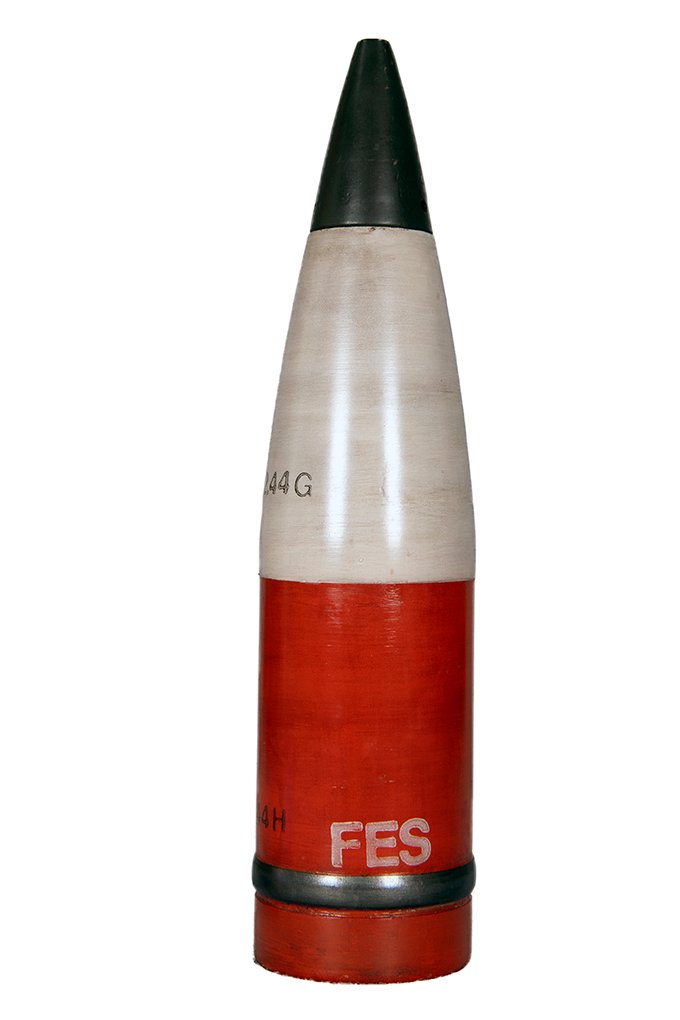
The “Weiss-Rot” (White-Red) designation refers to specific markings or color coding used to distinguish this specialized ammunition from combat rounds.
Hazards
Safety Classification
LOW-HAZARD ORDNANCE – This projectile poses minimal explosive threat compared to conventional munitions.
Primary Hazards
1. Black Powder Expulsion Charge
- Small quantity of black powder (smokeless powder) used for ejection mechanism
- Significantly less energetic than primary explosives
- Primary risk: Burns, flash injuries if charge ignites unexpectedly
- Degraded charges may become unstable over time
2. Mechanical Hazards
- Spring-loaded components under tension
- Sharp edges from corroded or damaged metal components
- Base plate ejection mechanism may be under spring pressure
- Aluminum shear wires may fragment if corroded
3. Chemical Hazards
- Black powder degradation products
- Corrosion from aged aluminum and steel components
- Potential for pressure buildup in sealed, deteriorating specimens
4. Historical Fragmentation Risk
- Although designed as non-lethal, the base plate and piston eject at high velocity
- Wooden block and steel components become projectiles during function
- Safe distance: Minimum 50 meters during function
Unexploded Ordnance (UXO) Considerations
Low Priority UXO: Due to minimal explosive content and non-lethal design, these projectiles represent lower risk than conventional ordnance. However:
- Aged black powder charges can become unpredictable
- Corrosion may weaken containment, leading to spontaneous pressure release
- Should still be treated with caution and reported to authorities
- May be encountered in former World War II artillery impact areas
- Often found in relatively intact condition due to lower mechanical stresses
Environmental Stability
- Steel and aluminum construction subject to corrosion
- Paper leaflets decompose relatively quickly
- Wooden components decay in moist environments
- Overall: Moderate environmental persistence (decades in favorable conditions)
Key Identification Features
Physical Dimensions
- Total Length: Approximately 420-450mm (16.5-17.7 inches)
- Body Diameter: 105mm (4.13 inches)
- Weight (Loaded): Approximately 14-15 kg (30.9-33 lbs)
- Weight (Empty): Approximately 6-7 kg (13.2-15.4 lbs)
Structural Components
Upper Body Section:
- Cylindrical steel construction
- Threaded connection to lower body (visible junction line)
- Houses wooden block containing black powder expulsion charge
- Fuze well at nose for time fuze
Lower Body Section:
- Main cylindrical cavity for leaflet storage
- Internal halved pipe with 3mm wall thickness
- Capacity: Approximately 0.45 kg (1 pound) of rolled leaflets
- Steel disc piston separates leaflets from base mechanism
Base Assembly:
- Base plate held by three aluminum shear wires (positioned at 120° intervals)
- One axial steel positioning pin prevents radial movement
- Copper or copper-alloy driving band near base
- Base fuze threads or striker mechanism
Color Schemes and Markings
Standard Markings:
- Body color: Gray, gray-green, or natural steel
- Red and white bands (hence “Weiss-Rot” designation)
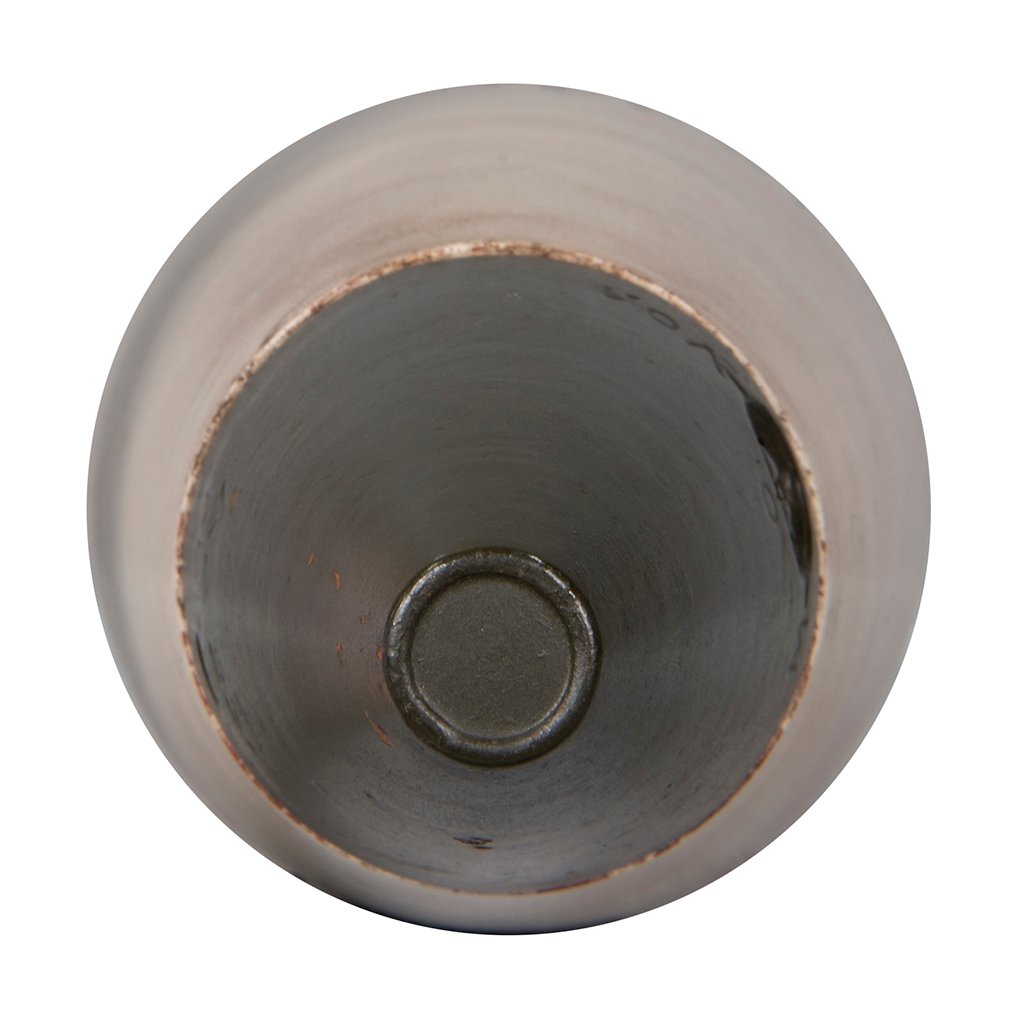
- Lot numbers and manufacturing codes stamped on base
- Fuze type markings on nose
- Weight markings: “Kart.” or “Kartusche” indicating cartridge type
Identification Bands:
- Red band above the driving band (characteristic of “Rot” series projectiles)
- White band or markings near nose section
- Some variants marked with “Propaganda” or “Prop.” stenciling
Distinctive Features
- Two-piece threaded construction: Visible threading where upper and lower bodies join
- Modified driving band: Shows signs of adaptation from standard HE rounds
- Lightweight: Noticeably lighter than standard 105mm HE projectiles
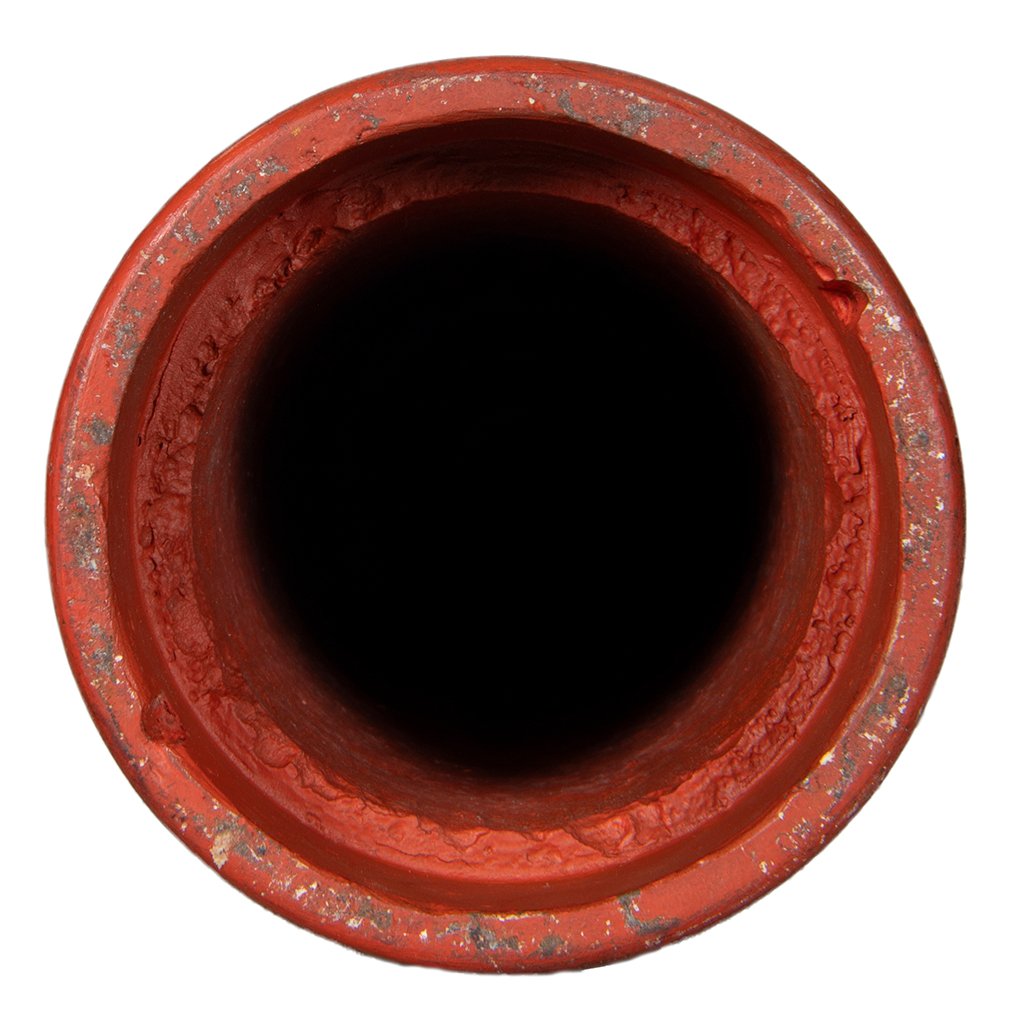
- Base design: Open or modified base compared to solid HE rounds
- No rotating band wear: Less pronounced than combat-fired projectiles due to lower pressures
Material Composition
- Body: Mild steel (lower structural requirements than combat rounds)
- Base plate: Steel
- Shear wires: Aluminum (designed for predictable failure)
- Piston: Steel disc
- Pipe halves: Steel (3mm wall thickness)
- Driving band: Copper alloy
- Internal components: Wooden block, cardboard spacers
Visual Condition Indicators
- Often found in better condition than HE rounds (less violent impact)
- May show corrosion at threaded joints
- Base plate may be missing if projectile functioned
- Leaflet remnants may be visible through openings
- Wood components often deteriorated in recovered specimens
Fuzing Mechanisms
Primary Fuze Type: Time Fuze
Designation: Various German artillery time fuzes compatible with 105mm projectiles
Common Fuze Types Used:
- Zeitzünder (Time Fuze): Mechanical or powder-train time fuzes
- Adjustable burn time: Typically 23 seconds ± 2 seconds
- Set before firing based on desired altitude/range for dispersal
Fuze Function Sequence
1. Loading and Preparation:
- Time fuze screwed into nose fuze well
- Fuze set to predetermined time based on ballistic calculations
- Time corresponds to point over target where leaflet dispersal is desired
- Safety mechanisms engaged during handling
2. Launch Phase:
- Setback force upon firing arms the fuze
- Fuze timing mechanism begins (powder train ignites or clockwork mechanism activates)
- Projectile follows ballistic trajectory
- No arming until after a safe distance from the gun (bore safety features)
3. In-Flight Phase:
- Fuze continues to burn or count down during flight
- Projectile stabilizes through spin imparted by rifling
- Typical flight time: 20-30 seconds depending on range
- Fuze designed to function at optimal altitude (200-500 meters typical)
4. Expulsion Sequence:
a. Fuze Function:
- At preset time, fuze flame channel opens
- Fire flashes down through central aluminum tube into wooden block
- Black powder expulsion charge ignites
b. Pressure Build-Up:
- Burning black powder generates gas pressure
- Pressure pushes wooden block downward
- Simultaneously, pressure forces steel piston upward
c. Structural Failure:
- Pressure on piston increases until shear wires fail
- Three aluminum shear wires break at designed pressure threshold
- Steel positioning pin shears or slides free
d. Ejection:
- Base plate expelled rearward at high velocity
- Piston and pipe halves follow
- Leaflets released into airstream
- Wooden block expelled through base opening
5. Leaflet Dispersal:
- Expelled leaflets separate in airstream
- Spin of projectile helps disperse materials
- Altitude and forward velocity determine footprint
- Typical coverage: Several hundred meters diameter
- Pattern depends on altitude of function, wind conditions, and leaflet characteristics
Safety Mechanisms
Fuze Safety Features:
- Bore safety: Setback-armed (requires firing acceleration to arm)
- Centrifugal safety: Spin-armed components prevent premature function
- Interrupt mechanisms: Prevent function if projectile tumbles or impacts before time elapses
Handling Safety:
- Shipping safety pin in fuze
- Safety cap over fuze well during transport
- Fuze installed only immediately before firing
Failure Modes:
- Early function: Rare, typically due to fuze defect; would scatter leaflets short of target
- Late function or dud: Projectile impacts without functioning; low hazard but charge remains
- Partial function: Shear wires may fail incompletely, resulting in poor dispersal
Arming Sequence Summary
- Safe: Fuze installed but safety pin in place
- Armed: Safety pin removed, fuze set, projectile loaded
- Firing: Setback and spin arm fuze
- Functioning: Time delay expires, expulsion charge ignites
- Expulsion: Base assembly ejects, leaflets disperse
Design Considerations
- Time fuze chosen over impact fuze for optimal altitude function
- Expulsion charge carefully calculated to disperse without destroying leaflets
- Shear wire strength engineered for consistent function
- System designed for reliability (propaganda mission success depends on function)
History of Development and Use
Origins and Development (1930s – Early 1940s)
The development of artillery-delivered propaganda munitions emerged from Germany’s comprehensive approach to psychological warfare during the interwar period and World War II. Several factors drove this innovation:
Strategic Motivations:
- Treaty of Versailles restrictions on German military development led to creative approaches
- Early 1930s experiments at Kummersdorf-West test facility included propaganda delivery systems
- Recognition that air superiority could not be guaranteed, requiring ground-based delivery methods
- Desire to reach enemy front-line troops beyond range of ground-based loudspeakers or leaflet drops
Technical Evolution:
- Initial experiments focused on 73mm rocket-based systems for leaflet delivery
- By 1940-1941, artillery-based systems proved more practical for accuracy and range
- Development of the 10cm Weiss-Rot Geschoss represented refinement of earlier concepts
- Design borrowed mechanical elements from standard 105mm high-explosive projectiles
Doctrinal Integration:
- German propaganda units (Propagandakompanien) integrated with combat forces
- Artillery units received specialized training for propaganda munitions
- Coordination between psychological warfare staff and artillery commands
Deployment Timeline
1941-1942: Initial Deployment
- First documented use on Eastern Front
- Limited numbers produced initially
- Testing and refinement of dispersal patterns
- Integration with Wehrmacht artillery batteries
1943-1944: Expanded Use
- Increased production as Germany lost air superiority
- Wider deployment across all fronts
- Used extensively on Western Front after Allied invasion
- Eastern Front remained primary theater of employment
- Italian campaign saw moderate use
1944-1945: Peak Employment
- Last two years of war saw most intensive use
- Germany’s loss of air superiority made artillery delivery essential
- Ardennes Offensive (Battle of the Bulge) December 1944: Heavy documented use
- Series of four coordinated leaflet campaigns fired at American forces
- Projectiles held approximately 100 leaflets each
- Fired from le.F.H. 18 series 105mm howitzers
- Campaigns targeted American morale during German counter-offensive
Notable Campaigns and Operations
Western Front – Ardennes Offensive (Winter 1944-1945):
- Well-documented series: “Your job to die,” “Your job to fight,” and related leaflets
- Fired at American positions during Rundstedt offensive
- Typical battery would fire 10-20 propaganda rounds per mission
- Mixed with regular fire missions to complicate Allied counter-battery operations
Eastern Front Operations:
- Used against Soviet forces throughout 1943-1945
- Leaflets emphasized harsh Soviet treatment of soldiers
- Promoted desertion and surrender to German forces
- Effectiveness disputed; Soviet commissars maintained strict discipline
Italian Campaign:
- Targeted Allied forces advancing through Italy
- Multilingual leaflets (English, Polish, French, Italian)
- Attempted to exploit tensions between Allied nations
Production and Distribution
Manufacturing:
- Produced at various German ordnance facilities
- Modified from standard 105mm projectile production lines
- Relatively simple to manufacture compared to complex fuzes
- Estimated thousands produced (exact figures lost or incomplete)
Logistics:
- Distributed to field artillery units through normal ammunition supply chains
- Special handling instructions issued
- Often stored separately from combat ammunition
- Leaflets prepared by propaganda units and issued to artillery
Loading Procedures:
- Projectiles typically shipped empty or with dummy loads
- Forward artillery units received leaflets from propaganda units
- Loading performed at battery level:
- Unscrew upper body from lower body
- Insert 1-pound pack of rolled leaflets into lower cavity
- Place steel piston on top
- Add cardboard spacers if needed for proper fit
- Screw upper body back onto lower body
- Install time fuze set for desired altitude/range
- Load and fire as standard 105mm round
Tactical Employment
Fire Missions:
- Propaganda rounds fired singly or in small numbers (5-10 rounds)
- Mixed into regular artillery schedules
- Timed to coincide with lulls in combat or during static periods
- Altitude typically 200-500 meters above target for optimal dispersal
Target Selection:
- Enemy assembly areas
- Rest areas behind front lines
- Communication trenches
- Areas with concentrated troop presence
- Civilian areas in some theaters (controversial practice)
Effectiveness Assessment:
Documented Impact:
- Allied intelligence collected and analyzed dropped leaflets
- Some evidence of morale impact among isolated units
- Surrender leaflets occasionally presented by defectors
- Overall strategic impact considered minimal
Limitations:
- Leaflet content often poorly translated (“Germ-english”)
- Messages sometimes counterproductive or mocked by recipients
- Allied troops generally well-supplied and motivated
- Competing with Allied counter-propaganda efforts
Technical Success:
- Delivery mechanism generally reliable
- Achieved desired dispersal patterns
- Projectiles functioned as designed in most cases
- Range and accuracy suitable for mission requirements
Post-War Legacy
Immediate Post-War:
- Large quantities captured by Allied forces
- Studied by Allied ordnance experts
- Examples preserved in military museums
- Influenced post-war propaganda munition development
Cold War Era:
- Concept adopted by various militaries
- US and Soviet forces developed similar systems
- Evolution toward rocket and aircraft-based delivery
- Artillery-based systems gradually phased out
Current Status:
- Obsolete: No longer in active service anywhere
- Historical Significance: Important example of psychological warfare integration
- Collector Interest: Sought by military collectors and historians
- UXO Presence: Occasionally found in former combat zones, particularly Eastern Europe
- Museum Specimens: Present in major military museums worldwide
Historical Significance
Innovation in Warfare:
- Represented integration of psychological operations with conventional artillery
- Demonstrated German innovation under resource constraints
- Showcased attempt to maintain propaganda delivery despite air superiority loss
Limitations of Technology:
- Illustrated limits of psychological warfare against well-supplied, motivated forces
- Demonstrated challenges of effective propaganda message creation
- Showed that delivery mechanism alone insufficient without effective content
Influence on Modern Doctrine:
- Contributed to development of post-war psychological operations
- Influenced thinking about non-lethal munitions
- Provided lessons for integration of information warfare with combat operations
Technical Specifications
Dimensional Data
- Overall Length: 420-450mm (16.5-17.7 in)
- Body Diameter: 105mm (4.13 in)
- Caliber: 10cm / 105mm
- Wall Thickness: Approximately 5-8mm (varies by section)
- Internal Pipe Wall: 3mm
Weight Specifications
- Complete Round (with leaflets): ~14-15 kg (30.9-33 lbs)
- Empty Projectile: ~6-7 kg (13.2-15.4 lbs)
- Leaflet Capacity: ~0.45 kg / 1 pound (approximately 100-150 leaflets depending on paper weight)
- Expulsion Charge: ~30-50 grams black powder
Ballistic Performance
- Muzzle Velocity: Approximately 470-540 m/s (depending on charge)
- Maximum Range: ~10,000-12,000 meters (with reduced charges for propaganda missions typically 4,000-8,000 meters)
- Flight Time: 20-40 seconds (depending on charge and range)
- Function Altitude: 200-500 meters above ground level (typical setting)
- Dispersion Pattern: 200-400 meter diameter footprint (varies with altitude and wind)
Operational Characteristics
- Operating Temperature: -20°C to +50°C (-4°F to 122°F)
- Storage Life: Limited by black powder stability and paper deterioration (typically 2-5 years in good conditions)
- Reliability: Estimated 85-95% function rate based on historical accounts
- Setup Time: 2-3 minutes per round for leaflet loading and fuze setting
Compatibility
- Artillery Systems: le.F.H. 18, 18M, 18/40 (105mm howitzers)
- Fuze Types: Standard German artillery time fuzes (various models)
- Propellant: Standard German artillery propellant charges (often reduced charges)
Explosive Content
- Main Charge: NONE – not a warhead munition
- Expulsion Charge: 30-50 grams black powder or smokeless powder
- Fuze Explosive: Minimal (standard time fuze components)
- Hazard Classification: Class 1.4S or similar (low hazard ammunition)
Construction Materials
- Body: Mild steel (St 37 or similar)
- Base Plate: Steel
- Shear Wires: Aluminum alloy (specific strength for designed function pressure)
- Piston: Steel
- Internal Pipe: Steel (3mm wall)
- Wooden Block: Hardwood (birch or beech typical)
- Driving Band: Copper-zinc alloy
Design Pressure
- Function Pressure: Approximately 5,000-8,000 kPa (725-1,160 psi)
- Shear Wire Breaking Strength: Calibrated for consistent ejection
Frequently Asked Questions
Q: Why did Germany use artillery to deliver propaganda instead of aircraft?
A: By 1943-1945, Germany had lost air superiority over most fronts. Allied fighter aircraft made propaganda leaflet drops by German aircraft extremely dangerous and often impossible. Artillery provided a safer alternative that could deliver materials with acceptable accuracy at ranges up to 10-12 kilometers. Additionally, artillery delivery could be precisely timed and integrated with combat operations without requiring specialized aircraft or risking valuable aviation assets. The method also allowed propaganda delivery in contested airspace where aircraft couldn’t operate safely.
Q: How does the 10cm Weiss-Rot Geschoss differ from a standard high-explosive 105mm artillery round?
A: The key differences are: (1) No explosive warhead – the projectile contains only leaflets and a small black powder expulsion charge, (2) Two-piece threaded construction allowing the body to be opened and loaded with leaflets, (3) Significantly lighter weight (approximately half the weight of an HE round), (4) Different internal structure with a pipe system for leaflet storage, (5) Ejection mechanism with shear wires and base plate designed to break away, and (6) Always used with time fuzes rather than impact fuzes to ensure airburst over the target area. The external appearance is similar to maintain compatibility with standard artillery handling equipment.
Q: What made the shear wires break at the right time, and why use aluminum?
A: The three aluminum shear wires were precisely engineered to fail at a specific pressure generated by the burning expulsion charge. Aluminum was chosen for several reasons: (1) Predictable mechanical properties allowing consistent failure at designed pressure, (2) Sufficient strength to hold the base plate during handling and firing, (3) Clean fracture characteristics without fragmentation, (4) Lower strength than steel, requiring less powerful expulsion charge, and (5) Resistance to corrosion during storage. The wires were positioned at 120-degree intervals to ensure even pressure distribution. When gas pressure from the burning black powder reached approximately 5,000-8,000 kPa, the wires would shear simultaneously, allowing clean ejection of the base assembly and leaflets.
Q: Was this type of propaganda delivery effective, and did it influence enemy troops?
A: The effectiveness was limited and remains debated by historians. Allied intelligence reports indicate that soldiers often collected the leaflets as curiosities or mocked the frequently poor translations (“Germ-english”). Some documented cases exist of soldiers surrendering with safe-conduct passes from propaganda leaflets, but these were relatively rare. The primary limitations were: (1) Poor message quality with ineffective or counterproductive content, (2) Well-supplied and motivated Allied troops less susceptible to propaganda, (3) Strong unit cohesion and morale among most Allied forces, (4) Effective Allied counter-propaganda, and (5) Relatively small number of leaflets per projectile (100-150 leaflets covered a large area thinly). The technical delivery system worked as designed, but the strategic impact on enemy morale was minimal compared to German expectations.
Q: How dangerous is an unexploded 10cm Weiss-Rot Geschoss found today?
A: These projectiles are significantly less dangerous than conventional high-explosive ordnance but should still be treated with caution. The primary hazard is the black powder expulsion charge, which can become unstable with age. Risks include: (1) Degraded black powder may ignite unexpectedly if disturbed, (2) Corroded components may fail suddenly if moved, (3) The spring-loaded mechanism may be under tension, (4) Sharp corroded edges, and (5) Possible chemical hazards from corrosion products. However, there is no large explosive fill like in HE rounds, and the explosive content is minimal (30-50 grams). Found examples should be reported to authorities but are generally considered lower-priority UXO. The greatest danger would be attempting to disassemble or forcibly open the projectile, which could ignite the remaining powder charge.
Q: Can these projectiles be identified by their markings, and what do the “Weiss-Rot” colors signify?
A: Yes, these projectiles have distinctive markings that aid identification. The name “Weiss-Rot” (White-Red) refers to colored bands painted on the projectile body – typically a white band near the nose and a red band above the driving band. The red band is particularly significant as it marked “Rot” series projectiles, which were rounds adapted or modified from their original design for different guns. Additional markings include: (1) Manufacturing codes and lot numbers stamped on the base, (2) Weight markings and cartridge designations, (3) Sometimes “Propaganda” or “Prop.” stenciled on the body, (4) Fuze type markings near the nose, and (5) Two-piece threaded construction visible as a seam around the body. These markings, combined with the lighter weight and modified base design, make identification relatively straightforward for trained ordnance personnel.
Q: How did artillery crews calculate the proper time setting for optimal leaflet dispersal?
A: Calculating the proper fuze time required considering several factors: (1) Desired range to target (affecting time-of-flight), (2) Desired altitude of function over the target (typically 200-500 meters for optimal dispersal), (3) Ballistic trajectory of the projectile based on charge used, (4) Wind conditions affecting leaflet drift, and (5) Desired coverage area. German artillery used firing tables and ballistic calculators that provided time-of-flight data for various ranges and charges. The fuze would be set for slightly less than the total flight time to ensure airburst over the target rather than ground impact. For example, if a projectile had a 30-second flight time to an 8,000-meter target, the fuze might be set for 28 seconds to function at approximately 300 meters altitude. Experienced crews could adjust for local conditions, and sometimes fired test rounds with reduced charges to verify settings before full missions.
Q: Were similar propaganda projectiles used by other nations during World War II or since?
A: Yes, other nations developed similar systems, though the German approach was the most sophisticated of the era. The Soviet Union experimented with propaganda shells, and the United States developed leaflet bombs and artillery projectiles, though primarily for post-war use. During the Cold War, both US and Soviet forces maintained artillery-delivered propaganda capabilities. Modern militaries have generally transitioned to rocket-based systems (such as modified artillery rockets), mortar-delivered leaflet canisters, and aerial delivery as preferred methods. The concept of artillery-delivered psychological operations materials continues in modified forms, though current emphasis is on electronic and digital information warfare rather than paper leaflets. Some contemporary systems exist for civilian applications like aerial firefighting marker rounds or emergency signal rounds, which use similar ejection mechanisms, demonstrating the enduring validity of the basic technical approach.
Safety Warning
This document is for educational and identification purposes only. All grenades and explosive ordnance are extremely dangerous and should only be handled by trained military personnel or explosive ordnance disposal (EOD) specialists. Unexploded ordnance (UXO) can remain lethal for decades and may be unstable. If you encounter suspected ordnance, do not touch it—mark the location, evacuate the area, and contact military or law enforcement authorities immediately.
The information presented here is intended for military professionals, historians, collectors (handling inert training replicas only), and educational purposes. Never attempt to disarm, modify, or handle live ordnance.