TM-62M Anti-Tank Mine
Ordnance Overview
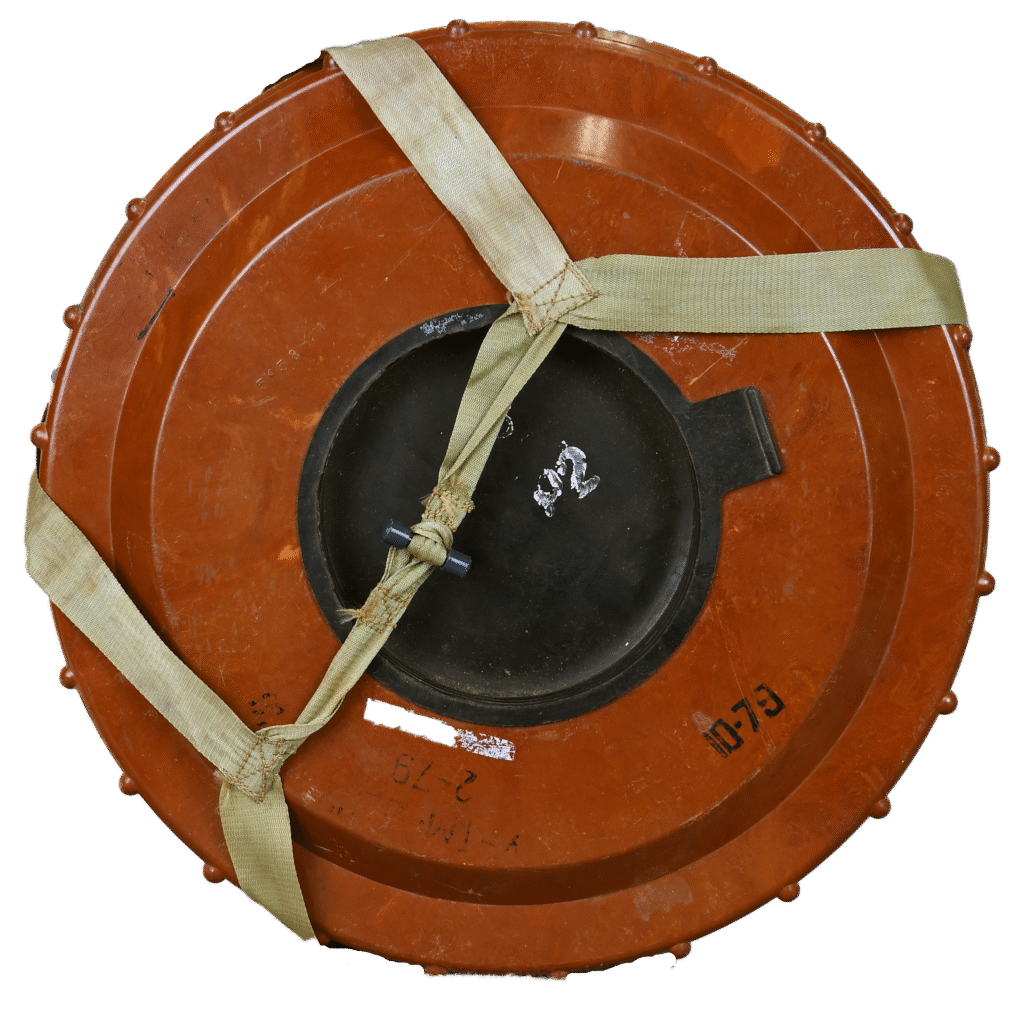
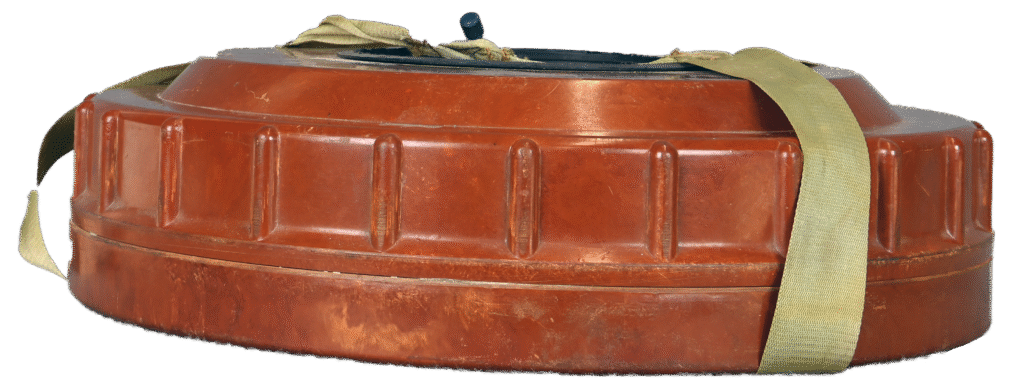
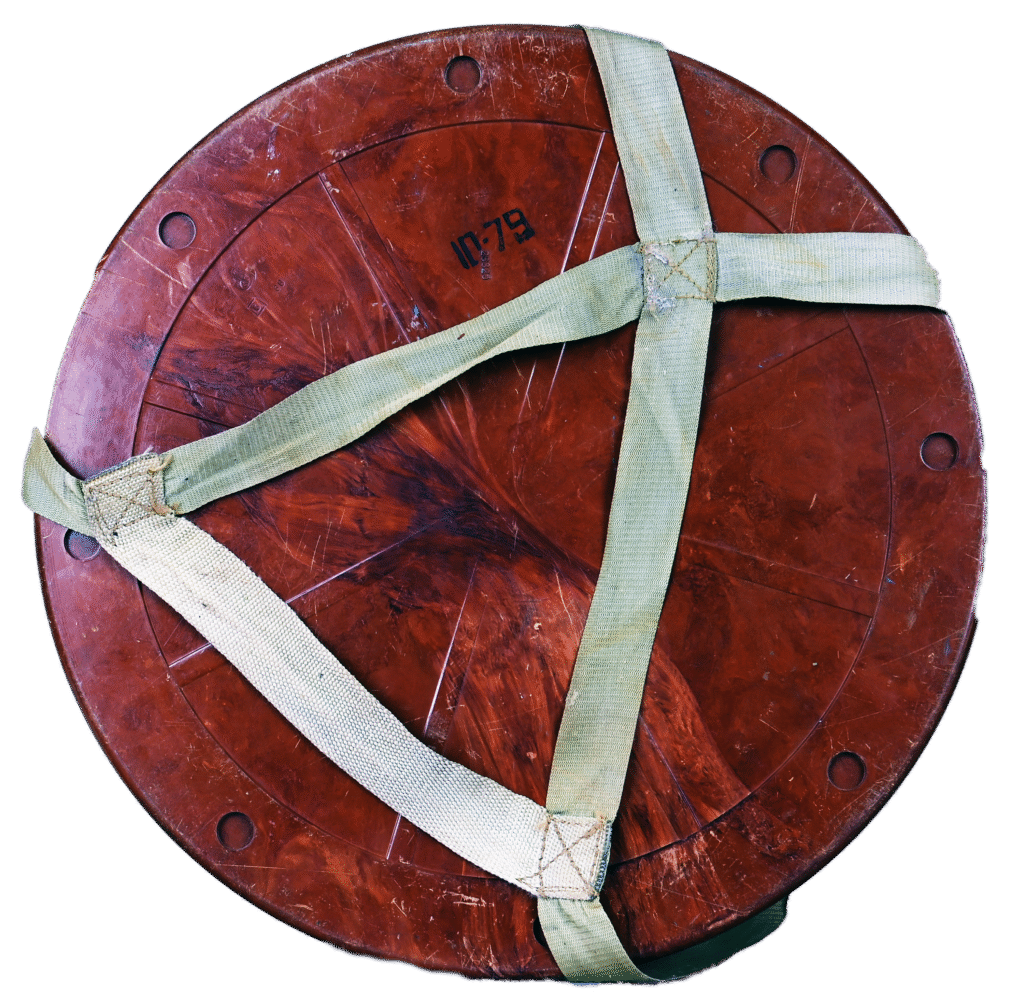
The TM-62M is a large, circular blast anti-tank mine designed to destroy or disable armored vehicles through a massive explosive charge detonated beneath the vehicle’s hull or tracks. This mine represents Soviet Cold War-era engineering focused on simplicity, reliability, and devastating effectiveness against armored targets. The TM-62M is one of the most widely distributed anti-tank mines in the world, found in conflicts across multiple continents and remaining a significant threat decades after its initial deployment. Its modular fuzing system and robust construction have made it a long-lasting component of military arsenals and, unfortunately, a persistent humanitarian hazard in former conflict zones.
Country/Bloc of Origin
- Country: Soviet Union / Russian Federation
- Development Period: Early 1960s
- Introduction to Service: 1963
- Production Period: 1963-1980s
- Current Status: Obsolescent but widely stockpiled and still in use
International Distribution:
The TM-62 series was exported extensively throughout the Cold War to:
- Warsaw Pact nations
- Soviet client states in Africa, Asia, and the Middle East
- Non-aligned nations purchasing Soviet military equipment
- Various armed groups and militias through secondary transfers
The mine has been documented in conflicts in Afghanistan, Iraq, Syria, Yemen, Lebanon, Cambodia, Angola, Mozambique, Eritrea, and numerous other regions. Licensed or unlicensed production occurred in several countries, with variants produced in countries like China, Egypt, and Iraq.
Ordnance Class
- Type: Anti-Tank Blast Mine
- Primary Role: Anti-armor / Anti-vehicle
- Emplacement Method: Hand-emplaced (surface or buried)
- Activation Method: Pressure-activated
- Target: Tracked and wheeled armored vehicles, trucks
- Classification: Non-detectable (minimal metal content) in some variants
The TM-62M is designed specifically to attack the most vulnerable part of an armored vehicle—the relatively thin belly armor and track systems. It relies on blast effect rather than penetration, making it effective against a wide range of vehicles from light trucks to main battle tanks.
Ordnance Family/Nomenclature
TM-62 Series:
The TM-62M is part of a larger family of related mines:
- TM-62P – Earlier variant with pressure fuze only
- TM-62P2 – Improved variant with more robust construction
- TM-62P3 – Version with anti-handling device capability
- TM-62M – The subject of this lesson; introduced MVCh-62 fuze
- TM-62D – Wooden-cased variant designed to be less detectable
- TM-62B – Variant with shaped-charge warhead for enhanced armor penetration
- TM-62T – Tilt-rod fuzed variant for side-attack
Associated Fuzes:
The TM-62M can accept multiple fuze types, contributing to its versatility:
- MVCh-62 – Primary mechanical pressure fuze
- MVM – Mechanical pressure fuze with adjustable sensitivity
- MVN-80 – Seismic/vibration influence fuze
- VP-13 – Anti-handling device (pull-wire)
- MUV series – Breakwire pull fuzes for anti-handling
NATO Designation:
- Often referenced as “TM-62” series in Western intelligence documents
Common Names:
- “TM-62” (shortened designation)
- Soviet Anti-Tank Mine
- Large circular mine (in field identification)
Hazards
The TM-62M presents multiple severe hazards to military and civilian populations:
Primary Blast Hazard:
The main threat from the TM-62M is its massive explosive charge:
- Explosive Content: 7.5 kg of TNT (or TNT equivalent)
- Blast Effect: Sufficient to destroy or severely damage main battle tank tracks, suspension systems, and hull bottoms
- Over-pressure: The detonation creates extreme pressure waves that can kill or injure vehicle occupants even if the hull is not penetrated
- Vehicle Destruction: Light vehicles (trucks, APCs, cars) are typically destroyed completely; armored vehicles suffer mission-kill damage (immobilization, track destruction, hull breach)
Lethal Radius:
- Direct: Any personnel within 3-5 meters of detonation face lethal fragmentation and blast effects
- Structural: Buildings and structures within 10 meters may suffer significant damage
- Pressure Effects: Blast overpressure can cause serious injuries to personnel within 15-20 meters
Activation Sensitivity:
- Pressure Requirement: Typically 150-300 kg (depending on fuze and settings)
- Selective Activation: This pressure range is designed to avoid activation by personnel or animals while reliably triggering under vehicles
- Degradation Concerns: Over time, mechanical components may become more sensitive due to corrosion, spring fatigue, or environmental damage
- Tilt-Rod Variants: TM-62T with tilt-rod fuzes can be triggered by much lighter contact (10-15 kg), expanding the hazard to personnel
Unexploded Ordnance Concerns:
- Longevity: The simple mechanical construction means TM-62M mines can remain functional for decades
- Environmental Stability: TNT filling is chemically stable; mines from the 1960s-1970s remain viable today
- Corrosion Effects: Metal components (fuze mechanisms, casing) corrode over time, potentially creating unpredictable sensitivity changes
- Booby-Trap Hazard: Mines with anti-handling devices remain extremely dangerous to anyone attempting removal without proper EOD procedures
Anti-Handling Devices:
Many TM-62M mines are emplaced with secondary fuzes designed to detonate if the mine is moved:
- VP-13 Pull Fuze: Attached to mine bottom; triggers if mine is lifted or tilted
- MUV Pull Fuze: Wire-activated fuze triggered by disturbance
- Victim-Operated Devices: Some mines have been recovered with improvised anti-handling additions
The presence of anti-handling devices makes manual clearance extremely hazardous and often necessitates explosive neutralization techniques.
Secondary Hazards:
- Fragmentation: While not a fragmentation mine per se, the metal casing and internal components create lethal metal fragments with a radius of 30+ meters
- Ground Shock: The detonation creates significant seismic effects that can trigger adjacent mines or damage underground utilities
- Fire Hazard: Detonation can ignite vegetation, vehicles, or nearby fuel sources
Long-Term Contamination:
TM-62M mines have created persistent contamination in numerous countries:
- Minefields remain hazardous for decades after conflict
- Agricultural land becomes unusable
- Transportation infrastructure is disrupted
- Economic development is severely hindered
- Civilian casualties continue long after hostilities cease
Key Identification Features
Physical Dimensions:
- Diameter: 320 mm (approximately 12.6 inches)
- Height: 98-110 mm (approximately 3.9-4.3 inches), varies slightly by variant
- Weight (fuzed): Approximately 10 kg (22 lbs)
- Weight (unfuzed): Approximately 9.5 kg
- Explosive Fill: 7.5 kg TNT (or equivalent composition)
Shape and Profile:
- Configuration: Low-profile circular disc design
- Top Surface: Flat or slightly convex pressure plate
- Side Profile: Straight cylindrical walls with minimal taper
- Base: Flat bottom with central fuze well and possible anti-handling attachment point
- Edges: Sharp or slightly rounded rim where top and sides meet
Color and Markings:
The TM-62M typically features:
- Body Color: Olive drab green, dark green, or black protective paint
- Weathering: Painted surfaces may fade to lighter green, brown, or gray depending on environmental exposure
- Markings: Cyrillic text stenciled or stamped on top surface, including:
- “TM-62M” designation
- Lot numbers and date codes
- Manufacturing plant codes
- Weight and explosive content warnings
- Color Codes: May have colored bands or markings indicating lot, fuze type, or other identification data
- Deterioration: Older mines may show significant paint loss, rust, and corrosion
Structural Features:
- Pressure Plate: Large circular top surface designed to distribute vehicle weight
- Fuze Well: Central circular opening (approximately 60-80mm diameter) on top surface for fuze installation
- Covered by screw-on fuze cap when fuzed
- May have protective plug when stored unfuzed
- Anti-Handling Socket: Threaded opening on base (typically 35-45mm diameter) for secondary fuze attachment
- Sealing: Rubber or composition gasket around fuze well to provide weatherproofing
- Construction: Pressed metal (steel or aluminum) with welded or crimped seams
Material Composition:
- Casing: Steel or aluminum alloy
- Steel variants are more common and more detectable
- Some TM-62D variants use wooden cases to reduce metal signature
- Explosive: TNT (Trinitrotoluene), sometimes mixed with RDX or other compositions
- Fuze Components: Brass, steel, aluminum in mechanical assemblies
- Seals: Rubber or synthetic gaskets
Fuze Identification:
When a TM-62M is encountered in the field, identifying the fuze type is critical:
MVCh-62 Pressure Fuze:
- Circular brass or steel housing protruding slightly from top surface
- Approximately 60-70mm diameter
- May have safety clip or pin visible
- Arming plug or indicator visible in center
MVM Pressure Fuze:
- Similar appearance to MVCh-62
- May have adjustment indicator for sensitivity settings
- Typically has colored safety indicators
MVN-80 Influence Fuze:
- More complex appearance with electronic or seismic components
- May have battery compartment visible
- Antenna or sensor elements may protrude slightly
Anti-Handling Device Indicators:
- Wire or cord exiting from base of mine
- Secondary fuze visible beneath mine if partially exposed
- Disturbed earth or anchor points suggesting wire connections
Field Identification Tips:
- Size: The TM-62M is large—approximately the size of a dinner plate
- Profile: Low and flat design, often partially buried with only pressure plate visible
- Central Fuze: The prominent central fuze well distinguishes it from some other mines
- Weight: If safe to assess remotely (with prodding tool), the TM-62M is heavy (~10 kg)
- Context: Often found in defensive lines, road denial points, or agricultural areas in former conflict zones
Comparison to Similar Mines:
- Larger than: Most Western mines like the M15 (4.9 kg) or M19 (12.7 kg but smaller diameter)
- Similar to: Other large Soviet mines like the TM-57 or TM-46
- Distinguished from TM-57 by: The TM-62M has a flatter profile and different fuze arrangement
- Different from PMN series: PMN mines are much smaller anti-personnel mines; TM-62M is far larger
Safety Note on Identification:
Visual identification should ALWAYS be performed from maximum safe distance using binoculars or optical devices. Never approach a suspected mine for close examination. Mark the location and report to EOD authorities.
Fuzing Mechanisms
The TM-62M employs a modular fuzing system that provides tactical flexibility and contributes to its widespread use:
Primary Fuzing – MVCh-62 Mechanical Pressure Fuze:
The most common fuze used with the TM-62M is the MVCh-62, a purely mechanical pressure-activated fuze:
Components:
- Pressure Plate: Large surface area distributes vehicle weight
- Belleville Springs: Compressed spring washers that provide resistance until sufficient force is applied
- Striker Assembly: Spring-loaded firing pin held in safe position
- Safety Pin: Removable mechanical interrupter preventing accidental activation
- Detonator: Sensitive primary explosive (lead azide or mercury fulminate) that initiates the booster
- Booster Charge: Secondary explosive (tetryl or RDX) that ensures reliable detonation of main charge
Operation Sequence:
- Safe State: With safety pin installed, the striker is mechanically blocked from reaching the detonator
- Arming: Operator removes safety pin after mine is emplaced; mine is now armed but requires activation pressure
- Activation: When 150-300 kg (depending on adjustment) is applied to pressure plate, Belleville springs compress
- Striker Release: At critical compression, mechanical catch releases striker
- Detonation: Striker impacts detonator, initiating explosive train: detonator → booster → main charge
- Explosion: 7.5 kg TNT charge detonates, creating blast effect
Sensitivity Adjustment:
The MVCh-62 can be adjusted (in some configurations) to change activation pressure:
- High Sensitivity: ~150 kg (for lighter vehicles or uncertain conditions)
- Standard: ~200-250 kg (typical setting for military operations)
- Low Sensitivity: ~300+ kg (to avoid triggering on lighter vehicles while ensuring main battle tank activation)
Alternative Pressure Fuzes:
MVM Fuze:
- Similar mechanical operation to MVCh-62
- More robust construction for harsh environments
- May include anti-tilt features that trigger detonation if mine is disturbed
Influence Fuzes:
MVN-80 Seismic/Magnetic Fuze:
- Detects ground vibrations and/or magnetic signatures from approaching vehicles
- Does not require direct pressure—can trigger when vehicle passes nearby
- Allows mines to be placed off-road where vehicles would not make direct contact
- Battery-powered; functional lifetime of weeks to months depending on storage and conditions
- More complex and less reliable than mechanical fuzes; less commonly encountered
Anti-Handling Devices:
The TM-62M can be fitted with secondary fuzes to prevent mine clearance:
VP-13 Pull Fuze:
- Screws into bottom socket of mine
- Attached to stake or anchor buried beneath mine
- If mine is lifted or tilted more than ~15-30 degrees, pull-wire activates fuze
- Creates extreme hazard for manual clearance operations
MUV Series Fuzes:
- Wire-activated mechanisms
- Can be configured with tripwires or connected to adjacent objects
- Triggers if wire is cut or tensioned
Booby-Trap Configurations:
Beyond official anti-handling devices, TM-62M mines have been recovered with:
- Improvised pressure-release switches beneath mine
- Command-wire initiators allowing remote detonation
- Collapsing fuzes that trigger on pressure relief
- Photo-electric triggers activated by light (lifting mine creates shadow)
Self-Neutralization:
Unlike modern “smart” mines, the TM-62M has NO self-neutralization or self-destruct features:
- Once armed, the mine remains dangerous indefinitely
- Only physical intervention (detonation or careful disassembly by EOD) can render it safe
- Mechanical components are highly reliable and can function after decades
Multiple Fuzing:
The TM-62M can theoretically be fitted with BOTH a top-mounted pressure fuze AND a bottom-mounted anti-handling device, creating multiple detonation paths:
- Primary: Vehicle pressure triggers main fuze
- Secondary: Clearance attempt triggers anti-handling fuze
- Result: Extremely difficult to defeat mine without mechanical clearance or explosive neutralization
Fuze Identification in the Field:
When encountering a TM-62M:
- Assume presence of anti-handling device until proven otherwise
- Never touch or move the mine
- Look for indicators: wires, disturbed earth beneath mine, secondary fuze components
- Mark and report location for professional EOD clearance
- Maintain safe distance: Minimum 50-100 meters for personnel not in protective equipment
History of Development and Use
Post-WWII Soviet Mine Development (1945-1960):
Following World War II, the Soviet Union recognized the need to modernize its landmine arsenal. Wartime mines like the TM-41 and TM-44 anti-tank mines had proven effective but showed limitations in reliability, shelf-life, and ease of manufacture. Soviet military planners studied captured German mine technology and their own wartime experience to develop a new generation of more reliable, powerful, and easily produced anti-tank mines.
Development Requirements:
The specifications for what would become the TM-62M included:
- Simplicity: Easy to manufacture with minimal precision machining
- Reliability: Mechanical fuzing that would function across wide temperature ranges (-40°C to +50°C)
- Lethality: Sufficient explosive content to defeat increasingly heavy armored vehicles
- Modularity: Acceptance of multiple fuze types for tactical flexibility
- Detectability: While metal construction for durability, provision for low-metal variants
- Production Economy: Inexpensive materials and straightforward assembly processes
Introduction – 1963:
The TM-62M entered Soviet military service in 1963, representing a significant improvement over earlier designs:
- Larger explosive charge (7.5 kg vs 5.7 kg in TM-46)
- More reliable fuzing mechanism
- Better weatherproofing and longevity
- Modular fuze system allowing tactical adaptation
Cold War Production and Proliferation (1963-1991):
Throughout the Cold War, the TM-62M was manufactured in enormous quantities:
- Soviet production: Estimates suggest millions of units produced
- Warsaw Pact production: Czechoslovakia, Poland, East Germany, and other allies produced licensed versions
- Export production: Client states like China, Egypt, Iraq, and others manufactured copies or variants
The mine was distributed to:
- Soviet Armed Forces: Standard issue for engineer units and defensive operations
- Warsaw Pact Militaries: Standardized equipment for Eastern Bloc nations
- Liberation Movements: Supplied to various armed groups aligned with Soviet interests
- Client States: Provided or sold to nations purchasing Soviet military equipment
Combat Employment – Global Conflicts:
The TM-62M has been documented in virtually every major conflict involving Soviet-aligned forces since the 1960s:
Vietnam War (1964-1975):
- Supplied to North Vietnamese forces
- Used defensively and in denial operations
- Particularly effective against U.S. armored vehicles and supply trucks
Soviet-Afghan War (1979-1989):
- Extensively used by Soviet forces for route security
- Employed in defensive perimeters around bases and convoys
- Afghan Mujahideen forces captured and re-used Soviet mines
- Widespread contamination of agricultural areas and roads
- Estimated hundreds of thousands deployed; many remain today
Middle Eastern Conflicts:
Yom Kippur War (1973):
- Syrian and Egyptian forces employed TM-62 series mines
- Used in defensive belts in Golan Heights and Sinai
- Delayed Israeli armored advances
Iran-Iraq War (1980-1988):
- Both sides employed TM-62M extensively (Iraq from Soviet supplies, Iran from captured Iraqi stocks)
- Created massive minefields in southern Iraq and western Iran
- Contributed to static warfare conditions in certain sectors
Gulf War (1991):
- Iraqi forces emplaced tens of thousands of TM-62 series mines
- Used in prepared defensive positions in Kuwait and southern Iraq
- Coalition mine clearance operations recovered substantial numbers
- UN mine clearance continues to find TM-62 mines decades later
Lebanese Civil War (1975-1990):
- Multiple factions employed Soviet-supplied mines
- Extensive contamination of southern Lebanon
- De-mining efforts continue
African Conflicts:
Angola (1975-2002):
- Widespread use by MPLA government forces (Soviet-backed)
- UNITA forces also used captured mines
- Angola became one of world’s most mine-contaminated nations
- Millions of square meters of agricultural land rendered unusable
Mozambique (1977-1992):
- Extensive deployment in civil war
- Major humanitarian crisis due to mine contamination
- Long-term impediment to development
Eritrean-Ethiopian War (1998-2000):
- Both sides employed TM-62 mines in defensive positions
- Created dense minefields along contested borders
- Ongoing clearance challenges
Post-Soviet Conflicts:
Chechen Wars (1994-1996, 1999-2009):
- Russian forces used TM-62 mines for defensive positions
- Chechen forces also employed captured mines
- Urban and rural contamination
Ukraine Conflict (2014-Present):
- Extensive mine use by both Ukrainian and separatist forces
- TM-62 series mines documented in eastern Ukraine
- Contributes to one of Europe’s worst landmine contamination situations
Syrian Civil War (2011-Present):
- Syrian government forces, various opposition groups, and ISIS have all employed TM-62 series mines
- Widespread contamination of agricultural and urban areas
- Mines used both tactically and for area denial
Yemen (2015-Present):
- Houthi forces, government troops, and coalition forces have employed TM-62 mines
- Contamination compounds humanitarian crisis
Tactical Employment Doctrine:
Soviet and Russian military doctrine prescribes specific TM-62M employment methods:
Defensive Minefields:
- Used in belts to channel enemy armor into engagement zones
- Typically emplaced in multiple rows with 4-6 meter spacing
- Combined with anti-personnel mines for mixed-obstacle belts
Road Denial:
- Placed on or near roads to prevent enemy use of transportation infrastructure
- Often hidden beneath surface material or at culverts and bridges
Point Defense:
- Employed around key installations, command posts, artillery positions
- Creates protective barriers against armored assault
Hasty Minefields:
- Rapid emplacement by engineer units during fluid operations
- Surface-laid for speed with minimal burial
Humanitarian Impact:
The global proliferation of TM-62M mines has created lasting humanitarian crises:
- Civilian Casualties: Thousands of deaths and injuries annually from vehicle strikes on mines
- Economic Impact: Agricultural land rendered unusable; infrastructure development impeded
- De-mining Costs: Billions of dollars spent on clearance operations worldwide
- Long-Term Contamination: Mines remain effective for decades; conflicts from the 1960s-70s still produce casualties
Mine Ban Treaty and Current Status:
The 1997 Mine Ban Treaty (Ottawa Treaty) prohibits anti-personnel mines but does NOT cover anti-tank mines like the TM-62M. However:
- The treaty has influenced reduction in overall mine use
- Some countries have unilaterally ceased using anti-tank mines
- Russia and many TM-62M-equipped nations are NOT treaty signatories
- The mine remains in stockpiles of numerous militaries worldwide
Current Status (2020s):
The TM-62M is considered obsolescent in modern militaries:
- Russian forces have newer designs (TM-83, TM-89) with improved features
- However, enormous stockpiles remain, and the mine’s simplicity ensures continued function
- Non-state actors and less-developed militaries continue to use TM-62 series mines
- The mine remains one of the most commonly encountered anti-tank mines in demining operations globally
The TM-62M’s legacy is one of technological effectiveness combined with profound humanitarian consequences—a weapon designed for military efficacy that has created suffering far beyond its intended battlefields.
Technical Specifications
Physical Characteristics:
- Diameter: 320 mm (12.6 inches)
- Height: 98-110 mm (3.9-4.3 inches)
- Weight (fuzed): 10.0 kg (22 lbs)
- Weight (unfuzed): 9.5 kg (20.9 lbs)
- Casing Material: Stamped steel or aluminum
- Casing Thickness: 2-4 mm depending on material
Explosive Content:
- Main Charge: 7.5 kg (16.5 lbs) TNT
- Composition: TNT (Trinitrotoluene), sometimes mixed with RDX/TNT composition (60/40)
- Detonation Velocity: ~6,900 m/s (TNT) to ~7,600 m/s (RDX/TNT mix)
- TNT Equivalency: 7.5 kg TNT or ~8.5 kg TNT equivalent if RDX composition
Performance Characteristics:
- Blast Effect: Sufficient to destroy tracks and suspension of main battle tanks; catastrophic damage to lighter vehicles
- Over-Pressure: Creates extreme pressure wave causing crew casualties in enclosed vehicles
- Crater Size: Approximately 1-1.5 meters diameter, 0.5-0.8 meters depth (soil dependent)
- Fragmentation Radius: ~30 meters lethal fragment projection
- Kill Probability: >90% mission-kill against armored personnel carriers; 50-70% mobility-kill against main battle tanks
Fuze Specifications:
MVCh-62 Mechanical Pressure Fuze:
- Activation Pressure: 150-300 kg (330-660 lbs) adjustable
- Pressure Plate Diameter: ~60-70 mm
- Operating Temperature: -40°C to +50°C
- Reliability: >95% function rate under specified conditions
- Safety: Mechanical safety pin prevents accidental activation
- Arming: Instant upon safety pin removal
- Shelf Life: Effectively unlimited for mechanical components
MVM Pressure Fuze:
- Activation Pressure: 200-400 kg (440-880 lbs)
- Operating Conditions: Similar to MVCh-62
- Additional Feature: Anti-tilt mechanism in some variants
Anti-Handling Devices:
VP-13 Pull Fuze:
- Activation Force: 3-8 kg (6.6-17.6 lbs) of pull
- Tilt Angle: Typically triggers at 15-30 degrees of tilt
- Placement: Installed in bottom fuze well
- Connection: Wire anchor to stake or buried anchor point
Environmental Specifications:
- Operating Temperature: -40°C to +50°C (-40°F to 122°F)
- Storage Temperature: -50°C to +60°C
- Humidity Resistance: Weatherproofed for extended outdoor exposure
- Soil Compatibility: Functions in sand, clay, mud, rocky terrain
- Water Resistance: Can function when waterlogged or partially submerged
- Shelf Life: 20+ years in proper storage; effectively indefinite for basic mechanical components
Emplacement Specifications:
- Emplacement Time: 2-5 minutes per mine by trained personnel
- Burial Depth: Surface to 10 cm typical; can be deeper for concealment
- Spacing: Typically 4-6 meters in minefield rows
- Density: 0.4-1.2 mines per meter of front (depending on tactical situation)
Logistical Data:
- Packaging: Typically wooden or metal containers holding 1-4 mines
- Storage: Dry, temperature-controlled facilities preferred but not essential
- Transportation: Can be transported in standard military trucks; no special hazardous material requirements for unfuzed mines
- Handling: Two-person carry for fuzed mine; one person can carry unfuzed mine short distances
Detection Characteristics:
Metal Content:
- Steel Variant: High metal content (~6-7 kg steel); readily detectable by metal detectors
- Aluminum Variant: Lower metal signature but still detectable
- Fuze: Brass/steel components add to metal signature
- TM-62D Wooden Variant: Minimum metal (fuze only); extremely difficult to detect with metal detectors
Detection Methods:
- Metal Detector: Highly effective for standard TM-62M
- Ground-Penetrating Radar: Can detect buried mines
- Prodding: Dangerous but traditional method; requires extreme caution
- Explosive Detection Dogs: Can identify explosive content
- Mechanical Clearance: Rollers, flails, plows can safely detonate or displace mines
Comparison to Other Anti-Tank Mines:
| Characteristic | TM-62M | M15 (USA) | VS-50 (Italy) | TM-46 (USSR) |
|---|---|---|---|---|
| Diameter | 320 mm | 208 mm | 90 mm | 305 mm |
| Weight | 10 kg | 4.9 kg | 0.185 kg | 8.6 kg |
| Explosive | 7.5 kg | 2.2 kg | 0.043 kg | 5.7 kg |
| Classification | AT | AT | AP | AT |
| Activation | 150-300 kg | 159 kg | 10+ kg | 180-380 kg |
Note: The TM-62M is substantially larger and more powerful than most contemporary anti-tank mines, reflecting Soviet emphasis on overwhelming blast effect.
Frequently Asked Questions
Q: Why is the TM-62M so much larger than Western anti-tank mines like the M15?
A: The TM-62M reflects Soviet military philosophy prioritizing overwhelming firepower and guaranteed effect. With 7.5 kg of TNT compared to the M15’s 2.2 kg, the TM-62M is designed to ensure a mission-kill against even the heaviest armored vehicles through sheer blast force rather than relying on precise placement or shaped-charge penetration. Soviet doctrine anticipated large-scale armored warfare against NATO forces where absolute reliability in destroying or immobilizing enemy tanks was paramount. The additional weight and size were considered acceptable trade-offs given the mechanized nature of Soviet engineer units and the importance of creating impenetrable defensive obstacles. The larger explosive charge also provides redundancy—even if the mine detonates sub-optimally (not directly under vehicle centerline), the blast effect is still likely to cause severe damage. Western mines like the M15 were designed with different priorities including easier transport by dismounted infantry and deployment in expeditionary operations, leading to smaller, lighter designs. The TM-62M’s size also reflects lower manufacturing costs for simpler, larger components compared to more sophisticated, compact designs requiring precision engineering.
Q: How does the TM-62M defeat modern armored vehicles with advanced protection systems?
A: The TM-62M defeats armored vehicles through blast effects rather than penetration, which has both advantages and limitations against modern armor. When a vehicle passes over the mine, the 7.5 kg TNT charge detonates underneath, creating several damaging effects: First, the massive blast wave propagates through the ground and air, striking the vehicle’s belly armor—typically the thinnest armor on any vehicle (often 20-40mm compared to 400-900mm frontal armor on main battle tanks). Second, the explosion creates a high-velocity soil ejecta “slug” that impacts the hull like a kinetic projectile. Third, the pressure wave can cause spalling on the interior surfaces, creating lethal fragments inside the crew compartment. Fourth, even if hull penetration doesn’t occur, the extreme acceleration forces (100-300 G’s) can cause catastrophic injuries to crew members. Most significantly, the blast destroys or damages critical components: tracks are shredded, road wheels shattered, suspension arms broken, and engine components damaged. Modern reactive armor (ERA) and active protection systems (APS) are largely ineffective against under-belly blast mines because they’re designed to counter shaped-charge jets and kinetic penetrators coming from horizontal angles, not vertical blast effects. However, modern Mine Resistant Ambush Protected (MRAP) vehicles and some tanks with belly armor enhancement kits (like the Israeli Trophy or Russian Relikt systems) can provide improved crew survival even if vehicle mobility is lost. The TM-62M remains effective at mission-kill (immobilization) even against modern vehicles, though crew survival has improved with advanced armor designs.
Q: Can the TM-62M be detected reliably with modern mine detection equipment?
A: Detection of the TM-62M varies significantly depending on the variant and detection method employed. The standard steel-cased TM-62M is relatively easy to detect with modern equipment due to its high metal content (approximately 6-7 kg of steel in the casing plus metal fuze components). Military-grade metal detectors can reliably identify these mines at typical burial depths of 5-10 cm. Ground-penetrating radar (GPR) systems are also effective, as they detect the density discontinuity created by the mine’s large mass even in challenging soil conditions. However, the TM-62D variant, which uses a wooden case with only the metal fuze, presents a much greater detection challenge—the metal signature is reduced by 85-90%, making it extremely difficult for metal detectors. Detection of low-metal variants requires multi-sensor approaches: GPR for detecting density changes, electromagnetic induction sensors for subtle metal signatures, and explosive vapor detection systems to identify chemical signatures from the TNT filling. Mine detection dogs are highly effective against TM-62M variants because they detect explosive vapors that leak through case seams over time. The mine’s relatively large size actually aids some detection methods—its bulk creates a significant disturbance in soil stratigraphy visible to GPR. Despite these capabilities, detection reliability is affected by soil conditions (mineralized soil creates false positives, very dry or rocky soil impedes GPR), burial depth, and vegetation cover. Modern de-mining operations typically employ multiple detection methods in combination to achieve 99%+ clearance rates, but the TM-62D variant remains one of the more challenging mines to reliably detect and clear.
Q: Why do anti-tank mines like the TM-62M remain dangerous for decades after conflicts end?
A: The extraordinary longevity of TM-62M mines creates persistent humanitarian hazards for multiple reasons. First, the mechanical fuzing system is extremely simple and robust—it contains no electronics, batteries, or components that degrade significantly over time. The steel springs, striker assemblies, and detonators can remain functional for 50+ years if protected from moisture. TNT, the primary explosive filling, is chemically stable and does not degrade under normal environmental conditions, maintaining its explosive properties indefinitely. Mines emplaced in the 1970s Soviet-Afghan War or 1980s Iran-Iraq War remain fully capable of detonation today. Second, the mine’s weatherproof construction protects critical components; even corroded cases may still contain functional fuzes and explosive charges. Third, unlike modern “smart” mines with self-destruct or self-neutralization features, the TM-62M has no time-limited components—once armed, it remains armed until physically disrupted or detonated. Fourth, environmental factors that might be expected to neutralize mines can paradoxically make them more dangerous: Corrosion can make mechanical components more sensitive, freeze-thaw cycles can disturb burial and reposition mines, and vegetation growth can obscure visual identification. Fifth, the mines may migrate from original emplacement locations due to flooding, erosion, agricultural activity, or animal burrowing, creating hazards in areas thought to be clear. Sixth, incomplete documentation of minefield locations during conflicts (especially in hasty or irregular warfare situations) means many contaminated areas are unknown. The combination of these factors means that TM-62M contamination represents a multi-generational problem requiring systematic clearance efforts costing billions of dollars and taking decades to complete. Countries like Afghanistan, Cambodia, and Angola face TM-62M contamination that will require clearance efforts extending to 2040-2050 or beyond.
Q: How do military engineers safely clear TM-62M minefields?
A: Mine clearance operations against TM-62M minefields employ multiple techniques depending on the tactical situation, available resources, and whether the operation is military (breaching) or humanitarian (clearance). Mechanical clearance is often the safest method: Mine-clearing vehicles equipped with heavy rollers (pushing rollers ahead of the vehicle to trigger mines) or flails (rotating chains that beat the ground, detonating mines) can clear lanes through minefields. Systems like the Soviet UR-77 “Meteorit” fire rocket-propelled explosive hoses across minefields, with the subsequent detonation sympathetically detonating mines in a cleared lane. Explosive breaching uses line charges (e.g., Bangalore torpedoes, MICLIC) to detonate mines through explosive overpressure, creating safe passages. However, these mechanical methods are less suitable for TM-62M mines with anti-handling devices, which can damage clearance equipment. Manual clearance by EOD personnel is the most precise but dangerous method: Trained technicians use metal detectors and prodding rods to locate mines, then either disarm them (removing the fuze while the mine is in place) or destroy them in-place using small shaped charges. When anti-handling devices are suspected, clearance teams never lift or tilt mines; instead, they excavate around the mine to identify any VP-13 or other secondary fuzes, then neutralize these before addressing the primary fuze. Remote-controlled vehicles and robots are increasingly used to reduce human exposure. Detection dogs are highly effective at locating TM-62M mines through explosive vapor detection. For humanitarian demining, systematic clearance follows strict protocols: area survey, detection, marking, careful excavation, verification, and documentation. Every square meter must be cleared to international standards (99.6% reliability). The presence of anti-handling devices makes TM-62M clearance particularly hazardous—even one in every 10-20 mines having a VP-13 fuze requires treating every mine as potentially booby-trapped, significantly slowing clearance operations and increasing costs from approximately $300-500 per mine cleared to $1,000+ per mine.
Q: What is the difference between the TM-62M and TM-62D variants, and why does it matter?
A: The TM-62M and TM-62D share the same basic function and explosive content but differ critically in their detectability, which has profound implications for clearance operations. The TM-62M uses a standard stamped steel or aluminum metal case, giving it a metal content of 6-7 kg. This makes it readily detectable with conventional metal detectors, which remain the primary tool in humanitarian demining operations. The TM-62D, designated “D” for derevyannyi (wooden), uses a wooden case construction with only the metal fuze remaining as a metal component. This reduces metal content by approximately 85%, leaving only 0.5-1 kg of metal. The practical effect is that the TM-62D is extremely difficult to detect with metal detectors alone, particularly in mineralized soils that already produce false signals. This difference matters enormously because mine clearance productivity and safety depend heavily on reliable detection. A demining team can clear 50-200 square meters per day with reliable metal detector signals; with low-metal mines, productivity can drop to 10-20 square meters per day due to the need for extensive manual prodding and alternative detection methods. The TM-62D requires multi-sensor approaches: ground-penetrating radar to detect density anomalies, vapor detection systems for explosive chemical signatures, and trained mine detection dogs. Each of these methods has limitations and can be defeated by environmental conditions (very dry soil reduces vapor emissions; rocky soil impedes GPR; heavy rain affects dog performance). The cost differential is significant: clearing TM-62M mines costs approximately $300-500 per mine using metal detectors and manual excavation; clearing TM-62D may cost $1,000-2,000+ per mine due to slower detection and the need for sophisticated equipment. For affected countries with limited resources, TM-62D contamination can make clearance economically impractical, leaving large areas permanently denied for development. The TM-62D also exemplifies the arms race between mine technology and detection technology—as detection methods improve, mine designers create harder-to-detect variants, perpetuating the landmine problem.
Q: How does the TM-62M compare to modern anti-tank mines in terms of effectiveness and technology?
A: The TM-62M represents 1960s engineering and, while still effective, shows its age when compared to modern anti-tank mine systems. Modern mines like the AT2 (Switzerland), TMRP-6 (former Yugoslavia), or DM-31 (Germany) incorporate several advances: Selective pressure fuzing with more sophisticated mechanical or electronic systems that can better discriminate between mine-clearing equipment and actual targets; off-route capabilities allowing side-attack against vehicle sides rather than belly; modular warheads including explosively formed penetrator (EFP) designs that can defeat modern belly armor more reliably; self-destruct and self-neutralization features that reduce long-term UXO hazards; longer-life modern explosives and plastics that resist environmental degradation better than TNT and steel; and lower metal content designs specifically intended to complicate detection. However, the TM-62M maintains relevance through several factors: Its massive explosive charge (7.5 kg) remains effective even against modern armored vehicles—while modern mines may use more sophisticated EFP or shaped-charge warheads, the TM-62M’s brute-force blast effect still achieves mission-kills. Its extreme simplicity means virtually zero mechanical failure rate and indefinite shelf life without maintenance. Its very low production cost (estimated $20-50 per unit) compared to modern mines ($200-500+) makes it attractive for resource-constrained militaries. Its lack of electronics means it cannot be jammed or defeated by electronic countermeasures, and it requires no battery maintenance or replacement. The TM-62M’s well-understood employment doctrine and universal familiarity among mine-equipped forces reduce training requirements. Perhaps most significantly, the enormous existing stockpiles (millions of units worldwide) ensure the TM-62M will remain in use for decades regardless of technological obsolescence. Modern militaries view the TM-62M as obsolescent but adequate—it may lack sophisticated features, but it reliably destroys or immobilizes vehicles at a fraction of the cost of advanced alternatives, making it “good enough” for many tactical scenarios.
Q: What are the legal and ethical considerations surrounding the continued use and stockpiling of the TM-62M?
A: The TM-62M exists in a complex legal and ethical space that reflects broader debates about landmines and humanitarian law. Legally, anti-tank mines like the TM-62M are NOT prohibited under the 1997 Mine Ban Treaty (Ottawa Treaty), which specifically bans anti-personnel mines only. The treaty defines anti-personnel mines as those designed to detonate from the presence, proximity, or contact of a person, while anti-tank mines require heavier pressure (typically 100+ kg) and are therefore legally distinct. However, this legal status is complicated by several factors: First, when anti-tank mines are used with anti-handling devices sensitive to human manipulation, they effectively become anti-personnel weapons in any clearance scenario, killing deminers and EOD personnel. Second, while designed for vehicles, TM-62M mines have caused thousands of civilian casualties when tractors, trucks, buses, and other civilian vehicles have struck them in former conflict zones. Third, the long-term contamination creates effects indistinguishable from anti-personnel mines—agricultural land rendered unusable, transportation disrupted, economic development blocked. Ethically, several concerns arise: The indiscriminate nature of the weapon once emplaced—it cannot distinguish between military and civilian vehicles. The long-term effects that continue harming civilians decades after conflicts end, violating principles of distinction (discriminating between combatants and civilians) and proportionality (military advantage vs. civilian harm). The particular cruelty of denying communities their land and livelihoods for generations. The failure to record minefield locations in many conflicts, effectively ensuring long-term civilian impact. Some nations argue that anti-tank mines retain military legitimacy for defensive operations and that proper record-keeping and post-conflict clearance mitigate humanitarian concerns. Others contend that the practical use of such weapons inevitably creates unacceptable civilian harm. Russia, China, the United States, and many TM-62M-equipped nations have not joined the Mine Ban Treaty, arguing that anti-tank mines retain legitimate military utility and that further restrictions would compromise defensive capabilities. Humanitarian organizations counter that the distinction between anti-personnel and anti-tank mines is artificial in practice—the humanitarian consequences are similar regardless of legal classification. The TM-62M thus embodies this unresolved tension: militarily effective and legally permitted, yet responsible for enormous civilian suffering globally.
SAFETY NOTICE: The TM-62M anti-tank mine is extremely dangerous. Never approach, touch, or attempt to move any suspected mine. Any circular, metallic object approximately 320mm in diameter found in conflict zones or former military areas should be treated as potentially deadly ordnance. Maintain a safe distance (minimum 100 meters) and immediately report findings to local authorities, police, military forces, or EOD personnel. Many TM-62M mines are equipped with anti-handling devices specifically designed to kill anyone attempting to move or disarm them. This information is provided strictly for educational identification purposes and to promote awareness of landmine hazards. Professional explosive ordnance disposal training and certification are required for any direct interaction with landmines.
Safety Warning
This document is for educational and identification purposes only. All grenades and explosive ordnance are extremely dangerous and should only be handled by trained military personnel or explosive ordnance disposal (EOD) specialists. Unexploded ordnance (UXO) can remain lethal for decades and may be unstable. If you encounter suspected ordnance, do not touch it—mark the location, evacuate the area, and contact military or law enforcement authorities immediately.
The information presented here is intended for military professionals, historians, collectors (handling inert training replicas only), and educational purposes. Never attempt to disarm, modify, or handle live ordnance.