TM-62P3 Anti-Tank Mine with MVP-62M Fuze

Ordnance Overview
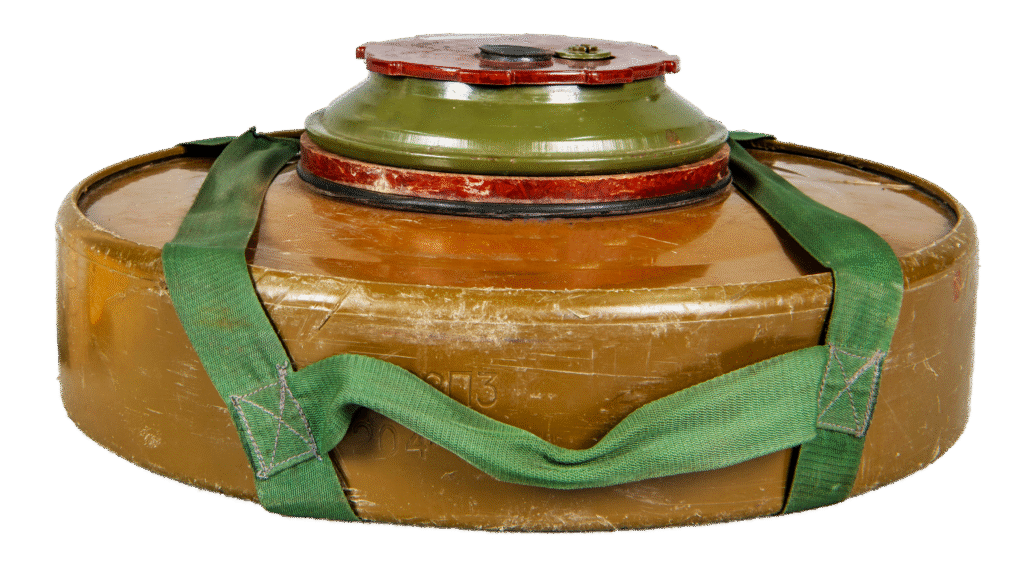
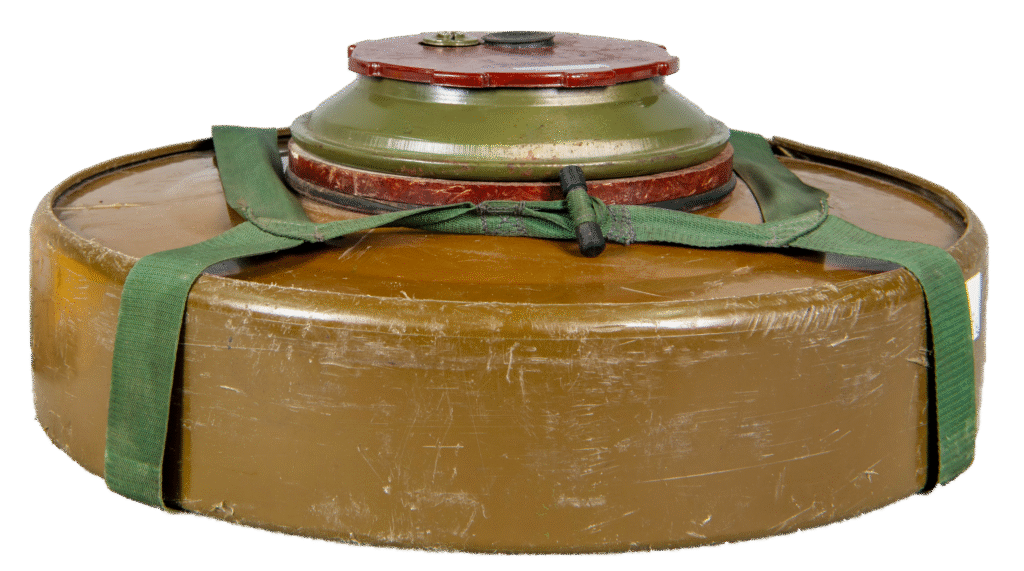
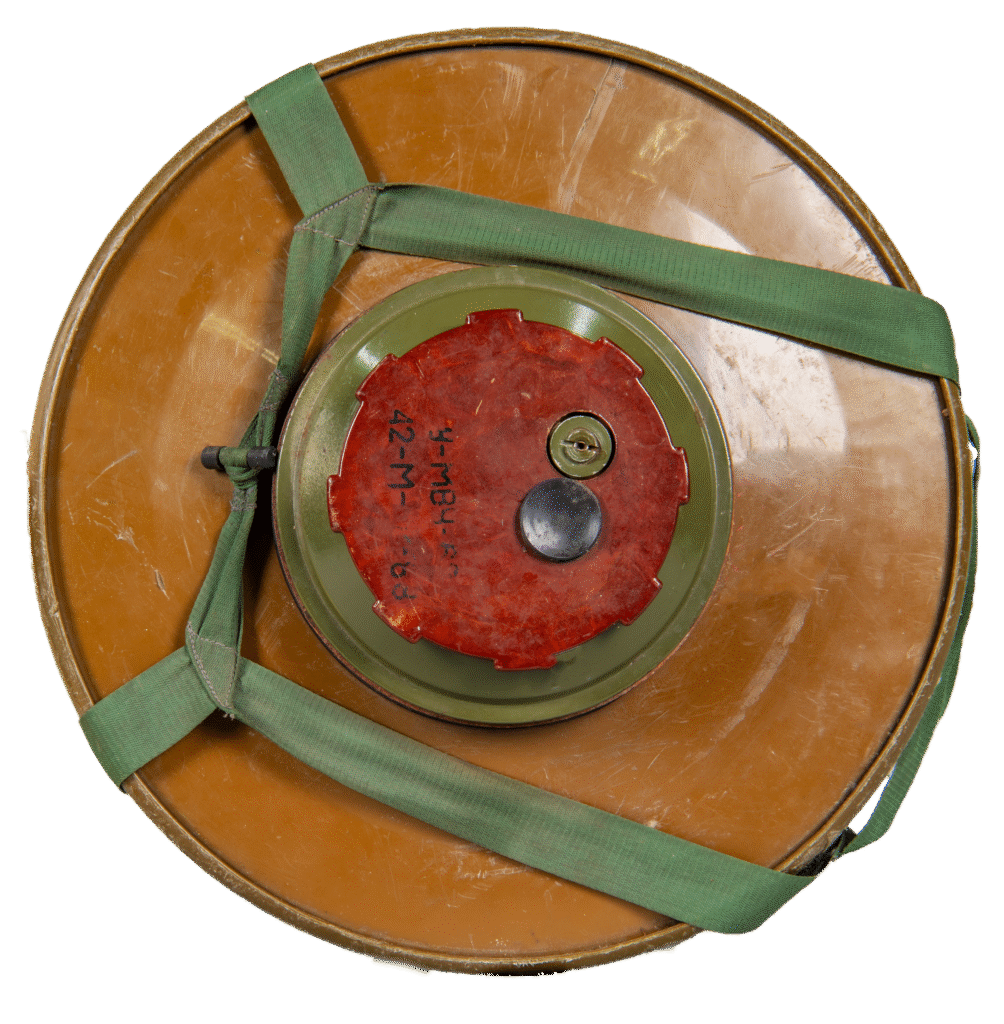
The TM-62P3 is a Soviet-designed anti-tank blast mine that represents a significant evolution in Soviet mine warfare technology. Part of the TM-62 series, this variant is specifically designed to work with the MVP-62M fuze, a highly sensitive magnetic influence fuze that makes it particularly effective against modern armored vehicles. The TM-62P3 is notable for its plastic construction, making it difficult to detect with traditional metal detectors, and its versatility in accepting multiple fuze types for different tactical situations.
Country/Bloc of Origin
- Country: Soviet Union (USSR)
- Development Period: 1960s-1970s
- International Production: Manufactured under license by various Warsaw Pact nations and exported widely to Soviet client states
- Current Operators: Still found in stockpiles and minefields across former Soviet states, Middle East, Africa, and Asia
Ordnance Class
- Type: Anti-Tank Blast Mine
- Primary Role: Anti-vehicular (designed to destroy or disable tracked and wheeled armored vehicles)
- Delivery Method: Hand-emplaced by combat engineers or specialized mine-laying teams
- Secondary Role: Area denial and defensive operations
Ordnance Family/Nomenclature
- Official Designation: TM-62P3 (Tankovaya Mina – Tank Mine, model 62, Plastic variant 3)
- Family Members:
- TM-62M (metal-cased variant)
- TM-62P (earlier plastic variant)
- TM-62P2 (improved plastic variant)
- TM-62P4 (variant with improved chemical resistance)
- TM-62D (wooden-cased variant for resource-limited situations)
- NATO Stock Number: Not assigned (Soviet ordnance)
- Common Names: “TM-62 Series,” sometimes simply called “TM-62” when specific variant is unclear
Hazards
Primary Hazards
CRITICAL WARNING: The TM-62P3 is an EXTREMELY DANGEROUS explosive device. All suspected mines should be treated as live and capable of detonation.
- Blast Hazard: Contains 7.5 kg of high explosive, sufficient to destroy or severely disable main battle tanks
- Fragmentation: While primarily a blast mine, the casing and surrounding soil create significant secondary fragmentation hazards
- Pressure Activation: Standard pressure fuzes activate at 150-300 kg of applied force
- Magnetic Influence: When fitted with MVP-62M fuze, can detonate from magnetic field changes caused by passing vehicles (no physical contact required)
Sensitivity Characteristics
- Pressure Sensitivity: Highly sensitive to vehicle pressure; generally safe from human foot traffic but should never be tested
- Magnetic Sensitivity: MVP-62M fuze responds to magnetic anomalies at distances up to 30 cm from mine
- Anti-Handling Devices: May be fitted with MVCh-62 tilt-rod anti-handling device or booby-trap attachments
- Environmental Stability: Plastic construction provides excellent resistance to moisture, temperature extremes, and aging
- Long-Term Hazard: Can remain functional for decades in field conditions
Kill/Danger Radius
- Direct Hit: Complete destruction of most armored vehicles
- Primary Danger Zone: 15-meter radius (lethal blast and fragmentation)
- Secondary Danger Zone: Up to 50 meters (injury from fragments and blast overpressure)
UXO Considerations
- Failure Rate: Low failure rate but deterioration of chemical components can make mines unstable
- Clearance Difficulty: Plastic body makes metal detection difficult; MVP-62M fuze requires specialized clearance procedures
- Booby-Trap Risk: Often rigged with anti-handling devices or stacked with secondary mines
Key Identification Features
Physical Dimensions
- Diameter: 320 mm (12.6 inches)
- Height: 110 mm (4.3 inches) without fuze; approximately 130 mm (5.1 inches) with MVP-62M fuze installed
- Weight: 9.5 kg (20.9 lbs) fully assembled with fuze
- Explosive Fill: 7.5 kg TNT or TNT/RDX composite
Visual Characteristics
Body Construction:
- Manufactured from olive-green or dark gray plastic (typically thermoplastic or rubber-modified plastic)
- Circular, disk-shaped profile with slightly domed top surface
- Flat bottom with recessed areas for stacking and transportation
- Ribbed or textured top surface to reduce slippage of camouflage materials
Distinctive Features:
- Large circular pressure plate on top surface (approximately 280 mm diameter)
- Central fuze well – circular opening in the center of the top surface (approximately 65 mm diameter)
- Six smaller auxiliary fuze wells arranged around the perimeter (can accommodate additional fuzes or anti-handling devices)
- Filling plug on the bottom (may be sealed with wax or tape)
- Molded or stamped markings indicating manufacture date, lot number, and variant designation
Color and Markings:
- Primary color: Olive drab, dark green, or gray
- Markings: Usually Cyrillic text indicating “TM-62P3” and manufacturing information
- Some examples may have painted or stenciled tactical markings
- Weathering can cause discoloration to lighter green or brown tones
Material Identification:
- Non-metallic construction (plastic/composite)
- Smooth or slightly textured surface finish
- May show molding seams or manufacturer’s marks
MVP-62M Fuze Identification
When installed, the MVP-62M fuze is visible in the central fuze well:
- Silver/metallic cylindrical body (approximately 60 mm diameter, 40-50 mm height)
- Distinctive copper-colored top cap with central arming mechanism
- May have safety pins or clips visible before arming
- Weathered examples may show corrosion on metal components
Fuzing Mechanisms
Primary Fuze: MVP-62M Magnetic Influence Fuze
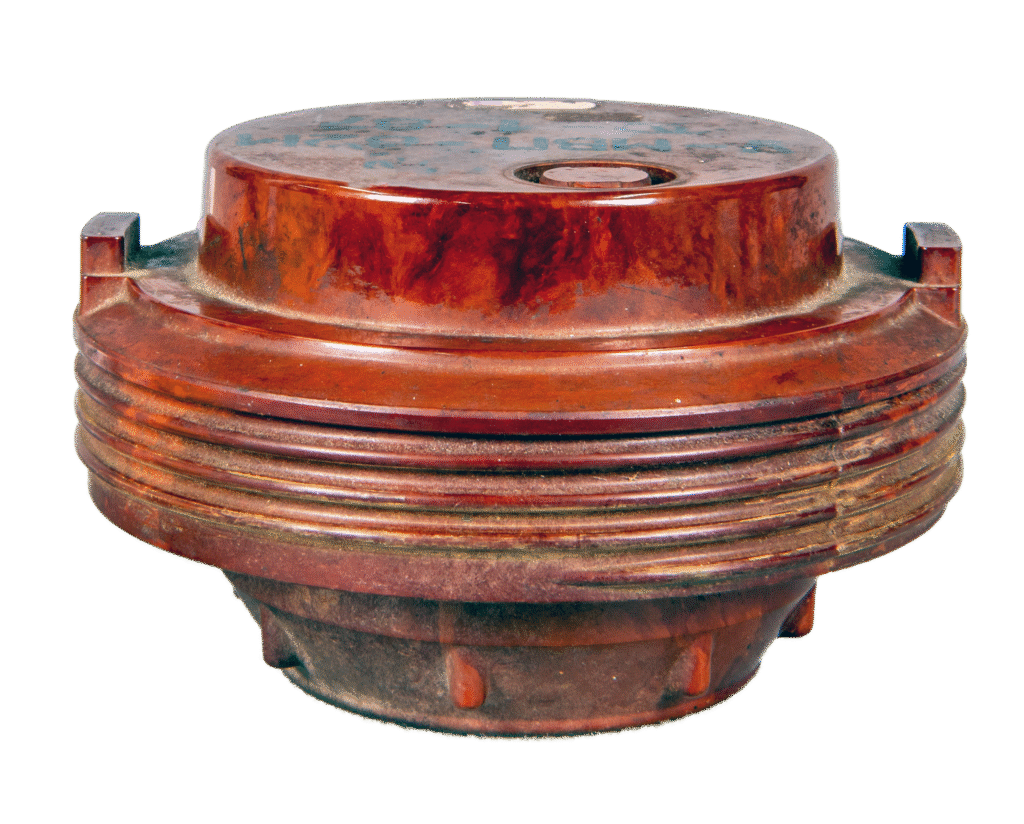
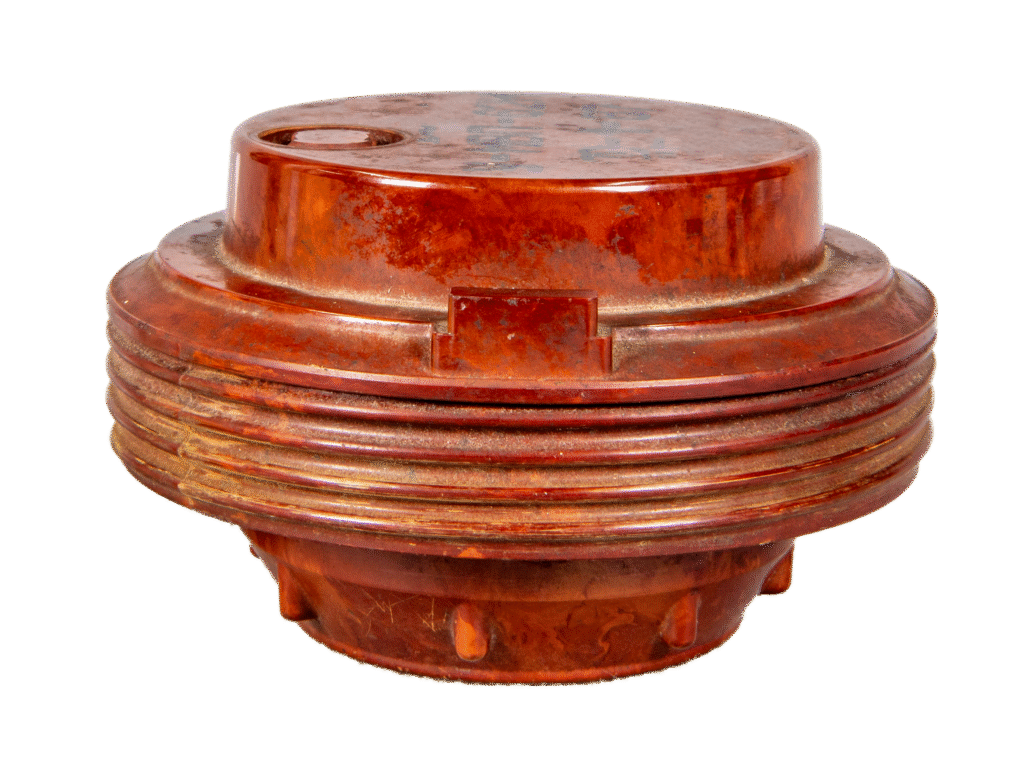
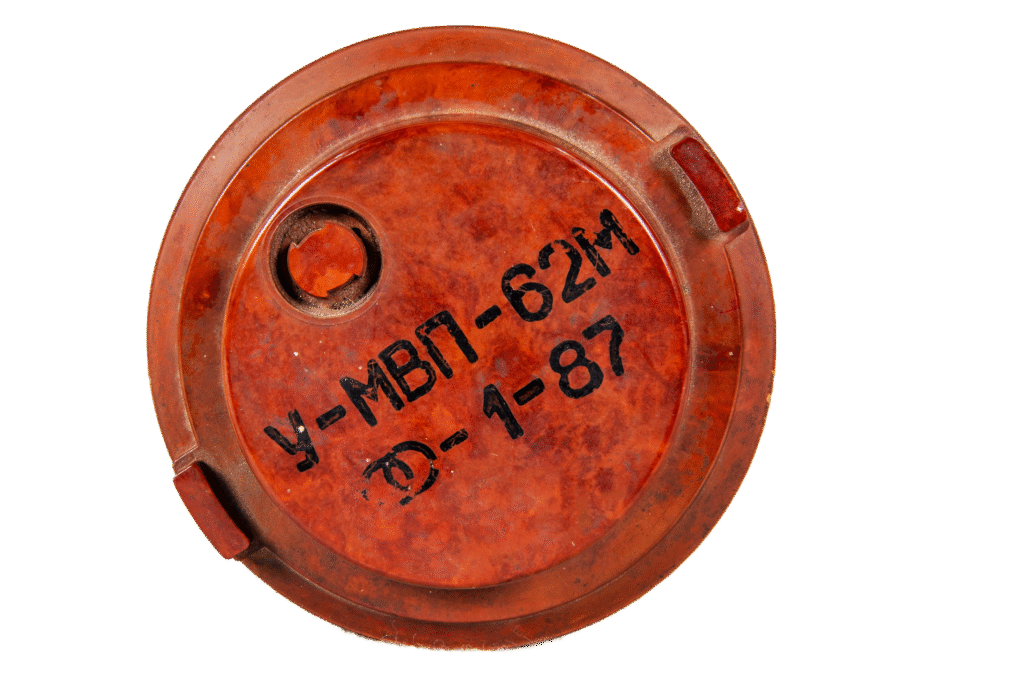
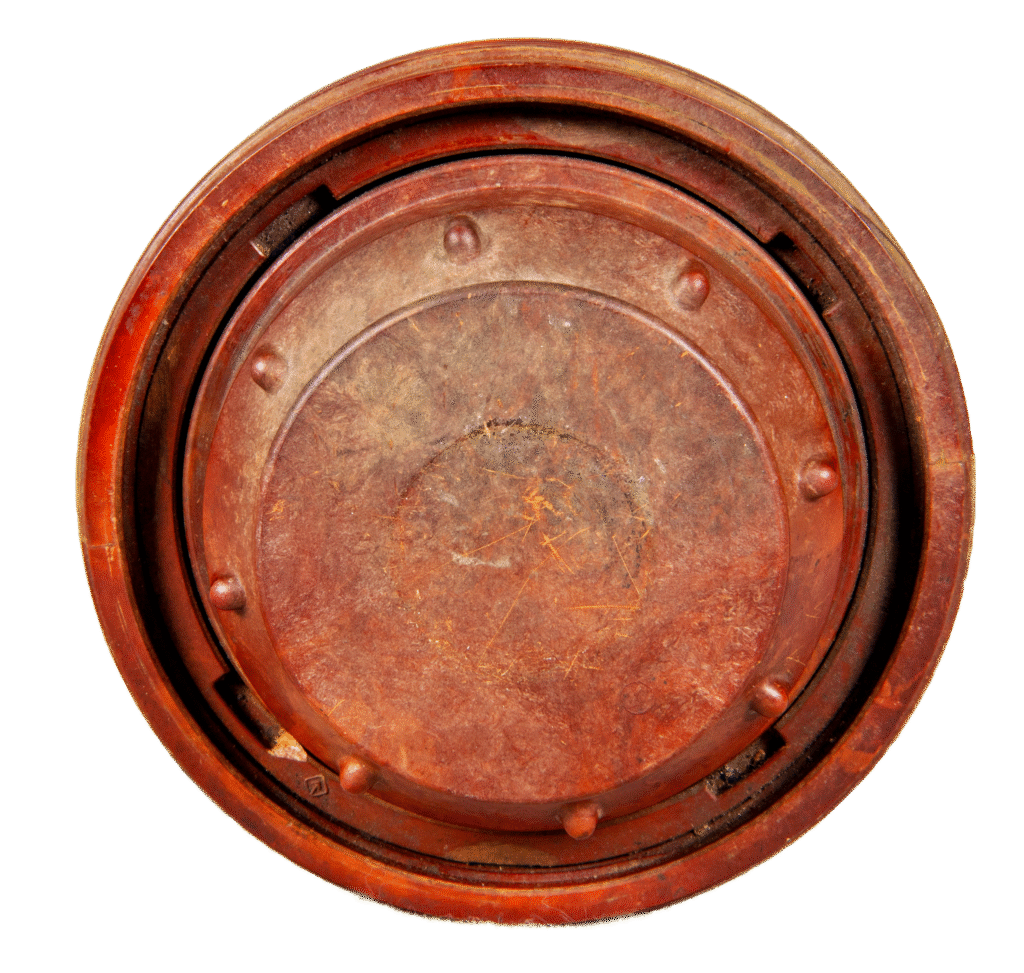
The MVP-62M (Magnetno-Vzryvatelnaya Podstavka – Magnetic Fuzing Platform) is a sophisticated influence fuze designed to detect changes in the Earth’s magnetic field caused by ferrous metal in passing vehicles.
Operating Principle:
- Contains a magnetic sensor (typically a magnetometer or magnetic needle suspended in fluid)
- Detects magnetic field distortion caused by vehicle’s metal chassis and engine block
- Does not require physical contact – functions as a proximity fuze
- Activation occurs when sufficient magnetic anomaly passes within detection range
Arming Sequence:
- Installation: Fuze is screwed into central fuze well of TM-62P3 body
- Safety Removal: Operator removes safety pin (often red-colored with metal ring)
- Time Delay: Self-arming delay of 15-20 minutes after safety pin removal
- Armed Status: After arming period, mine is fully active and will detonate when triggered
Triggering Mechanism:
- Detection Range: Typically responds to magnetic anomalies within 20-30 cm
- Selectivity: Can be adjusted (on some variants) to respond only to larger vehicles, reducing false positives from small equipment
- Response Time: Near-instantaneous detonation once threshold is exceeded
- No Self-Neutralization: Once armed, remains active indefinitely (no built-in self-destruct)
Advantages of Magnetic Influence Fuzing:
- Can detonate before vehicle makes contact, attacking vulnerable underbelly
- Multiple mines with MVP-62M fuzes can create “magnetic fence” where any passing vehicle triggers multiple mines
- Cannot be defeated by mine rollers or plows (vehicle passes over without contact)
- Effective against vehicles with mine protection kits
Vulnerabilities:
- Can be cleared by magnetic signature simulation devices
- Environmental magnetic anomalies (geological formations, other metallic debris) can cause false triggers or mask vehicle signatures
- Degaussed vehicles or those with reduced magnetic signatures are less likely to trigger
- Electronic countermeasures can interfere with sensor
Alternative Fuze Options
The TM-62P3 fuze well is compatible with multiple Soviet/Russian fuze types:
MV-62 Series (Pressure Fuzes):
- Standard mechanical pressure fuzes
- Activation pressure: 150-300 kg (vehicle weight)
- Simple, reliable, mechanical-only design
- No magnetic influence capability
MVN-80 (Pull Fuze):
- Can be installed with tripwire for alternative activation
- Less common in TM-62P3 applications
Anti-Handling Devices
The six auxiliary fuze wells can accommodate:
MVCh-62 (Tilt-Rod Anti-Handling Device):
- Vertical rod extending above mine (20-30 cm)
- Tilting rod activates mine, detonating on attempted removal or disturbance
- Designed to kill or injure mine clearance personnel
Secondary Pressure Fuzes:
- Additional MV-series fuzes in auxiliary wells
- Increases likelihood of detonation
- Makes clearance more dangerous
Booby-Trap Attachments:
- Pull-type igniters can be attached to surrounding objects
- Collapsing traps triggered by disturbance
History of Development and Use
Development Context
The TM-62 series was developed during the Cold War period (1960s-1970s) as Soviet military doctrine evolved to counter NATO’s armored capabilities. The development was driven by several factors:
Strategic Drivers:
- NATO Tank Threat: Western development of advanced main battle tanks (M60, Leopard 1, Chieftain) necessitated more effective anti-tank mines
- Metal Detector Proliferation: NATO mine clearance teams increasingly used metal detectors, prompting Soviet engineers to develop plastic-bodied mines
- Tactical Flexibility: Need for mines that could be rapidly deployed in various configurations
- Influence Fuzing Technology: Advances in electronics and magnetic sensors enabled non-contact detonation
Design Philosophy: The TM-62P3 specifically incorporated lessons learned from earlier mine programs:
- Plastic construction to defeat metal detectors while maintaining structural integrity
- Modular fuze system allowing tactical adaptation
- Large explosive charge sufficient to defeat increasingly well-armored vehicles
- Compatibility with multiple fuze types for different tactical scenarios
Chronological Development
1960s – Initial TM-62M:
- First TM-62 variant introduced with metal casing
- Established basic design parameters and explosive load
Early 1970s – TM-62P Introduction:
- Transition to plastic construction
- Initial plastic variants (TM-62P, TM-62P2) refined manufacturing techniques
Mid-to-Late 1970s – TM-62P3 Emerges:
- P3 variant improved chemical resistance and durability
- Enhanced compatibility with influence fuzes like MVP-62M
- Standardization across Warsaw Pact forces
1980s – Widespread Deployment:
- TM-62P3 became standard anti-tank mine throughout Soviet and Warsaw Pact forces
- Extensive use in defensive positions along Inner German Border
- Export to Soviet client states and allies worldwide
Combat Employment
Afghanistan (1979-1989):
- Extensively used by Soviet forces in defensive positions and road interdiction
- Mujahideen forces captured and re-employed examples against Soviet convoys
- Terrain and dispersed operations limited some tactical applications
Iran-Iraq War (1980-1988):
- Both sides employed TM-62 series mines in massive defensive minefields
- Magnetic fuze variants proved effective against armored formations
- Extensive minefields along borders remain hazardous decades later
Gulf War (1991):
- Iraqi forces employed TM-62P3 in defensive barriers in Kuwait and southern Iraq
- Coalition mine-clearing operations encountered significant numbers
- Breaching operations tested Western counter-mine capabilities
Balkans Conflicts (1990s):
- Used by various factions in Croatian, Bosnian, and Kosovo conflicts
- Long-term contamination of agricultural and residential areas
- Extensive post-conflict clearance operations continue
Chechen Wars (1994-1996, 1999-2009):
- Russian forces used in defensive positions and route security
- Chechen forces captured and employed against Russian armored vehicles
- Urban and mountainous terrain presented unique employment challenges
Ongoing Conflicts:
- Syria: Documented use by multiple parties in Syrian Civil War
- Ukraine: Reports of TM-62 series employment by separatist forces and in older defensive positions
- Nagorno-Karabakh: Armenian and Azerbaijani forces deployed in border minefields
Production and Distribution
Manufacturing:
- Primary production in Soviet Union at multiple munitions plants
- Licensed production by Warsaw Pact states (Poland, Czechoslovakia, Romania, Bulgaria)
- Estimated total production: Several million units across all TM-62 variants
Global Distribution:
- Supplied to over 50 nations during Cold War
- Extensive stockpiles remain in former Soviet republics
- Found in conflict zones across Middle East, Africa, Central Asia, and Southeast Asia
Current Status:
- Still in Active Service: Remains in arsenals of Russia, Belarus, and former Soviet states
- Obsolescent but Dangerous: While newer mine designs exist, TM-62P3 remains tactically viable
- Humanitarian Concern: Millions of TM-62 series mines remain in unmarked minefields globally
- Clearance Operations: Major demining efforts continue in former conflict zones
Impact on Warfare and Doctrine
Tactical Innovations:
- Demonstrated effectiveness of plastic mines against metal-detector-equipped clearance teams
- Validated magnetic influence fuzing as force-multiplier in anti-tank operations
- Influenced NATO counter-mine doctrine development
Arms Control Implications:
- TM-62 series not covered by 1997 Ottawa Treaty (which addresses anti-personnel mines)
- Anti-tank mines remain legal under international law with certain restrictions
- Extensive humanitarian impact drives ongoing clearance and advocacy efforts
Legacy:
- Design elements influenced subsequent Russian mine development (TM-72, TM-83, PTM-3)
- Western militaries developed countermeasures specifically addressing TM-62 capabilities
- Remains case study in mine warfare education and EOD training worldwide
Technical Specifications
Explosive Characteristics
- Main Charge: 7.5 kg TNT or TNT/RDX composite (specific formulation varies by manufacturer and production period)
- Explosive Type: Typically TNT (trinitrotoluene) or TNT/RDX mixture (50/50 or 60/40)
- Detonation Velocity: Approximately 6,900 m/s (TNT) or higher with RDX mixtures
- Blast Effect: Sufficient to penetrate 30-40mm of armor plate or disable track systems on main battle tanks
Physical and Environmental Specifications
- Operating Temperature Range: -40°C to +60°C (-40°F to +140°F)
- Storage Temperature: -50°C to +50°C (-58°F to +122°F)
- Humidity Resistance: Excellent due to plastic construction and sealed components
- Shelf Life: 15-20 years in controlled storage; indefinite in field conditions with proper environmental sealing
- Water Resistance: Can function after complete submersion; plastic body prevents corrosion
MVP-62M Fuze Specifications
- Power Source: Internal battery (typically silver oxide or mercury cell)
- Battery Life: 10-15 years under normal storage conditions
- Arming Delay: 15-20 minutes after safety pin removal
- Detection Range: 20-30 cm from mine surface (varies with vehicle magnetic signature and soil conditions)
- Sensitivity Adjustment: Some variants include sensitivity controls (high/low settings)
- Self-Destruct Mechanism: None – remains active indefinitely once armed
Deployment Specifications
- Emplacement Time: 5-10 minutes per mine for trained personnel
- Recommended Spacing: 4-8 meters in anti-tank minefields (density varies by tactical situation)
- Emplacement Depth: Typically buried 5-10 cm below surface with pressure plate flush or slightly below grade
- Minefield Density: Standard Soviet doctrine: 0.5-1.0 mines per meter of front in main defensive belt
Logistical Data
- Packaging: Typically shipped in wooden crates containing 6-8 mines
- Transportation Weight: Approximately 11-12 kg per mine in protective packaging
- Shelf Storage: Requires climate-controlled ammunition storage facilities
- Field Storage: Can be stored in field conditions but requires protection from direct sunlight and extreme temperatures
Frequently Asked Questions
Q: What makes the TM-62P3 with MVP-62M fuze particularly dangerous compared to other anti-tank mines?
A: The combination creates a uniquely challenging threat for several reasons. First, the plastic body makes it extremely difficult to detect with standard metal detectors – only the small metal fuze components provide a detection signature. Second, the MVP-62M magnetic influence fuze allows the mine to detonate without physical contact, meaning traditional mine-clearing equipment like rollers and plows are ineffective. The mine can sense a vehicle’s magnetic signature 20-30 cm away and detonate before the vehicle makes contact, attacking the vulnerable underbelly. Finally, the large 7.5 kg explosive charge is sufficient to destroy or mission-kill even heavily armored vehicles. This combination of difficult detection, contact-free detonation, and devastating blast makes it one of the most effective anti-tank mines ever developed.
Q: Can the MVP-62M fuze be defeated by degaussing a vehicle or reducing its magnetic signature?
A: Theoretically, yes, but with significant practical limitations. Degaussing (neutralizing a vehicle’s magnetic field) or using magnetic signature reduction techniques can reduce the likelihood of triggering the MVP-62M fuze. Some modern military vehicles incorporate passive magnetic reduction features. However, completely eliminating a large armored vehicle’s magnetic signature is nearly impossible – the sheer mass of ferrous metal in the engine, chassis, and armor creates an unavoidable magnetic disturbance. Additionally, degaussing procedures are time-consuming and effects are temporary, making this impractical for extended operations. The most effective counter-measure remains route clearance with specialized mine-detection equipment that can identify the mine’s presence before a vehicle approaches, combined with controlled detonation or manual removal by EOD personnel.
Q: Why does the TM-62P3 have six auxiliary fuze wells in addition to the central well?
A: The auxiliary fuze wells serve multiple tactical purposes. First, they allow the mine to be fitted with anti-handling devices like the MVCh-62 tilt-rod fuze, which detonates the mine if someone attempts to remove or disturb it during clearance operations. This dramatically increases the danger to mine clearance teams. Second, additional pressure fuzes can be installed in the auxiliary wells to increase the probability of detonation – if the primary MVP-62M fuze fails or the vehicle’s magnetic signature is insufficient, the additional pressure fuzes provide redundancy. Third, the wells can accommodate booby-trap devices connected by wires or pulls to surrounding objects, creating a more complex minefield where any disturbance might trigger multiple mines. This modular design reflects Soviet doctrine of creating highly redundant, difficult-to-clear minefields that require significant time and resources to breach.
Q: How do mine clearance teams safely deal with a TM-62P3 fitted with an MVP-62M fuze?
A: Clearance of this mine configuration is extremely hazardous and requires specialized training and equipment. The process typically involves: (1) Detection using ground-penetrating radar or advanced metal detectors capable of finding the small metal fuze components, (2) Remote probing to confirm the mine type and fuze configuration without approaching it, (3) If MVP-62M is confirmed, EOD personnel must assess for anti-handling devices and booby traps, (4) Clearance can proceed via controlled detonation in place (safest method) using explosive charges placed remotely, or (5) If the mine must be recovered intact, specialized tools can neutralize the fuze using remote manipulation or by carefully extracting the fuze after confirming no anti-handling devices are present. In practice, most TM-62P3 mines with MVP-62M fuzes are destroyed in place rather than manually removed due to the extreme risk. Modern clearance often employs robotic systems and blast-resistant vehicles to reduce personnel exposure.
Q: Is the TM-62P3 considered a “smart” mine, and does it have any self-destruct capabilities?
A: The TM-62P3 with MVP-62M is often called a “semi-smart” mine due to its magnetic influence sensing capability, but it lacks true smart mine features. While the magnetic fuze provides a degree of target discrimination (it responds to large ferrous metal masses like vehicles but not to personnel or small equipment), it does not have sophisticated friend-or-foe identification, programmable activation periods, or communication capabilities found in modern smart mines. Critically, it has NO self-destruct or self-neutralization mechanism – once armed, it remains dangerous indefinitely. This is a major humanitarian concern, as these mines can remain active and lethal for decades after a conflict ends. The battery powering the MVP-62M fuze may eventually fail after 10-15+ years, but the mine can still function with alternate pressure fuzes, and a depleted battery does not make the mine safe. This lack of self-destruct capability is one reason why extensive demining operations are necessary in former Soviet conflict zones.
Q: What historical factors led to the development of plastic-bodied mines like the TM-62P3?
A: The shift to plastic construction in the TM-62 series was driven by the escalating cat-and-mouse game between mine deployment and mine detection during the Cold War. By the 1960s, NATO forces had widely adopted portable metal detectors for mine clearance operations, making traditional all-metal mines increasingly vulnerable to detection and removal. Soviet military engineers recognized that reducing the metal content would dramatically complicate enemy clearance efforts while maintaining the mine’s effectiveness. The TM-62P3’s plastic body meant that only the small fuze assembly contained significant metal, reducing the detection signature by roughly 90% compared to all-metal mines. This development forced NATO to invest in more sophisticated detection technologies like ground-penetrating radar and prompted changes in doctrine that emphasized slower, more deliberate breaching operations. The success of plastic-bodied mines also influenced international humanitarian discussions, as they were harder for post-conflict demining efforts to locate. This evolutionary pressure between mine design and counter-mine technology continues to shape modern mine warfare.
Q: If a TM-62P3 has been in the ground for 20-30 years, does it become safer or more dangerous over time?
A: Paradoxically, aged mines can be BOTH less reliable AND more dangerous. On one hand, the plastic body and sealed construction provide excellent protection against environmental degradation, meaning the main explosive charge can remain fully functional for decades. The explosive compounds (TNT/RDX) are chemically stable and resist decomposition. However, the MVP-62M fuze’s battery will eventually deplete after 10-20 years, potentially rendering the magnetic influence capability inactive. Despite this, the mine can still function with any auxiliary pressure fuzes that may have been installed, and the primary explosive charge remains potent. More concerning, aged mines may become LESS predictable – seals may degrade allowing moisture infiltration, plastic can become brittle in extreme temperatures, and any anti-handling devices may become unstable. Corrosion of the metal fuze components can cause unpredictable sensitivity. For these reasons, demining experts consider old minefields potentially MORE dangerous than newly-laid ones, as the mines may function erratically or detonate from disturbances that wouldn’t have triggered a new mine. This is why professional EOD personnel approach all suspected ordnance with maximum caution regardless of age.
Q: How does the TM-62P3 compare to modern Western anti-tank mines in terms of capability and effectiveness?
A: The TM-62P3 remains highly competitive with many modern Western anti-tank mine designs, though some newer systems offer additional features. Compared to mines like the U.S. M15 or German DM31, the TM-62P3 has a comparable or larger explosive charge (7.5 kg vs. 10.3 kg for M15 or 9.2 kg for DM31), ensuring similar destructive capability. The plastic construction matches or exceeds Western equivalents in terms of detection resistance. The MVP-62M magnetic influence fuze was actually ahead of its time when developed, and similar systems were later adopted in Western mines. However, modern Western designs often incorporate features the TM-62P3 lacks: electronic fuzes with selectable settings, self-destruct/self-neutralization mechanisms (important for humanitarian compliance), remote arming/disarming capabilities, and sophisticated target discrimination. The TM-62P3’s lack of smart features means it remains active indefinitely, creating long-term humanitarian hazards. Nevertheless, in terms of pure destructive effectiveness and detection resistance, it remains a formidable weapon that poses serious challenges to armored forces. Its continued presence in global stockpiles and minefields means military forces must still train extensively on defeating TM-62 series mines decades after their introduction.
Safety Warning
This document is for educational and identification purposes only. All grenades and explosive ordnance are extremely dangerous and should only be handled by trained military personnel or explosive ordnance disposal (EOD) specialists. Unexploded ordnance (UXO) can remain lethal for decades and may be unstable. If you encounter suspected ordnance, do not touch it—mark the location, evacuate the area, and contact military or law enforcement authorities immediately.
The information presented here is intended for military professionals, historians, collectors (handling inert training replicas only), and educational purposes. Never attempt to disarm, modify, or handle live ordnance.