122mm OF-462 High-Explosive Projectile
Overview
The OF-462 is a Soviet-designed 122mm high-explosive fragmentation artillery projectile that has served as one of the most widely produced and distributed artillery rounds in history. Developed for the ubiquitous D-30 howitzer and its variants, the OF-462 represents the classic Soviet approach to artillery ammunition: reliable, effective, mass-producible, and simple to employ. This projectile has been used in virtually every major conflict since the 1960s and remains in active service with dozens of armies worldwide. Its widespread availability and proven effectiveness have made it a cornerstone of artillery operations for both conventional armies and irregular forces.
Country/Bloc of Origin
- Country: Soviet Union (USSR)
- Development Period: Late 1950s to early 1960s
- Current Users: Russia, former Soviet republics, China, Middle Eastern nations, African countries, Asian nations—over 60 countries total
- Licensed Production: China (as Type 86 HE), Egypt, Iran, Iraq, North Korea, and numerous other countries
- Current Status: Widely active in service; one of the most common artillery projectiles globally
Ordnance Class
- Type: Artillery Ammunition – Projectile
- Primary Role: High-Explosive Fragmentation (HE-FRAG) for area targets
- Secondary Roles:
- Suppression of enemy positions
- Counter-battery fire
- Destruction of light fortifications
- Anti-personnel effects
- Delivery Method: Tube artillery, indirect fire
- Caliber: 122mm (4.8 inches)
- Launch Platform:
- D-30 2A18 towed howitzer (primary)
- 2S1 Gvozdika self-propelled howitzer
- Various upgraded 122mm systems
Ordnance Family/Nomenclature
Official Designations
- Primary: OF-462 (ОФ-462 in Cyrillic)
- GRAU Index: 3OF56 (complete round with standard propellant charge)
- Alternative Index: OF-462Zh (earlier variant)
- NATO Reporting: 122mm HE-FRAG
Related Variants and Family Members
Direct Variants:
- OF-462N: Improved variant with refined manufacturing
- OF-462Zh: Earlier production version
- OF-462G: Modified base for improved ballistics
- OF-462U: Training/practice variant (inert fill)
Chinese Equivalents:
- Type 86 HE: Chinese-manufactured copy
- Type 86A: Improved Chinese variant
Related 122mm Rounds:
- 3OF6: Older HE-FRAG with different ballistics
- OF-471: Rocket-assisted projectile
- 3OF27: Reduced range practice round
- 3SH1: Cargo projectile with submunitions
- 3SH2: Illumination round
Common Names and Nicknames
- “Standard HE” (most common reference)
- “Base HE-FRAG” (technical designation)
- Simply “OF round” in Russian service
- “122 HE” in generic reference
Hazards
Primary Hazard Categories
1. Blast Overpressure
- Explosive Fill: 3.6-3.8 kg of TNT or equivalent
- Lethal Blast Radius: 10-15 meters from point of detonation
- Serious Injury Radius: 20-30 meters
- Overpressure Effects: Can cause lung damage, eardrum rupture, and internal injuries
- Enhanced Effects in Enclosed Spaces: Overpressure amplified in bunkers, rooms, trenches
2. Fragmentation Effects (Primary Casualty Mechanism)
- Fragment Count: Approximately 1,500-2,500 lethal fragments
- Fragment Weight Range: 0.3-20 grams (majority 2-8 grams)
- Initial Velocity: 1,200-1,600 m/s
- Lethal Fragment Radius: 30-40 meters
- Maximum Fragment Range: 300+ meters
- Fragment Density: High density pattern within 50 meters
- Penetration: Can penetrate body armor, light vehicles, and thin walls
3. Unexploded Ordnance (UXO) Hazards
- Typical Failure Rate: 3-8% depending on conditions and age
- Fuze Sensitivity: Can become more sensitive over time
- Long-term Stability: Remains hazardous for decades
- Environmental Degradation: Corrosion can expose explosive fill
- Secondary Explosion Risk: Can detonate sympathetically from nearby explosions
4. Ground Impact Hazards
- Cratering: Creates crater 0.5-1.5 meters deep, 2-4 meters diameter
- Shrapnel Throw: Debris and soil ejected with high velocity
- Ricochet Potential: May skip on hard surfaces before detonation
- Buried UXO: Can be buried by impact, creating hidden hazard
5. Handling and Storage Hazards
- Fuze Sensitivity: Requires careful handling when fuzed
- Propellant Hazards: Separate charges can ignite if damaged
- Sympathetic Detonation: Improper stacking can cause chain reactions
- Temperature Sensitivity: Explosive stability decreases at temperature extremes
- Chemical Degradation: TNT can “sweat” nitroglycerin in extreme heat
Safety Protocols
Minimum Safe Distances:
- General Personnel: 200 meters from known UXO
- EOD Approach: 300+ meters until threat assessment complete
- Fragmentation Cover: Requires substantial barriers (concrete, earth, armored vehicles)
UXO Response:
- Do not approach or disturb
- Mark location clearly from safe distance
- Establish 300-meter exclusion zone
- Report to military/police authorities immediately
- Await professional EOD team
Critical Warning: OF-462 projectiles remain fully lethal indefinitely. Age does not make them safer—degradation often increases sensitivity.
Key Identification Features
Physical Dimensions
- Overall Length: 640mm (25.2 inches)
- Body Diameter: 122mm (4.8 inches)
- Total Weight: 21.8 kg (48 lbs) complete projectile
- Explosive Fill Weight: 3.6-3.8 kg (7.9-8.4 lbs)
- Projectile Body Weight: Approximately 18 kg (without fuze)
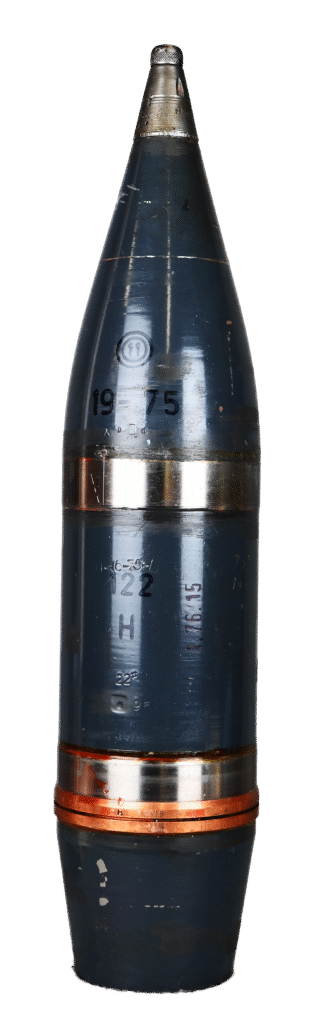
Visual Identification Characteristics
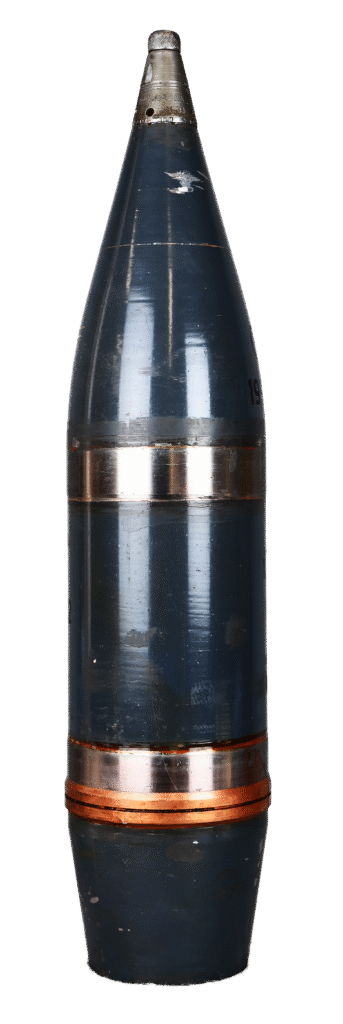
Body Profile:
- Nose: Ogival (pointed) nose with smooth curve
- Body: Cylindrical main section with consistent diameter
- Boattail: Tapered rear section for improved aerodynamics
- Fuze Well: Threaded cavity at nose for point-detonating fuze
- Driving Band: Copper or copper-alloy band near base
Color Schemes (Standard Marking):
Soviet/Russian Standard:
- Olive drab or dark gray body paint
- Two yellow bands indicating HE content
- White or black stenciled markings
- Red fuze well (when empty) or fuze painted red
Alternative Schemes:
- Light gray (later production)
- Dark green (some manufacturers)
- Unpainted with protective coating (storage/export)
Surface Features:
- Relatively smooth body (no pre-formed fragmentation)
- May show machining marks
- Driving band has pre-cut grooves for rifling engagement
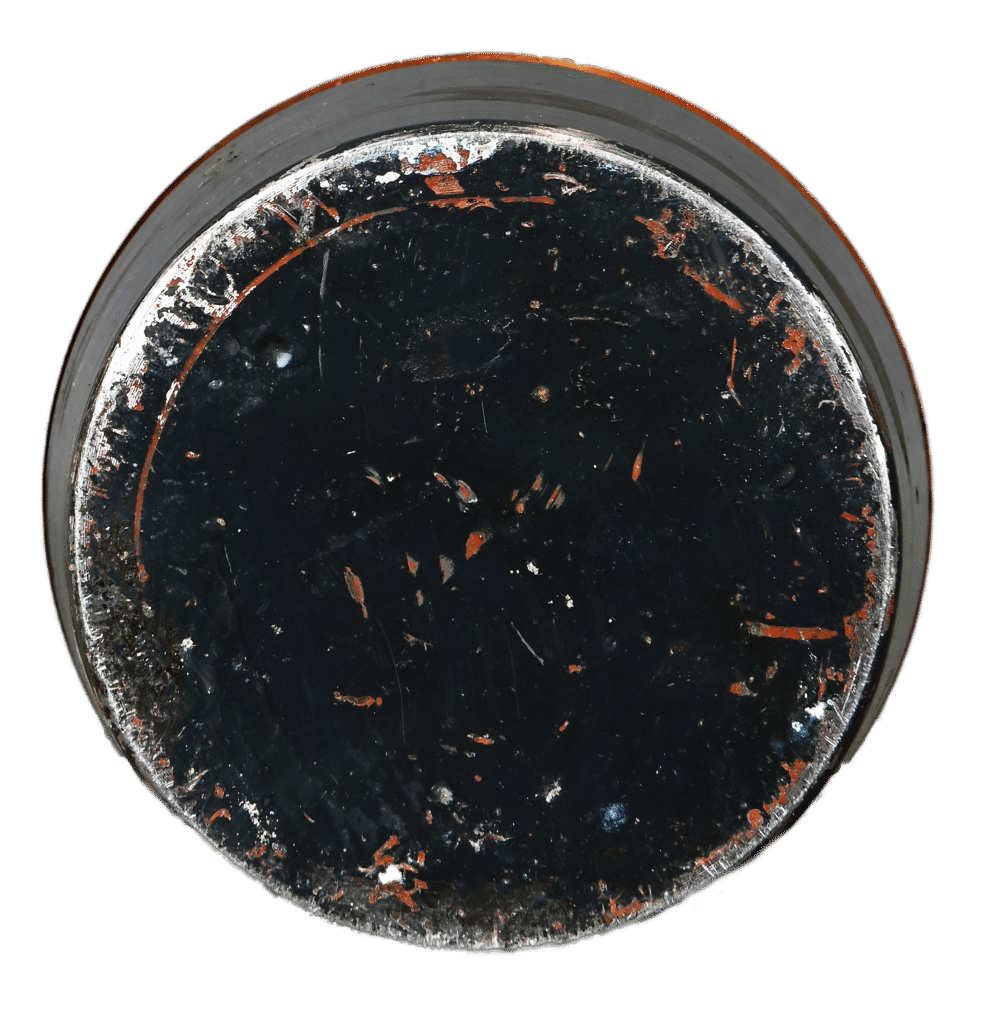
- Base may have gas check plate or sealing plug
Markings and Stenciling:
Located on body, typically includes:
- “ОФ-462” or “OF-462” designation
- Lot number (format varies by manufacturer)
- Year of manufacture (often 2-digit: 75, 88, 03, etc.)
- Factory code or symbol
- Explosive type marking (“TNT” or Cyrillic equivalent)
- Weight markings
- Warning symbols
Material Composition
- Body: High-strength steel (typically medium-carbon steel)
- Driving Band: Copper or copper-lead alloy
- Fuze: Brass/steel components (when installed)
- Explosive Fill: TNT, Amatol, or TNT/RDX compositions
- Base Plug: Steel with tracer cavity (if equipped)
Condition Indicators
New/Good Condition:
- Paint intact with clear markings
- No rust or corrosion
- Driving band undamaged
- Fuze threads clean
Aged/Poor Condition:
- Heavy rust or paint loss
- Corroded driving band
- Stenciled markings faded
- Possible explosive “sweating” (crystalline residue)
- Damaged threads
UXO Indicators:
- Fuze still installed
- Impact damage to nose or body
- Embedded in soil/structures
- May be partially buried
- Driving band shows rifling marks (fired round)
Fuze Configuration
When fuzed, typically shows:
- Fuze protruding from nose
- Fuze safety pin (if not removed for firing)
- Fuze marking band (color-coded)
- Setting ring (if delay fuze)
Fuzing Mechanisms
The OF-462 can be fitted with various fuze types depending on mission requirements. Soviet/Russian doctrine provides multiple fuze options to enable tactical flexibility.
Primary Fuze Types
1. V-429 Point-Detonating Fuze (Most Common)
Function:
- Superquick point-detonating (PD) fuze
- Impact-activated
- Direct-action percussion mechanism
Arming Sequence:
- Setback force during firing drives arming sleeve rearward
- Centrifugal force from projectile spin releases safety mechanisms
- Fuze fully armed after approximately 2-4 seconds of flight (150-300 meters)
- Multiple redundant safeties prevent premature function
Safety Features:
- Bore safety: prevents function until projectile clears muzzle
- Setback safety: requires minimum acceleration
- Centrifugal safety: requires minimum rotational velocity (spin)
- Detonator out-of-line until armed
- Interrupted thread safety in earlier variants
Operation:
- Upon impact, firing pin drives forward into detonator
- Initiates explosive train through booster
- Functions on contact with ground, structures, or soft targets
- Designed to function even on oblique impacts
2. V-90 Mechanically-Timed Fuze
Function:
- Mechanical clockwork time fuze
- Pre-set before firing for airburst capability
- Used for anti-personnel effects over open terrain or dug-in troops
Setting Process:
- Graduated time scale on fuze body (typically 0-50 seconds)
- Set using fuze wrench to desired time of flight
- Time correlated to range using firing tables
- Must account for charge temperature and meteorological data
Arming:
- Setback and centrifugal safeties similar to V-429
- Clockwork mechanism begins timing after arming
- Functions in air at preset time, regardless of impact
Use Cases:
- Engaging troops in trenches or foxholes
- Defeating overhead cover
- Creating airbursts over open terrain
3. V-119 Delay Fuze
Function:
- Point-detonating fuze with optional delay
- 0.05-0.15 second delay after impact
- Allows penetration before detonation
Applications:
- Penetrating light fortifications
- Enhanced effects against structures
- Bunker engagement
- Defeating sandbag emplacements
Mechanism:
- Delay element (powder train) ignites on impact
- Projectile penetrates target during delay
- Detonates inside structure for maximum effect
4. Proximity Fuze (V-90P – Limited Use)
Function:
- Radio frequency (RF) proximity fuze
- Detonates at predetermined height above ground
- Rarely issued for OF-462 due to cost
Technology:
- Doppler radar sensing
- Battery-powered electronics
- Preset burst height (typically 5-15 meters)
Advantages:
- Optimal fragmentation pattern
- Defeats cover and concealment
- No ricochet or duds
Fuze Selection Doctrine
Typical Employment:
- Point Targets: V-429 (superquick PD)
- Area Targets: V-90 (time fuze for airburst)
- Fortifications: V-119 (delay)
- Mixed Targets: Combination of fuze types in fire mission
Fuze Installation
- Fuzes stored and transported separately
- Installed immediately before loading
- Requires fuze wrench for proper installation
- Safety pins remain in place until final fire command
- Incorrect installation can cause misfires or premature function
Self-Destruct and Anti-Disturbance Features
Important Note: Standard OF-462 fuzes do NOT include:
- Self-destruct mechanisms
- Self-neutralization features
- Anti-handling devices (except specialized variants)
Implications:
- UXO remains hazardous indefinitely
- No automatic safety after landing
- Manual clearance required for unexploded rounds
History of Development and Use
Genesis and Development (1958-1963)
The OF-462 emerged from a Soviet artillery modernization program in the late 1950s. The introduction of the D-30 2A18 122mm howitzer in 1960 required a complementary ammunition suite optimized for its capabilities.
Design Goals:
- Improved fragmentation over older 122mm projectiles
- Standardized production across Soviet manufacturing base
- Compatibility with both towed and self-propelled platforms
- Balance of range, lethality, and cost-effectiveness
- Simplified logistics through design standardization
Development Challenges:
- Optimizing fragmentation pattern without pre-formed fragments
- Achieving consistent ballistics across temperature ranges
- Maintaining structural integrity during high-stress gun launch
- Minimizing production costs for mass manufacture
Technical Innovations:
- Refined body design for improved fragmentation distribution
- Optimized boattail for extended range
- Enhanced driving band design for consistent engagement
- Improved explosive fill formulations for stability
Production History
Soviet Production (1963-1991):
- Multiple factories across USSR
- Production volumes: millions of rounds annually at peak
- Export production for Warsaw Pact and client states
- Continuous minor improvements in manufacturing
Post-Soviet Production (1991-Present):
- Continued Russian production
- Manufacturing in Ukraine, Belarus, Bulgaria
- Licensed production worldwide
International Manufacturing:
- China: Mass production as Type 86, likely largest current producer
- Egypt: Licensed production for domestic use and export
- Iran: Domestic production program since 1980s
- Iraq: Production until 2003
- North Korea: Significant production capabilities
- Pakistan: Production for domestic artillery
- India: Production for 122mm systems
Estimated Total Production: Conservative estimates suggest 50-100+ million rounds produced globally since 1963, making it one of the most manufactured artillery projectiles in history.
Combat History and Employment
Vietnam War (1960s-1970s):
- Supplied to North Vietnamese and Viet Cong forces
- Used extensively against U.S. and South Vietnamese positions
- Demonstrated effectiveness in jungle warfare
- Established reputation for reliability
Arab-Israeli Conflicts:
- 1967 Six-Day War: Used by Egyptian and Syrian forces
- 1973 Yom Kippur War: Massive employment by Arab armies
- 1982 Lebanon War: Continued use by Syrian and PLO forces
- Proved effective but accuracy limitations noted
Soviet-Afghan War (1979-1989):
- Extensively used by Soviet forces
- Effective in mountain warfare for suppression
- Used for counter-fire and defensive fire missions
- Challenges with spotting in mountainous terrain
Iran-Iraq War (1980-1988):
- Massive consumption by both sides
- Used in static warfare reminiscent of WWI
- Iran received supplies from multiple sources
- Iraq employed domestically-produced variants
Post-Cold War Conflicts:
Former Yugoslavia (1991-1999):
- All factions employed OF-462 or variants
- Extensive use in siege warfare (Sarajevo, Vukovar)
- Significant civilian casualties from artillery
Chechen Wars (1994-1996, 1999-2009):
- Heavy Russian employment
- Urban combat applications
- Precision challenges in built-up areas
Iraq War (2003-2011):
- Used by Iraqi forces pre-invasion
- Later employed by insurgent groups
- Significant UXO problem post-conflict
Syrian Civil War (2011-Present):
- All major factions use OF-462 or equivalents
- Extensive urban employment
- Massive humanitarian impact
- Chinese and Iranian production prominent
Nagorno-Karabakh Conflicts:
- 1990s conflict and 2020 war
- Both Armenian and Azerbaijani use
- Demonstrated vulnerability to counter-battery fire
Ukraine Conflict (2014-Present):
- Massive employment by both sides
- Hundreds of thousands of rounds fired
- UXO contamination major issue
- Mix of Soviet-era and recent production
Tactical Evolution and Lessons Learned
Strengths Identified:
- Reliable function across diverse conditions
- Adequate lethality for most targets
- Simple logistics and employment
- Compatible with simple fire control systems
- Effective suppression capability
Limitations Recognized:
- Accuracy limited compared to guided munitions
- Requires multiple rounds for effect on point targets
- Vulnerable to counter-battery radar
- Limited penetration against hardened structures
- Weather significantly affects accuracy
Modern Context:
- Remains relevant despite precision munition advances
- Cost-effectiveness for area targets
- Mass fires doctrine still employed by many armies
- UXO contamination significant humanitarian challenge
- Arms control implications in some conflicts
Current Status (2025)
Active Service: Remains in frontline service with:
- Russian Armed Forces (massive stockpiles)
- Chinese PLA (Type 86 variant)
- Indian Army
- Middle Eastern militaries (Syria, Iran, Egypt, etc.)
- African nations (Angola, Ethiopia, etc.)
- Asian countries (Vietnam, North Korea, Myanmar, etc.)
Stockpiles: Enormous quantities stored worldwide:
- Russian stockpiles: millions of rounds
- Chinese reserves: likely largest stockpiles
- Former Soviet states: substantial holdings
- Various client states: thousands to millions of rounds each
Replacement Programs:
- Russia developing more advanced 122mm rounds
- Some nations transitioning to guided munitions
- However, OF-462 production continues due to cost and simplicity
- Likely to remain in service for decades
Arms Transfer:
- Continues to be supplied in regional conflicts
- Subject to various arms embargoes
- Diverted to non-state actors in some cases
- Significant black market availability in conflict zones
Technical Specifications
Ballistic Performance
Muzzle Velocity:
- Maximum charge: 690 m/s (2,264 ft/s)
- Reduced charges: 270-550 m/s depending on charge selection
Maximum Range:
- D-30 howitzer: 15,300 meters (standard charge)
- D-30 howitzer: 21,900 meters (maximum charge, elevated wear)
- 2S1 Gvozdika: Similar performance
Minimum Safe Range:
- Typically 1,000-1,500 meters (fuze arming distance and safety)
Time of Flight:
- Maximum range: approximately 60-70 seconds
- Mid-range (10 km): approximately 35-40 seconds
Trajectory:
- High-angle fire: 45-70 degrees elevation
- Can engage defilade targets
- Plunging fire enhances effects on trenches
Accuracy (Circular Error Probable – CEP):
- Approximately 1% of range (well-maintained gun, good conditions)
- 150-meter CEP at 15 km typical
- Degrades with barrel wear, propellant age, meteorological factors
Terminal Velocity:
- Approximately 250-400 m/s at impact (varies with range and trajectory)
Explosive and Fragmentation Characteristics
Explosive Fill:
- Type: TNT (most common), Amatol, or TNT/RDX blends
- Weight: 3.6-3.8 kg
- Detonation Velocity: 6,900 m/s (TNT)
Fragmentation Pattern:
- Natural Fragmentation: Body designed to fragment predictably
- Fragment Distribution: Roughly circular pattern with forward bias
- Fragment Count: 1,500-2,500 lethal fragments
- Fragment Velocities: 1,200-1,600 m/s initial
- Fragment Mass Distribution:
- Light fragments (0.3-2g): 40%
- Medium fragments (2-8g): 45%
- Heavy fragments (8-20g): 15%
Casualty Radius:
- Lethal Radius (50% probability of kill): 20-25 meters
- Effective Casualty Radius: 30-40 meters
- Maximum Fragment Range: 300+ meters
- Suppression Radius: 50-75 meters (troops seek cover)
Penetration Capabilities:
- Light vehicle armor: Up to 10mm at close range (fragments)
- Sandbag walls: Partial penetration, effective blast transfer
- Wooden structures: Significant damage
- Concrete: Surface damage only, effective blast in rooms
- Body armor: Can defeat soft armor with direct fragment hits
Propellant System
Charge System:
- Type: Modular bag charges (separate loading)
- Charge Zones: Typically 1-6 (varies by system)
- Base Charge: Non-removable base increment
- Incremental Charges: Removable cloth bags containing propellant
- Propellant Type: Single-base or double-base nitrocellulose
Charge Selection:
- Lower charges: Shorter range, higher trajectory, less barrel wear
- Higher charges: Maximum range, more barrel wear, higher muzzle blast
Ignition:
- Primer in base of cartridge case
- Percussion-fired by howitzer firing mechanism
Environmental and Storage Specifications
Operating Temperature Range:
- Firing: -50°C to +50°C (-58°F to +122°F)
- Storage: -50°C to +60°C (-58°F to +140°F) for short periods
Temperature Effects:
- Cold propellant: Reduced muzzle velocity, shorter range
- Hot propellant: Increased velocity, extended range
- Correction tables used to adjust for propellant temperature
Storage Life:
- Design Life: 15-20 years under ideal conditions
- Practical Life: Can remain serviceable for 30+ years
- Degradation Factors:
- Humidity and moisture
- Temperature cycling
- Improper storage
- Packaging damage
Storage Requirements:
- Climate-controlled facilities preferred
- Protection from moisture essential
- Separate storage of projectiles and propellant charges
- Periodic inspection required
Humidity Resistance:
- Sealed packaging protects from moisture
- Copper driving band can corrode in high humidity
- Fuze threads vulnerable to corrosion
- Propellant hygroscopic (absorbs moisture)
Altitude Compensation:
- Performance affected by air density
- Range decreases at higher altitudes
- Firing tables include altitude corrections
Frequently Asked Questions
Q: Why does the OF-462 remain so widely used despite being designed in the 1960s?
A: The OF-462’s enduring relevance stems from several factors that reflect both its inherent design merits and practical realities of modern warfare. First, the basic physics of artillery fragmentation have not fundamentally changed—a steel shell filled with high explosive and accelerated to high velocity remains an effective way to deliver anti-personnel effects. Second, the OF-462 represents an optimal balance of lethality, cost, and manufacturability; it’s “good enough” for the vast majority of artillery missions while being cheap enough to produce in enormous quantities. Third, the global proliferation of 122mm artillery systems (particularly the D-30, one of history’s most successful howitzer designs) ensures continued demand. Fourth, for many militaries, especially those in developing nations, the cost differential between the OF-462 and modern guided munitions is prohibitive—you can produce hundreds or thousands of OF-462 rounds for the cost of a single precision-guided projectile. Finally, in high-intensity conflicts where ammunition consumption is measured in tens of thousands of rounds daily (as seen in Ukraine), even wealthy nations find themselves relying on conventional projectiles due to the impossibility of producing precision munitions in such quantities. The OF-462 will likely remain in service until 122mm artillery itself becomes obsolete.
Q: How does the fragmentation pattern of the OF-462 compare to modern pre-fragmented artillery projectiles?
A: The OF-462 uses natural fragmentation—the steel body breaks apart upon detonation following the material’s stress patterns and weak points. In contrast, modern pre-fragmented projectiles use either a wire-wound body, pre-scored grooves, or embedded steel spheres to create more uniform and predictable fragment sizes. The advantages of pre-fragmented designs include more consistent fragment weight distribution (important for calculating lethality), better control over fragment patterns, and often improved efficiency (more fragments in the lethal weight range). However, the OF-462’s natural fragmentation is not necessarily inferior for area targets. While pre-fragmented rounds produce more fragments in the “optimal” 2-5 gram range, the OF-462 generates a mix of light, medium, and heavy fragments that collectively create effective casualty effects. The heavier fragments retain energy at greater distances, while lighter fragments create dense patterns nearby. Manufacturing simplicity also matters—the OF-462 requires only quality steel and good casting/machining, while pre-fragmented rounds require more sophisticated manufacturing. For suppression and area denial, the difference in effectiveness is often marginal, which is why many armies continue using natural fragmentation designs.
Q: What makes the OF-462 particularly dangerous as unexploded ordnance (UXO)?
A: The OF-462 presents several specific UXO hazards that make it particularly concerning. First, the sheer quantity—given that tens of millions have been fired in conflicts worldwide, even a 5% failure rate means millions of UXO items exist globally, with concentrations in former conflict zones like Vietnam, Afghanistan, Iraq, Syria, and Ukraine. Second, the fuze mechanisms, particularly the V-429 point-detonating fuze, can become more sensitive over time as components corrode, making rounds that failed to detonate on impact potentially hair-trigger sensitive to disturbance years later. Third, the large explosive fill (3.6-3.8 kg) means each UXO represents a substantial threat—accidental detonation can kill everyone within 30-40 meters. Fourth, environmental degradation can expose the explosive fill, which may become unstable or sensitive. Fifth, the projectiles can be buried on impact, creating hidden hazards that may be uncovered by farming, construction, or erosion decades later. Sixth, the OF-462’s robust steel construction means it remains structurally intact for decades, unlike some munitions that deteriorate to the point of being visually obvious as ordnance. Finally, in some conflict zones, unexploded artillery shells are scavenged for scrap metal or their explosive content, leading to tragic accidents. Professional EOD teams treat all suspected OF-462 UXO as immediate high-order explosive threats.
Q: How effective is the OF-462 against modern armored vehicles, and how has this affected its tactical employment?
A: The OF-462’s effectiveness against armored vehicles is extremely limited, which reflects its design as a fragmentation round rather than an anti-armor weapon. Against modern main battle tanks (MBTs), the OF-462 is essentially ineffective—even a direct hit will detonate on the external armor with no meaningful penetration. The explosive force and fragments cannot defeat modern composite armor, reactive armor, or even substantial rolled homogeneous armor. Against infantry fighting vehicles (IFVs) and armored personnel carriers (APCs), results depend on armor thickness: lightly armored vehicles (10-20mm) can suffer mobility kills, sensor damage, or injury to exposed crew, but are unlikely to be catastrophically destroyed. Unarmored vehicles, trucks, and support equipment are vulnerable to direct hits and near misses. This limitation has shaped tactical employment—in modern combined-arms warfare, OF-462 is not used for anti-armor missions (that’s the role of dedicated anti-tank weapons). Instead, it’s employed for suppressing enemy infantry, destroying soft targets, attacking artillery positions, disrupting logistics, and creating area denial. In the Ukraine conflict, artillery fragmentation rounds like OF-462 are primarily used to target infantry positions, logistics nodes, and command posts rather than tanks, with anti-armor missions left to ATGMs, mines, and direct-fire weapons. This specialization is actually tactically sound—using a $500 artillery shell against dispersed infantry is cost-effective, while using it against a $4 million tank is wasteful.
Q: What are the main factors that affect the accuracy of OF-462 fire, and how do artillery units compensate?
A: Artillery accuracy is affected by numerous interdependent variables, which is why achieving first-round hits on point targets is extremely difficult without precision guidance. Meteorological factors are critical: wind speed and direction at multiple altitude bands affect trajectory differently, temperature affects propellant burn rate and air density, and barometric pressure influences projectile flight. Propellant temperature is particularly important—a 20°C difference can change range by 200+ meters at maximum range, requiring careful measurement and correction. Barrel wear degrades accuracy as rifling wears down, affecting spin stabilization and muzzle velocity consistency. Ammunition lot variation means different production batches may have slightly different ballistics due to manufacturing tolerances. Gun laying errors from incorrect azimuth or elevation settings directly translate to miss distance. Projectile mass variation between rounds affects trajectory. Earth rotation (Coriolis effect) at long ranges and high latitudes can shift impact points. Artillery units compensate through several methods: Meteorological stations provide updated atmospheric data throughout fire missions. Registration fire on known points allows calculation of actual vs. predicted impact. Propellant temperature corrections adjust charge selection. Firing tables that account for all these variables. Multiple-round fire for effect compensates for dispersion by ensuring adequate coverage. Adjustment fire where observers correct based on observed impacts. Modern systems add digital fire control computers that calculate corrections automatically. Despite all compensations, the inherent Circular Error Probable (CEP) of unguided artillery means precision against point targets requires either advanced fire control systems or acceptance that multiple rounds will be needed.
Q: How does the OF-462’s cost-effectiveness compare to precision-guided munitions (PGMs), and when does each make tactical sense?
A: This question gets to the heart of modern artillery doctrine evolution. A basic OF-462 round costs approximately $400-800 depending on manufacturer and order volume (Chinese production on the low end, Russian/Western production higher). A GPS-guided 155mm Excalibur round costs approximately $68,000-112,000 depending on variant and contract. The cost ratio is roughly 100-200:1. However, cost-effectiveness isn’t just about unit price—it’s about probability of kill and total mission cost. For point targets (command posts, radio positions, individual vehicles), an Excalibur achieves approximately 90-95% first-round hit probability within 5-10 meters CEP. The OF-462 might require 10-50 rounds to achieve similar destruction probability, depending on range and conditions. At 50 rounds × $600 = $30,000, the cost becomes competitive, BUT you’ve revealed your position for an extended fire mission, consumed 50 rounds of limited ammunition, exposed your unit to counter-battery fire, and tied up the gun for several minutes. For this mission, PGMs make sense. For area targets (infantry positions spread over 100+ meters, suppression fires, suspected enemy locations), the OF-462 excels—you WANT a large impact area, and the lower accuracy is irrelevant. Firing 5-10 OF-462 rounds creates effective suppression for $3,000-8,000, while using PGMs would be wasteful overkill. For sustained bombardment (as in Ukraine, where hundreds of thousands of rounds are fired), only conventional ammunition is feasible—no military can afford or produce PGMs in such quantities. The tactical doctrine that emerges is: use PGMs for high-value, time-sensitive point targets where first-round effects are critical; use conventional rounds like OF-462 for area targets, suppression, harassment, and sustained fire. The OF-462’s niche is secure precisely because precision is sometimes unnecessary and even undesirable for certain missions.
Q: What makes 122mm artillery systems like the D-30 (which fires the OF-462) so popular globally compared to other calibers?
A: The 122mm caliber’s global success, particularly embodied in the D-30 howitzer and OF-462 ammunition, represents an optimal “sweet spot” in artillery design that balances multiple competing factors. Mobility and deployability: A 122mm system can be towed by light trucks, while 152mm and 155mm systems often require heavier vehicles; this makes 122mm attractive for armies with limited heavy transport. The D-30 weighs only 3.2 tons, enabling rapid deployment and extraction. Projectile weight: At ~22 kg, the OF-462 can be manually handled by a two-person crew for sustained periods, enabling high rates of fire without mechanical ammunition handling. 155mm rounds at 43+ kg require mechanical handling for sustained operations. Lethality vs. cost: The OF-462 delivers adequate lethality for infantry and soft targets (the majority of artillery targets) at significantly lower cost than 152mm/155mm rounds. For many armies, the reduced lethality compared to larger calibers is acceptable given the cost savings. Ammunition availability: Decades of Soviet production and export created enormous global stockpiles and production infrastructure. A nation can adopt 122mm artillery and be confident ammunition will remain available for decades. Logistics simplicity: Lighter ammunition means more rounds per truck, simpler handling, and reduced logistics burden. Training: The systems are relatively simple to operate and maintain, requiring less specialized training than more complex artillery. Tactical niche: 122mm fills the gap between heavy mortars (120mm) and divisional artillery (152mm/155mm), providing battalion-level commanders with responsive, organic fire support. The result is that for developing nations, insurgent groups, and even some modern militaries, 122mm offers “good enough” capability at manageable cost and complexity. This is why countries continue choosing 122mm systems decades after their introduction—the fundamental value proposition remains compelling.
Q: Given the massive use of OF-462 rounds in recent conflicts like Syria and Ukraine, what are the long-term humanitarian and environmental consequences?
A: The extensive employment of OF-462 and similar artillery rounds creates profound long-term consequences that will affect these regions for generations. Unexploded ordnance contamination is perhaps the most immediate concern—at a 5% failure rate, the hundreds of thousands (possibly millions) of rounds fired in Ukraine and Syria mean tens of thousands of UXO items scattered across civilian areas, farmland, and forests. These pose ongoing death and injury risks to civilians, particularly children. Clearance operations will take decades and enormous resources—clearing one square kilometer of moderately contaminated land can cost hundreds of thousands of dollars. Agricultural impact is severe: farmers cannot safely work contaminated land, UXO explosions during farming kill workers and damage equipment, and large areas remain fallow. Vietnam still suffers from UXO contamination 50+ years post-conflict. Environmental toxicity from explosive residues, heavy metals (copper, lead from driving bands), and TNT breakdown products contaminates soil and groundwater. TNT and its metabolites are toxic and can persist for years. Psychological trauma from living in contaminated areas creates ongoing stress, especially for children who may encounter ordnance. Economic development is severely impaired—contaminated land cannot be developed, foreign investment is deterred, and reconstruction is delayed and complicated. Ecosystem damage from cratering, deforestation from fires, and chemical contamination affects wildlife and plant communities for years. The total cost is staggering: Lebanon spent over $500 million on UXO clearance after the 2006 conflict (which involved far less artillery than Ukraine). Full clearance of heavily contaminated regions like Donbas may require decades and billions of dollars. This is one of war’s hidden long-term costs—the artillery rounds that are fired in hours or days create hazards and consequences that persist for generations, affecting people who weren’t even born when the weapons were used.
Safety Warning
This document is for educational and identification purposes only. All grenades and explosive ordnance are extremely dangerous and should only be handled by trained military personnel or explosive ordnance disposal (EOD) specialists. Unexploded ordnance (UXO) can remain lethal for decades and may be unstable. If you encounter suspected ordnance, do not touch it—mark the location, evacuate the area, and contact military or law enforcement authorities immediately.
The information presented here is intended for military professionals, historians, collectors (handling inert training replicas only), and educational purposes. Never attempt to disarm, modify, or handle live ordnance.