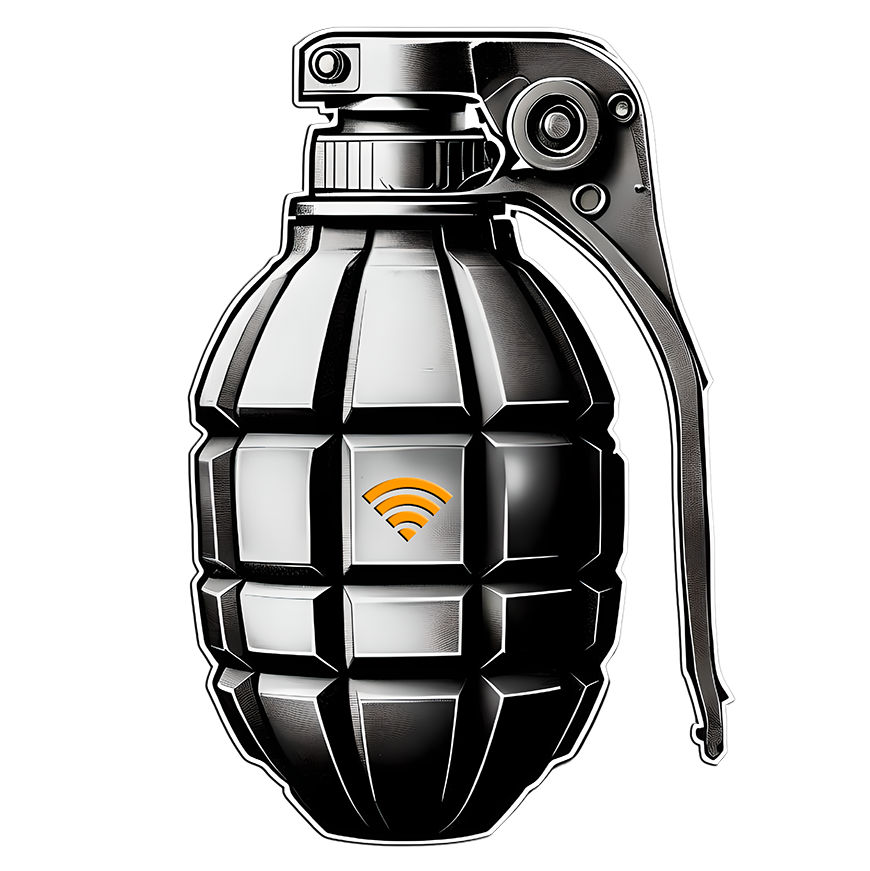
RGD-5 Fragmentation Grenade

Ordnance Overview

The RGD5 (Ruchnaya Granata Distantsionnaya model 5, meaning “Hand Grenade Remote model 5”) is a post-World War II Soviet-designed defensive fragmentation grenade that has become one of the most widely distributed hand grenades in the world. Known for its simple, reliable design and distinctive smooth oval shape, the RGD-5 represents the Soviet philosophy of producing effective, economical ordnance suitable for mass production and distribution to allied forces worldwide.

Country/Bloc of Origin

  • Country: Soviet Union (USSR)
  • Development Period: Early 1950s
  • International Proliferation: Extensively produced under license in China (as the Type 59), Bulgaria, Poland, and numerous other Warsaw Pact nations
  • Current Users: Still in service with dozens of countries, particularly in Eastern Europe, Asia, Africa, and the Middle East, despite being largely replaced in Russian service by the RGN and RGO grenades

Ordnance Class

  • Type: Hand grenade
  • Primary Role: Anti-personnel fragmentation (defensive grenade)
  • Delivery Method: Hand-thrown
  • Tactical Classification: Defensive grenade (larger danger radius than throw distance, requiring thrower to use cover)
  • Function: Time-delay fragmentation

Ordnance Family/Nomenclature

Official Designations
  • Soviet/Russian Designation: RGD-5 (РГД-5)
  • Chinese Designation: Type 59 grenade
  • NATO Reporting: No specific NATO designation; generally referred to by Soviet designation
Family Variants
  • RGD-5M: Modified version with improved fragmentation characteristics
  • Type 59: Chinese licensed production with minor manufacturing variations
  • Various national variants: Minor modifications produced by different Warsaw Pact countries
Related Grenades
  • RG-42: Earlier WWII-era Soviet fragmentation grenade with similar fuze system
  • F-1: Soviet defensive grenade with cast iron body (higher fragment count but heavier)
  • RGN/RGO: Modern Russian replacements with dual-mode fuzing

Hazards

Primary Hazard: Fragmentation
  • Fragment Pattern: 360-degree omnidirectional fragmentation
  • Fragment Count: Approximately 100-150 fragments from the segmented liner
  • Lethal Radius: 25-30 meters (80-100 feet)
  • Casualty Radius: Up to 100 meters (330 feet) from secondary fragments and ricochets
  • Fragment Velocity: Fragments travel at approximately 1,000 m/s initially
Blast Effects
  • Explosive Fill: 110 grams of TNT
  • Blast Overpressure: Dangerous within 5-7 meters
  • Confined Space Hazard: Significantly increased lethality in enclosed areas
Fuze Sensitivity
  • Moderate Sensitivity: UZRGM fuze is impact-resistant but can be initiated by severe mechanical shock
  • Striker Spring: Degradation over time can cause premature or delayed detonation
  • Environmental Degradation: Corrosion of fuze components in UXO can create unpredictable sensitivity
Special Considerations
  • UXO Hazard: Grenades with degraded fuzes may become impact-sensitive
  • Booby-Trap Usage: Frequently modified for use as improvised explosive devices
  • Storage Stability: Generally stable but moisture infiltration can cause fuze degradation
  • Safety Pin Removal: Once pin is pulled, only the safety lever prevents detonation

Key Identification Features

Physical Dimensions
  • Total Length: 114 mm (4.5 inches) with fuze installed
  • Body Diameter: 58 mm (2.3 inches)
  • Weight: 310 grams (11 ounces) complete with fuze
  • Explosive Weight: 110 grams TNT
Distinctive Characteristics

Body Shape:

  • Smooth, egg-shaped oval body (ovoid profile)
  • Thin sheet-steel construction (0.55mm thick)
  • Internal fragmentation liner with pre-formed notches
  • No external ridges or segmentation (unlike F-1 grenade)

Color Schemes:

  • Standard: Olive drab or dark green paint
  • Variations: Gray, brown, or unpainted (rust-colored) depending on manufacturer and age
  • Markings: Lot numbers and manufacturing codes typically stamped on body

Fuze Assembly:

  • UZRGM fuze (or variants like UZRGM-2) protruding from top
  • Silver or brass colored fuze cap visible at top
  • Safety pin with pull ring (typically metal ring, sometimes fabric loop)
  • Safety lever (spoon) along the side of the fuze assembly

Material Composition:

  • Body: Thin pressed steel
  • Fragmentation liner: Segmented steel or iron
  • Fuze: Aluminum alloy housing with steel components

Comparison Points

  • Smoother than F-1: The F-1 grenade has a distinctively ridged cast-iron body, while RGD-5 is smooth
  • Smaller than M26: American M26/M67 grenades have a textured spherical body with external coil
  • Unique profile: The elongated oval shape distinguishes it from most modern spherical grenades

Fuzing Mechanisms

UZRGM Series Fuze

The RGD-5 employs the UZRGM (Unified Grenade Fuze Model) or its variants (UZRGM-2), which is a time-delay pyrotechnic fuze used across multiple Soviet grenade types.

Operating Sequence
  1. Safe Configuration:
    • Safety pin inserted through fuze body and safety lever
    • Spring-loaded striker held in compressed position by safety lever
    • Striker cannot contact primer while pin is in place
  2. Arming Procedure:
    • User removes safety pin by pulling the ring
    • Safety lever remains held by user’s grip
    • Grenade is still safe as long as lever is depressed
  3. Initiation:
    • When grenade is thrown, safety lever is released
    • Striker spring drives firing pin into percussion cap
    • Percussion cap ignites delay element
  4. Delay Period:
    • Nominal Delay: 3.2 to 4.2 seconds
    • Pyrotechnic delay column burns at controlled rate
    • No external indication of delay countdown
  5. Detonation:
    • Delay element ignites detonator
    • Detonator initiates main TNT charge
    • TNT detonates, fragmenting the body and liner
Safety Features
  • Safety Pin: Primary safety; prevents accidental striker release
  • Safety Lever: Secondary safety; must be released for striker to function
  • Delay Element: Provides time for thrower to achieve safe distance
Limitations and Failures
  • No Impact Function: Purely time-delay; will not detonate on impact
  • Dud Rate: Approximately 2-5% dud rate with aged grenades
  • No Self-Destruct: Dud grenades remain indefinitely hazardous
  • Fuze Degradation: Moisture and corrosion can affect reliability over decades
  • No Anti-Handling Device: Standard version has no booby-trap features

History of Development and Use

Development Context (1950-1954)

Following World War II, the Soviet military sought to modernize its infantry equipment based on combat experience. The existing RG-42 grenade, while effective, was considered too simple and lacked refinement. Simultaneously, the heavy F-1 defensive grenade was excellent for positional warfare but too cumbersome for mobile infantry operations.

The RGD-5 was developed in the early 1950s to provide:

  • A lighter defensive grenade for mechanized infantry
  • Improved fragmentation characteristics through internal liner design
  • Simplified mass production using stamped components
  • Standardized fuzing across grenade types (UZRGM system)
Adoption and Production (1954-present)
  • 1954: Officially adopted by Soviet Armed Forces
  • 1950s-1960s: Mass production across Soviet Union and Warsaw Pact nations
  • 1960s-1970s: Exported to aligned nations worldwide, becoming ubiquitous in developing countries
  • 1980s: Licensed production expanded to China (Type 59) and other allies
  • 1990s-2000s: Gradually replaced in Russian service by RGN/RGO grenades, but remained in inventory
Combat Employment

The RGD-5 has seen extensive combat use in virtually every conflict involving Soviet-equipped forces:

Major Conflicts:

  • Vietnam War: Used extensively by NVA and Viet Cong forces
  • Soviet-Afghan War (1979-1989): Standard issue to Soviet forces
  • Yugoslav Wars (1991-1999): Used by all factions
  • Chechen Wars (1994-1996, 1999-2009): Employed by both Russian and Chechen forces
  • Syrian Civil War (2011-present): Widespread use by government and opposition forces
  • Ukrainian Conflict (2014-present): Found in use by various factions
Tactical Impact

The RGD5’s design influenced infantry tactics:

  • Defensive Employment: Required throwers to use cover due to large fragmentation radius
  • Combined Arms: Often used alongside offensive grenades (RGO, RGN) for different tactical scenarios
  • Urban Warfare: Particularly effective in building clearing operations
  • Ease of Training: Simple operation made it ideal for conscript armies and irregular forces
Current Status
  • Russian Military: Largely phased out in favor of RGN/RGO grenades but remains in reserve stocks
  • Worldwide Distribution: Still in active service with approximately 50+ countries
  • Conflict Zones: Continues to appear in ongoing conflicts, often from Cold War-era stockpiles
  • Improvised Munitions: Frequently modified into booby traps and IEDs in insurgent conflicts
  • Production: Chinese Type 59 variant still in limited production
Legacy and Influence

The RGD-5 represents one of the most successful grenade designs in history by sheer distribution numbers. Its simplicity, reliability, and ease of manufacture made it the template for numerous indigenous grenade designs in developing nations. The standardized UZRGM fuze system became a benchmark for Soviet ordnance design philosophy: interchangeable, simple, and robust.

Technical Specifications

Explosive Characteristics
  • Explosive Type: TNT (Trinitrotoluene)
  • Explosive Weight: 110 grams (3.9 ounces)
  • TNT Equivalency: 110 grams (by definition)
  • Detonation Velocity: Approximately 6,900 m/s (TNT standard)
Fragmentation Data
  • Fragment Generation Method: Internal pre-notched steel liner
  • Approximate Fragment Count: 100-150 effective fragments
  • Fragment Weight Range: 0.5-5 grams per fragment
  • Fragment Material: Mild steel
  • Fragmentation Pattern: Approximately spherical distribution with slight concentration at equator
Operational Parameters
  • Fuze Delay Time: 3.2 – 4.2 seconds (nominal 3.5-4 seconds)
  • Throwing Range (average soldier): 30-40 meters
  • Effective Casualty Radius: 25-30 meters
  • Maximum Fragment Danger: 100+ meters
  • Storage Temperature Range: -40°C to +50°C
  • Shelf Life: Indefinite with proper storage; fuze degradation possible after 20+ years
Dimensional Summary
MeasurementMetricImperial
Total Length114 mm4.5 in
Body Diameter58 mm2.3 in
Body Thickness0.55 mm0.022 in
Total Weight310 g11 oz
Explosive Weight110 g3.9 oz
Deployment Considerations
  • Carry Method: Typically carried in grenade pouches (4-6 per soldier)
  • Priming: Pin removed immediately before throwing
  • Cooking Off: Not recommended due to unpredictable delay tolerances
  • Confined Spaces: Highly effective; overpressure increases lethality
  • Open Terrain: Effective but fragments may have limited ground coverage

Frequently Asked Questions

Q: Why is the RGD-5 classified as a “defensive” grenade when it’s lighter and smaller than the F-1?

A: The defensive vs. offensive classification is based on the danger radius relative to throwing distance, not weight or size. The RGD-5’s fragmentation radius of 25-30 meters exceeds the average throwing distance of 30-40 meters, meaning the thrower is within the danger zone unless using cover (defensive posture). Despite being lighter than the F-1, the RGD-5’s 110g TNT charge and fragmentation liner still create a danger radius larger than most soldiers can safely throw. True “offensive” grenades like the RGO produce smaller danger radii that allow throwers to operate in the open.

Q: How does the smooth body of the RGD-5 create fragments if it has no external ridges like the F-1 or M26?

A: The RGD-5 uses an internal fragmentation liner with pre-formed notches rather than relying on the body to fragment. Inside the smooth steel shell is a separate segmented liner that breaks into controlled fragments when the TNT detonates. This design provides more predictable fragmentation patterns and allows for a thinner, lighter outer body. The smooth exterior is simply a containment shell that also breaks apart, but the primary fragments come from the engineered internal liner. This approach was more sophisticated than simple cast-iron bodies that fragment unpredictably.

Q: What are the practical differences between the Soviet RGD-5 and the Chinese Type 59?

A: The Chinese Type 59 is essentially a licensed copy of the RGD-5 with only minor manufacturing variations. The differences include: slightly different external markings and lot numbers (Chinese characters vs. Cyrillic), sometimes different paint shades (Chinese versions often appear slightly lighter green), and minimal dimensional tolerances from different production equipment. Functionally, they are interchangeable, using the same UZRGM fuze system and identical explosive fill. Many Type 59 grenades were exported to developing nations under Chinese aid programs, making them common in Africa and Southeast Asia. Field identification requires checking markings, as the external profile is virtually identical.

Q: Why does the RGD-5 have such a long delay (3.5-4 seconds) compared to modern grenades with 4-5 second delays?

A: The RGD-5’s 3.5-4 second delay is actually quite standard for grenades of its era, and the comparison with “4-5 second” modern grenades is somewhat misleading. Most modern Western grenades (like the M67) have delays of 4-5.5 seconds, only marginally longer. The Soviet doctrine favored slightly shorter delays for several reasons: it reduced the enemy’s ability to throw grenades back, it minimized the thrower’s exposure time after release, and it accommodated Soviet tactical employment where grenades were often used from covered positions with shorter throw distances. The trade-off is less margin for error—throwers had to release quickly after pulling the pin. Modern Russian grenades (RGN/RGO) actually retained similar delay times, suggesting Soviet doctrine found this timing optimal for their tactics.

Q: Can a RGD-5 grenade explode if you shoot it with a bullet?

A: While possible under specific circumstances, it is extremely unlikely that a bullet would cause a RGD-5 to detonate. The UZRGM fuze requires the striker spring to drive the firing pin into the percussion cap with significant force—a bullet passing through would not reliably reproduce this mechanical sequence. Additionally, the safety lever would need to be released first. TNT is also relatively insensitive to impact compared to more sensitive explosives; a bullet striking the main charge might not initiate it. However, if a bullet struck the fuze assembly precisely while the grenade was armed (pin removed, lever released), there is a theoretical possibility of initiating the percussion cap or delay element. In UXO scenarios where fuzes have degraded, bullet impact sensitivity might increase slightly but remains unlikely. The greater danger is ricochets and bullet fragments around the grenade.

Q: Why do some RGD5 grenades have a fabric loop instead of a metal pull ring?

A: The variation in pull ring design reflects different manufacturing periods, countries, and intended tactical environments. Metal rings (typically steel or aluminum) were standard for Soviet production and provide a rigid pull that’s easier to grasp with gloved hands in cold weather—critical for Soviet forces operating in Arctic conditions. Fabric loops (cloth or canvas) appeared in several contexts: Chinese Type 59 production sometimes used them for cost savings, tropical deployments favored them as metal rings could corrode or become hot in humid climates, and some Warsaw Pact nations used fabric loops to reduce metal requirements during wartime production. Both are functionally equivalent; the pin secures the fuze regardless of ring material. Field troops sometimes replaced lost or damaged rings with improvised cord or wire, so any RGD-5 found in the field might have non-standard pull ring materials.

Q: How do modern Russian grenades (RGN/RGO) compare to the RGD5, and why was replacement necessary?

A: The RGN (offensive) and RGO (defensive) grenades replaced the RGD-5 starting in the 1980s with several key improvements: dual-mode fuzing (both impact and 3.2-4 second delay, increasing reliability), better fragmentation patterns with engineered fragment sleeves producing more uniform coverage, improved safety features with more robust fuze mechanisms, and modernized production using contemporary materials and manufacturing techniques. The RGD-5’s primary limitation was its time-delay-only fuze—if the grenade landed in soft material (snow, mud, vegetation), the delay allowed enemies to escape or even throw it back. Impact fuzing eliminated this problem. Additionally, 1980s warfare emphasized mechanized and urban combat where predictable fragmentation and reliable function were more critical than the RGD-5’s simplicity. However, the RGD-5’s lower cost and proven reliability meant it remained in production and service alongside newer designs, particularly for reserve forces and export to allied nations.

Q: What should a civilian do if they encounter a suspected RGD-5 grenade, especially in former conflict zones?

A: DO NOT TOUCH, MOVE, OR DISTURB any suspected ordnance. Even decades-old grenades remain extremely dangerous—fuze mechanisms can degrade and become impact-sensitive, the safety pin may be corroded or missing, and any handling could cause detonation. The proper procedure is: (1) Mark the location from a safe distance (at least 100 meters) using natural features or improvised markers, (2) Evacuate the area and prevent others from approaching, (3) Contact authorities immediately—local police, military, or explosive ordnance disposal (EOD) teams in former conflict zones, (4) Provide precise location information, description, and any visible markings, and (5) Wait for professionals—only trained EOD personnel should approach, assess, and neutralize the device. In areas with known UXO contamination, stay on marked paths, never dig or disturb soil, and educate community members (especially children) about ordnance recognition and avoidance. The RGD5’s widespread distribution means it appears frequently in clearance operations worldwide, and professional disposal is the only safe option.


Safety Warning

This document is for educational and identification purposes only. All grenades and explosive ordnance are extremely dangerous and should only be handled by trained military personnel or explosive ordnance disposal (EOD) specialists. Unexploded ordnance (UXO) can remain lethal for decades and may be unstable. If you encounter suspected ordnance, do not touch it—mark the location, evacuate the area, and contact military or law enforcement authorities immediately.

The information presented here is intended for military professionals, historians, collectors (handling inert training replicas only), and educational purposes. Never attempt to disarm, modify, or handle live ordnance.