F1 Fragmentation Grenade
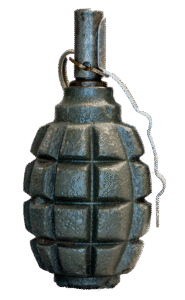

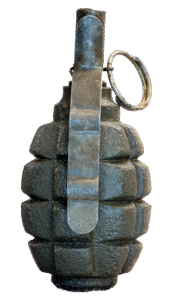
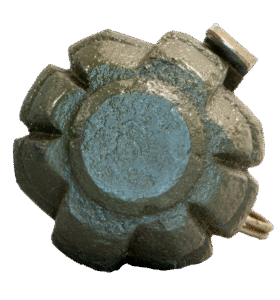
Ordnance Overview
The F1 fragmentation grenade is one of the most recognizable and widely distributed hand grenades in history, serving as the standard defensive fragmentation grenade for Soviet and Russian forces since World War II. Known for its distinctive “pineapple” or “lemon” segmented body and robust construction, the F1 has achieved legendary status in military circles for its reliability, lethality, and sheer ubiquity. With production numbers in the hundreds of millions and distribution to dozens of countries over eight decades, the F1 remains in active service worldwide and continues to appear in virtually every modern conflict. Its design represents the Soviet philosophy of simple, rugged, and effective weapons suitable for mass production and use by minimally trained troops.
The F1’s external segmentation has made it instantly recognizable in popular culture, and it has become virtually synonymous with the concept of a “hand grenade” in many parts of the world. Despite being designed in the late 1930s, the F1’s fundamental design has proven so effective that it has remained largely unchanged through multiple wars and conflicts.
Country/Bloc of Origin
- Country: Soviet Union / USSR
- Design Period: 1939-1940
- Designer: F.I. Rdultovsky (defensive grenade development program)
- Entry into Service: 1940 (pre-World War II)
- Based on: French F-1 grenade design (World War I era) with Soviet modifications
International Production and Variants:
- Licensed production throughout Warsaw Pact nations (Poland, East Germany, Czechoslovakia, Bulgaria, Romania, Hungary)
- Production in China (as Type 1 grenade)
- Licensed and unlicensed production in numerous countries including:
- North Korea
- Yugoslavia (M79 variant)
- Vietnam
- Cuba
- Egypt
- Iraq (prior to 2003)
- Multiple former Soviet republics continue production
- Exported to over 50 countries during Cold War
- Continues to be manufactured in several countries today
Ordnance Class
Primary Classification:
- Type: Hand Grenade – Fragmentation
- Category: Defensive Grenade
- Primary Role: Anti-Personnel
- Fragmentation Type: Controlled fragmentation (pre-notched/segmented body)
Employment Method:
- Hand-thrown by individual soldier
- Rifle-launched with specialized adapters (limited use)
- Booby-trap employment with tripwire adaptations (field modification)
Defensive vs. Offensive Classification:
The F1 is classified as a defensive grenade, meaning:
- Heavy fragmentation jacket that creates large danger radius
- Intended for use from cover due to fragments traveling beyond throwing range
- Not safe for assault use where troops advance immediately after throwing
- Contrasts with offensive grenades (like RGD-5) with lighter bodies and smaller fragment radius
Ordnance Family/Nomenclature
Soviet/Russian Designation:
- F-1: Official military designation (F = Fragmentation)
- Граната Ф-1 (Granata F-1): Full Russian designation
Common Names and Nicknames:
- “Limonka” (Лимонка): Russian nickname meaning “little lemon” due to shape and segmentation
- “Pineapple”: Common English nickname referencing segmented surface
- “Efka”: Russian slang abbreviation
- “Defensive Grenade”: Technical classification descriptor
Related Variants and Family Members:
Direct Variants:
- F-1 (Original): With UZRGM fuze (1940s-1950s)
- F-1 with UZRGM-2: Improved fuze variant (1954)
- F-1 with URG: Early unified fuze system
- Modern F-1: With UZRGM or URG-N fuze systems
International Variants:
- Type 1 (China): Chinese licensed copy, virtually identical
- M79 (Yugoslavia): Yugoslav variant with minor modifications
- RG-42 influence: Similar Soviet grenade with smoother body
- URG series fuzes: Multiple fuze variants compatible with F-1 body
Related Soviet Grenades:
- RGD-5: Offensive grenade (lighter, smaller fragment radius)
- RG-42: Similar vintage defensive grenade with different body pattern
- RGO/RGN: Modern Soviet/Russian impact grenades
Identification Codes:
- Grenades marked with production date, factory code, and lot number
- Cyrillic markings typically stamped on fuze well or body
- Color coding may vary by production batch and age
Hazards
Primary Hazard Profile:
Fragmentation Hazard – CRITICAL:
- Fragment Type: Steel body fragments into 290-350 pieces
- Fragment Weight: Individual fragments range from 0.5g to 13g
- Fragment Velocity: 700-1,000 meters/second at detonation
- Lethal Radius: 30-50 meters (98-164 feet) – fragments retain lethal velocity
- Casualty Radius: Up to 100-200 meters (328-656 feet) – fragments can cause injury
- Effective Casualty Radius: Approximately 10-15 meters for reliable kills
- Penetration: Fragments can penetrate 3-5mm of steel plate or standard military helmet
- Fragment Pattern: 360-degree dispersal with concentration in horizontal plane
- Cover Penetration: Fragments can penetrate light vegetation, wooden structures, and sandbag layers
Blast Hazard:
- Explosive Fill: 60 grams (2.1 oz) TNT
- Blast Overpressure: Significant within 5 meters
- Primary Blast Injuries: Concussion, eardrum rupture, internal injuries within close proximity
- Structure Damage: Minimal; designed for anti-personnel effect not demolition
Fuze Hazards:
- Delay Time: 3.2-4.2 seconds (UZRGM fuze) – shorter than many Western grenades
- Premature Function: Possible with degraded or damaged fuze assemblies
- Striker Mechanism: Spring-loaded, released by pulling pin and releasing lever
- Impact Sensitivity: Body impact does NOT detonate; only fuze time train causes detonation
Unexploded Ordnance (UXO) Hazards:
Critical UXO Characteristics:
- Dud Rate: Estimated 1-5% depending on production quality and storage conditions
- Unstable Aging: Degraded fuze components may become sensitive or unreliable
- Moisture Damage: Water infiltration can degrade explosive fill and corrode fuze mechanism
- Corrosion: Extensive corrosion may expose explosive fill or weaken body integrity
- Fuze Degradation: Old fuzes may have degraded time delay or striker spring tension
Specific UXO Dangers:
- Partial Burn: Fuze may have initiated but not detonated main charge—highly dangerous
- Striker Position: Deteriorated lever may fail, but striker remains under spring tension
- Chemical Instability: Aged TNT may develop sensitivity or become unstable
- Body Integrity: Corroded body segments may fragment unexpectedly if handled
- Movement Sensitivity: Shifting internal components in degraded grenades
Environmental and Handling Hazards:
- Temperature Extremes: Thermal cycling can affect explosive stability over decades
- Moisture Intrusion: Compromised seals allow water to degrade internals
- Drop Impact: While designed to withstand rough handling, aged grenades may be compromised
- Chemical Exposure: Leaking battery acid or explosive degradation products
- Fragment Projection: Even moving a UXO can cause accidental detonation
Safety Protocol for Suspected UXO:
- Never approach closer than 100 meters without EOD qualification
- Never touch, move, or disturb any suspected grenade
- Evacuate area to at least 100-meter radius
- Mark location from safe distance if possible
- Report immediately to military or law enforcement EOD units
- Assume armed – treat all grenades as live until confirmed inert by qualified personnel
Key Identification Features
Physical Dimensions:
- Height: 117mm (4.6 inches) including fuze assembly
- Diameter: 55mm (2.2 inches) at widest point
- Weight (complete): 600 grams (1.32 lbs)
- Weight (explosive fill): 60 grams (2.1 oz) TNT
- Body Weight: Approximately 540 grams (1.19 lbs) cast iron
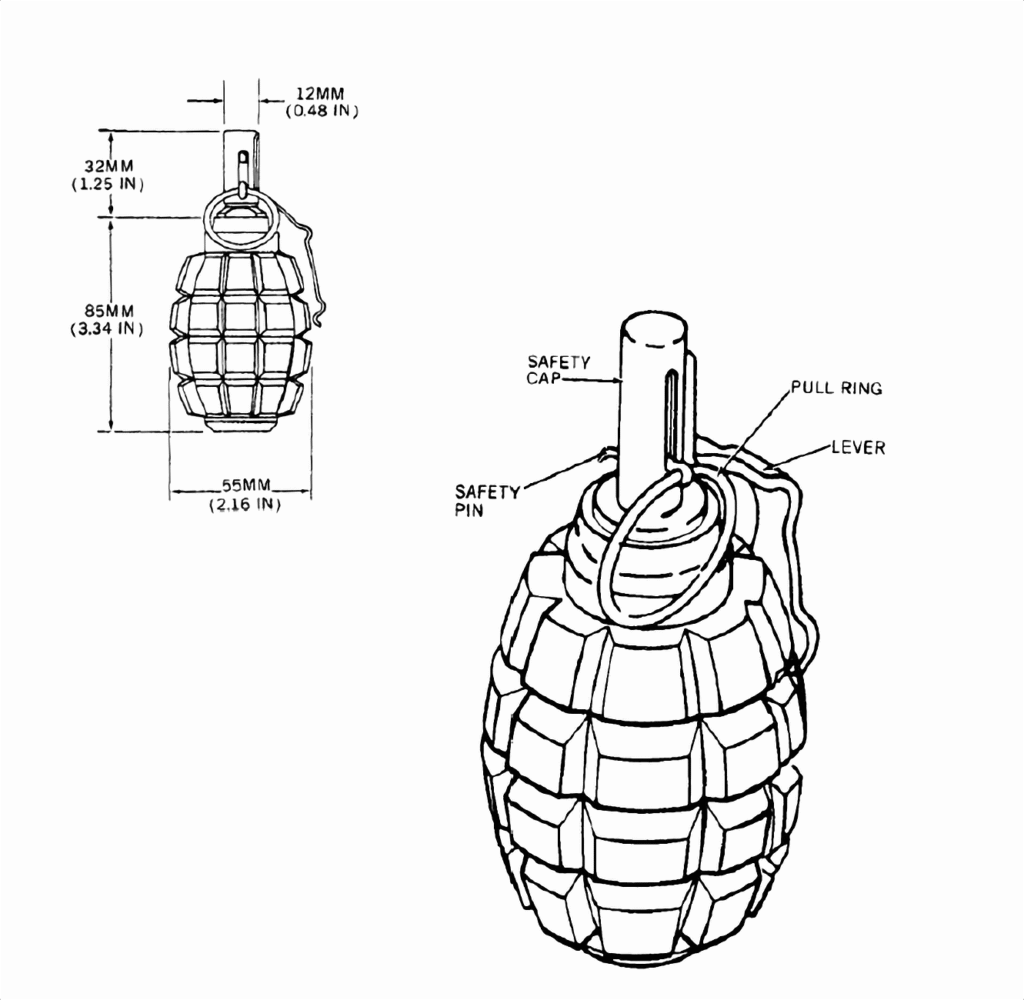
Distinctive Visual Characteristics:
Body Design:
- Shape: Ovoid/lemon-shaped body tapering slightly toward top
- Segmentation: Horizontal and vertical grooves creating distinctive grid pattern
- Segment Pattern: Approximately 16 horizontal rows with 8-10 vertical grooves
- Surface Texture: Rough cast iron with raised rectangular segments
- Classic “Pineapple” Appearance: Deep grooves between segments (3-5mm deep)
Color Schemes and Markings:
Standard Coloration:
- Operational Grenades:
- Dark olive green (most common)
- Olive drab or grayish-green
- Dark gray (some production lots)
- Variations in shade due to age, storage, and manufacturer
- Training Grenades:
- Black body with white or light blue stripes
- Blue body (some variants)
- White markings indicating “inert”
- Paint Condition: Worn, flaking, or rusted examples common in field
Markings:
- Cyrillic text stamped on fuze well rim
- Production date codes (typically two-digit year)
- Factory identification codes
- Lot numbers
- Fuze type designation (stamped on fuze itself)
- Export versions may have additional markings
Fuze Assembly Appearance:
UZRGM Fuze (Most Common):
- Top Cap: Circular metal cap approximately 25mm diameter
- Safety Pin: Metal ring-pin with pull ring extending from lever
- Pull Ring: Metal ring (sometimes folded flat against body)
- Safety Lever (Spoon): Metal lever running along side of fuze
- Fuze Well: Threaded opening at top of grenade body
- Striker Assembly: Visible striker mechanism when fuze removed
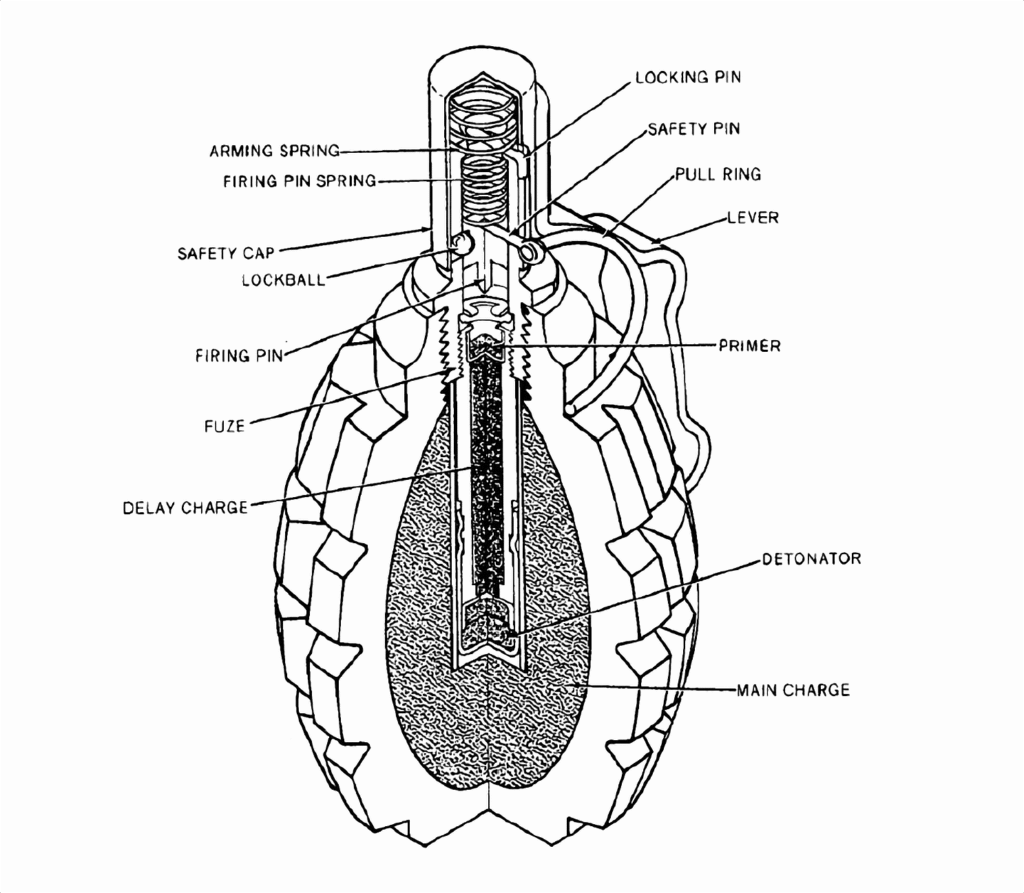
Fuze Variations:
- UZRGM: Original pattern with prominent lever
- UZRGM-2: Improved version, visually similar
- URG/URG-N: Slightly different profile, unified fuze system
- Foreign Fuzes: May have different configurations in imported/licensed versions
Material Composition:
Body:
- Primary Material: Cast iron (ferrous metal)
- Production Method: Sand casting with machined fuze well
- Finish: Painted over bare iron (paint often deteriorated on old examples)
- Segments: Integral to casting, not applied surface treatment
- Magnetic: Body is strongly magnetic (iron composition)
Fuze:
- Steel components
- Brass or copper striker pin
- Spring steel striker spring
- Pyrotechnic delay element
- Detonator assembly (lead azide or similar primary explosive)
Internal Construction (Not Visible Externally):
- Central vertical cavity containing TNT charge
- Detonator well extending down from fuze
- Explosive pressed around central void
- Air gap between explosive and body wall (design feature)
Transportation and Storage Appearance:
Packaging:
- Wooden crates (older stocks)
- Metal boxes with sealed lids
- Cardboard boxes (more modern)
- Individual grenades may be wrapped in wax paper or plastic
- Fuzes typically packaged separately for safety
- Crate markings indicate contents, quantity, production date, hazard class
Storage Configuration:
- Grenades stored with fuzes removed (screwed out)
- Fuzes stored in separate containers
- Transportation with fuzes installed only immediately before combat operations
- Safety pins remain in place even when fuzes installed
Field Carry Configuration:
- Typically carried on load-bearing equipment in pouches
- Fuze installed, safety pin in place, often with safety clip added
- Some soldiers carry with fuzes removed for extra safety
Distinguishing from Similar Grenades:
F1 vs. RG-42:
- F1 has deeper segmentation and more pronounced “pineapple” appearance
- RG-42 has smoother, less defined segmentation pattern
- F1 is heavier and stockier in shape
F1 vs. Western Grenades:
- F1’s segmentation is deeper and more regular than U.S. Mk II “pineapple”
- F1 has more pronounced taper toward top
- F1’s fuze assembly protrudes more noticeably
Condition Indicators:
Age Assessment:
- Rust or corrosion on body (common on decades-old examples)
- Worn or missing paint
- Dents or deformation of body segments
- Fuze corrosion (green/white oxidation)
- Loose fuze assembly
- Presence of Cyrillic date codes indicating production year
Fuzing Mechanisms
Standard Fuze System:
The F1 grenade employs a time-delay pyrotechnic fuze system, most commonly the UZRGM (Универсальный Запал Ручной Гранаты Модернизированный / Universal Modernized Hand Grenade Fuze) or its successor variants. The fuzing mechanism is entirely separate from the grenade body and screws into the threaded fuze well at the top of the grenade.
UZRGM Fuze Components:
Primary Components:
- Safety Pin: Prevents safety lever from being released
- Safety Lever (Spoon): Holds striker in armed position
- Striker Spring: Provides force to drive striker into primer
- Striker: Metal pin with firing point
- Primer: Impact-sensitive initiator
- Delay Element: Pyrotechnic time-delay composition (3.2-4.2 seconds)
- Detonator: Primary explosive (lead azide or PETN)
- Fuze Body: Threaded metal assembly housing all components
Arming and Functioning Sequence:
1. Safe State (Storage/Transport):
- Fuze may be installed or removed from grenade body
- Safety pin inserted through holes in lever and fuze body
- Lever held against fuze body by pin
- Striker compressed against spring, unable to move
- System mechanically blocked from functioning
2. Armed State (Tactical Carry):
- Fuze installed in grenade body (hand-tight threading)
- Safety pin inserted through lever
- Grenade carried in pouch or on equipment
- Critical: Even with pin removed, lever must be released for activation
- Some troops add additional safety clip or tape for extra security
3. Initiation Sequence (Throwing):
Step 1 – Pin Removal:
- Operator grasps grenade body firmly, maintaining pressure on lever
- Operator pulls safety pin (ring-pull) completely free of fuze
- Lever still held by operator’s grip
- At this point: Grenade is armed but NOT initiated (can be made safe by reinserting pin)
Step 2 – Lever Release (Throwing Motion):
- Operator throws grenade, releasing grip
- Lever flies free from fuze body (propelled by internal spring tension)
- This is the moment of no return – time delay begins
Step 3 – Striker Movement:
- With lever released, striker spring drives striker downward
- Striker impacts primer cap with significant force
- Primer fires instantly
Step 4 – Delay Train Ignition:
- Primer flash ignites pyrotechnic delay composition
- Delay element burns for 3.2-4.2 seconds (temperature dependent)
- During this period: Grenade is in flight or has landed, burning internally
- No external indication of burning delay train
Step 5 – Detonator Initiation:
- Delay train fire reaches detonator assembly
- Detonator (primary explosive) detonates
- Detonation shock wave enters main explosive charge
Step 6 – Main Charge Detonation:
- TNT main charge detonates
- Detonation wave shatters cast iron body
- Fragmentation and blast effects occur
Timing Characteristics:
Nominal Delay:
- Design Specification: 3.2-4.2 seconds
- Average Delay: 3.6-3.8 seconds in most production lots
- Temperature Effects:
- Cold conditions: Delay may extend toward 4+ seconds
- Hot conditions: Delay may shorten toward 3 seconds or less
- Degraded fuzes: Unpredictable timing
Tactical Implications:
- Shorter than many Western grenades (U.S. M67 is 4-5.5 seconds)
- Provides less time for enemy to throw back
- Requires practice for optimal throwing technique (air burst vs. ground detonation)
- “Cooking off” (holding after release) is extremely dangerous due to timing variability
Safety Mechanisms:
Primary Safety Features:
- Safety Pin: Mechanical block preventing lever release
- Safety Lever: Must be physically released for initiation
- Positive Arming Action: Requires deliberate pin removal AND lever release
- Double Action Required: Two separate actions (pin removal, lever release) prevent accidental activation
Secondary Safety Practices:
- Safety Clip: Some militaries add wire clip over lever as backup
- Tape Wrap: Lever may be taped to body for additional security
- Separate Fuze Storage: Fuzes stored separately from bodies in transport
- Transportation Containers: Grenades carried in protective pouches
Fuze Variants and Differences:
UZRGM (Original):
- Standard Soviet/Russian issue
- 3.2-4.2 second delay
- Proven reliability
UZRGM-2 (Improved):
- Enhanced weather resistance
- Better moisture sealing
- Slightly more consistent timing
- Visually nearly identical to UZRGM
URG Series:
- Unified fuze system compatible with multiple Soviet grenades
- Interchangeable with F-1 body
- Similar functioning principle
- May have minor dimensional differences
Foreign Variants:
- Chinese Type 1 uses domestically-produced equivalent fuze
- Yugoslav M79 may use different fuze designation but similar function
- Some export versions received different fuze types based on recipient nation
Common Fuze Malfunctions:
Hang Fires:
- Delay element ignited but burning abnormally slowly
- Most dangerous malfunction – grenade may detonate after extended delay
- Can result from moisture damage, defective composition, or extreme cold
Duds:
- Striker fires but delay element fails to ignite (rare)
- Detonator fails to function (more common with aged grenades)
- Main charge fails to detonate (very rare with TNT)
Premature Function:
- Delay burns faster than specified
- Most common with degraded fuzes or those exposed to extreme heat
- Can result in detonation before grenade reaches target
Lever Release Failure:
- Corroded or damaged lever may stick and not release
- Results in dud
- Grenade still dangerous – may detonate if struck or fuze disturbed
Cook-Off Prevention:
WARNING: “Cooking off” (holding grenade 1-2 seconds after releasing lever to achieve air burst) is extremely dangerous with F-1 grenades due to:
- Short and variable delay time (3.2-4.2 seconds)
- Temperature effects on burn rate
- Degraded fuze timing uncertainty
- Risk of premature function
Safe Practice: Throw immediately upon releasing lever to ensure maximum distance from detonation.
Fuze Handling and Maintenance:
Installation:
- Screw fuze into body hand-tight (do not over-torque)
- Ensure clean threads for proper seating
- Verify safety pin can be fully inserted
Inspection:
- Check for corrosion on fuze body
- Verify lever moves freely but securely
- Ensure safety pin is not bent or damaged
- Test lever spring tension (if appropriate and authorized)
- Check for cracks in fuze body
Storage:
- Store fuzes separately from grenade bodies when possible
- Protect from moisture
- Avoid extreme temperature cycling
- Inspect periodically for degradation
History of Development and Use
Origins and Development (1930s-1940):
The F1 grenade’s development story intertwines Soviet industrial capability with lessons learned from earlier conflicts and foreign design influences. The designation “F-1” actually derives from a French World War I fragmentation grenade, the F-1 grenade developed by Citroën (yes, the automobile manufacturer), which Soviet military planners studied during the interwar period.
Design Evolution:
Pre-F1 Soviet Grenades:
- Soviet forces in the 1920s-1930s used various grenades including the M1914/30 and RGD-33
- These earlier designs suffered from complexity, unreliability, and production difficulties
- Need for simpler, more effective fragmentation grenade became apparent
French F-1 Influence:
- French F-1 (also called “Citroën grenade”) introduced in 1915
- Featured segmented cast iron body for controlled fragmentation
- Proved effective in World War I trench warfare
- Soviet Union acquired samples through various channels in 1920s-1930s
Soviet Development Program:
- F.I. Rdultovsky led Soviet defensive grenade development
- Objective: Create reliable, effective, mass-producible fragmentation grenade
- Design incorporated French F-1 body concept with Soviet fuze technology
- Simplified manufacturing for rapid wartime production
- Emphasis on using available materials (cast iron, TNT)
Design Characteristics:
- Cast iron body provided both weight and fragmentation material
- Segmentation pattern optimized for controlled fragment size
- TNT filling standardized at 60 grams for balance of lethality and production economy
- Soviet-designed UZRG fuze (later improved to UZRGM) provided reliable delay mechanism
- Overall design prioritized simplicity and battlefield effectiveness
Adoption and Production:
- Official Adoption: 1940 (designated F-1)
- Initial Production: Multiple factories across Soviet Union
- Wartime Production: Ramped up massively during World War II
- Production Method: Sand-casting for body, simple machining for fuze well
World War II Employment (1941-1945):
The F1 saw extensive use throughout the Great Patriotic War (Soviet term for their WWII conflict):
Eastern Front Combat:
- Urban Warfare: Particularly effective in Stalingrad, Berlin, and other urban battles
- Defensive Positions: Used from trenches and fortifications
- Close Combat: Standard equipment for assault troops and tank-killer teams
- Partisan Warfare: Widely distributed to partisan units behind German lines
Tactical Lessons:
- Large fragment radius valuable in defensive situations
- Weight made throwing difficult for some troops (led to development of lighter RGD-5)
- Reliability in extreme cold (Russian winter) proved superior to some German grenades
- Segmented body aided grip in muddy, wet conditions
Production Numbers:
- Exact figures classified, but estimated 70-100+ million produced 1941-1945
- Multiple production facilities including factories evacuated eastward
- Quality varied by facility and production urgency
- Later war production generally better quality than emergency 1941-1942 output
Post-WWII Evolution (1945-1991):
Korean War (1950-1953):
- Supplied to North Korean and Chinese forces
- First major post-WWII combat employment
- Proved effective in mountainous terrain combat
Fuze Improvements:
- UZRGM fuze introduced (improved weather resistance)
- UZRGM-2 further refinements in 1950s
- URG series developed for compatibility across grenade types
Cold War Distribution:
- Massive exports to Warsaw Pact allies
- Provided to Communist forces in Vietnam, Cuba, Africa, Middle East
- Licensed production agreements with multiple countries
- Became standard Soviet-bloc defensive grenade
Vietnam War (1965-1975):
- North Vietnamese and Viet Cong forces used extensively
- Effective in jungle warfare and bunker defense
- U.S. forces frequently captured F1 grenades
- Some American troops preferred F1’s shorter delay over M26/M61 grenades
Middle East Conflicts:
Six-Day War (1967):
- Egyptian, Syrian, Jordanian forces equipped with F1
- Used in urban combat and defensive positions
Yom Kippur War (1973):
- Continued Egyptian/Syrian employment
- Found effective in Sinai and Golan Heights fighting
Soviet-Afghan War (1979-1989):
- Standard Soviet forces equipment
- Mujahideen captured and used against Soviets
- Mountain warfare highlighted shorter delay time advantages
- Fragmentation effective against personnel in open terrain
Persian Gulf Wars:
- Iraqi forces extensively equipped with F1 (1991, 2003)
- Found in large quantities by Coalition forces
- Continued insurgent use post-2003
Post-Cold War Conflicts (1991-Present):
Yugoslav Wars (1991-1999):
- All factions used F1 grenades (Yugoslav M79 variant)
- Extensive urban combat employment
- Grenade warfare significant component of siege operations (Sarajevo, Vukovar)
Chechen Wars (1994-1996, 1999-2009):
- Both Russian and Chechen forces used F1
- Urban combat in Grozny highlighted grenade effectiveness
- Defensive grenade role ideal for building/rubble defense
Syrian Civil War (2011-Present):
- All factions employ F1 grenades from Syrian Army stockpiles
- Extensive combat footage available
- Continued effectiveness in urban warfare demonstrated
- Some improvised rifle-launched variants documented
Ukrainian Conflict (2014-Present):
- Both Ukrainian and separatist forces use F1
- Post-Soviet stockpiles remain significant
- Trench warfare revival (2022-present) mirrors WWI-style grenade use
- Modern combat shows F1 remains tactically relevant in static warfare
Other Modern Conflicts:
- Afghanistan (Taliban forces)
- Iraq (various insurgent groups)
- Libya (2011-present)
- Yemen (2015-present)
- Various African conflicts
- Southeast Asian insurgencies
Production and Distribution Statistics:
Total Production:
- Soviet/Russian Production: Estimated 500+ million grenades (1940-2000s)
- Warsaw Pact Production: Additional 100+ million
- Chinese Production: Estimated 200+ million (Type 1)
- Other Licensed Production: 50+ million
- Total Estimate: 800 million to 1 billion+ F1 grenades produced globally
Geographic Distribution:
- Former Soviet Union: Massive stockpiles in Russia and former republics
- Eastern Europe: Large quantities in former Warsaw Pact nations
- Middle East: Extensive distribution to Syria, Iraq, Egypt, Libya, Yemen
- Asia: China, North Korea, Vietnam, Afghanistan
- Africa: Angola, Mozambique, Ethiopia, and numerous other nations
- Latin America: Cuba, Nicaragua, and others received smaller quantities
Current Status (2020s):
Active Service:
- Russian Federation: Still in inventory, though supplemented by newer designs
- Former Soviet Republics: Primary grenade for many militaries
- Developing Nations: Continues as frontline equipment
- Non-State Actors: Widely available to insurgent and terrorist groups
Production Status:
- Russia: Limited continued production, mainly for export and stockpile replenishment
- China: Continues Type 1 production
- Other Nations: Several countries maintain production capability
- Quality: Modern production generally higher quality than Cold War emergency production
Stockpile Issues:
- Millions of aging grenades in storage worldwide
- Degrading fuzes becoming safety concern
- Some nations conducting disposal programs
- Others refurbishing fuzes while retaining bodies
Impact on Military Development:
The F1’s influence on grenade design includes:
- Validated Defensive Grenade Concept: Demonstrated value of heavy fragmentation grenade
- Mass Production Model: Showed simple designs enable wartime production scale
- Standardization: Led to standardized Soviet/Russian grenade fuze systems
- Offensive vs. Defensive Doctrine: Influenced military thinking on grenade role differentiation
- Longevity: Proved simple, robust designs can serve effectively for 80+ years
Cultural Impact:
The F1 has achieved iconic status:
- Appears in countless war films, documentaries, video games
- “Limonka” nickname ubiquitous in Russian military culture
- Symbol of Soviet/Russian military equipment in popular culture
- Instantly recognizable silhouette worldwide
- Referenced in literature, music, and art concerning modern warfare
Legacy and Future:
The F1 grenade represents one of the longest-serving weapons in continuous military use. While modern grenades like the U.S. M67 or Russian RGO/RGN incorporate improvements (safer fuzes, better fragmentation, lighter weight), the fundamental effectiveness of the F1’s simple design ensures its continued presence on battlefields worldwide. Given the enormous stockpiles remaining and ongoing production, the F1 will likely continue to be encountered in conflicts for decades to come, potentially remaining in service beyond its 100th anniversary in 2040.
Technical Specifications
Overall Specifications:
Dimensions:
- Total Height: 117mm (4.6 in) with UZRGM fuze installed
- Body Height: 90mm (3.5 in) without fuze
- Maximum Diameter: 55mm (2.2 in)
- Fuze Diameter: ~25mm (1.0 in)
Weights:
- Total Weight: 600 grams (21.2 oz / 1.32 lbs)
- Explosive Fill: 60 grams (2.1 oz) TNT
- Body Weight: ~540 grams (19 oz)
- Fuze Weight: ~30 grams (1.1 oz)
Explosive Composition:
Main Charge:
- Type: TNT (Trinitrotoluene)
- Weight: 60 grams (2.1 oz)
- Configuration: Pressed or poured into central cavity
- Detonation Velocity: ~6,900 m/s for TNT
- TNT Equivalent: 60 grams (by definition, as it IS TNT)
Detonator:
- Type: Primary explosive (lead azide or PETN-based)
- Weight: <1 gram
- Function: Bridge between delay train and main charge
Fuze Composition:
- Delay Element: Pyrotechnic composition (proprietary Soviet formulation)
- Primer: Impact-sensitive initiator compound
- Burn Rate: Calibrated for 3.2-4.2 second delay
Fragmentation Characteristics:
Body Construction:
- Material: Cast iron (grey cast iron)
- Casting Method: Sand casting
- Wall Thickness: Approximately 5-7mm
- Segmentation Depth: 3-5mm grooves
- Segment Pattern: ~16 horizontal rows × 8-10 vertical divisions
Fragment Performance:
- Total Fragment Count: 290-350 fragments (varies by detonation characteristics)
- Fragment Weight Range: 0.5 grams to 13 grams
- Average Fragment Weight: ~1.5-2.5 grams
- Fragment Velocity (at source): 700-1,000 m/s initially
- Fragment Type: Irregular steel pieces (not pre-formed)
Casualty Radii:
Lethal Radius:
- Reliable Lethality: 5-8 meters (16-26 feet)
- Extended Lethality: 10-15 meters (33-49 feet)
- Fragment Lethality Range: Fragments retain lethal velocity to 30-50 meters (98-164 feet)
- Definition: Distance at which fragments maintain sufficient velocity/mass for penetration of human tissue
Casualty Radius:
- Primary Casualty Zone: 15-20 meters (49-66 feet)
- Extended Casualty Potential: 100-200 meters (328-656 feet) where fragments can cause injury
- Note: Casualties beyond 50m typically minor wounds unless fragment strikes vital area
Safety Distances:
- Minimum Safe Distance (Thrower): 30-35 meters from detonation point
- Cover Required: Thrower must use hard cover due to fragment range exceeding throwing distance
- Danger Zone: 100-meter radius should be clear of friendly forces without hard cover
Penetration Performance:
- Steel Plate: Can penetrate 3-5mm mild steel
- Military Helmet: Can penetrate standard steel helmet at close range
- Body Armor: Can defeat soft body armor (non-ballistic plates) within lethal radius
- Cover: Fragments can penetrate wood, sandbags (single layer), light vegetation
- Brick/Concrete: Limited penetration; fragments may ricochet
Blast Performance:
Overpressure Effects:
- Peak Overpressure (1 meter): Approximately 200-300 kPa
- Lethal Overpressure Range: <2 meters
- Eardrum Rupture Range: 3-5 meters
- Primary Blast Injury: Generally secondary to fragmentation in F1 design
Blast Radius:
- Blast effects minimal beyond 5 meters
- Not designed for demolition or bunker destruction
- Confined space detonation amplifies blast effects significantly
Employment Specifications:
Throwing Performance:
Average Soldier:
- Maximum Throw Distance: 30-40 meters (98-131 feet)
- Effective Throw Distance: 25-35 meters (82-115 feet)
- Optimal Engagement Range: 20-30 meters
- Accuracy: Decreases significantly beyond 25 meters
Trained Soldier:
- Maximum Throw Distance: 40-50 meters (131-164 feet)
- Effective Throw Distance: 35-45 meters (115-148 feet)
Limitations:
- Weight (600g) makes throwing difficult for smaller-stature troops
- Longer throws reduce accuracy significantly
- Fragment danger radius (~30-50m) exceeds typical throwing range, requiring cover
Delay Timing:
Standard UZRGM Fuze:
- Nominal Delay: 3.2-4.2 seconds
- Average: 3.6-3.8 seconds
- Temperature Effects:
- Below -20°C: May extend to 4.5+ seconds
- Above +40°C: May shorten to 3.0 seconds or less
- Production Variation: ±0.5 seconds between grenades from same batch
Tactical Timing Considerations:
- Flight Time (25m throw): ~1.5-2 seconds
- Detonation Timing (25m throw): Air burst or ground detonation at ~1.5-2 seconds after impact
- Enemy Reaction Time: 3-4 second delay provides minimal time to throw back
- Cook-Off Danger: Short delay makes “cooking” extremely hazardous
Environmental Operating Conditions:
Temperature Range:
- Storage: -50°C to +50°C (-58°F to +122°F)
- Operating: -40°C to +50°C (-40°F to +122°F)
- Optimal Performance: -10°C to +30°C (14°F to 86°F)
Environmental Resistance:
- Water Resistance: Sealed fuze provides protection from rain/moisture
- Submersion: Not waterproof; extended submersion degrades reliability
- Humidity: Can operate in high humidity environments
- Dust/Sand: Generally resistant, though may affect fuze mechanism if severe
- Altitude: Functional from sea level to high altitude (reduced blast effects at extreme altitude)
Shelf Life and Storage:
Storage Life:
- Fuze (sealed): 10-15 years nominal
- Explosive Fill (TNT): 20-30+ years (TNT very stable)
- Overall System: 15-20 years under proper storage conditions
- Extended Storage: Many examples 50+ years old still encountered, reliability questionable
Storage Requirements:
- Temperature-Controlled: Ideally 15-25°C (59-77°F)
- Humidity Control: <70% relative humidity
- Ventilation: Adequate air circulation
- Fuze Separation: Fuzes stored separately from bodies
- Inspection: Periodic inspection for corrosion, degradation
Deterioration Indicators:
- Extensive rust/corrosion on body or fuze
- Loose fuze assembly
- Damaged or missing safety pin
- Deformed body segments
- Fuze lever movement resistance
- Green/white corrosion on fuze components
Employment Methods:
Standard Hand Throwing:
- Typical employment method
- Requires hard cover for thrower safety
- Thrown from prone, kneeling, or standing positions
- Defensive positions, trenches, fighting holes
Rifle Launch (Limited Use):
- Special adapters developed for AK-pattern rifles
- Extends range to 100-150 meters
- Rarely used due to accuracy limitations
- Some improvised launchers documented in conflicts
Booby Trap Employment:
- Tripwire activation (remove pin, rig tripwire to pull lever)
- Door/window traps (lever-release mechanisms)
- Field expedient methods common in irregular warfare
- Highly dangerous to set; requires extensive training
Comparison with Similar Grenades:
F1 vs. U.S. M67:
- F1: 600g, 60g TNT, 3.2-4.2s delay
- M67: 400g, 180g Composition B, 4-5.5s delay
- F1 heavier body, fewer fragments but larger individual fragments
- M67 lighter, more fragments, longer delay, better for assault use
F1 vs. Soviet RGD-5:
- F1: Defensive, 600g, 30-50m fragment range
- RGD-5: Offensive, 310g, ~15m fragment range
- RGD-5 designed for assault (fragments don’t endanger thrower)
- F1 more lethal but requires cover
F1 vs. German M24:
- F1: Fragmentation grenade
- M24: Concussion/stick grenade (offensive)
- Entirely different design philosophies
- M24 safer for thrower but less lethal
Frequently Asked Questions
Q: Why is the F1 considered a “defensive” grenade, and what makes it different from an “offensive” grenade?
A: The F1’s classification as a defensive grenade stems from its heavy cast iron body designed to produce lethal fragmentation at distances beyond safe throwing range, making it suitable only for use from behind cover. The critical distinction lies in fragment danger radius: the F1’s fragments remain lethal out to 30-50 meters, while even a strong-armed soldier can typically throw it only 30-40 meters. This means the thrower is within the lethal fragmentation zone and must be behind hard cover (walls, trenches, fighting holes) when the grenade detonates. In contrast, offensive grenades like the Soviet RGD-5 or German M24 have lighter bodies producing minimal fragmentation, with blast and fragments generally contained within 10-15 meters—less than typical throwing range. This allows attacking troops to throw offensive grenades and immediately advance without being endangered by their own weapons. The F1’s substantial iron body (540 grams vs. ~100g for offensive types) creates this fundamental tactical limitation but also provides devastating anti-personnel effects within its larger radius. Doctrinally, defensive grenades defend positions by forcing attackers into kill zones, while offensive grenades support assaults by suppressing defenders without endangering advancing friendly troops.
Q: Why does the F1 have that distinctive “pineapple” segmentation pattern, and does it actually control how the grenade fragments?
A: The F1’s iconic segmentation serves both functional and aesthetic purposes, though its actual impact on fragmentation is more limited than commonly believed. The grooves do create predetermined weak points in the cast iron body that influence fragment formation to some degree—the grenade tends to break along segment boundaries, creating more uniform fragment sizes than a completely smooth body would produce. However, modern analysis shows that the segmentation’s effect is relatively modest; the primary fragmentation characteristics are determined more by the iron’s material properties, wall thickness, and explosive-to-metal ratio than by surface grooves. The segmentation produces an average of 290-350 fragments weighing 0.5-13 grams, somewhat more consistent than random fracture would create, but far from the precision of modern pre-fragmented grenades with wire coils or pre-formed fragments. The pattern also serves important secondary functions: it provides excellent grip in wet, muddy, or bloody conditions (critical in WWI-era trench warfare that influenced its design), creates surface area that holds paint better than smooth iron, and makes the grenade instantly recognizable by feel even in darkness. The aesthetic similarity to a pineapple is coincidental—the design derives from the French WWI F-1 grenade, which established the segmented pattern. Interestingly, the Soviet Union continued using segmented bodies long after fragmentation technology advanced beyond needing them, largely because the pattern had become iconic, manufacturable, and “good enough” for military purposes.
Q: What should I do if I find what appears to be an F1 grenade while hiking, metal detecting, or in an attic/garage?
A: If you encounter a suspected F1 grenade, IMMEDIATELY STOP and DO NOT TOUCH OR MOVE IT. Treat every found grenade as live and extremely dangerous, regardless of appearance or condition. Follow this protocol: (1) Stop approaching – if you’ve seen it, you’re close enough; do not get closer to inspect, photograph, or examine it. (2) Mark the location visually or with a distant marker if possible, but do not place anything near the grenade itself. (3) Retreat at least 100 meters along the same path you approached, moving slowly and carefully. (4) Clear the area – ensure no one else approaches; establish a perimeter if in a public area. (5) Call authorities immediately – contact police, military explosive ordnance disposal (EOD), or emergency services (911 in U.S.) and report the exact location. (6) Provide information – describe the item’s appearance, location, and how you found it, but emphasize you did NOT touch it. (7) Wait for EOD – only qualified explosive ordnance disposal technicians should handle, move, or render safe any suspected ordnance. Do NOT: attempt to determine if it’s “live” or inert, move it “just to see,” take it with you “to show someone,” unscrew the fuze, submerge it in water, or photograph it from close range. Even grenades that appear rusted, damaged, or obviously old can remain extremely dangerous—age often makes ordnance more unstable and sensitive. Fuzes can deteriorate and become hypersensitive; explosive fill can develop instability; and corrosion can weaken structural integrity. Thousands of UXO casualties occur annually worldwide because people assumed old ordnance was safe. EOD teams are trained and equipped to handle these situations safely—your job is to recognize danger, retreat, and report. Remember: No souvenir, photograph, or curiosity is worth your life or limbs.
Q: How does the F1’s 3.2-4.2 second delay compare to other grenades, and why did the Soviets choose such a short delay time?
A: The F1’s 3.2-4.2 second delay is notably shorter than many Western grenades—for comparison, the U.S. M67 uses a 4-5.5 second delay, and the British L109 uses 3-4.2 seconds. The Soviet choice of a shorter delay reflects deliberate tactical philosophy and historical experience. Primary advantages of the shorter delay include: (1) Reduced throw-back opportunity – enemies have minimal time (often <1 second after impact) to locate, grab, and return the grenade before detonation, a significant concern in WWI/WWII trench warfare. (2) Reliable detonation placement – shorter flight time means more predictable detonation location, reducing the chance of grenades rolling away from target areas. (3) Psychological pressure – hearing a grenade land with knowledge of imminent detonation creates intense stress. (4) Close-quarters combat – in building clearing or trench fighting, shorter delays are advantageous. Disadvantages include: (1) Higher risk to thrower – less time to seek cover after throwing. (2) Cook-off danger – “cooking” (holding after releasing lever) is extremely hazardous due to timing uncertainty. (3) Placement difficulty – less time for grenade to reach distant targets. The Soviet approach prioritized denying enemies throw-back opportunities and ensuring detonation in target zones over maximum throwing distance. This philosophy suited Soviet close-combat tactics emphasizing aggressive assault and defensive positions. Soviet doctrine also paired the F1 with offensive grenades (RGD-5, later RGO) for situations requiring longer-range throws. Modern Russian grenades continue using similar delay times (RGO/RGN use 3.2-4.2 seconds), showing this design choice remains valued in Russian military thinking. The shorter delay requires better training and discipline—throwers must commit to cover immediately after release—but Soviet military culture accepted this as reasonable given the tactical advantages.
Q: Given how old the F1 design is (1940s), why is it still in widespread use rather than being replaced by modern grenades?
A: The F1’s continued global prevalence stems from a combination of design adequacy, economic factors, and logistics realities rather than technical superiority. Design factors supporting longevity include: the grenade’s core function—delivering fragments to kill personnel in a radius—hasn’t fundamentally changed in 80+ years, and the F1 performs this role adequately despite not being optimized by modern standards. The cast iron body and TNT fill are chemically stable with 20-30+ year shelf lives, allowing long-term stockpiling. The simple design has few failure modes and requires minimal maintenance. Economic considerations are overwhelming: with 800 million to 1 billion+ F1s produced globally, replacing them would cost tens of billions of dollars for marginal tactical improvement. For many nations, particularly developing countries and former Soviet states, the F1 represents a “free” grenade—already paid for decades ago and sitting in warehouses. Modern alternatives like the U.S. M67 (~$45-50 each) or advanced designs like the IMI Offensive/Defensive (~$30-40) represent significant budget expenditure when multiplied by thousands or millions of grenades. Tactical adequacy: While modern grenades offer improvements (safer fuzing, better fragmentation control, reduced weight), these represent incremental rather than revolutionary advantages. In actual combat, the F1’s lethality remains devastating within its radius—modern body armor doesn’t protect against grenade fragments in most cases, and the F1’s fragment size (larger than many modern designs) actually provides good penetration. Logistics and compatibility: The massive existing F1 infrastructure (training, storage, transport containers, doctrine) makes replacement disruptive. The UZRGM fuze system’s compatibility across multiple Soviet grenade types creates efficiency. Ongoing conflicts: In regions with active conflicts drawing on Cold War stockpiles (Middle East, Eastern Europe, Africa), F1 grenades remain readily available through legitimate and illicit channels, ensuring continued use regardless of official military procurement decisions. Future trajectory: Wealthy militaries are gradually replacing F1s with modern designs, but this process will take decades. Resource-constrained militaries will likely continue using F1 stockpiles for the foreseeable future. Given current stockpiles and ongoing production in some countries, the F1 will almost certainly remain in active use beyond 2040, making it one of the longest-serving weapons in continuous military service—approaching or exceeding 100 years from adoption to final retirement.
Q: How dangerous is “cooking” an F1 grenade (holding it for 1-2 seconds after releasing the lever to achieve an air burst), and did Soviet/Russian doctrine recommend this practice?
A: “Cooking” an F1 grenade is extremely dangerous and explicitly discouraged by Soviet/Russian military doctrine, despite occasional battlefield practice by experienced troops who accept the substantial risk. The dangers stem from multiple factors: Timing uncertainty – the F1’s 3.2-4.2 second nominal delay has a 1-second variance even within the same production batch, meaning you cannot reliably predict when detonation will occur. Holding for “2 seconds” could actually mean the grenade detonates in your hand if it’s on the short end of the timing spectrum (3.2 seconds actual). Temperature effects make timing even less predictable—hot environments can shorten delays below 3 seconds, while extreme cold might extend them beyond 4 seconds, but you cannot know the actual burn rate until detonation. Degraded fuzes in older stockpile grenades introduce additional uncertainty; corrosion, moisture damage, or propellant degradation can cause premature function or hang-fires. Production variation between different factories, batches, and years created inconsistencies in fuze timing that compound the uncertainty. Stress effects: In combat, accurately counting seconds while under fire is unreliable; time perception distorts under stress, leading soldiers to hold too long. Official doctrine in Soviet/Russian military manuals explicitly states: “Throw immediately upon releasing lever” and prohibits cooking. The practice is considered a disciplinary issue if observed by officers. However, practical reality shows that some veteran troops, particularly in urban combat or attacking bunkers, occasionally cook F1s to achieve air bursts or prevent throw-backs, accepting the mortality risk. This practice is informal, never officially sanctioned, and represents individual soldiers making high-risk tactical decisions. Western comparison: U.S. military doctrine similarly forbids cooking M67 grenades despite their longer delay (4-5.5 seconds) due to similar timing uncertainties. Casualties: Multiple documented cases exist of soldiers killed by grenades detonating during attempted cooking, though exact statistics are difficult to obtain. Bottom line: Cooking F1 grenades is effectively Russian roulette with ordnance—some soldiers survive doing it repeatedly, others die on their first attempt. The practice should never be attempted, and represents precisely the type of high-risk behavior that separates desperation tactics from sound military practice.
Q: What are the actual differences between the Soviet F1, the Chinese Type 1, and the Yugoslav M79 grenades—are they truly identical or just similar?
A: While these grenades are extremely similar and often difficult to distinguish without close examination, there are subtle differences reflecting local manufacturing practices and improvements. Soviet F1 (Original): Cast iron body with distinctive deep segmentation, 60g TNT fill, UZRGM or UZRGM-2 fuze, Cyrillic markings indicating Soviet production facility and date codes, typical olive green or grayish-green paint, weight ~600g. Production quality varied significantly by era—WWII “emergency production” examples can be cruder than Cold War specimens. Chinese Type 1: Licensed copy of F1 with ~98% dimensional similarity, uses Chinese-produced fuze mechanically equivalent to UZRGM but with Chinese markings, TNT fill typically identical at 60g, body casting sometimes slightly different in fine segment detail due to different sand casting molds, markings in Chinese characters instead of Cyrillic, paint may range from olive drab to darker green shades, quality control generally consistent in post-1950s production. Some Chinese production includes minor metallurgical differences in iron composition based on available materials. Weight essentially identical to Soviet F1. Yugoslav M79: Yugoslav domestic production with more noticeable differences, body design nearly identical to F1 but some variations in segment depth and pattern from unique casting molds, uses Yugoslav-manufactured fuze (similar function, 3.5-4.2 second delay), some production batches used different explosive fills (occasionally Composition B instead of pure TNT), markings in Latin alphabet with Yugoslav military codes, paint typically olive green but some batches in darker shades, slightly different fuze well threading in some production runs (still compatible with Soviet fuzes in practice), weight ~590-610g depending on production lot. Yugoslav quality control was generally good, comparable to Soviet standard production. Practical Identification: In field conditions, distinguishing between these requires reading markings—the physical appearance is otherwise nearly identical. All three are functionally equivalent in tactical use, with the same ~3.2-4.2 second delay, similar fragmentation patterns, and identical employment doctrine. Interchangeability: Soviet F1 fuzes generally fit Type 1 and M79 bodies and vice versa, though this isn’t officially recommended due to potential threading tolerance differences. Performance differences: In practice, fragmentation patterns and lethality are essentially identical—any soldier facing F1, Type 1, or M79 encounters the same tactical threat. Current distribution: F1s appear in former Soviet sphere conflicts, Type 1s predominate in Asian conflicts and wherever Chinese military aid reached, M79s appear in Balkan conflicts and wherever Yugoslav weapons circulated. Collector perspective: These variants matter to ordnance collectors and historians, but to military users or EOD technicians, they represent the same threat and are treated identically in safety protocols.
Safety Warning
This document is for educational and identification purposes only. All grenades and explosive ordnance are extremely dangerous and should only be handled by trained military personnel or explosive ordnance disposal (EOD) specialists. Unexploded ordnance (UXO) can remain lethal for decades and may be unstable. If you encounter suspected ordnance, do not touch it—mark the location, evacuate the area, and contact military or law enforcement authorities immediately.
The information presented here is intended for military professionals, historians, collectors (handling inert training replicas only), and educational purposes. Never attempt to disarm, modify, or handle live ordnance.