FMU-56B/B Bomb Fuze


Ordnance Overview
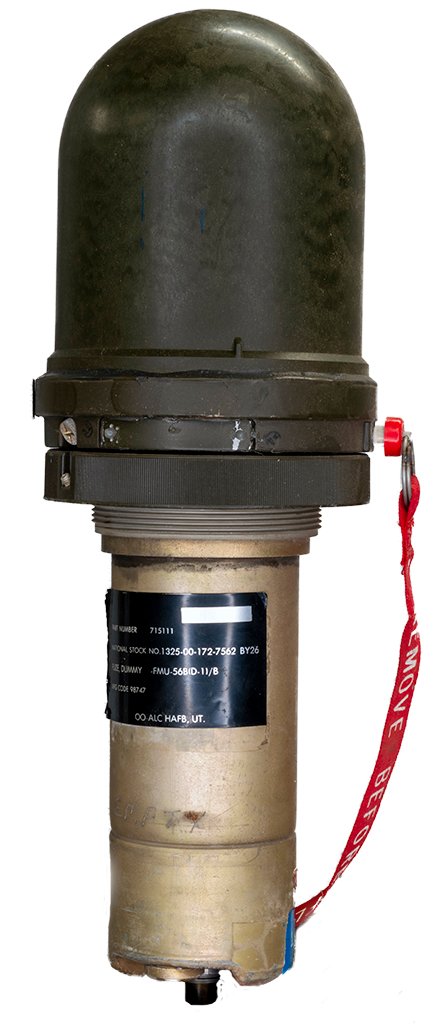
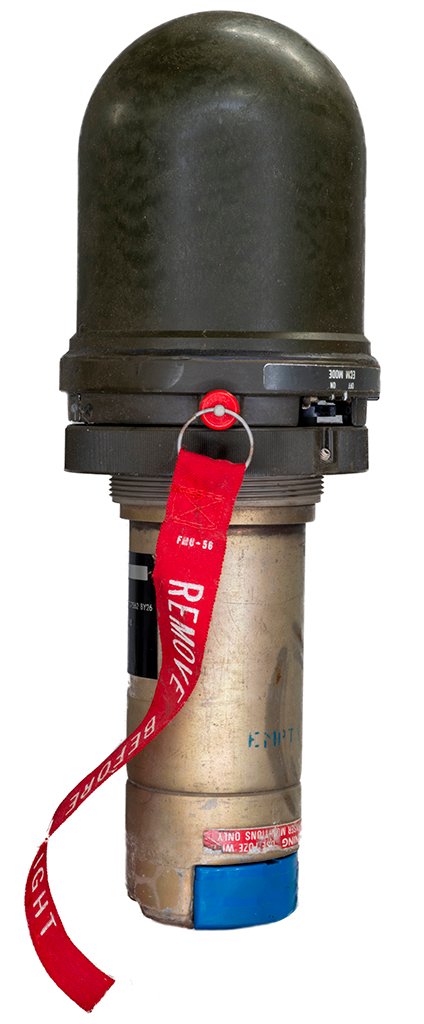
The FMU-56B/B is a United States nose-mounted proximity fuze developed during the Cold War era for use with aircraft-delivered bomb dispensers and cluster munitions. Designated within the “FMU” (Fuze, Munition Unit) nomenclature system, this electronic proximity fuze was designed to detect approaching ground targets and initiate weapon function at a predetermined altitude, optimizing the dispersal pattern of submunitions from cluster bomb dispensers. The FMU-56 series represented an advancement in air-delivered munition fuzing technology, providing aircrews with airburst capability for enhanced target coverage against area targets such as personnel concentrations, light vehicles, and other soft targets.
⚠️ SAFETY WARNING: All ordnance, including fuzes, should be considered dangerous until proven safe by qualified explosive ordnance disposal (EOD) personnel. Fuzes contain sensitive explosive components and electronic systems that may remain functional for extended periods. Never handle suspected ordnance. Report any discoveries to military or law enforcement authorities immediately.
Country/Bloc of Origin
- Country: United States of America
- Development Period: Cold War era (1960s–1970s)
- Primary Manufacturer: Motorola Government Electronics Division
- Contract Reference: F08635-73-C-0007 (1973 procurement contract)
- Service Branches: U.S. Air Force, U.S. Navy
The FMU-56 series was developed during the Vietnam War era when the United States was rapidly expanding its inventory of cluster munitions and required sophisticated fuzing systems to optimize weapon effectiveness. Motorola’s Government Electronics Division, known for radar and electronic warfare systems, provided the electronic proximity sensing technology for this fuze family.
Ordnance Class
- Type: Aircraft bomb fuze
- Primary Role: Proximity (VT) fuzing for bomb dispensers
- Position: Nose-mounted
- Function: Airburst initiation of dispenser opening mechanisms
- Category: Electronic proximity fuze
The FMU-56B/B falls within the category of Variable Time (VT) or proximity fuzes, which use electronic sensing to determine the optimal moment for weapon function based on distance to target rather than impact or elapsed time. This class of fuze revolutionized air-delivered munitions by enabling airburst detonation for maximum effect against area targets.
Ordnance Family/Nomenclature
Official Designations
- Primary Designation: FMU-56B/B (Fuze, Munition Unit, 56, Model B, Bomb)
- Variant: FMU-56D/B (later production variant)
- Training Variant: FMU-56D (D-2)/B (inert training fuze)
Nomenclature Breakdown
Following U.S. military fuze naming conventions:
- FMU: Fuze, Munition Unit (standard prefix for bomb fuzes)
- 56: Sequential designation number within the FMU series
- B: Production/modification letter (second production variant)
- /B: Indicates bomb application
Associated Weapons Systems
The FMU-56B/B was designed for use with:
- Mk 7 Mod 2 Bomb Dispenser
- Mk 7 Mod 3 Bomb Dispenser
- Mk 7 Mod 4 Bomb Dispenser
- Related cluster munition dispensers of the Vietnam/Cold War era
Related Fuze Systems
The FMU-56 operated alongside other dispenser fuzes including:
- Mk 339 Mod 0/Mod 1: Mechanical time fuze (primary alternative)
- FMU-140 Series: Later proximity fuze for Rockeye II and GATOR weapons
Hazards
Primary Hazards
- Explosive Components: Contains initiating explosives (detonator/booster elements) capable of causing injury or death
- Electronic Systems: Battery-powered circuitry may remain energized in unexpected conditions
- Proximity Sensor: Radio frequency transmitter/receiver may be affected by electromagnetic interference
Sensitivity Concerns
- RF Sensitivity: Proximity fuzes are susceptible to electromagnetic radiation from radar, radio transmitters, and other RF sources (RADHAZ/HERO concerns)
- Impact Sensitivity: Internal explosive components may detonate if subjected to severe impact
- Environmental Degradation: Aged fuzes may exhibit unpredictable behavior due to component deterioration
Specific FMU-56 Hazards
- Armed State Uncertainty: If separated from its weapon, the fuze’s armed/safe status may be difficult to determine
- Battery State: Internal thermal battery may have been activated, leaving the fuze in a potentially armed condition
- Proximity Function: If armed, the fuze may activate when detecting nearby objects, including EOD personnel
UXO Considerations
- Dud Dispensers: Unexploded cluster munition dispensers with intact FMU-56 fuzes present extreme hazards
- Separated Fuzes: Fuzes separated from their dispensers may have been partially armed
- Battlefield Recovery: FMU-56 equipped dispensers deployed in Vietnam and subsequent conflicts may still exist as UXO
⚠️ CRITICAL WARNING: Proximity fuzes are designed to function without physical contact with the target. An armed proximity fuze may detonate when EOD personnel or equipment approach within its sensing range. Extreme caution and specialized render-safe procedures are required.
Key Identification Features
Physical Characteristics
| Feature | Specification |
|---|---|
| Position | Nose-mounted |
| General Shape | Cylindrical with conical or ogive nose section |
| Material | Aluminum housing with steel components |
| Mounting Interface | Threaded or bayonet fitting for dispenser nose cavity |
External Features
- Nose Antenna: Radar/RF antenna integrated into the forward section for proximity sensing
- Selector Switches: Rotary switch assemblies for setting function parameters
- Arming Wire Provisions: Attachment points for aircraft arming wire systems
- Electrical Connectors: Interface connections for aircraft fire control systems
- Safe/Arm Indicator: Visual indication of fuze status
Markings and Identification
Based on documented examples, FMU-56 fuzes bear markings including:
- NSN (National Stock Number): 1325-NC-132856G (for FMU-56D variant)
- Nomenclature: “FUZE, PROXIMITY-FMU-56D (D-2)/B” or similar
- Manufacturer Code: MFG CODE 94990 (Motorola Government Electronics Division)
- Contract Number: Contract reference (e.g., F08635-73-C-0007)
- Lot/Serial Information: Production lot and individual serial numbers
- Selector Position Reference Plate: Indicates switch settings
Distinctive Recognition Points
- Nose-mounted configuration with antenna section forward
- Multiple selector switches (“wheels”) for pre-flight settings
- Motorola manufacturing markings (MFG CODE 94990)
- Proximity fuze configuration distinguishes from mechanical time fuzes
- Dispenser-specific mounting configuration
Fuzing Mechanisms
Operating Principle
The FMU-56B/B employs radar proximity sensing (also called Variable Time or VT fuzing) to detect the approach of ground targets and initiate fuze function at a predetermined height above the surface.
System Components
- Radio Frequency Transmitter/Receiver: Emits radar signals and detects return echoes from the ground or target
- Signal Processing Electronics: Analyzes return signals to determine altitude/distance
- Power Supply: Thermal battery activated at weapon release
- Safe and Arm (S&A) Device: Mechanical system preventing premature detonation
- Detonator/Initiator: Explosive element that initiates the dispenser’s opening charges
- Selector Switches: Allow pre-flight setting of function parameters (Height of Function, arming time, etc.)
Arming Sequence
- Pre-Flight Configuration:
- Selector switches set to desired parameters
- Fuze installed in dispenser nose fairing
- Safety devices in place
- Aircraft Release:
- Weapon separates from aircraft
- Arming wire withdrawal initiates arming sequence
- Thermal battery activates, powering electronics
- In-Flight Arming:
- Environmental sensors confirm valid flight conditions
- S&A device aligns explosive train
- Proximity sensor begins transmitting
- Arming time delay ensures safe separation from aircraft
- Function:
- Proximity sensor detects ground approach
- At preset Height of Function (HOF), fuze initiates
- Detonator fires, activating dispenser separation charges
- Submunitions release and disperse
Safety Features
- Multiple Safety Interlocks: Require sequential removal for arming
- Environmental Discrimination: Airspeed, altitude, and acceleration sensors prevent ground-level arming
- Arming Delay: Time delay ensures aircraft safe separation
- S&A Device: Physical barrier in explosive train until armed
- RF Shielding: Protection against electromagnetic interference (RADHAZ/HERO)
Function Modes
- Proximity Mode: Primary function—airburst at preset altitude
- Impact Backup: Some variants may include impact backup if proximity function fails
- Self-Destruct: May include self-destruct timing for safety
History of Development and Use
Development Context
The FMU-56 series was developed during a period of rapid advancement in U.S. air-delivered munitions technology, driven by the demands of the Vietnam War and Cold War strategic requirements. The proliferation of cluster munitions created a need for sophisticated fuzing systems that could optimize submunition dispersal patterns.
Development Timeline
1960s – Conceptual Development
- U.S. military recognized the need for proximity fuzing in cluster munitions
- Early VT fuze technology adapted from anti-aircraft applications
- Development contracts issued to electronics manufacturers
Early 1970s – Production
- Motorola Government Electronics Division awarded production contracts
- Contract F08635-73-C-0007 (1973) documented for FMU-56D production
- Integration with Mk 7 dispenser series
Vietnam War Era – Operational Deployment
- FMU-56 equipped dispensers deployed in Southeast Asia
- Used with Mk 7 Mod 2 and subsequent dispenser variants
- Employed against area targets including personnel, vehicles, and materiel
Operational Employment
The FMU-56B/B was employed with cluster munition dispensers designed for:
- Anti-personnel missions: Dispersing antipersonnel submunitions over troop concentrations
- Anti-materiel missions: Attacking vehicle parks, supply depots, and light equipment
- Area denial: Creating hazard areas through submunition dispersal
Relationship to Mk 7 Dispenser
The Mk 7 bomb dispenser series was the primary carrier for FMU-56 fuzes:
- Mk 7 Mod 2/3/4: Air-launched, free-fall dispensers using mechanical time fuzes (Mk 339) or proximity fuzes (FMU-56)
- Payload: BLU-77/B HEAT bombs and other submunitions
- Function: Flexilinear shaped charges (FLSCs) cut dispenser open, releasing payload
Evolution and Replacement
The FMU-56 series was eventually superseded by more advanced proximity fuzing systems:
- FMU-140 Series: Later proximity fuze for Rockeye II (Mk 20) and GATOR weapons
- Improved Electronics: Subsequent fuzes incorporated advances in microprocessor technology
- Enhanced Safety: Later designs addressed RADHAZ and handling safety concerns
Current Status
- Service Status: Obsolete/Replaced
- Inventory Status: Likely exhausted or demilitarized
- Historical Significance: Represents Cold War-era proximity fuze technology
- UXO Relevance: May exist in unexploded condition in former conflict zones
Technical Specifications
| Specification | Value |
|---|---|
| Designation | FMU-56B/B |
| Type | Proximity (VT) bomb fuze |
| Position | Nose |
| Manufacturer | Motorola Government Electronics Division |
| Manufacturer Code | 94990 |
| Country | United States |
| Era | Cold War (1960s–1970s) |
| NSN (FMU-56D) | 1325-NC-132856G |
| Compatible Weapons | Mk 7 Mod 2, Mod 3, Mod 4 Bomb Dispensers |
| Function Mode | Proximity airburst |
| Sensing Method | Radio frequency (radar) |
| Power Source | Thermal battery (activated at release) |
| Safety System | Mechanical Safe & Arm (S&A) device |
| Settings | Adjustable via selector switches |
| Contract Reference | F08635-73-C-0007 (1973) |
Setting Parameters
The FMU-56B/B featured multiple selector switches for pre-flight configuration:
- Height of Function (HOF): Preset altitude for proximity function
- Arming Time: Delay before fuze reaches armed state
- Additional Parameters: May include sensitivity and backup mode settings
Frequently Asked Questions
Q: What is the purpose of a proximity fuze on a cluster munition dispenser?
A: A proximity fuze optimizes the dispersal of submunitions by initiating the dispenser opening at a calculated height above the target area. This airburst function allows submunitions to spread over a wider area than ground-level function would permit. For the Mk 7 dispenser, the FMU-56B/B would trigger the flexilinear shaped charges that split the dispenser open, releasing BLU-77/B bomblets or other submunitions at the optimal altitude for target coverage.
Q: How does the FMU-56B/B differ from the Mk 339 mechanical time fuze?
A: The Mk 339 mechanical time fuze functions based on a preset time delay after weapon release—the fuze counts down a selected interval (e.g., 1.2 to 50 seconds) and then functions regardless of altitude. The FMU-56B/B, by contrast, uses radar to sense actual distance to the ground and functions at a specific height regardless of when that altitude is reached. Proximity fuzing provides more consistent results across varying release altitudes and aircraft speeds, while mechanical time fuzing requires careful calculation of release parameters.
Q: Why was Motorola selected to manufacture bomb fuzes?
A: Motorola’s Government Electronics Division possessed extensive expertise in radar, radio frequency systems, and military electronics—all critical technologies for proximity fuze development. The company’s experience with RF transmitter/receiver systems, signal processing, and ruggedized military electronics made it well-suited for producing the sophisticated electronic components required for VT fuzing. Defense electronics represented a significant portion of Motorola’s business during the Cold War era.
Q: What are RADHAZ/HERO concerns with proximity fuzes?
A: RADHAZ (Radiation Hazards) and HERO (Hazards of Electromagnetic Radiation to Ordnance) refer to the risk that external electromagnetic energy from radar, radio transmitters, or other sources could inadvertently activate proximity fuze electronics. Because proximity fuzes contain sensitive RF receivers, they can potentially be triggered by strong electromagnetic fields. For this reason, weapons with proximity fuzes require special handling procedures around flight decks, radar installations, and radio transmitters, including minimum safe distances and RF emission restrictions.
Q: Is the FMU-56B/B still in service?
A: The FMU-56B/B has been replaced by more modern fuzing systems. Current U.S. cluster munition dispensers (where not restricted by policy) typically use updated fuze designs such as the FMU-140 series. The FMU-56 represents Cold War-era technology that has been superseded by advances in electronics, safety systems, and reliability. However, legacy weapons in some allied nation stockpiles or unexploded ordnance in former conflict zones may still contain FMU-56 fuzes.
Q: What happens if the proximity function fails?
A: Depending on the specific fuze variant and settings, the FMU-56 may include backup functioning modes. Some proximity fuzes incorporate impact backup—if the radar sensing fails to detect the ground, the fuze will function upon physical impact. Others may include a self-destruct timing function that initiates the fuze after a maximum elapsed time. If all functioning modes fail, the weapon becomes a dud, presenting significant UXO hazards.
Q: How can EOD personnel identify an armed FMU-56 fuze?
A: Specific safe/arm indicators and visual inspection criteria are detailed in EOD technical manuals. Generally, proximity fuzes include visual indicators showing whether the S&A device has aligned the explosive train. However, the electronic status of the proximity sensing system may not be visually determinable. EOD procedures for proximity fuzes assume the worst case and employ appropriate standoff distances and render-safe procedures. The fuze should be treated as armed unless positively confirmed otherwise by qualified personnel using approved procedures.
Q: Were FMU-56 equipped weapons used in conflicts other than Vietnam?
A: The Mk 7 dispenser series and associated fuzing systems saw service throughout the Cold War period. While Vietnam was a primary deployment theater, these weapons were stockpiled at U.S. bases worldwide and provided to allied nations. Specific employment records for individual conflicts are not always publicly available, but the weapon systems remained in inventory through the 1970s and 1980s until replaced by improved designs.
Safety Warning
This document is for educational and identification purposes only. All grenades and explosive ordnance are extremely dangerous and should only be handled by trained military personnel or explosive ordnance disposal (EOD) specialists. Unexploded ordnance (UXO) can remain lethal for decades and may be unstable. If you encounter suspected ordnance, do not touch it—mark the location, evacuate the area, and contact military or law enforcement authorities immediately.
The information presented here is intended for military professionals, historians, collectors (handling inert training replicas only), and educational purposes. Never attempt to disarm, modify, or handle live ordnance.