M18A1 Claymore Directional AP Mine
Ordnance Overview
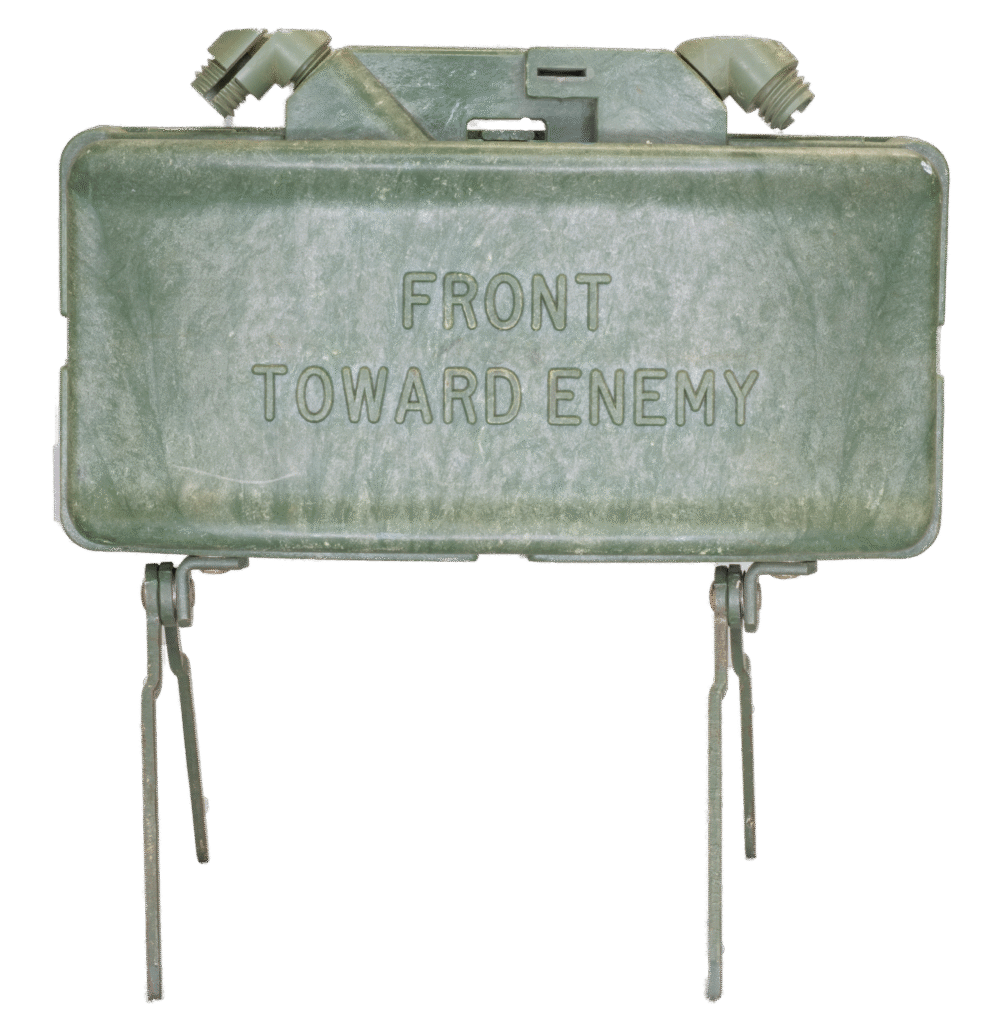
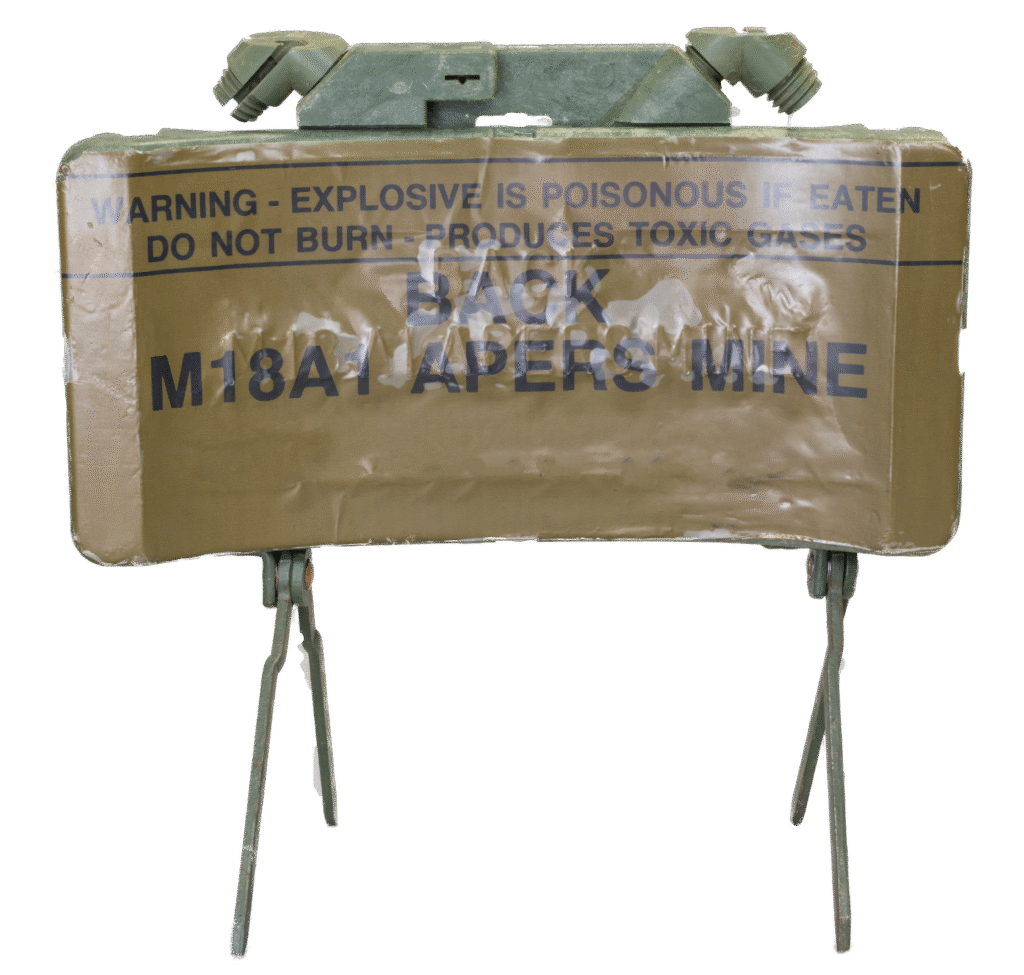
The M18A1 Claymore is one of the most recognizable and widely-used directional anti-personnel mines in military history. Distinguished by its distinctive curved rectangular shape and the embossed text “FRONT TOWARD ENEMY” on its olive drab face, the Claymore revolutionized mine warfare by introducing a controlled fragmentation pattern that could be aimed like a weapon. Unlike traditional mines that disperse fragments in all directions, the Claymore projects a fan-shaped pattern of steel balls in a predetermined killing zone, making it highly effective for ambushes, perimeter defense, and controlled defensive operations.
Country/Bloc of Origin
- Country: United States of America
- Development Period: 1952-1960
- Primary Developer: Norman MacLeod, with refinement by Picatinny Arsenal
- International Variants: The Claymore concept has been copied or licensed by numerous nations, including Canada (C19), UK variants, and various unlicensed copies produced by countries worldwide
Ordnance Class
- Type of Weapon: Directional fragmentation anti-personnel mine
- Primary Role: Anti-personnel area denial and defensive weapon
- Delivery Method: Hand-emplaced, above-ground installation
- Activation: Command-detonated (primary) or victim-activated via tripwire (secondary)
- Category: Controlled fragmentation device
Ordnance Family/Nomenclature
Official Designations
- Primary: M18A1 (current standard)
- Historical: M18 (original designation, pre-1960)
- NATO Stock Number: 1345-00-589-9834
- Federal Supply Classification: Class 1345 (Demolition Materials)
Common Names and Variants
- Common Names: Claymore mine, Claymore
- Origin of Name: Named after the Scottish Claymore sword, reflecting its directional “cutting” effect
- Related Variants:
- M18 (original model, 1960-1963)
- XM18 (experimental designation)
- M18A1 (improved model with standardized components, 1963-present)
International Derivatives
- Canadian C19 Elsie
- MON-50, MON-100, MON-200 (Soviet/Russian directional mines, similar concept)
- Various unlicensed copies worldwide
Hazards
Primary Hazards
Fragmentation Hazard (PRIMARY):
- Projects approximately 700 steel balls (10.5 grains / 0.68 grams each)
- Primary kill zone: 50 meters (165 feet) in a 60-degree horizontal arc
- Casualty-producing range: Up to 100 meters (330 feet)
- Maximum fragment range: 250 meters (820 feet)
- Fragments travel at approximately 1,200 meters per second (3,937 fps)
Blast Overpressure:
- Secondary hazard within 16 meters (52 feet) of the mine
- Backblast danger area extends 16 meters (52 feet) to the rear
Danger Zones:
- Kill Zone: 50m × 60° arc to front
- Casualty Zone: 100m × 60° arc to front
- Backblast Area: 16m radius to rear
- Safe Distance for Operator: Minimum 16 meters (52 feet) from mine when detonated
Sensitivity Characteristics
- Not pressure-sensitive when properly employed in command-detonation mode
- Relatively stable in storage and handling when safed
- Shock-sensitive explosive (C4/Composition C-4)
- Vulnerable to sympathetic detonation from nearby explosions
Environmental Considerations
- Weather Resistance: Moderate – plastic case provides some protection
- UV Degradation: Prolonged sun exposure degrades plastic case
- Temperature Range: Functions from -32°C to +63°C (-25°F to +145°F)
- Moisture: Blasting cap and firing system susceptible to water damage over time
UXO Hazards
- Claymores left in place with firing wire attached remain extremely dangerous
- Abandoned Claymores may have been booby-trapped with secondary firing devices
- Never approach or handle suspected Claymore mines
- Electrical firing systems may retain charge even if disconnected
- Corrosion may make components unstable over time
Special Warnings
⚠️ CRITICAL SAFETY INFORMATION:
- The Claymore must ALWAYS be positioned with “FRONT TOWARD ENEMY” text facing the target area
- Reversed Claymores will kill friendly personnel in the backblast area
- Fragmentation can penetrate light cover and vegetation
- Claymore fragments can ricochet off hard surfaces, creating unpredictable danger zones
- All personnel must be behind cover or at safe distance when detonated
Key Identification Features
Physical Dimensions
- Length: 216 mm (8.5 inches)
- Width: 35 mm (1.375 inches)
- Height: 83 mm (3.25 inches)
- Weight: 1.58 kg (3.5 pounds) complete with accessories
- Mine Body Weight: 1.27 kg (2.8 pounds)
Distinctive Characteristics
Shape and Profile:
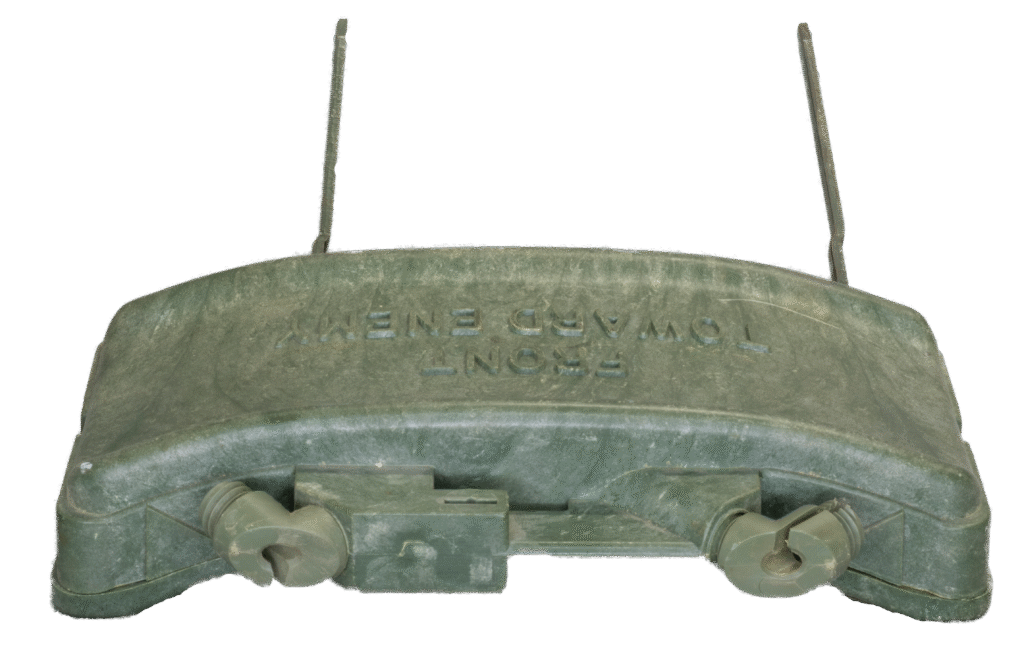
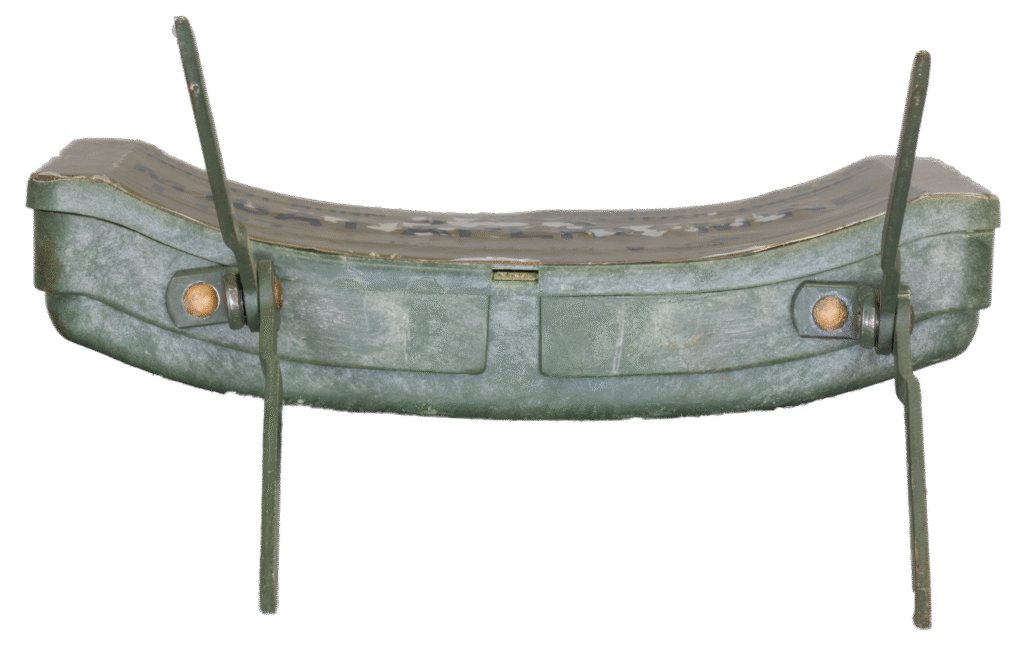
- Distinctive curved rectangular shape (convex curve faces enemy)
- Fiberglass-reinforced plastic case (polystyrene)
- Curvature designed to focus fragmentation pattern
- Four folding scissor legs for ground emplacement
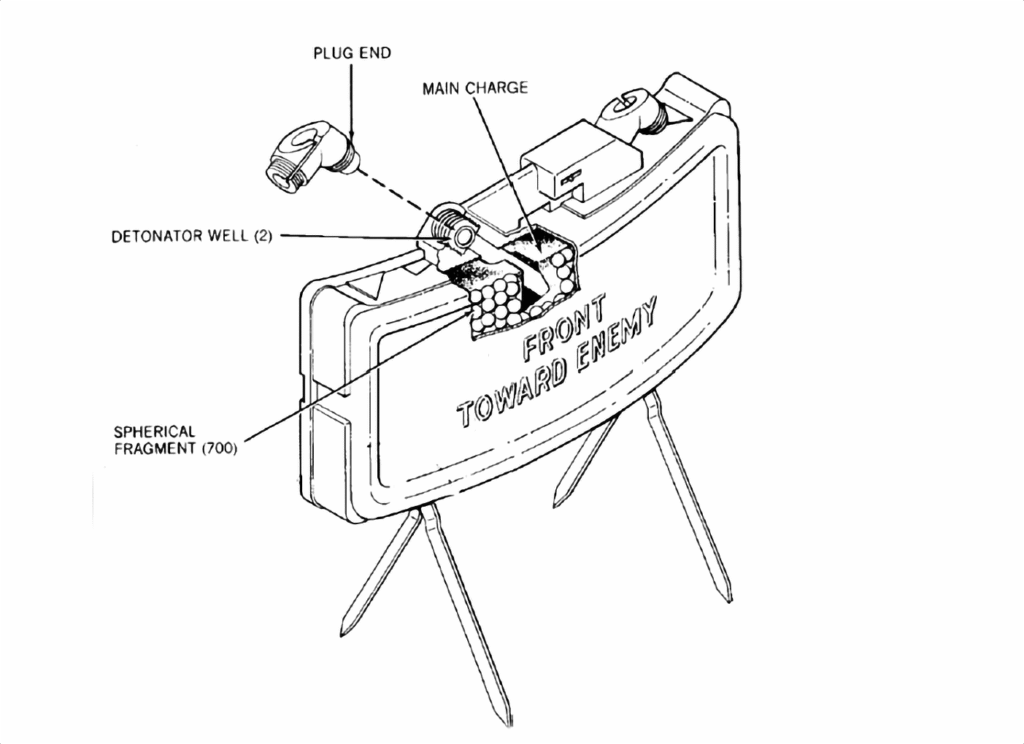
Color and Markings:
- Olive Drab Green (OD green) plastic case
- “FRONT TOWARD ENEMY” embossed in large letters on convex face
- Manufacturer markings and lot numbers on sides
- Date of manufacture stamped on case
- Aiming peep sight molded into top of mine
External Features:
- Two detonator wells (top center of mine body)
- Blasting cap adapter visible at detonator well
- Molded legs fold against body for transport
- Slit-type aiming sight on top surface
- Mounting provision for M4 electric blasting cap
Internal Construction Indicators:
- If opened or damaged: layer of C4 explosive visible (white/off-white)
- Steel ball matrix embedded in epoxy resin matrix behind explosive layer
- Convex steel plate on rear face (backplate)
Material Identification
- Case: Fiberglass-reinforced polystyrene plastic
- Legs: Aluminum or steel wire
- Explosive: Composition C-4 (RDX-based plastic explosive)
- Projectiles: Hardened steel balls (1/8 inch diameter)
- Backplate: Steel
Packaging and Accessories
When found complete, includes:
- M4 electric blasting cap (or M6 electric-safety)
- M57 firing device (clacker)
- M40 test set
- 30.5 meters (100 feet) of firing wire (two-conductor)
- M10 bandoleer carrying case
Fuzing Mechanisms
The M18A1 Claymore employs a dual-mode firing system, capable of both command detonation and victim activation.
Primary Mode: Command Detonation (Preferred Employment)
M57 Firing Device (“Clacker”):
- Type: Hand-operated electrical firing device
- Power Source: Piezoelectric crystal generator (no battery required)
- Voltage Output: Approximately 5 volts when squeezed
- Current: Sufficient to fire M4 electric blasting cap
- Range: Effective up to 100 meters (330 feet) with standard wire
- Operation: Squeeze handle generates electrical pulse through firing wire
Firing Sequence:
- M4 electric blasting cap inserted into detonator well
- Firing wire connects blasting cap to M57 firing device
- Operator squeezes M57 handle rapidly 2-3 times
- Electrical pulse ignites blasting cap
- Blasting cap detonates C4 explosive charge
- Explosive drives steel balls forward in directional pattern
- Total time from initiation to fragment dispersal: microseconds
Safety Features:
- M57 requires deliberate squeezing action (not accidental activation)
- Electrical test set (M40) allows circuit testing without detonation
- Short-circuit clip on firing wire prevents accidental detonation during emplacement
- Safety pin on blasting cap prevents premature detonation during handling
Secondary Mode: Tripwire Activation (Booby Trap Mode)
M142 Firing Device (Tripwire Adapter):
- Type: Mechanical tripwire actuator
- Trigger Force: Approximately 3-8 pounds of pull
- Design: Spring-loaded striker with safety pin
- Operation: Tripwire pull releases striker into M4 blasting cap
Activation Sequence:
- M142 attached to Claymore with M4 blasting cap
- Tripwire (typically paracord or wire) attached to M142 pull-ring
- Tripwire positioned across likely avenue of approach
- When target hits tripwire, pull-ring is extracted
- Spring-loaded firing pin strikes M4 blasting cap
- Detonation sequence identical to command mode
Limitations of Tripwire Mode:
- Non-discriminatory – will detonate for any target
- Cannot be controlled or detonated on command
- May be accidentally triggered by animals, friendly forces, or weather
- Considered less desirable than command detonation for most applications
Arming and Safety Procedures
Arming Sequence:
- Emplace mine in desired location facing target area
- Verify “FRONT TOWARD ENEMY” faces correctly
- Insert M4 blasting cap into detonator well
- Connect firing wire to blasting cap
- Unspool firing wire to firing position
- Remove short-circuit clip from firing wire
- Connect firing wire to M57 firing device
- Mine is now armed and ready to fire
Safety Considerations:
- Always maintain short-circuit clip on firing wire during emplacement
- Test electrical circuit with M40 test set before connecting M57
- Ensure all friendly personnel are aware of mine locations
- Mark mine locations on map/diagram for recovery
- Never point mine toward friendly positions
Anti-Handling Features
While the standard M18A1 does not include built-in anti-handling devices, they can be added:
- Anti-disturbance fuzes can be connected to secondary detonator well
- M1 pressure-release switches placed under mine
- M3 or M5 pressure switches attached to rear
- Improvised booby traps (command-detonated by observer watching mine)
UXO Warning: Any Claymore found in the field should be assumed to have anti-handling devices attached and must only be approached by qualified EOD personnel.
History of Development and Use
Development Origins (1952-1960)
The Claymore mine emerged from Korean War experiences where U.S. forces faced massed infantry attacks and required more effective defensive weapons.
Early Development:
- 1952: Norman MacLeod, a U.S. weapons designer, began developing the directional mine concept at Picatinny Arsenal
- Inspiration: The German Schrapnellmine (S-Mine or “Bouncing Betty”) demonstrated the effectiveness of fragmentation mines, but MacLeod sought a directional alternative
- Early Prototypes: Named “Claymore” after the Scottish broadsword, reflecting its “cutting” fragmentation effect
- Challenge: Creating a controlled fragmentation pattern rather than omnidirectional dispersal
Design Evolution:
- Initial designs used shaped charges, but fragmentation patterns were inconsistent
- MacLeod developed the curved rectangular design to focus fragments
- Curved steel plate and properly arranged spheres created predictable pattern
- C3 explosive initially used, later replaced by more stable C4 composition
Testing and Refinement:
- 1954-1956: Extensive testing at Aberdeen Proving Ground
- Adjustments to curvature, ball arrangement, and explosive charge
- Development of reliable electrical firing system (M57 clacker)
- 1960: Standardized as M18
Improvement to M18A1:
- 1963: Upgraded to M18A1 designation
- Improved plastic case with better weather resistance
- Standardized components for easier manufacturing
- Enhanced reliability of blasting cap adapter
- Current standard remains largely unchanged since 1963
Combat Deployment and Historical Use
Vietnam War (1965-1975):
- First large-scale combat employment of the Claymore
- Perimeter defense: Used extensively around base camps and fire support bases
- Ambush operations: Infantry units employed Claymores in coordinated ambushes along trails
- Night defensive fires: Controlled detonation prevented friendly casualties
- Effectiveness: Proved highly effective against massed infantry attacks
- Psychological impact: Distinctive “crack” of detonation and deadly effectiveness became well-known
Key Tactical Applications in Vietnam:
- Firebase defense: Multiple Claymores positioned in overlapping fields of fire
- Trail interdiction: Ambush teams used command-detonated Claymores to initiate attacks
- Listening posts: Small teams employed Claymores for self-defense
- Helicopter landing zones: Perimeter security during insertions/extractions
Post-Vietnam Conflicts:
Cold War Era:
- Standard defensive weapon in NATO forces
- Deployed extensively along the inner-German border
- Stockpiled for defensive operations worldwide
1980s-1990s:
- Grenada (1983): Used in defensive positions
- Panama (1989): Perimeter defense applications
- Persian Gulf War (1991): Defensive positions and perimeter security
- Somalia (1993): Urban defensive operations
- Balkans (1990s): Peacekeeping force defensive measures
Global War on Terror (2001-Present):
- Afghanistan (2001-2021): Checkpoint security, base defense, ambush operations
- Iraq (2003-2011): Convoy security, base perimeter defense, urban operations
- Continuing use: Remains in active service with U.S. and allied forces worldwide
Production and Distribution
Manufacturing:
- Primary manufacturer: Various U.S. defense contractors over decades
- Current production: Continues for U.S. military and foreign military sales
- Production numbers: Millions produced since 1960 (exact numbers classified)
- Cost: Approximately $120-150 per unit (current pricing)
International Distribution:
- Supplied to NATO allies and partner nations through Foreign Military Sales
- Licensed production in some allied countries
- Proliferation: Copied designs exist worldwide, including MON-series mines (Russia/Soviet)
Tactical and Doctrinal Impact
Doctrinal Changes:
- Introduced concept of controlled fragmentation into mine warfare
- Enabled discriminatory engagement – operator could choose when to fire
- Shifted mine employment from passive barriers to active defensive weapons
- Reduced fratricide risk compared to conventional mines
Tactical Innovation:
- Claymore-based ambushes became standard infantry tactic
- Integration with trip flares and sensors for automated defense
- Scalable defense: From individual fighting positions to large perimeters
- Command detonation allowed safe employment near friendly forces
Influence on Mine Design:
- Inspired similar directional mines worldwide (MON-50, MON-100, MON-200)
- Demonstrated viability of above-ground mine emplacement
- Modern variants: Some current systems use Claymore-type directional principles in automated defensive systems
Current Status
In Service:
- Remains standard issue in U.S. Army, Marine Corps, and Special Operations Forces
- Active service with dozens of allied militaries worldwide
- Continuously stockpiled and maintained
- No plans for replacement in near future
Modern Context:
- Ottawa Treaty (1997): U.S. is not a signatory; Claymore use continues
- Command-detonation exemption: Command-detonated Claymores generally not considered banned mines under international law when employed in command mode
- Tripwire controversy: Victim-activated mode (tripwire) is more legally problematic under mine ban treaties
- Doctrinal emphasis: Current U.S. doctrine emphasizes command-detonation over victim-activation
Legacy:
- One of the most successful and enduring mine designs in history
- Remains highly effective despite being over 60 years old
- Symbol of controlled defensive firepower
- Cultural impact: Recognized even in popular culture due to distinctive “FRONT TOWARD ENEMY” marking
Technical Specifications
Explosive Content
- Explosive Type: Composition C-4 (RDX-based plastic explosive)
- Explosive Weight: 682 grams (1.5 pounds)
- RDX Content: Approximately 91% by weight
- Detonation Velocity: 8,040 m/s (26,400 fps)
- TNT Equivalence: Approximately 1.34:1
Fragmentation System
- Projectile Type: Hardened steel balls
- Ball Diameter: 3.175 mm (1/8 inch, 10.5 grain)
- Number of Balls: Approximately 700
- Arrangement: Embedded in epoxy resin matrix in curved layer
- Fragment Velocity: 1,200 m/s (3,937 fps)
- Fragment Pattern: 60° horizontal arc, 2° above and below horizontal
Effective Range and Pattern
- Optimum Range: 50 meters (165 feet)
- Horizontal Coverage: 60-degree arc
- Vertical Coverage: Approximately 4-degree arc (2° up, 2° down)
- Pattern Dimensions at 50m:
- Width: 55 meters (180 feet)
- Height: 2 meters (6.5 feet)
- Maximum Effective Range: 100 meters (casualties)
- Maximum Fragmentation Range: 250 meters
Electrical Characteristics
- Blasting Cap: M4 electric (or M6 electric-safety)
- Firing Current: Minimum 0.5 amperes
- Firing Voltage: Minimum 2.5 volts DC
- M57 Output: Approximately 5 volts, sufficient current
- Wire Resistance: Maximum 40 ohms for standard 100-foot firing wire
- Circuit Test: M40 test set (measures circuit continuity without detonation)
Environmental Specifications
- Operating Temperature: -32°C to +63°C (-25°F to +145°F)
- Storage Temperature: -51°C to +71°C (-60°F to +160°F)
- Humidity: Resistant to moderate humidity; prolonged immersion degrades electrical system
- Shelf Life: Indefinite for mine body; blasting caps have limited shelf life (inspect regularly)
Deployment Specifications
- Emplacement Time: 1-2 minutes per mine (trained personnel)
- Firing Wire Length: Standard 30.5 meters (100 feet); can be extended with additional wire
- Minimum Safe Distance (Command): 16 meters (52 feet) behind cover
- Minimum Safe Distance (Maintenance): 300 meters when defusing or deactivating
Packaging
- Primary Container: M10 bandoleer (satchel)
- Bandoleer Contents:
- 1× M18A1 mine
- 1× M57 firing device
- 1× M4 blasting cap
- 1× spool firing wire (100 feet)
- 1× M40 test set
- Shipping Container: Wooden crates or fiber containers (multiple bandoleers)
- Weight (complete package): Approximately 1.8 kg (4 pounds)
Comparative Data
For reference, compared to other anti-personnel mines:
- Larger kill radius than conventional blast mines (5-10m typical)
- Directional pattern vs. omnidirectional fragmentation
- Heavier than most AP mines but hand-portable
- More complex than simple pressure mines but far more controllable
Frequently Asked Questions
Q: Why is the M18A1 Claymore called a “directional” mine, and how does this differ from conventional mines?
A: The Claymore is called directional because it projects its lethal fragmentation in a controlled, fan-shaped pattern rather than dispersing fragments equally in all directions. The mine’s curved rectangular shape focuses approximately 700 steel balls into a 60-degree arc extending 50-100 meters to the front, while minimizing danger to the rear. This directionality is achieved through the mine’s curved design, which positions the explosive charge behind a layer of steel balls embedded in epoxy; when detonated, the explosive drives the balls forward in a predictable pattern. Conventional anti-personnel mines (like the M14 or PMN-series) disperse fragments, blast, or pressure effects in all directions, creating a circular danger zone. The Claymore’s directional design allows friendly forces to safely operate behind the mine and enables tactical control over the engagement area—you aim it like a weapon rather than creating an indiscriminate hazard zone.
Q: What does “command-detonated” mean, and why is this the preferred mode of employment for the Claymore?
A: Command-detonation means the mine is fired by a human operator using the M57 firing device (“clacker”) connected via electrical wire, giving the operator complete control over when—and if—the mine detonates. This is the preferred employment method because it offers several critical advantages: First, it eliminates fratricide risk by allowing operators to positively identify targets before firing, ensuring friendly forces aren’t accidentally engaged. Second, it maintains surprise—the enemy doesn’t know the mine is present until detonation. Third, it allows multiple mines to be fired simultaneously in coordinated ambushes. Fourth, it enables safe recovery if the tactical situation changes—an unfired Claymore can be disconnected and removed. While the Claymore can be rigged with tripwires (M142 firing device) for victim-activation, this mode is non-discriminatory and may engage friendly forces, animals, or unintended targets. Command detonation preserves the Claymore’s greatest advantage: controlled, discriminatory application of lethal force exactly when and where the operator chooses.
Q: What is the significance of the “FRONT TOWARD ENEMY” marking, and what happens if a Claymore is positioned incorrectly?
A: The “FRONT TOWARD ENEMY” marking is arguably the most important feature of the Claymore mine—it must be positioned correctly or the results are catastrophic for friendly forces. The embossed text indicates which face of the mine (the convex/curved face) must point toward the target area; this is the direction the 700 steel balls will travel at 1,200 meters per second. If a Claymore is accidentally reversed, the fragmentation pattern is directed toward friendly positions instead of the enemy, creating a deadly fratricide situation. The backblast area (16 meters to the rear) becomes the kill zone, potentially killing the operator or nearby personnel. This is not a theoretical concern—there are documented incidents where improperly oriented Claymores killed friendly troops during training or combat. The marking’s high visibility and clear language are safety-critical design features. Proper emplacement procedures require soldiers to verify orientation by physically reading the marking, using the molded aiming sight, and conducting buddy-checks before connecting the firing wire. The importance of this simple text cannot be overstated: it’s the difference between engaging the enemy and killing your own forces.
Q: How does the M18A1 compare to the Soviet/Russian MON-series directional mines?
A: The Soviet/Russian MON-series mines (MON-50, MON-100, MON-200) are directly inspired by the Claymore and share the same directional fragmentation concept, but with significant differences. The MON-50 is roughly equivalent to the Claymore—both use approximately 700 grams of explosive and produce similar fragmentation patterns at comparable ranges. However, MON-series mines use a flat rectangular design rather than the Claymore’s curved shape, and typically employ a fragmentation liner or pre-formed fragments rather than individual steel balls. The MON-100 (100mm designation) and MON-200 contain progressively more explosive and fragments, extending effective range and lethality. A key tactical difference is that MON mines are often employed with electronic sensors or tripwires for automatic engagement, while U.S. doctrine emphasizes command-detonation for Claymores. Operationally, all directional mines share the same advantage: focused fragmentation that allows safer employment near friendly forces compared to omnidirectional mines. The Claymore’s curved design generally produces a more consistent fragment pattern, while MON mines’ larger variants offer greater stand-off range. Both systems remain highly effective and widely proliferated in their respective spheres of influence.
Q: Can the M18A1 Claymore defeat body armor, and what factors affect its lethality against protected targets?
A: The Claymore’s lethality against body armor depends heavily on range, armor type, and fragment impact patterns. At optimum range (50 meters), individual 10.5-grain steel balls strike with significant kinetic energy but may be defeated by modern hard armor plates (ceramic or steel). However, the Claymore’s lethality mechanism against armored targets relies on multiple simultaneous impacts—even if individual fragments can’t penetrate armor, the sheer number of impacts (potentially dozens of balls striking a man-sized target) causes trauma, fragment penetration in unarmored areas (face, neck, limbs, groin), and armor plate failure through cumulative stress. Soft body armor (Kevlar/aramid) offers minimal protection against Claymore fragments at close range. At extended ranges (75-100 meters), fragment velocity decreases and dispersion increases, reducing effectiveness against both armored and unarmored targets. Historical data from Vietnam and subsequent conflicts shows that even targets with partial protection suffer severe casualties from Claymore strikes due to the fragment density and multiple impact effects. The weapon remains highly effective because it attacks the entire body, not just the armored torso, and overwhelms protective equipment through sheer volume of projectiles. Against modern hard armor, the Claymore remains lethal but not universally so—it inflicts casualties through unprotected areas, blast effects, and psychological shock even when armor stops some fragments.
Q: Why hasn’t the M18A1 Claymore been replaced by more modern technology despite being designed in the 1950s?
A: The Claymore remains in service over 60 years after its development because it represents a mature, optimized solution to a persistent tactical problem: controlled anti-personnel defense. Several factors explain its longevity: First, the fundamental physics of directional fragmentation haven’t changed—the Claymore’s curved design and fragment arrangement are nearly optimal for its intended purpose. Second, the weapon is mechanically simple, rugged, and reliable with minimal maintenance requirements, critical qualities for field equipment. Third, it’s cost-effective—at approximately $120-150 per unit, it delivers devastating firepower at a fraction of the cost of modern alternatives. Fourth, the command-detonation feature gives it flexibility that autonomous systems lack; human operators provide discrimination and tactical judgment that sensors cannot match. While experimental replacements have been tested (including sensor-fuzed systems and automated defensive units), none offer sufficient advantage to justify replacing millions of stockpiled Claymores. Modern innovations focus on integration rather than replacement—Claymores are now networked with sensors, night vision, and command systems while retaining the basic mine design. The Claymore’s continued service reflects a military axiom: if a weapon system reliably accomplishes its mission at acceptable cost, there’s little incentive to replace it. Like other enduring designs (the M2 Browning, the M18 smoke grenade), the Claymore succeeds because it works—simple, effective, and hard to improve upon.
Q: What are the key safety considerations when encountering a suspected Claymore mine in the field?
A: Encountering a suspected Claymore or similar directional mine requires extreme caution and adherence to explosive ordnance disposal (EOD) protocols. First and foremost: never approach, touch, or attempt to move any suspected ordnance—evacuate the area immediately and report the find to military authorities or EOD personnel. If you must identify a Claymore from a safe distance (50+ meters), key indicators include the distinctive curved rectangular shape, olive drab color, and “FRONT TOWARD ENEMY” text on the convex face. However, assume any suspected Claymore has been booby-trapped with anti-handling devices attached to the rear, sides, or underneath the mine—these secondary firing systems are designed to detonate if the mine is lifted, tilted, or disturbed. Firing wires may still be connected and energized, or electronic sensors may have replaced the wire. Weather-degraded Claymores are particularly dangerous because corrosion can make components unstable and unpredictable. The explosive (C4) remains sensitive indefinitely, and the electrical blasting cap may be corroded but still functional. Never cut firing wires, as this may trigger anti-handling circuits. If you discover a Claymore on your property or in a civilian area, immediately call police or military EOD—these are not souvenirs and retain full lethal capability decades after emplacement. The only safe approach to any suspected ordnance is professional disposal by trained personnel.
Q: How are Claymore mines employed tactically in modern military operations, and what are the legal considerations surrounding their use?
A: Modern tactical employment of the M18A1 Claymore emphasizes command-detonated defensive operations while navigating complex legal and operational constraints. Tactically, Claymores are used for perimeter defense around forward operating bases, vehicle checkpoints, and patrol bases—typically positioned in overlapping fields of fire to cover likely avenues of approach. In offensive operations, infantry units employ them in hasty ambushes along trails or roads, with multiple Claymores fired simultaneously to initiate contact. Small units use Claymores to secure overnight positions or observation posts, providing protective fires that can be controlled from inside fighting positions. Modern integration includes connecting Claymores to sensors (ground surveillance radar, motion detectors, or infrared systems) while maintaining human-in-the-loop control—the sensor cues the operator, but the decision to fire remains with trained personnel. Legally, Claymore use is governed by the law of armed conflict and, for many nations, by the Ottawa Mine Ban Treaty (1997). The United States is not a signatory to the Ottawa Treaty, but U.S. policy restricts Claymore use: command-detonated employment is legal under U.S. and international law because it requires human activation (making it a “command-detonated munition” rather than a mine). Victim-activated employment (tripwires) is legally problematic and generally prohibited except in specific circumstances like force protection in imminent threat situations. Current doctrine prioritizes command detonation and requires detailed emplacement records, retrieval procedures, and accountability to prevent Claymores from becoming abandoned munitions. These legal and policy considerations don’t diminish the Claymore’s tactical value—they ensure its employment remains discriminate, controlled, and compliant with the laws of war.
Safety Notice
⚠️ WARNING: All information provided is for educational and identification purposes only.
- Never approach, handle, or attempt to move any suspected ordnance, including Claymore mines
- All unexploded ordnance (UXO) must be treated as armed and dangerous regardless of apparent condition
- Suspected ordnance should be reported immediately to military authorities, law enforcement, or explosive ordnance disposal (EOD) teams
- Do not attempt to defuse, disarm, or recover military ordnance without proper training and authorization
- This lesson is intended for military training, EOD education, and historical understanding—not for unauthorized ordnance handling
If you discover suspected military ordnance:
- Do not touch or move the item
- Mark the location from a safe distance
- Evacuate the immediate area
- Report to authorities immediately
- Prevent others from approaching
Safety Warning
This document is for educational and identification purposes only. All grenades and explosive ordnance are extremely dangerous and should only be handled by trained military personnel or explosive ordnance disposal (EOD) specialists. Unexploded ordnance (UXO) can remain lethal for decades and may be unstable. If you encounter suspected ordnance, do not touch it—mark the location, evacuate the area, and contact military or law enforcement authorities immediately.
The information presented here is intended for military professionals, historians, collectors (handling inert training replicas only), and educational purposes. Never attempt to disarm, modify, or handle live ordnance.