MUV-2 Mine Fuze
Ordnance Overview
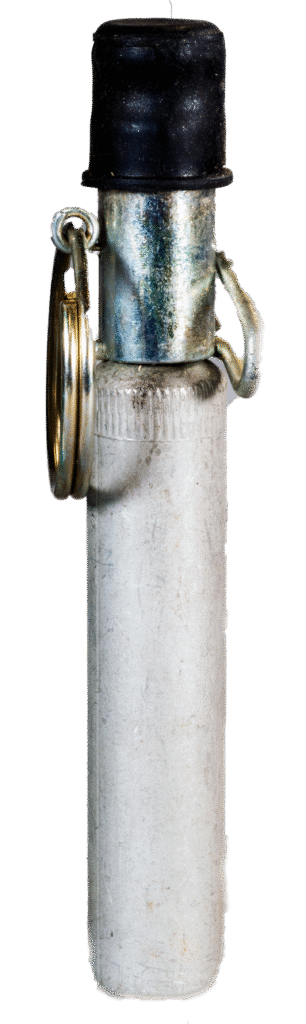
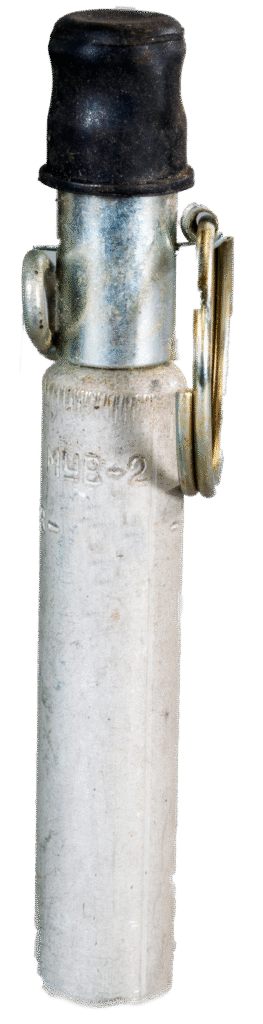
The MUV-2 (Minski Udarno-Vzryvatel, or “Minimal Impact Fuze”) is a Soviet-designed minimum-metal anti-personnel mine fuze developed during the Cold War era. This ingenious device exemplifies Soviet mine warfare doctrine’s emphasis on simplicity, reliability, and economy. The MUV-2 is specifically designed to function with the PMN-series anti-personnel mines (primarily the PMN-2), though it can be adapted for use with other mine bodies. What makes the MUV-2 particularly noteworthy—and concerning from a humanitarian standpoint—is its extremely minimal metal content, making it exceptionally difficult to detect with standard metal detectors. The fuze represents a sophisticated approach to mine design that prioritizes low-cost production and resistance to detection while maintaining reliable function under diverse environmental conditions.
Country/Bloc of Origin
- Country: Soviet Union (USSR)
- Development Period: 1970s-1980s
- Operational Introduction: Early 1980s
- Production Status: Produced through the late Soviet era; continued production in successor states
- International Distribution: Widely exported to Soviet client states and allies throughout the 1980s-1990s, including:
- Afghanistan (Soviet forces and later DRA forces)
- Angola
- Cambodia
- Mozambique
- Various Middle Eastern nations
- Former Yugoslavia
- Current Status: Remains in service in many countries; large stockpiles exist; encountered regularly in mine-contaminated areas worldwide
Ordnance Class
- Weapon Type: Anti-personnel mine fuze assembly
- Primary Role: Pressure-activated firing mechanism for minimum-metal anti-personnel blast mines
- Subcategory: Mechanical-pressure fuze, direct-action type
- Delivery Method: Hand-emplaced (component installed in mine body during field deployment)
- Compatible Systems: Primarily PMN-2 anti-personnel mine, but adaptable to various mine bodies
- Classification: Mine fuze component (not a complete mine)
Ordnance Family/Nomenclature
Official Designation:
- MUV-2 (МУВ-2 in Cyrillic)
- Full designation: Minski Udarno-Vzryvatel, Model 2
Related Family Members:
- MUV-3: Improved variant with enhanced sensitivity range
- MUV-4: Later model with modified pressure plate design
- MUV-2M: Modernized version with improved environmental sealing
Associated Mine Bodies:
- PMN-2: Primary mine designed for MUV-2 fuze
- PMN-3: Later mine model also using MUV-2 derivatives
- PMN-4: Most recent PMN-series mine compatible with MUV-2 family fuzes
- Various improvised or modified mine bodies
Common Names and Nicknames:
- “Minimal fuze” (translation of “minimal” component)
- “Green fuze” (referring to typical color of body)
- “PMN fuze” (when context of mine is understood)
NATO Stock Number: No formal NATO stock number (Soviet origin, though NATO has classification codes for identification purposes)
Hazards
The MUV-2 fuze presents severe hazards that make mines equipped with this fuze particularly dangerous to military and civilian populations.
Primary Hazards:
Blast Injury:
- When installed in a PMN-2 mine (containing approximately 100-115g of TNT), the fuze initiates a blast sufficient to cause severe foot and lower leg trauma
- Typical injuries include traumatic amputation below the knee, extensive soft tissue damage, and fragmentation wounds
- Secondary injuries from blast overpressure include traumatic brain injury and internal organ damage
- Blast effects extend to approximately 1-2 meters from point of detonation
Pressure Sensitivity:
- Activation pressure: 5-15 kg (11-33 lbs) depending on adjustment and age
- Designed to function under the weight of an average person
- Will not typically function from small animals but will activate from larger animals (livestock)
- Degradation over time can increase sensitivity, making older mines more prone to activation
Detection Difficulty:
- Minimal metal content (less than 1 gram of metal in the fuze assembly) makes detection with standard metal detectors extremely difficult
- Mine body (PMN-2) also uses minimal metal, creating an exceptionally low metal signature
- Dogs and other biological detection methods are more effective than metal detectors
- Ground-penetrating radar shows limited effectiveness in certain soil conditions
Unexploded Ordnance Risks:
- Mines with MUV-2 fuzes can remain functional for decades
- Environmental degradation may increase sensitivity or cause unpredictable behavior
- Corrosion of the small amount of metal present can affect function but not necessarily neutralize the mine
- Freezing and thawing cycles can affect plastic components, potentially making the fuze more or less sensitive
Booby-Trap Features:
- Some MUV-2 variants include anti-handling devices
- Certain configurations incorporate tilt-rod or pull-wire assemblies that make the mine booby-trapped
- Disturbance of the mine body can initiate detonation even without pressure on the main fuze
Environmental Persistence:
- No self-destruct or self-neutralization mechanism
- Plastic construction resists environmental degradation better than older metal fuzes
- Can function after prolonged submersion, burial, or exposure to extreme temperatures
- Chemical degradation of plastic occurs slowly, meaning decades-long functional life
Special Warnings:
- EXTREME DANGER: The MUV-2’s minimal metal content has made PMN-2 mines among the most difficult to clear
- Historical contamination from Soviet-Afghan War, Yugoslav conflicts, and African wars means these mines remain a present danger
- Agricultural activities, construction, and even casual walking in contaminated areas pose severe risks
Key Identification Features
Proper identification of the MUV-2 fuze is essential for EOD personnel, humanitarian demining teams, and military forces operating in mine-contaminated areas.
Physical Dimensions:
- Height: Approximately 25-30 mm (1.0-1.2 inches) when installed in mine body
- Diameter: Approximately 30-35 mm (1.2-1.4 inches) at the pressure plate
- Total Weight: Approximately 15-20 grams (0.5-0.7 oz)
- Metal Content: Less than 1 gram (minimal steel spring and striker)
Shape and Profile:
- Cylindrical body with flat top pressure plate
- Low-profile design that sits flush or slightly recessed in mine body
- Simple, unadorned appearance reflecting functional design
- No prominent external features or protrusions in armed state
Color and Markings:
- Body Color: Typically olive green, dark green, or brown plastic
- Pressure Plate: May be same color as body or slightly different shade
- Markings: Usually minimal or absent; some examples show Cyrillic characters or lot codes
- Weathering: Plastic may fade to lighter green or gray-green with UV exposure
- Discoloration: White or chalky appearance possible from chemical degradation
Distinctive Features When Observed in Mine:
Top (Pressure Plate) View:
- Circular or slightly elliptical pressure plate flush with mine body surface
- May show concentric circles or radial lines from manufacturing process
- Center may have small dimple or marking
- Smooth surface to minimize visible profile
Side View (if mine is exposed):
- Cylindrical fuze well in center of mine body
- Fuze body extends into mine but does not protrude from bottom
- Simple mechanical interface with mine body
Material Composition:
- Body: Plastic (typically polypropylene or similar polymer)
- Pressure Plate: Plastic, same or similar material to body
- Internal Spring: Small steel compression spring (primary metal component)
- Striker: Steel firing pin
- Detonator: Lead azide or similar primary explosive in small aluminum or brass cup (the only substantial metal)
Identification in Recovered Mines:
- Often seen threaded into top of PMN-2 mine body
- May have safety clip or pin still in place (if mine was never armed)
- Arming plug or cap may be visible in armed mines
- Green or earth-tone colors predominate
Comparison to Similar Fuzes:
- Simpler than MD-9 fuze (which has more metal content)
- More compact than older MUV-1 (predecessor model)
- Lacks the elaborate mechanical features of Western mine fuzes like the M605
- More difficult to identify than metallic fuzes due to lack of distinctive metal components
Fuzing Mechanisms
The MUV-2 employs a mechanical-pressure activation system that exemplifies Soviet design philosophy: maximum simplicity and reliability with minimal materials.
Fuze Type:
- Mechanical pressure fuze with direct-action firing mechanism
- Non-electrical system – no batteries, circuits, or electronic components
- Pure mechanical device relying on physical compression
Pre-Installation State:
Before the fuze is installed in a mine and armed:
- Fuze is in an inert, safe condition
- Safety pin prevents striker from contacting detonator
- Detonator is not installed (transported and stored separately)
- Pressure plate is locked in safe position
Installation and Arming Sequence:
- Mine Preparation:
- PMN-2 or other compatible mine body is prepared for deployment
- Fuze well (central threaded cavity) is cleaned and inspected
- Explosive charge (typically TNT) is verified to be properly positioned
- Fuze Installation:
- MUV-2 fuze is carefully threaded into the fuze well
- Proper thread engagement ensures correct seating depth
- Care is taken to ensure no dirt or debris interferes with mechanism
- Detonator Installation:
- Small detonator (primary explosive charge) is inserted into the fuze body
- Detonator seats in cavity directly below the striker pin path
- This step represents the point where the system becomes potentially live
- Safety Pin Removal:
- Metal safety pin or clip is carefully removed
- This releases the mechanical interlock that prevents striker movement
- Critical moment: After this step, the mine is fully armed and any pressure exceeding threshold will cause detonation
- Final Arming:
- Arming plug (if present) is removed or rotated to armed position
- Pressure plate is now free to move and compress internal spring
- Mine is live and will function when stepped on
Operational Mechanism:
When armed and subjected to pressure:
- Pressure Application: Target (person, animal, vehicle tire in some cases) steps on mine or pressure plate
- Spring Compression: Pressure plate moves downward, compressing internal spring
- Striker Release: When pressure exceeds threshold (5-15 kg), mechanical catch releases
- Striker Impact: Spring-loaded striker pin drives downward into detonator
- Primary Detonation: Detonator explodes from percussion impact
- Main Charge Initiation: Detonator shock wave initiates TNT main charge
- Mine Detonation: Full explosive energy is released, creating blast effect
Pressure Threshold Characteristics:
- Design Threshold: Typically 5-10 kg for new fuzes
- Adjustment: Some variants allow minor adjustment of sensitivity via spring tension
- Age Effects: Older fuzes may become more sensitive (3-5 kg) or less sensitive (15-20 kg) due to spring corrosion or plastic creep
- Environmental Factors:
- Freezing can increase required pressure (plastic stiffness)
- Heat can decrease required pressure (plastic softening)
- Moisture generally has minimal effect due to sealed design
Firing Train:
Primary → Secondary → Main Charge sequence:
- Striker Impact: Mechanical energy from falling striker
- Detonator: Primary explosive (lead azide, ~0.3-0.5g)
- Booster (if present): Small amount of secondary explosive
- Main Charge: TNT or other high explosive in mine body (100-115g in PMN-2)
Safety Features:
- Safety pin prevents accidental striker release during transport and handling
- Detonator stored separately until final arming
- Positive mechanical interlock requires deliberate arming sequence
- Thread design prevents fuze from backing out accidentally
Reliability Considerations:
- Very high reliability: Simple mechanical design has few failure modes
- Environmental stability: Plastic construction resists moisture better than metal fuzes
- Long shelf life: Can remain functional for decades in storage or deployed
- Cold weather performance: Generally reliable down to -40°C, though pressure threshold may increase
- Estimated functionality: 90%+ reliability in proper deployment conditions
Anti-Handling Variants:
Some MUV-2 fuzes or mines using MUV-2 fuzes incorporate anti-handling features:
- Tilt rods: Vertical rods that trigger detonation if mine is disturbed
- Pull-wire assemblies: Wires attached to stakes that trigger if pulled
- Secondary fuze wells: Allow installation of booby-trap fuzes on bottom of mine
No Self-Destruct:
- The MUV-2 does NOT include self-destruct or self-neutralization mechanisms
- Once armed, the mine remains dangerous indefinitely
- This contributes significantly to the humanitarian impact of mines using this fuze
History of Development and Use
Development Context (1970s):
The MUV-2 fuze was developed during the Cold War as part of the Soviet Union’s extensive land mine development programs. Soviet military doctrine emphasized extensive use of land mines for defensive operations, area denial, and channeling enemy forces into kill zones. By the 1970s, mine warfare technology was evolving rapidly, with increasing focus on:
- Reduced detectability: Western forces were improving metal detector technology, making traditional metal-bodied mines easier to locate
- Cost reduction: Mass production of mines required inexpensive, simplified designs
- Reliability: Mines needed to function in diverse environments from Arctic cold to tropical heat
- Simplicity: Conscript soldiers needed to emplace mines quickly without complex training
The MUV-2 was designed to address these requirements, particularly the detectability issue. By minimizing metal content to less than 1 gram, the fuze made mines extremely difficult to detect with standard mine detection equipment.
Design Philosophy:
Soviet engineers, drawing on extensive experience from World War II and subsequent conflicts, created the MUV-2 with several key principles:
- Mechanical reliability over electronic complexity: No batteries to fail, no circuits to corrode
- Minimal manufacturing cost: Plastic injection molding and simple spring mechanisms
- Field repairability: Simple enough that basic repairs could be made by combat engineers
- Standardization: Compatible with multiple mine bodies using standard threading
Integration with PMN-Series Mines:
The MUV-2 was specifically designed to work with the PMN-2 anti-personnel mine, which was itself a revolutionary design. The PMN-2, introduced in the early 1980s, featured:
- Nearly all-plastic construction (mine body)
- Approximately 100-115g TNT charge
- Minimal metal signature
- Rubber gasket seals for waterproofing
Together, the MUV-2 fuze and PMN-2 body created one of the most difficult-to-detect mine combinations in the world, with a total metal content of less than 2 grams.
First Operational Deployment:
The MUV-2 entered service with Soviet forces in the early 1980s and was quickly put to use in the Soviet-Afghan War (1979-1989).
Soviet-Afghan War (1979-1989):
The MUV-2-equipped PMN-2 mines were extensively used by Soviet forces in Afghanistan for:
- Protecting military installations and base perimeters
- Denying movement corridors to Mujahideen forces
- Creating defensive barriers around key infrastructure
- Area denial operations in strategic regions
The mines proved devastatingly effective. Their minimal detectability meant Mujahideen forces, lacking sophisticated detection equipment, suffered heavy casualties. The widespread use of PMN-2 mines created extensive contamination that persists to this day—Afghanistan remains one of the most heavily mine-contaminated countries in the world, with PMN-2 mines representing a significant portion of the remaining UXO.
Ironically, when Soviet forces withdrew, many of the PMN-2 mines were left behind or were captured by Mujahideen forces and later used by various Afghan factions against each other throughout the civil war years (1989-2001) and beyond.
Export and Proliferation:
Throughout the 1980s, the Soviet Union exported PMN-2 mines with MUV-2 fuzes to numerous client states and allied forces:
Angola: Extensive use during the Angolan Civil War (1975-2002) by both MPLA government forces and UNITA rebels who captured Soviet stocks. Angola became one of the world’s most heavily mined countries.
Mozambique: Used during the Mozambican Civil War (1977-1992), contributing to massive civilian casualties and long-term contamination.
Cambodia: Supplied to Vietnamese forces and Cambodian government troops during the Cambodian-Vietnamese War and subsequent conflicts. Cambodia’s mine contamination includes significant numbers of PMN-2 mines.
Yugoslavia: Yugoslav People’s Army stockpiles included PMN-2 mines, which were later used by various factions during the Yugoslav Wars (1991-2001), particularly in:
- Croatia
- Bosnia and Herzegovina
- Kosovo
Middle East: Various Middle Eastern countries received PMN-2 mines, including Syria, Iraq, Libya, and others. These mines have been used in multiple conflicts including:
- Iran-Iraq War (1980-1988)
- Various Arab-Israeli conflicts
- Lebanese Civil War
- Recent Syrian Civil War
Africa: Widespread distribution to African nations resulted in PMN-2 mines being used in conflicts in:
- Ethiopia/Eritrea
- Sudan
- Somalia
- Chad
- Western Sahara
Post-Soviet Production:
After the dissolution of the Soviet Union in 1991, production of MUV-2 fuzes continued in successor states, particularly Russia. Additionally, some former Soviet allies began producing copies or derivatives:
- Bulgaria
- Romania
- Former Yugoslav states
- Possibly China (unconfirmed)
Impact on Mine Warfare:
The MUV-2 and PMN-2 combination had several significant impacts on mine warfare:
- Detection Crisis: Western military forces found their standard metal detectors largely ineffective against PMN-2 mines, necessitating development of new detection technologies including:
- Ground-penetrating radar
- Dogs trained for explosive detection
- Prodding and probing techniques (slow and dangerous)
- Humanitarian Catastrophe: The minimal detectability of PMN-2 mines made humanitarian demining extraordinarily difficult and expensive. Clearing PMN-2 minefields required:
- Manual prodding (1-2 square meters per day per deminer)
- Extensive use of mine detection dogs
- Advanced technology (expensive and not always effective)
- Casualty Patterns: PMN-2 mines have caused hundreds of thousands of casualties worldwide, with particular impact on:
- Children (lighter weight sometimes insufficient to trigger, but not always)
- Agricultural workers returning to fields post-conflict
- Refugees and displaced persons returning home
- Animals and livestock
- International Treaty Implications: The widespread humanitarian impact of mines like the PMN-2 (using MUV-2 fuzes) was a major factor driving the 1997 Ottawa Treaty (Mine Ban Treaty) which prohibited the use, production, and transfer of anti-personnel mines. However, neither Russia nor the United States signed this treaty, and many mine-affected countries also did not sign.
Current Status (2025):
Operational Use:
- Remains in service in Russian military forces
- Stockpiled in large quantities in former Soviet states
- Continues to be encountered in current conflicts (e.g., Syria, Ukraine)
- Used by non-state actors who have accessed old stockpiles
Contamination Legacy:
- Tens of millions of PMN-2 mines (with MUV-2 fuzes) believed to remain in the ground worldwide
- Afghanistan alone may have millions of PMN-2 mines remaining
- Clearance efforts continue in dozens of countries
- Annual casualties from PMN-2 mines number in the thousands globally
Technological Response: Modern mine detection has evolved specifically to address minimal-metal mines:
- Multi-sensor systems combining metal detection, ground-penetrating radar, and chemical sniffers
- Biological detection (dogs, trained rats)
- Mechanical clearance systems (armored vehicles with flails or tillers)
- Standoff detection using various sensor technologies
Despite these advances, PMN-2 mines with MUV-2 fuzes remain among the most challenging anti-personnel mines to detect and clear.
Technical Specifications
Dimensional Specifications:
- Fuze Height (overall): 25-30 mm
- Fuze Diameter: 30-35 mm at pressure plate, 28-30 mm at body
- Thread Size: M28 or similar metric thread (compatible with PMN-2 mine body)
- Pressure Plate Diameter: 30-35 mm
- Pressure Plate Thickness: 2-3 mm
Weight Specifications:
- Total Fuze Weight: 15-20 grams
- Metal Content: <1 gram (primarily steel spring and striker)
- Plastic Components: ~14-19 grams
- Detonator Weight: ~0.5-1 gram
Activation Characteristics:
- Pressure Threshold (nominal): 5-15 kg (11-33 lbs)
- Typical Military Setting: 8-10 kg
- Possible Range with Adjustment: 3-20 kg (varies by specific model and condition)
- Pressure Application Area: Approximately 7-9 cm² (pressure plate area)
- Activation Time: Instantaneous (mechanical, no delay)
Material Specifications:
- Body Material: Polypropylene or similar thermoplastic polymer
- Pressure Plate Material: Polypropylene or reinforced plastic composite
- Spring Material: Steel (possibly stainless steel in later models)
- Striker Material: Hardened steel
- Detonator Cup: Aluminum or brass
- Gaskets/Seals: Rubber or synthetic rubber compounds
Environmental Specifications:
- Operating Temperature Range: -40°C to +60°C (-40°F to +140°F)
- Storage Temperature Range: -50°C to +70°C (-58°F to +158°F)
- Humidity Resistance: Sealed design resists moisture; functional after submersion
- Waterproof Rating: Can function after prolonged submersion (weeks to months)
- UV Resistance: Plastic subject to degradation with prolonged UV exposure; affects appearance more than function
- Chemical Resistance: Resistant to most soil chemicals, petroleum products
Detonator Specifications:
- Type: Standard military detonator (MD type or equivalent)
- Primary Explosive: Lead azide, approximately 0.3-0.5 grams
- Detonator Dimensions: Approximately 6-8 mm diameter, 15-20 mm length
- Output: Sufficient to reliably initiate TNT or other secondary explosives
Reliability Data:
- Design Reliability: >95% function rate under specification conditions
- Field Reliability: 85-95% depending on environmental factors and age
- Shelf Life (stored properly): 20+ years
- Functional Life (deployed): Can remain functional for decades
Electrical Properties:
- Electrical Signature: Essentially none (no electronic components)
- Static Sensitivity: Not applicable (mechanical device)
- EMI Susceptibility: None (no electronics to be affected)
Detectability:
- Metal Content: <1 gram (extremely difficult to detect)
- Metal Detector Signature: Minimal; often below detection threshold of standard military metal detectors
- GPR Signature: Detectable but requires optimal soil conditions
- Chemical Signature: TNT vapor detectable by trained dogs or chemical sensors
- Visual Signature: Minimal if properly emplaced
Manufacturing:
- Production Method: Plastic injection molding for body components
- Assembly: Simple mechanical assembly of springs, strikers, and plastic components
- Quality Control: Basic mechanical testing of pressure threshold and striker function
- Production Cost: Very low (approximately $1-5 per fuze in mass production)
Interface Specifications:
- Thread Type: Metric, typically M28 x 1.5 or similar
- Thread Engagement: Minimum 3-4 full turns for proper seating
- Detonator Interface: Standard military detonator cavity
- Compatible Mine Bodies: PMN-2, PMN-3, PMN-4, and potentially improvised mine bodies with appropriate threading
Frequently Asked Questions
Q: What makes the MUV-2 fuze particularly difficult to detect compared to other mine fuzes?
A: The MUV-2’s extraordinary detection difficulty stems from its deliberate minimal-metal design philosophy. With less than 1 gram of metal content—consisting only of a small steel spring, striker pin, and the detonator’s metal cup—the fuze produces an almost negligible magnetic signature. Standard military metal detectors, which are calibrated to detect objects containing at least 2-3 grams of ferrous metal, often fail to register the MUV-2’s presence. When installed in a PMN-2 mine (which itself contains minimal metal), the entire system may have less than 2 grams of metal total, making it extraordinarily difficult to locate with conventional detection equipment. This stands in stark contrast to older mine fuzes like the MD-9, which contains 15-20 grams of metal, or Western fuzes which often contain 50+ grams. The MUV-2’s minimal metal content requires humanitarian demining organizations to employ much slower manual prodding techniques, trained detection dogs, or expensive ground-penetrating radar systems—all of which significantly increase the time and cost of clearance operations. A deminer using a metal detector might clear 50-100 square meters per day in a field contaminated with metal-bodied mines; that same deminer using manual prodding techniques in a PMN-2 minefield might clear only 1-2 square meters per day.
Q: How does the MUV-2 remain reliable despite having almost no metal parts?
A: The MUV-2 achieves remarkable reliability through elegant mechanical simplicity rather than complex engineering. The fuze operates on basic physics principles that don’t require metal for most functions. The plastic body and pressure plate are actually advantages in many ways: plastic doesn’t corrode like metal, resists moisture better than steel, and maintains its mechanical properties across a wide temperature range. The only metal components—the striker spring and striker pin—are the parts that absolutely must be metal to function: the spring needs the elastic properties of steel to store mechanical energy, and the striker needs to be hard metal to reliably impact the detonator. These few metal parts are protected within the plastic housing from environmental exposure. The mechanism’s genius lies in its simplicity: pressure compresses the spring, the spring drives the striker, the striker hits the detonator. There are no electrical contacts to corrode, no batteries to expire, no complex linkages to jam. This mechanical simplicity, combined with the durability of modern plastics, results in a fuze that can remain functional for decades after emplacement. Field reports indicate functional PMN-2 mines with MUV-2 fuzes have been found and safely destroyed 30+ years after emplacement, still fully capable of detonation.
Q: Why do anti-personnel mines like those using the MUV-2 typically have lower activation pressures than anti-tank mines?
A: The pressure threshold difference between anti-personnel (AP) and anti-tank (AT) mines reflects their fundamentally different tactical purposes and target characteristics. Anti-personnel mines like the PMN-2 with MUV-2 fuze are designed to activate under the weight of a person (typically 50-100 kg total, with weight distributed over one foot during walking). The activation pressure of 5-15 kg is set low enough to ensure reliable activation by an adult human while theoretically (though not reliably) avoiding activation by small animals. In contrast, anti-tank mines must withstand the weight of soldiers walking or running over them—potentially many soldiers before a vehicle arrives—without detonating. AT mine fuzes typically require 150-300 kg of pressure, which only a vehicle’s wheel or track can provide. This pressure differential is critical to military tactics: AT mines can be walked through (dangerous but possible), while AP minefields cannot be safely crossed without clearance. The PMN-2’s 5-15 kg threshold represents a carefully calculated balance: high enough to potentially (though unreliably) avoid activation by children or small animals, but low enough to reliably activate under an adult’s footfall. This tragic calculation reflects the grim reality of mine warfare design, where even the “discriminating” pressure threshold fails to prevent casualties among children, who often weigh enough to activate the mine. This is one of many reasons why anti-personnel mines are banned under the Ottawa Treaty.
Q: Can the MUV-2 fuze be defused or rendered safe if discovered?
A: Under NO circumstances should anyone except highly trained Explosive Ordnance Disposal (EOD) personnel attempt to defuse or interact with a mine equipped with an MUV-2 fuze. That said, EOD procedures do exist for dealing with MUV-2-equipped mines, though they are extremely dangerous. The safest method is blow-in-place destruction, where the mine is destroyed by placing a charge next to it and detonating from a safe distance. However, if the mine must be recovered for intelligence purposes or if blow-in-place is impossible (due to proximity to structures, for instance), trained EOD technicians may attempt to render it safe. This process is perilous and involves: (1) Careful excavation around the mine without disturbing it, (2) Checking for anti-handling devices or booby traps, (3) Attempting to reinsert the safety pin if accessible, (4) Very carefully removing the detonator from the fuze well, (5) Once the detonator is removed, the mine is significantly safer but still contains explosive main charge. The danger cannot be overstated: any pressure on the mine, any tilt, any vibration can cause activation. A single mistake means death or severe injury. The MUV-2’s simplicity, which makes it reliable, also makes it unforgiving—there’s no battery to run down, no electronic self-neutralization to wait for. It remains as dangerous after 30 years as the day it was emplaced. This is why the only safe response to finding such a mine is to mark the location, evacuate the area, and immediately notify EOD professionals.
Q: How has the MUV-2 and PMN-2 combination influenced modern humanitarian demining techniques?
A: The MUV-2/PMN-2 combination fundamentally challenged and transformed humanitarian demining practices worldwide. Before the widespread deployment of minimal-metal mines in the 1980s, demining organizations relied heavily on metal detectors, which allowed relatively rapid clearance of metal-bodied mines. The PMN-2’s minimal signature rendered this approach largely ineffective, forcing the development of new methodologies. First, manual prodding became the primary technique: deminers carefully probe the soil at shallow angles using bayonets or purpose-built prodders to physically locate buried mines. This method is reliable but agonizingly slow—a skilled deminer can clear only 1-2 square meters per day, compared to 50-100 square meters per day using metal detectors on metallic mines. Second, biological detection methods saw massive expansion: mine detection dogs were trained to smell the explosive compounds, and some organizations even trained African giant pouched rats for this purpose (rats are too light to trigger the mines). Third, ground-penetrating radar technology advanced significantly, though it remains expensive and dependent on soil conditions. Fourth, mechanical clearance methods using armored vehicles with flails or tillers were refined, though these are only suitable for certain terrain types. Fifth, multi-sensor detection systems combining metal detectors, GPR, and chemical sniffers were developed, though these remain costly. The net effect is that clearing PMN-2 minefields costs 10-50 times more per hectare than clearing fields containing metallic mines. Afghanistan’s PMN-2 contamination is estimated to require billions of dollars and decades of work to fully clear. The MUV-2/PMN-2 thus represents a watershed in the humanitarian impact of mine warfare—it’s not just about the number of mines, but their resistance to clearance that creates lasting harm.
Q: What is the shelf life of an MUV-2 fuze, and how does aging affect its function?
A: The MUV-2 fuze, when properly stored in controlled conditions (cool, dry, protected from UV radiation), has a remarkable shelf life of 20+ years, with some examples remaining functional after 30-40 years of storage. This longevity is largely due to its all-plastic construction and minimal electronic components (zero). Plastic degradation occurs slowly in controlled environments, and the critical metal components—the spring and striker—are protected from corrosion by the plastic housing. However, aging does affect function, and the effects depend heavily on storage or deployment conditions. In controlled storage, the primary age-related effect is slow spring relaxation, which may slightly increase the pressure required for activation—a 20-year-old fuze might require 12-15 kg instead of the original 8-10 kg. In field deployment, environmental factors accelerate changes: UV exposure causes plastic to become brittle (though this affects the visible pressure plate more than internal components), temperature cycling can cause plastic to crack or springs to fatigue, and moisture (despite seals) can eventually cause steel components to corrode. Paradoxically, aged fuzes can become either more or less sensitive: corrosion may increase friction and raise activation pressure, or spring fatigue may reduce required pressure. This unpredictability makes old PMN-2 mines particularly dangerous. A mine that might not have activated in 1985 could activate from less pressure in 2025 due to spring weakening, or might require more pressure due to plastic stiffening. This variability is one reason why no mine should ever be assumed safe due to age—decades-old PMN-2 mines continue to kill and maim people across multiple continents.
Q: Why didn’t international humanitarian law prevent the development and deployment of minimal-metal mines like those using the MUV-2?
A: The development and widespread deployment of minimal-metal mines like the MUV-2/PMN-2 occurred in a legal and moral vacuum that wouldn’t begin to close until the 1990s. When the MUV-2 was developed in the 1970s and deployed in the 1980s, there were essentially no international legal restrictions on anti-personnel mine design, only on certain delivery methods. The 1980 Convention on Certain Conventional Weapons (CCW) Protocol II addressed some mine issues, but it was weak, poorly enforced, and had limited signatories. Crucially, there were no provisions specifically addressing detectability or requiring minimal metal content for humanitarian clearance. From a military perspective, reducing detectability was seen as a legitimate tactical advantage, no different from camouflaging other weapons. The humanitarian implications—the virtual impossibility of post-conflict clearance—were either not considered or were deemed secondary to military effectiveness. The Soviet Union, engaged in the Afghan War, prioritized weapons that would be effective against Mujahideen fighters, not weapons that could be easily cleared after the war ended. It wasn’t until the late 1980s and 1990s, when the catastrophic humanitarian impact of mines became undeniable through extensive documentation by organizations like the International Campaign to Ban Landmines (ICBL), that international sentiment shifted. This eventually led to the 1997 Ottawa Treaty, which banned anti-personnel mines entirely. However, this treaty came too late—by 1997, tens of millions of PMN-2 mines with MUV-2 fuzes had already been produced and deployed worldwide. Even today, major military powers including Russia, the United States, and China have not signed the Ottawa Treaty, and minimal-metal mine technology has only proliferated further. The MUV-2 thus represents a tragic case study in the intersection of military technology and humanitarian law: a weapons system that was entirely legal under international law when created, but whose long-term consequences have been devastating.
Q: How does the activation mechanism of the MUV-2 compare to more sophisticated modern mine fuzes?
A: The MUV-2 represents one end of the mine fuze design spectrum: maximum simplicity and minimal cost, sacrificing sophistication for reliability and economy. In contrast, modern “smart” mine fuzes (primarily in Western systems) incorporate features the MUV-2 completely lacks. For instance, the U.S. M607 fuze includes self-destruct mechanisms (using electronic timers and small explosive charges) that destroy the mine after a set period (typically 4-120 hours), dramatically reducing long-term UXO contamination. Modern fuzes may also include self-neutralization features (battery-powered systems that render the mine inert after the battery expires, typically 14-120 days). Some advanced fuzes incorporate magnetic or seismic sensors to discriminate between personnel and vehicles, or can be remotely activated/deactivated. The MUV-2 has absolutely none of these features: it is a pure pressure-activated device that, once armed, remains armed indefinitely with no possibility of self-neutralization or remote control. This philosophical difference reflects divergent design priorities: Soviet/Russian doctrine emphasized producing vast numbers of simple, cheap, long-lasting mines for strategic defense, while Western doctrine (particularly post-1990s) has increasingly emphasized limitation of humanitarian impact through self-destruct and self-neutralization. The MUV-2’s mechanical simplicity does offer certain advantages: it cannot be jammed electronically, cannot be “aged out” by simply waiting for batteries to die, and costs a fraction of sophisticated fuzes (perhaps $2 vs. $50-200 for advanced fuzes). However, the humanitarian cost of this simplicity is immense—every MUV-2 fuze in a deployed mine represents a potential casualty that could occur decades into the future, with no natural expiration date. This fundamental design choice—perpetual lethality versus limited temporal effectiveness—remains one of the most contentious issues in mine warfare ethics.
Q: In practical terms, what should a civilian do if they suspect they’ve found a mine with an MUV-2 fuze?
A: If you suspect you’ve encountered a PMN-2 mine or any other landmine—whether you recognize it specifically or not—follow this critical protocol: STOP IMMEDIATELY. FREEZE WHERE YOU ARE. Do not take another step forward, backward, or to either side. Anti-personnel mines are often laid in patterns, and while you may have spotted one, others may be nearby. Carefully look around without moving your feet—scan the ground in all directions for any signs of other mines, disturbed earth, or tripwires. If you can safely call for help using a phone or radio without significant movement, do so immediately. If not, carefully retrace your exact steps backward—literally placing your feet in the same footprints you made coming in, as these are the only areas you can be certain are clear. Once you’ve backed away a safe distance (minimum 50 meters), mark the area if possible with whatever is available (clothing tied to a stick, stones arranged in an arrow pointing away from the danger). Immediately notify local authorities, military forces, or humanitarian demining organizations. Provide as precise a location as possible. Under NO circumstances should you: attempt to photograph the mine closely, try to mark it by placing anything on or near it, throw rocks at it to “test” if it’s real, attempt to dig around it, or touch it in any way. Even if you believe you recognize it as an MUV-2-equipped PMN-2 mine, your recognition doesn’t make you qualified to handle it—only extensively trained EOD personnel should approach confirmed mines. Remember: that “old mine” that’s been sitting there for 30 years is just as deadly today as it was when first emplaced. Every year, people are killed by mines they thought were probably safe or too old to function. When it comes to landmines, there is no such thing as being too cautious.
CRITICAL SAFETY WARNING:
All information provided is for educational, identification, and humanitarian demining support purposes only. The MUV-2 fuze and mines equipped with it represent an ongoing threat to civilian populations in dozens of countries worldwide.
If you encounter suspected ordnance:
- STOP – Do not move forward or backward
- MARK – If safely possible, mark the area from a distance
- REPORT – Immediately notify authorities
- EVACUATE – Keep all persons at safe distance (minimum 100 meters)
- EDUCATE – Warn others about the danger
NEVER:
- Touch, move, or disturb suspected mines or fuzes
- Attempt to disarm or defuse ordnance
- Assume that old ordnance is safe
- Throw objects at suspected mines
- Enter mined areas without proper clearance certification
Mine-contaminated areas should only be entered after professional clearance and certification by qualified organizations. When traveling in areas with historical conflict, always:
- Stay on marked/paved roads
- Heed warning signs
- Consult local authorities about safe areas
- Consider the conflict history of the region
Safety Warning
This document is for educational and identification purposes only. All grenades and explosive ordnance are extremely dangerous and should only be handled by trained military personnel or explosive ordnance disposal (EOD) specialists. Unexploded ordnance (UXO) can remain lethal for decades and may be unstable. If you encounter suspected ordnance, do not touch it—mark the location, evacuate the area, and contact military or law enforcement authorities immediately.
The information presented here is intended for military professionals, historians, collectors (handling inert training replicas only), and educational purposes. Never attempt to disarm, modify, or handle live ordnance.