PFM-1 Anti-Personnel Scatterable Mine

Ordnance Overview
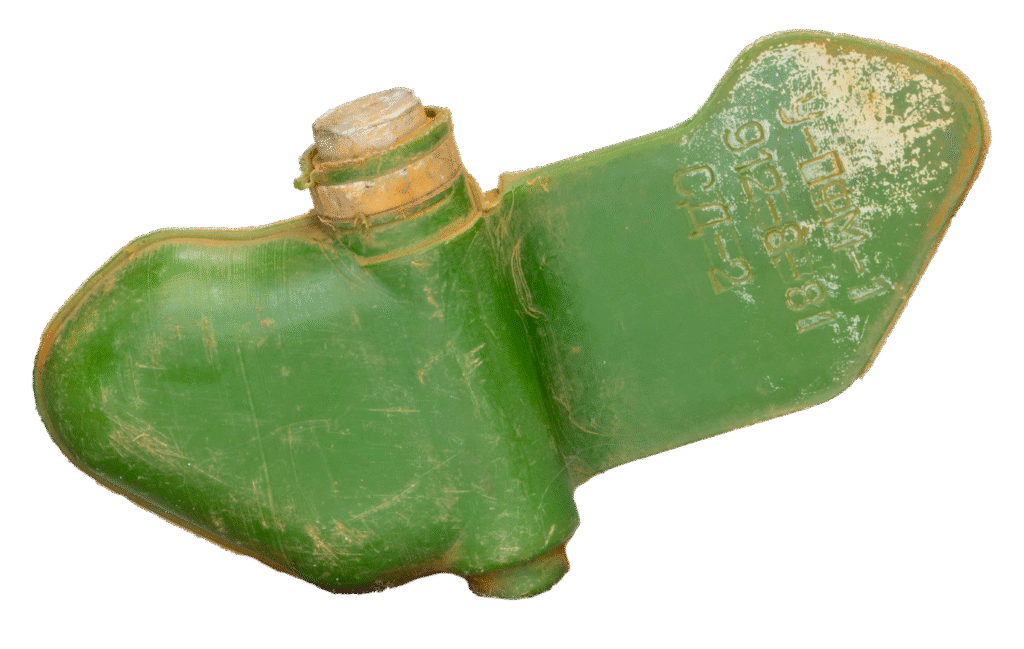
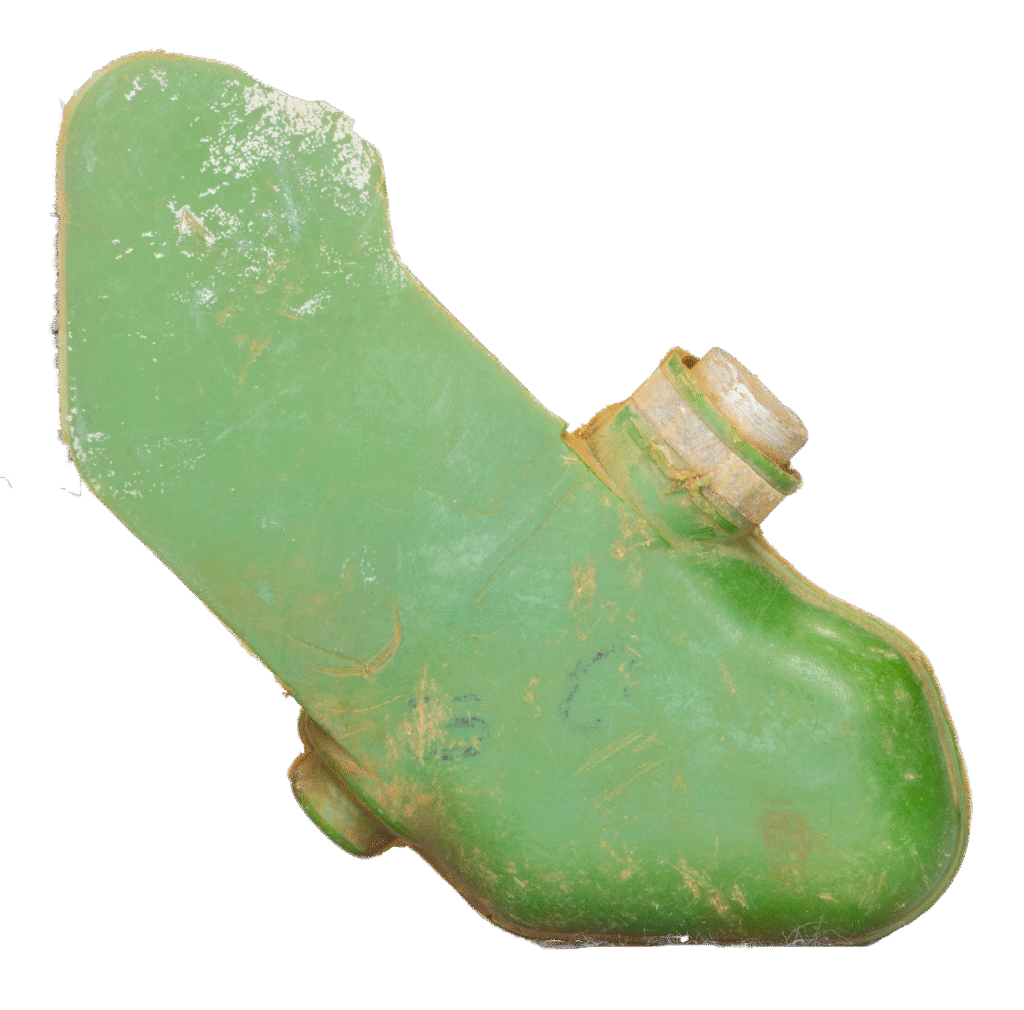
The PFM-1 is a Soviet-designed anti-personnel blast mine that has become one of the most infamous weapons in modern warfare due to its distinctive appearance and devastating impact on civilian populations. Nicknamed the “butterfly mine” or “green parrot” because of its wing-like stabilizing fins, the PFM-1 is designed to be air-scattered in large numbers over wide areas, creating instant minefields without the need for manual emplacement. Its small size, plastic construction, and bright colors have led to tragic consequences, as curious children often mistake the mines for toys. The PFM-1 represents a particularly controversial class of weapon that has caused thousands of casualties long after conflicts ended.
Country/Bloc of Origin
- Country: Soviet Union (USSR)
- Development Period: Late 1970s to early 1980s
- Primary Manufacturer: Soviet state munitions factories
- International Production: Manufactured in Soviet Union and exported; possible licensed production in some Warsaw Pact states
- Current Operators: Stockpiled by Russia and former Soviet republics; extensively documented in Afghanistan, Chechnya, Nagorno-Karabakh, and other conflict zones
Ordnance Class
- Type: Anti-Personnel Blast Mine (Scatterable)
- Primary Role: Area denial, casualty generation, and psychological warfare
- Delivery Method:
- Air-scattered from helicopters (most common)
- Air-scattered from fixed-wing aircraft
- Ground-dispersed from rocket systems (BM-21 Grad, other MLRS)
- Hand-emplaced (uncommon but possible)
- Classification: Minimum-metal mine, scatterable munition
Ordnance Family/Nomenclature
- Official Designation: PFM-1 (Protivopeekhotnaya Fugasnaya Mina – Anti-Personnel High-Explosive Mine, Model 1)
- NATO Reporting Name: Not officially assigned
- Common Names:
- “Butterfly Mine” (most common English nickname)
- “Green Parrot” (Afghan nickname due to color and wing-like shape)
- “Toy Mine” (tragic nickname referring to children mistaking them for toys)
- Related Variants:
- PFM-1S: Improved variant with self-destruct mechanism (developed but not widely deployed)
- PMF-1: Early prototype designation
- Similar Systems:
- U.S. BLU-43 “Dragontooth” (similar concept and delivery method)
- Italian VS-50 (similar size and effect, different appearance)
Hazards
Primary Hazards
EXTREME DANGER WARNING: The PFM-1 is specifically designed to maim rather than kill, creating long-term burden on medical systems and psychological impact on civilian populations. These mines are indiscriminate and pose extreme danger to all who encounter them.
- Blast Hazard: Contains 37-40 grams of liquid explosive (VS-60 or VS-2D), sufficient to sever or severely damage a foot or hand
- Fragmentation: Minimal – designed primarily as a blast weapon causing traumatic amputation rather than fragmentation wounds
- Pressure Activation: Extremely sensitive – activates with as little as 5 kg (11 lbs) of pressure
- Casualty Profile: Typically causes foot/leg amputation; hand injuries common when people pick up the mine
Sensitivity Characteristics
- Pressure Sensitivity: EXTREMELY SENSITIVE – can be triggered by a child’s weight, an animal, or even heavy rainfall/hail in some conditions
- Cumulative Pressure: Designed to activate on first disturbance, but weathered examples may require repeated pressure
- No Anti-Handling Device: Does not incorporate dedicated anti-handling mechanisms, but any disturbance may trigger activation
- Environmental Degradation: Plastic casing becomes brittle over time, especially in extreme cold, making mines more unpredictable
- UV Degradation: Colors fade and plastic degrades under prolonged sun exposure
Environmental Stability and Aging
- Temperature Effects: Operates in wide temperature range but liquid explosive becomes more sensitive at temperature extremes
- Moisture Impact: Seals may degrade allowing moisture infiltration, causing unpredictable sensitivity
- Freeze-Thaw Cycles: Repeated freezing and thawing can cause casing cracks and explosive degradation
- Long-Term Hazard: Can remain functional for 10-20+ years depending on environmental conditions
Kill/Danger Radius
- Direct Contact: Severe foot/leg injury or amputation
- Immediate Danger: Within 1-2 meters (fragmentation from casing fragments and secondary projectiles)
- Psychological Danger: Entire affected area becomes psychologically hazardous, restricting civilian movement and land use
Special Considerations
- Child Attraction: Bright colors and distinctive shape attract children who mistake them for toys
- Difficulty of Visual Detection: Small size and wide dispersal make visual location extremely challenging
- Agricultural Hazard: Frequently found in agricultural areas where air-scattering covered farmland
- Animal Triggers: Livestock frequently trigger mines, causing economic hardship
Key Identification Features
Physical Dimensions
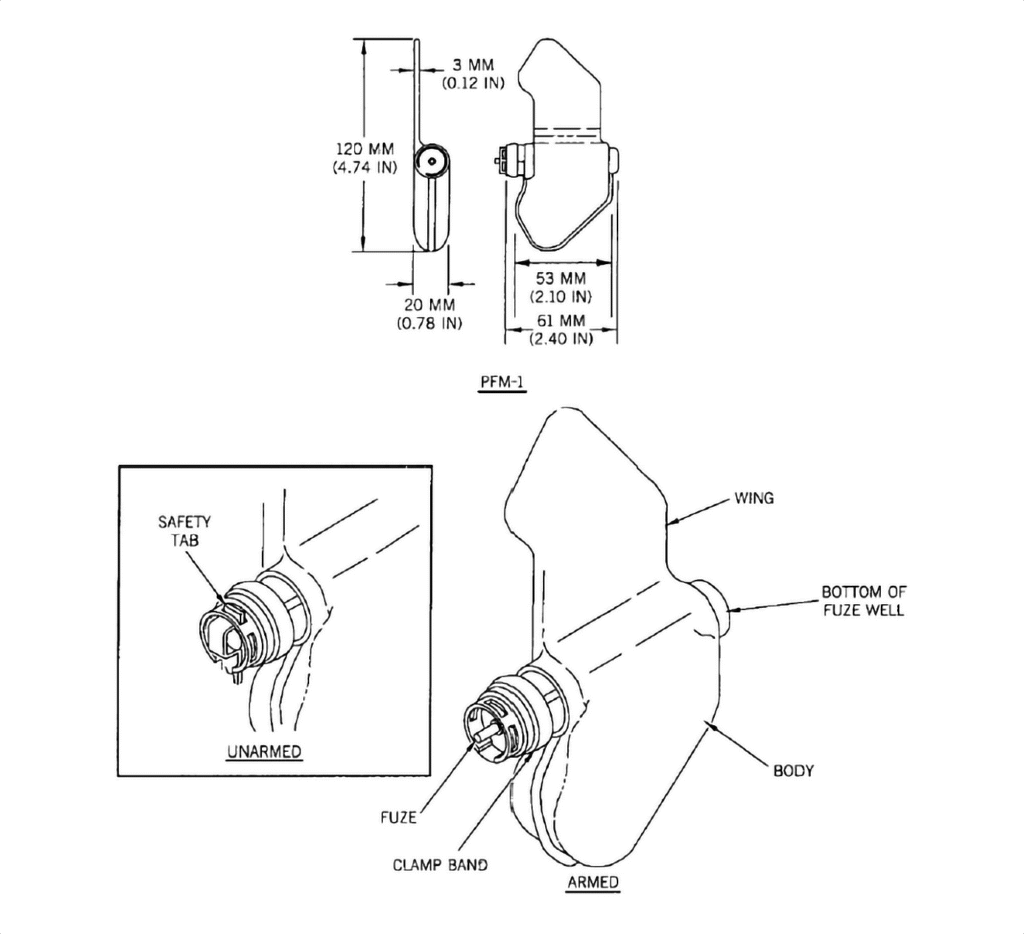
- Length: 119 mm (4.7 inches) measured tip to tip of stabilizing wings
- Width: 62 mm (2.4 inches) at widest point of wings
- Body Diameter: Approximately 30-35 mm (1.2-1.4 inches)
- Height/Thickness: 20 mm (0.8 inches) main body thickness
- Weight: 75-80 grams (2.6-2.8 oz) total weight
- Explosive Fill: 37-40 grams VS-60 or VS-2D liquid explosive
Visual Characteristics
Distinctive Wing Shape: The PFM-1’s most recognizable feature is its wing or fin configuration:
- Single folding wing that wraps around the cylindrical body during storage/transport
- Wing extends and locks into position after deployment
- Wing acts as stabilizer during descent and pressure plate when on ground
- Creates distinctive “butterfly” or “bat-like” silhouette when deployed
Body Construction:
- Cylindrical main body made of plastic/polyethylene
- Thin-walled construction (approximately 2-3 mm thick)
- Hollow interior contains liquid explosive
- Threaded or snap-fit assembly (body separates into two halves)
Color Schemes: The PFM-1 is found in several color variations, all highly visible:
- Green: Most common color (various shades from bright green to olive drab)
- Brown/Tan: Used in desert environments (less common)
- Red/Orange: Less common variants
- Sand/Beige: Desert camouflage variant
- Weathered Examples: UV exposure causes color fading to white, pale yellow, or gray
CRITICAL WARNING: The bright colors were NOT designed for visibility/safety. Soviet doctrine intended the colors to blend with certain terrains (green for vegetation, tan for desert). The tragic irony is that these colors make the mines attractive to children.
Wing/Stabilizer Details:
- Flexible plastic material (softer than body)
- Ribbed or corrugated surface on wing for strength
- Approximately 60-80 mm span when fully extended
- Serrated or smooth edge depending on production batch
- Wing locks into extended position via snap-fit mechanism
Markings:
- Generally unmarked – no text, lot numbers, or manufacturer markings visible externally
- Some variants may have molded production codes on interior surfaces (not visible without disassembly)
- No standard color-coding system for different variants
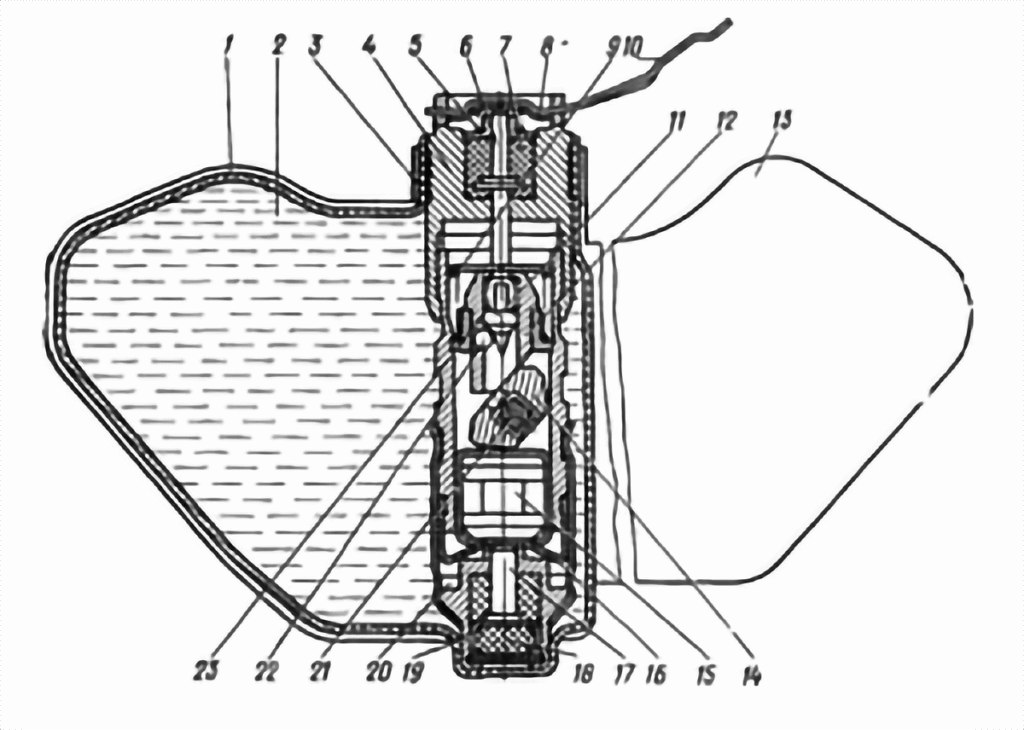
Fuze Assembly (Internal)
The fuze is integral to the mine and not externally visible, but understanding its configuration is important:
- Liquid-filled detonator capsule in central cavity
- Pressure-sensitive ampoule containing primary explosive
- No arming pin or external safety – becomes armed through deployment process
- Crush mechanism – pressure on wing or body crushes internal ampoule, initiating detonation
Fuzing Mechanisms
Primary Fuzing System: Liquid Explosive Crush Fuze
The PFM-1 employs a simple but effective crush-activated fuzing system that is integral to the mine’s design. Unlike mines with removable mechanical fuzes, the PFM-1’s fuzing is built into the mine body and cannot be separated.
Construction:
- Central cavity in mine body contains liquid explosive (VS-60 or VS-2D)
- Thin-walled plastic ampoule or chamber filled with liquid explosive
- Minimal internal structure – the entire mine body acts as the pressure sensor
- No mechanical parts – completely chemical/physical activation
Operating Principle:
- Pressure Application: Weight applied to wing or top of mine body
- Plastic Deformation: Thin plastic walls flex inward under pressure
- Ampoule Rupture: Internal ampoule containing primary explosive ruptures/compresses
- Initiation Sequence: Chemical mixing or compression of liquid explosive initiates detonation
- Main Charge Detonation: Primary explosive triggers main charge of VS-60/VS-2D
- Blast Effect: Rapid combustion of liquid explosive creates blast wave
Activation Threshold:
- Minimum Pressure: Approximately 5 kg (11 lbs) will trigger detonation
- Typical Activation: 8-12 kg pressure (child’s weight or single adult step)
- Maximum Pressure: No upper limit – any pressure exceeding minimum will detonate mine
Arming Sequence: Unlike complex mines with delayed arming, the PFM-1 has a simplified arming process:
- Storage Configuration: Wing folded flat against body, mine is relatively stable
- Deployment: Mine is ejected from dispenser (aircraft, helicopter, rocket warhead)
- Wing Extension: Aerodynamic forces during descent cause wing to unfold and lock
- Ground Impact: Mine lands on ground, wing provides stability
- Armed Status: Once wing is extended and mine is at rest, it is FULLY ARMED – no time delay
CRITICAL WARNING: There is NO time delay arming on standard PFM-1 mines. They become active immediately upon landing. Some later PFM-1S variants were designed with self-destruct mechanisms, but these are rarely encountered.
Advantages of Liquid Explosive System:
- Extreme simplicity – no mechanical parts to fail or maintain
- Very low cost to manufacture
- Reliable in various climates (within operating temperature range)
- Lightweight – allows mass deployment from aircraft
- No metal components (or minimal metal) – difficult to detect
Vulnerabilities and Limitations:
- Temperature Sensitivity: Liquid explosive performance degrades at extreme temperatures
- No Self-Destruct: Remains active indefinitely (standard PFM-1)
- Environmental Degradation: Plastic casing becomes brittle, making mine less predictable over time
- No Safe/Armed Indicator: No external indication whether mine is armed or inert
- Cannot Be Rendered Safe: Once deployed, mine cannot be safely defused – must be destroyed in place
Detonation Characteristics
Failure Modes:
- Dud Rate: Relatively low (2-5% estimated) for fresh mines
- Degraded Performance: Aged mines may have higher dud rates as explosive degrades
- Partial Detonation: Some degraded mines may partially detonate (low-order detonation) rather than full blast
- No Detonation: Complete duds occur if ampoule fails to rupture or liquid explosive has fully degraded
Safety Considerations for EOD Personnel:
- Extremely Hazardous to Handle: No safe procedure for manual extraction
- Preferred Clearance Method: Explosive destruction in place
- Mechanical Clearance: Tilling, flailing, or detonation by overpressure (explosives)
- Chemical Neutralization: Experimental methods using solvents, but not standard practice
PFM-1S Variant (Limited Deployment)
A later variant designated PFM-1S was developed with a self-destruct mechanism, but was not widely produced or deployed:
Claimed Features:
- Battery-powered timer with self-destruct at 4 hours or 4 days (sources vary)
- Self-neutralization rendering mine inert after set period
- Compliance with Emerging Standards: Designed to address international humanitarian concerns
Reality:
- Very limited deployment – most PFM-1 mines encountered are original non-self-destruct version
- Reliability of self-destruct mechanism questionable
- Even with self-destruct, mines remain hazardous during active period
History of Development and Use
Development Context and Strategic Rationale
The PFM-1 was developed in the late 1970s as part of Soviet military doctrine emphasizing rapid area denial and force multiplication. The development reflected several Cold War-era strategic considerations:
Tactical Requirements:
- Rapid Minefield Creation: Need to quickly establish defensive obstacles without dedicating engineering units to manual emplacement
- Airpower Utilization: Leverage helicopter and aircraft assets to create instant barriers
- Force Multiplier: Allow small units to control large areas by denying terrain to enemy
- Casualty Generation: Designed to wound rather than kill, maximizing strain on enemy medical and logistics systems
- Psychological Warfare: Create fear and restrict civilian/military movement
Technical Drivers:
- Lightweight Design: Minimizing weight allowed each aircraft to carry thousands of mines
- Plastic Construction: Defeated metal detectors, complicating clearance
- Simple Mechanism: Low-cost mass production and high reliability
- Immediate Arming: No time delay allowed instant area denial
Doctrinal Context: Soviet military theory envisioned conflicts where:
- Rapid Defensive Positions: Need to establish defensive lines quickly during fluid armored warfare
- Guerrilla Warfare: Anti-insurgency operations required area denial without large troop commitments
- Economic Warfare: Disrupting enemy rear areas, agriculture, and infrastructure
Chronological Development and Deployment
Late 1970s – Initial Development:
- Design work began at Soviet munitions research facilities
- Influenced by earlier U.S. development of BLU-43 “Dragontooth” scatterable mine
- Emphasis on simplicity, low cost, and mass-production capability
- Testing conducted in Soviet test ranges
Early 1980s – Initial Production:
- Full-scale production begins
- Initial stockpiling and integration into Soviet military doctrine
- Training of helicopter crews and artillery units in deployment procedures
- Dispersal systems integrated with Mi-8, Mi-24 helicopters and BM-21 Grad MLRS
1979-1989 – Afghanistan War (PRIMARY USE):
The Soviet-Afghan War became the proving ground and primary deployment of the PFM-1, with catastrophic humanitarian consequences:
Military Employment:
- Massive Deployment: Millions of PFM-1 mines scattered across Afghanistan
- Tactical Uses:
- Helicopter Landing Zones: Securing LZ perimeters during troop insertions
- Route Denial: Blocking mountain passes and supply routes used by Mujahideen
- Village Punishment: Collective punishment of villages suspected of supporting resistance
- Agricultural Targeting: Deliberate mining of farmland to create refugee flows
- Defensive Perimeters: Protecting Soviet/Afghan government bases and positions
Delivery Methods in Afghanistan:
- Mi-8/Mi-24 Helicopters: Primary delivery platform, dropping mines from cassettes
- Fixed-Wing Aircraft: An-12 and other transport aircraft scattered mines over large areas
- BM-21 Grad Rockets: Mine-filled rocket warheads dispersed PFM-1 over target areas
- Artillery: Some deployment via artillery-delivered scatterable submunitions
Humanitarian Catastrophe:
- Civilian Casualties: Tens of thousands of civilians killed or maimed (exact figures unknown)
- Child Victims: Disproportionate impact on children attracted to bright colors
- Agricultural Devastation: Farmland rendered unusable, contributing to famine
- Refugee Crisis: Forced displacement as mined areas became uninhabitable
- Medical Overwhelm: Afghan medical system unable to cope with amputation cases
- Long-Term Contamination: Mines remained deadly decades after Soviet withdrawal (1989)
International Response:
- First Major Documentation: Humanitarian organizations began documenting butterfly mine casualties
- Photographic Evidence: Distinctive appearance made PFM-1 recognizable in conflict reporting
- Arms Control Advocacy: Afghanistan’s PFM-1 contamination became central argument for Mine Ban Treaty
1994-1996 & 1999-2009 – Chechen Wars:
- Russian forces employed PFM-1 in anti-insurgency operations
- Urban and mountain terrain deployment
- Continued civilian casualties in post-conflict environment
- Contributed to international pressure on Russia regarding landmine use
1988-1994 – Nagorno-Karabakh Conflict:
- Armenian and Azerbaijani forces used PFM-1 (from Soviet stockpiles)
- Deployment in disputed territories
- Post-conflict clearance remains incomplete
1990s – Balkans:
- Limited reports of PFM-1 use in Croatian and Bosnian conflicts
- Possible deployment from former Yugoslav stockpiles
2008 – Georgia-Russia Conflict:
- Reports of PFM-1 deployment, though less extensive than historical use
- International observers documented mine contamination
2020 – Nagorno-Karabakh (Second War):
- Renewed reports of PFM-1 use by Armenian and Azerbaijani forces
- Both cluster munitions and mines documented by international observers
- Significant post-conflict clearance challenges
Production and Global Distribution
Manufacturing Scale:
- Estimated Production: Tens of millions of units produced during Soviet era
- Production Facilities: Multiple Soviet munitions plants
- Cost: Extremely low per-unit cost (estimated $2-5 per mine)
- Export: Supplied to Soviet client states and allied forces worldwide
Known Stockpiles and Contamination:
- Afghanistan: Largest contamination – estimated millions of mines remain
- Chechnya: Significant contamination in conflict zones
- Nagorno-Karabakh: Both Armenia and Azerbaijan territories affected
- Other Former Soviet Republics: Unknown quantities in national stockpiles
- Export Recipients: Various Soviet client states received PFM-1 stocks
International Humanitarian Response and Mine Ban Treaty
The PFM-1’s devastating impact on civilians, particularly in Afghanistan, played a crucial role in international efforts to ban anti-personnel mines:
1980s-1990s – Advocacy Building:
- Photographic Documentation: Victims of PFM-1, especially children, featured prominently in humanitarian campaigns
- Medical Evidence: Amputation statistics from Afghanistan highlighted mine impact
- NGO Campaigns: International Campaign to Ban Landmines (ICBL) used PFM-1 as example of indiscriminate weapons
1997 – Ottawa Treaty (Mine Ban Treaty):
- Formal Ban: Treaty prohibits use, production, stockpiling, and transfer of anti-personnel mines
- PFM-1 as Case Study: Butterfly mine extensively cited in treaty negotiations
- Global Adoption: 164 nations ratified treaty (Russia, U.S., China notably did NOT sign)
Post-Treaty Reality:
- Non-Signatory States: Russia maintains PFM-1 stockpiles (though official policy on use is unclear)
- Ongoing Contamination: Pre-1997 deployment areas remain contaminated
- Clearance Efforts: Major demining operations continue in Afghanistan and elsewhere
Legacy and Long-Term Impact
Humanitarian Consequences:
- Estimated Casualties: Exact figures unknown, but tens of thousands killed/maimed (Afghanistan alone)
- Generational Impact: Children born after conflicts continue to encounter mines
- Economic Devastation: Agricultural land remains unusable decades later
- Medical Burden: Long-term care for amputees strains health systems
- Psychological Trauma: Fear of mines restricts normal life and economic activity
Clearance Challenges:
- Detection Difficulty: Plastic construction and small size complicate detection
- Wide Dispersal: Air-scattering created random patterns, not organized minefields
- Environmental Integration: Mines buried by soil movement, vegetation growth
- Incomplete Records: Soviet/Russian forces did not maintain accurate minefield maps
Modern Demining Efforts:
- Manual Clearance: Slow, dangerous work by trained deminers
- Mechanical Clearance: Tilling and flailing machines effective but not usable in all terrain
- Animal Detection: Mine detection dogs effective for PFM-1 (explosive scent detection)
- Explosive Clearance: Controlled detonation using explosive charges
Educational Impact:
- Case Study: PFM-1 remains primary example in EOD training worldwide
- Humanitarian Education: Featured in mine-risk education programs for civilians
- Policy Debates: Central example in ongoing debates about weapons regulation
Technological Legacy:
- Countermeasure Development: Influenced development of mine-detection technology
- Doctrine Changes: Affected international military doctrine on scatterable munitions
- Design Influence: Both positive (clearance tools) and negative (similar weapons by other nations)
Technical Specifications
Explosive Characteristics
- Main Charge: 37-40 grams of liquid explosive
- Explosive Type: VS-60 or VS-2D (liquid explosives based on nitroglycerine compounds)
- Consistency: Viscous liquid (syrup-like) at normal temperatures
- Detonation Velocity: Approximately 7,000-7,500 m/s
- Blast Effect: Sufficient to cause severe foot/leg trauma or amputation; hand amputation if picked up
Physical Specifications
- Total Weight: 75-80 grams (2.6-2.8 oz)
- Body Diameter: 30-35 mm (1.2-1.4 inches)
- Body Height: 20 mm (0.8 inches)
- Wing Span (Extended): 119 mm (4.7 inches) tip to tip
- Wing Thickness: Approximately 1-2 mm
- Material Composition:
- Body: Polyethylene or similar plastic
- Wing: Flexible plastic (often softer polymer than body)
- Metal Content: Minimal to none (small metal components in some variants)
Environmental and Operational Specifications
- Operating Temperature Range: -40°C to +50°C (-40°F to +122°F)
- Optimal Performance: 0°C to +30°C (32°F to 86°F)
- Temperature Limitations:
- Below -40°C: Plastic becomes extremely brittle, liquid explosive may freeze
- Above +50°C: Liquid explosive stability decreases, plastic may soften
- Humidity Resistance: Moderate – seals may degrade over time allowing moisture infiltration
- UV Resistance: Poor – plastic and colors degrade under prolonged sun exposure
- Shelf Life (Storage): 10-15 years in controlled conditions
- Field Life: Highly variable – 1-20+ years depending on environmental conditions
Activation Specifications
- Minimum Activation Pressure: 5 kg (11 lbs)
- Typical Activation Pressure: 8-16 kg (18-35 lbs)
- Pressure Surface: Entire wing and top body surface (approximately 30-40 cm²)
- Arming Time: Immediate upon landing (no delay)
- Self-Destruct: None on standard PFM-1 (PFM-1S variant claimed 4-hour or 4-day self-destruct, rarely encountered)
Deployment Specifications
Helicopter Deployment:
- Dispenser Capacity: Cassettes typically hold 50-100 PFM-1 mines
- Dispersal Pattern: Random scatter over 100-200 meter swath
- Deployment Altitude: 50-200 meters AGL (Above Ground Level)
- Deployment Speed: Variable; typically 100-150 km/h
Fixed-Wing Aircraft:
- Dispenser Capacity: Larger cassettes holding 200-500+ mines
- Dispersal Pattern: Long linear pattern following flight path
- Deployment Altitude: 100-500 meters AGL
Ground-Based Rocket Systems (BM-21 Grad, etc.):
- Warhead Capacity: 312 PFM-1 mines per rocket (specialized mine-laying rocket)
- Range: 10-20 km (depending on rocket type)
- Dispersal Pattern: Oval/circular pattern at target area
- Deployment Density: 0.5-2 mines per square meter (varies by munition and range)
Minefield Density
- Strategic Density: 0.3-1.0 mines per square meter (area denial)
- Tactical Density: 0.1-0.3 mines per square meter (route interdiction)
- Psychological Density: Even 0.01-0.1 mines per square meter creates significant fear and restriction
Detection Characteristics
- Metal Detector: Minimal signature (difficult to detect)
- Ground-Penetrating Radar: Possible detection but small size is challenging
- Visual Detection: Difficult due to small size, color camouflage, and environmental integration
- Chemical Detection (Dogs): Very effective – mine detection dogs can reliably find PFM-1
- Infrared: Limited utility (plastic does not retain heat differently than surroundings)
Frequently Asked Questions
Q: Why is the PFM-1 called the “butterfly mine” and why are the colors so bright if it’s supposed to be a weapon?
A: The nickname “butterfly mine” comes from the distinctive wing-like stabilizer that extends during descent, giving it a shape reminiscent of a butterfly in flight. The bright colors (green, tan, sometimes red) were NOT intended to make the mine visible as a warning – this is a common misconception. Soviet military doctrine intended these colors to provide camouflage in specific environments: green blends with vegetation and grass, tan blends with desert sand and soil, etc. The tragic irony is that in practice, these bright colors make the mines highly visible and attractive to children who mistake them for toys. In Afghanistan, children called them “green parrots” because of the bright green color and unusual shape. The colors have contributed to the extraordinarily high rate of child casualties associated with PFM-1 mines. Modern demining education programs must specifically warn children not to touch these “interesting” objects, as the attractive appearance works against safety.
Q: How does the PFM-1’s liquid explosive system work, and why was liquid explosive chosen instead of traditional solid explosives like TNT?
A: The PFM-1 uses a liquid explosive system (VS-60 or VS-2D compounds based on nitroglycerine) that is integral to its simple, lightweight design. The mine’s entire body is essentially a thin-walled plastic container filled with liquid explosive, with the fuzing mechanism built into this structure. When pressure is applied to the wing or top surface, the plastic deforms and an internal ampoule ruptures, initiating the explosive reaction. Liquid explosive was chosen for several practical reasons: (1) It allowed for simpler, cheaper manufacturing with no complex fuze assembly required, (2) It reduced weight significantly compared to solid explosive plus metal casing, enabling aircraft to carry many more mines, (3) The liquid explosive could be poured into the plastic body during manufacturing, streamlining mass production, (4) It provided adequate blast effect for the intended anti-personnel role without requiring large quantities. The downside is that liquid explosives are more sensitive to temperature extremes and may degrade faster than solid explosives over time. However, for Soviet doctrine emphasizing mass deployment of cheap, disposable mines, these trade-offs were acceptable.
Q: If the PFM-1 only contains 37-40 grams of explosive, why is it so dangerous? How does such a small charge cause serious injuries?
A: While 37-40 grams seems small compared to larger munitions, it’s important to understand that the PFM-1 is specifically designed and optimized to cause severe injuries to the human body at contact distance. When someone steps on a PFM-1, the explosive detonates directly against their foot, creating a focused blast effect. The detonation velocity of ~7,000-7,500 m/s generates an instantaneous overpressure wave that causes traumatic amputation by literally tearing tissue and crushing bone. The mine doesn’t need to kill – Soviet doctrine deliberately designed it to maim, as wounded soldiers require evacuation and medical care, straining enemy resources far more than killed soldiers would. A typical injury is traumatic amputation at or above the ankle, severe fractures extending up the leg, and significant soft tissue damage. If the mine is picked up and handled (as children often do), the blast occurs at hand level, resulting in hand/arm amputation and often severe facial, chest, and eye injuries. For comparison, 40 grams is roughly equivalent to a large firecracker in weight, but military explosive compounds are far more powerful than pyrotechnics, and the difference in energy release is enormous when detonated in direct contact with tissue.
Q: Why can’t demining teams simply use metal detectors to find PFM-1 mines like they do with other mines?
A: The PFM-1 was specifically designed with minimal or no metal content to defeat metal detectors, which were the primary mine-detection tool when it was developed. The mine body is plastic, the explosive is liquid (no metal components), and even the fuzing mechanism uses chemical/physical activation without metal parts. Some production variants may have tiny metal components (a few grams), but these create such a weak signature that standard metal detectors often cannot reliably detect them, especially if the mine is buried under even a few centimeters of soil. This makes metal-detector-based clearance extremely unreliable for PFM-1-contaminated areas. Modern demining operations rely on alternative methods: (1) Mine Detection Dogs are very effective at detecting PFM-1 because they smell the explosive chemicals rather than looking for metal, (2) Ground-Penetrating Radar (GPR) can sometimes detect the density contrast between the plastic mine and surrounding soil, though the small size is challenging, (3) Manual Prodding where deminers carefully probe the ground with thin rods at shallow angles to physically locate mines, (4) Mechanical Clearance using machines that till or flail the soil, deliberately triggering any mines present. These methods are all slower, more expensive, and more dangerous than metal detection, which is why the PFM-1’s design has made clearance so difficult in places like Afghanistan.
Q: What is the actual casualty data from PFM-1 mines, and how many are still in the ground?
A: Precise casualty figures for PFM-1 mines are impossible to determine because conflict zones often lack comprehensive medical records, many casualties occur in remote areas, and attribution to specific mine types is not always recorded. However, available data provides a grim picture. In Afghanistan alone, where millions of PFM-1 mines were deployed between 1979-1989, estimates suggest tens of thousands of casualties over the subsequent decades. The International Campaign to Ban Landmines (ICBL) documented that in the peak contamination years (1980s-1990s), landmines (predominantly PFM-1 and similar Soviet mines) caused 10-20 casualties per day in Afghanistan. Studies of mine casualties consistently showed that 20-40% of victims were children, with PFM-1 disproportionately responsible for child casualties due to its attractive appearance. As for remaining contamination, exact numbers are unknown, but demining organizations estimate millions of PFM-1 mines remain in Afghanistan, with additional significant contamination in Chechnya, Nagorno-Karabakh, and other former Soviet conflict zones. The challenge is that air-scattered deployment created random, unmapped minefields covering enormous areas. Afghanistan’s Mine Action Programme continues to clear thousands of PFM-1 mines annually decades after they were deployed, suggesting clearance will continue for many more years.
Q: Did the Soviet Union or Russia ever admit to the humanitarian problems caused by the PFM-1, and did they change their policies?
A: Soviet and later Russian official responses to PFM-1 criticism have been complex and evolved over time. During the Soviet-Afghan War, the USSR denied or downplayed reports of butterfly mine casualties, characterizing criticism as Western propaganda. After the Soviet withdrawal from Afghanistan (1989) and the eventual collapse of the USSR (1991), more open discussion became possible. Throughout the 1990s, as international pressure built toward the Mine Ban Treaty, Russia acknowledged the humanitarian impact of landmines but resisted international restrictions on anti-personnel mines, arguing they were legitimate military weapons. Russia developed the PFM-1S variant with claimed self-destruct capabilities, partly in response to international pressure, though this variant was never widely deployed. Russia refused to sign the 1997 Ottawa Treaty banning anti-personnel mines, citing security concerns and maintaining that mines remain necessary for territorial defense. However, Russia has not deployed PFM-1 mines in large-scale operations since the Chechen conflicts, possibly due to both international pressure and changes in military doctrine. Russian officials have also participated in some demining efforts in former conflict zones, though critics argue this does not adequately address the legacy contamination. The current official Russian position is that anti-personnel mines are legal weapons under international law (true – the Mine Ban Treaty is not universal), that their use follows military necessity, and that humanitarian concerns are addressed through restrictions of use rather than complete prohibition.
Q: What makes clearing PFM-1 mines from an area so difficult, and why hasn’t Afghanistan been completely cleared after 30+ years?
A: The challenge of clearing PFM-1 mines from Afghanistan and other affected areas stems from multiple compounding factors that make it one of the most difficult demining tasks ever undertaken. First, the scale of contamination is staggering – millions of mines were scattered across hundreds of thousands of square kilometers, with no maps or records of where they were deployed. Second, air-scattering created random patterns rather than organized minefields, meaning every square meter of suspected area must be individually checked. Third, the plastic construction defeats metal detectors, requiring slower, more expensive detection methods like mine detection dogs or manual prodding. Fourth, environmental factors have integrated mines into the landscape – they’ve been buried by soil erosion, covered by vegetation, washed into new locations by flooding, and scattered by animal activity. Fifth, ongoing conflict in Afghanistan has prevented systematic clearance operations in many areas, and new conflicts (Taliban resurgence, etc.) have occasionally resulted in additional mine deployment. Sixth, funding limitations mean demining operations proceed at a pace of only a few square kilometers per year in a country where tens of thousands of square kilometers are suspected to be contaminated. Seventh, technical challenges include degraded mines that are unpredictable, mines in difficult terrain (mountains, agricultural fields, urban areas), and the need to balance thoroughness with practical clearance rates. Finally, economic factors mean cleared land is sometimes re-contaminated by new conflicts or people avoid cleared areas due to lack of confidence in clearance quality. Despite these challenges, demining organizations have made significant progress – tens of thousands of mines have been cleared and extensive mine-risk education has reduced casualty rates. However, complete clearance will likely take decades more under the best circumstances.
Q: How does the PFM-1 compare to similar scatterable mines developed by other countries, like the U.S. BLU-43 Dragontooth?
A: The PFM-1 and U.S. BLU-43 “Dragontooth” share similar operational concepts (air-scattered, anti-personnel, plastic construction) but differ in important ways that reflect different design philosophies. The BLU-43, deployed extensively in Vietnam and Laos, has a spherical or cylindrical body with a protruding pressure pin that resembles a large spike or tooth (hence “Dragontooth”). It was typically olive drab or brown in color, less visually distinctive than the PFM-1’s bright colors. The BLU-43 contained about 31 grams of explosive (slightly less than PFM-1’s 37-40g) and used a purely mechanical firing pin mechanism rather than liquid explosive. Both mines are approximately the same size and weight. Key differences: (1) The PFM-1’s liquid explosive system is simpler and cheaper than the BLU-43’s mechanical fuze, but potentially less reliable at temperature extremes, (2) The BLU-43’s pressure pin makes it somewhat easier to visually identify if exposed, while the PFM-1’s flat profile and wing can be harder to spot, (3) The PFM-1’s bright colors have contributed to higher child casualty rates compared to BLU-43, (4) Deployment scales differed – the U.S. scattered millions of BLU-43s in Southeast Asia, while the USSR deployed comparable numbers of PFM-1 in Afghanistan. Both mines have caused extensive long-term humanitarian problems. Other similar systems include the Italian VS-50 (ground-emplaced but similar size/effect), various other Soviet scatterable mines (PFM-1S, PMN series), and numerous other nations’ designs. The common thread is that small, plastic scatterable mines are extremely difficult and expensive to clear, creating humanitarian disasters that persist decades after deployment.
Q: Is there any safe way for a civilian who encounters a suspected PFM-1 mine to mark it or warn others, or should they simply leave the area immediately?
A: If a civilian encounters a suspected PFM-1 or any other suspected ordnance, the absolute priority is personal safety – do not approach, touch, or disturb the object in any way. The PFM-1 is extremely sensitive and any handling can trigger detonation. Even well-intentioned attempts to mark or flag the mine can result in tragedy. The recommended procedure taught by mine-risk education programs is: (1) STOP immediately – if you think you see a mine, freeze in place to avoid stepping on others you haven’t seen, (2) DO NOT TOUCH – never pick up, kick, throw rocks at, or otherwise disturb the suspected mine, (3) Carefully retrace your exact steps backward to exit the suspected mined area using the path you came in on, (4) Note the location – mentally note landmarks or GPS coordinates if available, but do not approach to place markers, (5) Warn others – verbally warn anyone nearby and try to establish a visual cordon at a safe distance (at least 25-50 meters), (6) Report immediately to local authorities, military forces, police, or mine-action organizations – every country with mine contamination has reporting procedures. In some areas, mine-action NGOs provide marking materials (flags, paint) to local residents trained in safe marking procedures, but this is only done after specific training. For untrained civilians, attempting to mark a mine is more dangerous than simply leaving and reporting. The mine-action organization will send trained deminers who have proper equipment and procedures for safe marking, investigation, and eventual clearance. In Afghanistan and other heavily contaminated areas, children are taught “Recognize, Retreat, Report” as a simple rule. This education has saved countless lives by reducing the impulse to touch interesting-looking objects like the PFM-1.
Safety Warning
CRITICAL: All information provided in this document is for educational, identification, and mine-risk awareness purposes only.
- The PFM-1 is an EXTREMELY DANGEROUS device that has killed and maimed thousands of people, especially children
- ALL suspected ordnance, including PFM-1 mines, must be considered LIVE and LETHAL until proven otherwise by qualified EOD personnel
- NEVER approach, touch, pick up, kick, throw, or otherwise disturb ANY suspected mine or ordnance
- The PFM-1’s attractive colors and interesting shape make it particularly dangerous to children – PARENTS AND EDUCATORS: Teach children never to touch unusual objects found outdoors
- If you encounter a suspected PFM-1 or any ordnance:
- STOP – do not approach further
- DO NOT TOUCH – even slight pressure can cause detonation
- RETREAT carefully along the path you came
- REPORT immediately to authorities or mine-action organizations
- Mark the area and warn others from a safe distance (minimum 50 meters)
- Professional clearance requires specialized training, equipment, and authorization
Mine Risk Education Resources:
- Contact local mine-action coordination centers in affected countries
- Organizations like the HALO Trust, Mines Advisory Group (MAG), and others provide community education
- Many countries have hotlines for reporting suspected ordnance
This document is intended for military training, EOD education, humanitarian mine-action education, and civilian awareness. It must never be used to construct, deploy, or tamper with explosive devices. The information aims to save lives through education and awareness.