PG-7M HEAT Rocket Warhead
Ordnance Overview
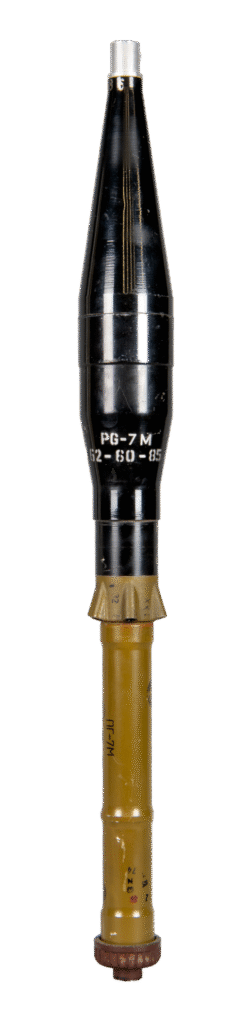
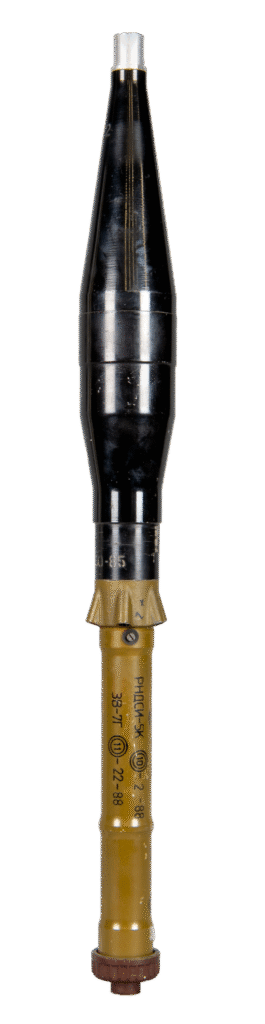
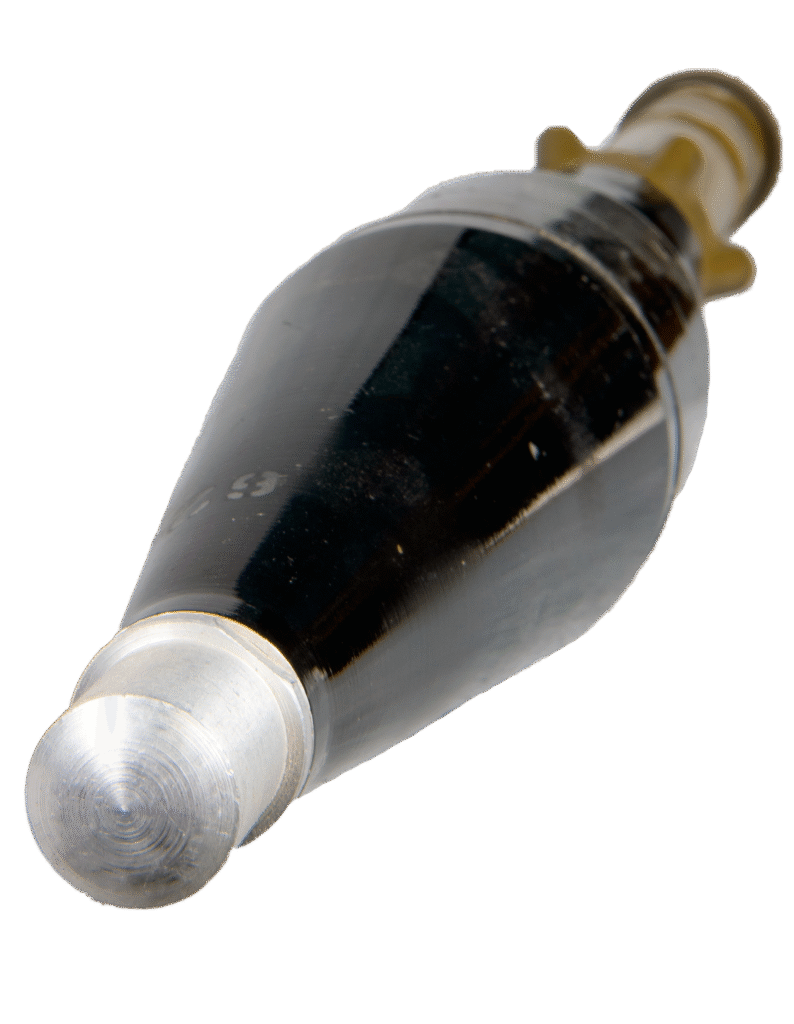
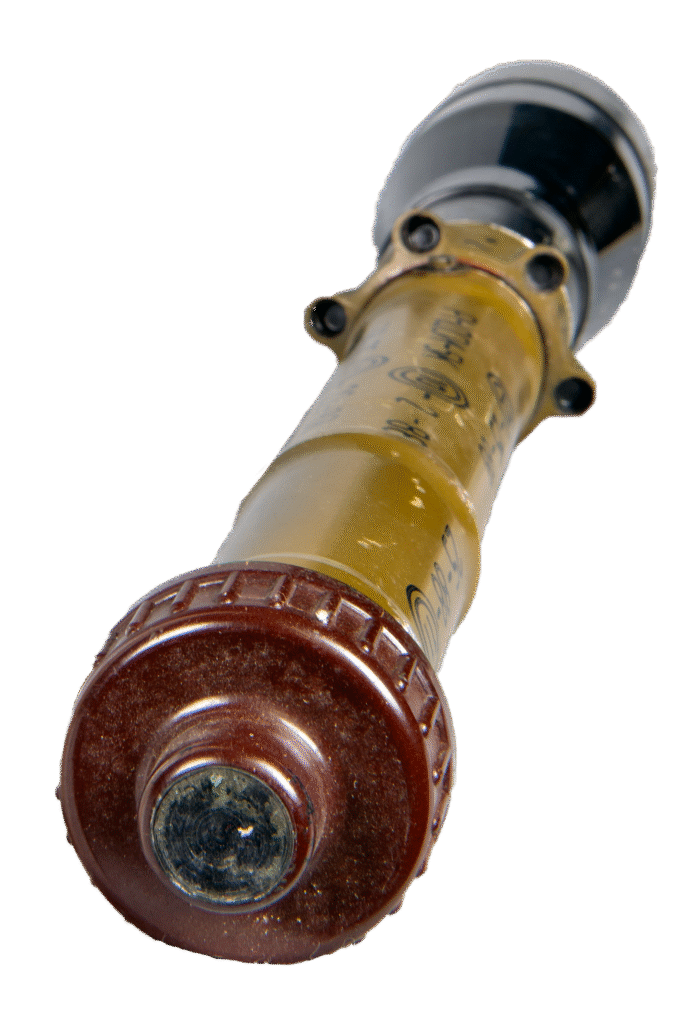
The PG-7M is a High-Explosive Anti-Tank (HEAT) rocket warhead designed for use with the RPG-7 portable anti-tank grenade launcher. As one of the earliest production warheads developed for the RPG-7 system, the PG-7M represents a significant advancement in infantry anti-armor capabilities. This fin-stabilized projectile combines a powerful shaped-charge warhead with a rocket motor to deliver armor-penetrating performance at tactically relevant ranges. The PG-7M established the basic design principles that would influence subsequent RPG-7 ammunition development for decades.
Country/Bloc of Origin
- Country: Soviet Union (USSR)
- Development Period: Late 1950s to early 1960s
- Military Bloc: Warsaw Pact
- International Production: The PG-7M was widely produced under license by numerous countries including China (Type 69 HEAT), Egypt, Romania, Bulgaria, and North Korea. The design has been manufactured by dozens of nations and remains in production in various forms.
Ordnance Class
- Type: Anti-tank rocket-propelled grenade warhead
- Primary Role: Anti-armor / anti-tank
- Secondary Capabilities: Anti-fortification, anti-materiel
- Delivery Method: Shoulder-fired recoilless launcher (RPG-7)
- Propulsion: Two-stage rocket motor with initial booster and sustainer motor
- Guidance: Unguided, fin-stabilized ballistic trajectory
Ordnance Family/Nomenclature
Soviet/Russian Designations:
- PG-7M: Primary Soviet designation (PG = Protivotankovaya Granata, “anti-tank grenade”)
- Replaced earlier PG-7 and PG-7V models with improved penetration
Related Variants in the RPG-7 Family:
- PG-7V: Earlier standard warhead with slightly less penetration
- PG-7VM: Improved variant with better armor penetration
- PG-7VL: Extended-range variant with improved flight characteristics
- PG-7VR: Tandem-charge version designed to defeat explosive reactive armor (ERA)
- OG-7: Fragmentation variant for anti-personnel use
- TBG-7V: Thermobaric variant for enclosed spaces and fortifications
Foreign Designations:
- Type 69 HEAT (China): Direct Chinese copy of the PG-7M
- Various designations used by different manufacturing countries
NATO Reporting Conventions: Generally referred to by Soviet designation or as “RPG-7 HEAT round”
Hazards
The PG-7M presents multiple significant hazards to personnel and requires extreme caution when encountered:
Explosive Hazards
- Shaped-Charge Warhead: Contains approximately 700-730 grams of high explosive (typically A-IX-1 or A-IX-2 composition). Upon detonation, the shaped charge creates a focused jet of superplastic metal capable of penetrating armored steel.
- Blast Effect: While primarily designed for armor penetration, the warhead produces significant blast overpressure in a 5-10 meter radius.
- Fragmentation: The warhead casing and rocket body create dangerous fragmentation upon detonation, with lethal fragments effective to 15-20 meters.
Fuzing Sensitivity
- Impact Sensitivity: The PG-7M uses a piezoelectric point-detonating fuze that activates upon impact. The fuze has a self-arming distance of 5-10 meters after launch.
- Degraded Rounds: Older or environmentally damaged rounds may have corroded or unstable fuze components, increasing sensitivity to handling.
- Unexploded Ordnance (UXO): Failed rounds may have armed fuzes but remain unexploded, creating an extreme handling hazard.
Propellant Hazards
- Rocket Motor: Contains solid propellant that can deflagrate violently if ignited outside the launcher. Fire exposure poses significant risk.
- Toxic Fumes: Degraded propellant may release toxic gases, particularly in enclosed storage areas.
Special Considerations
- Standoff Distance: The shaped-charge design requires optimal standoff distance from the target for maximum effect. This design feature means the warhead can detonate on minimal obstacles (brush, fences, etc.).
- Minimum Arming Distance: Rounds that fail to arm properly within the first 5-10 meters still contain explosive and are extremely hazardous.
- Storage Stability: Properly stored rounds have long shelf lives, but improper storage or environmental exposure can degrade components and increase hazards.
Danger Zones
- Direct Impact: Penetration jet effective through armor; lethal to personnel
- Blast Radius: 5-10 meters for blast overpressure
- Fragmentation: 15-20 meters for lethal fragments; injury-causing fragments to 50+ meters
CRITICAL SAFETY WARNING: All RPG-7 ammunition must be treated as armed and dangerous. Never approach, touch, or disturb suspected ordnance. Report finds immediately to military EOD or law enforcement. The shaped-charge warhead can detonate from shock, fire, or fuze malfunction.
Key Identification Features
The PG-7M can be identified through several distinctive characteristics:
Physical Dimensions
- Overall Length: Approximately 915-920 mm (36-36.2 inches) when assembled
- Warhead Diameter: 85 mm (3.35 inches) at the base of the shaped charge
- Nose Cone Diameter: 70 mm (2.75 inches)
- Stabilizer Span: Approximately 260-280 mm (10.2-11 inches) when fins are deployed
- Total Weight: 2.0-2.25 kg (4.4-5.0 lbs) depending on variant
Warhead Section
- Conical Nose Shape: Distinctive ogive (pointed) nose cone, typically painted black or dark color
- Standoff Probe: Extended piezoelectric fuze probe extending 20-30 mm forward of the nose cone
- Warhead Body: Cylindrical body section with conical forward section, typically in dark green, olive drab, or black
- Copper Liner: The shaped-charge copper cone liner is internal and not visible on intact rounds
Rocket Motor Section
- Cylindrical Body: Smooth cylindrical section aft of the warhead, typically painted in green or matching military colors
- Nozzle Assembly: Venturi-style rocket nozzle at the rear, usually black or dark metal
- Stabilizer Fins: Six pop-out stabilizer fins that deploy upon launch, typically metal with wrapped or folded design when stored
Color and Markings
- Standard Colors: Dark green, olive drab, or black for warhead section; motor section usually matches
- Cyrillic Markings: Soviet-era rounds feature Cyrillic text indicating type (ПГ-7М), lot number, and manufacturing date
- Chinese Copies: May have Chinese characters and “Type 69” designation
- Colored Bands: Some rounds feature colored bands (yellow, white, or red) indicating warhead type or lot information
- Manufacturing Stamps: Production facility codes and year stamps on motor casing
Construction Materials
- Warhead Casing: Steel or aluminum alloy construction
- Nose Cone: Typically plastic or light alloy
- Motor Casing: Steel tube with protective paint
- Fins: Steel or aluminum, spring-loaded
Distinctive Features for Field Identification
- Two-Part Construction: Clear division between warhead section and rocket motor section
- Nose Probe: The extended piezoelectric fuze probe is highly distinctive
- Fin Configuration: Six-fin stabilizer arrangement is characteristic of RPG-7 family
- Size: At just over 900 mm length and 85 mm warhead diameter, the PG-7M is recognizable by its dimensions
- Threading: Visible threading where warhead screws onto motor body
Differentiation from Similar Ordnance
- PG-7V vs PG-7M: Nearly identical external appearance; PG-7M may have slightly different nose cone geometry and improved liner
- OG-7 Fragmentation: Shorter, bulbous warhead section; no standoff probe
- PG-7VR Tandem: Features dual-charge warhead with tandem nose section, significantly longer overall length
Fuzing Mechanisms
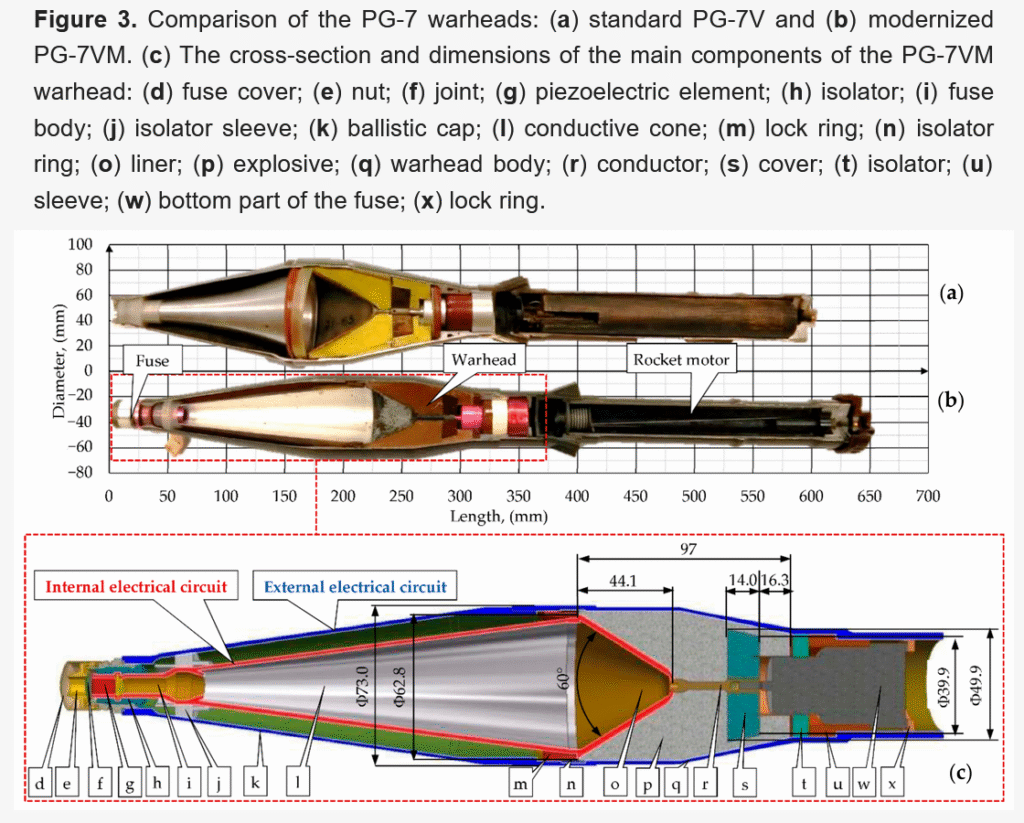
The PG-7M employs a sophisticated fuzing system designed to ensure reliable detonation against armored targets while maintaining safety during handling and transport.
Primary Fuze Type
VP-7 Series Piezoelectric Point-Detonating Fuze (or variants):
- Fuze Location: Mounted in the nose cone with standoff probe extending forward
- Operating Principle: Piezoelectric impact sensor converts mechanical shock from target impact into electrical impulse that initiates the detonator
Arming Sequence
- Safe State: During storage and prior to launch, the fuze is mechanically safed by a rotor or blocking device that keeps the detonator out of line with the explosive train.
- Launch Initiation: When the RPG-7 is fired, the initial booster charge acceleration forces the safety rotor to begin moving.
- Centrifugal Arming: The spin imparted to the projectile by the launcher’s rifling (or aerodynamic forces) causes a centrifugal arming mechanism to overcome spring tension and align the detonator with the explosive train.
- Time-Delay Arming: The fuze incorporates a time-delay mechanism (typically mechanical spring-driven or pyrotechnic delay) that requires 5-10 meters of flight (approximately 0.05-0.10 seconds) before the fuze becomes fully armed.
- Armed State: After the minimum arming distance, the fuze is fully armed and will detonate upon target impact.
Impact Detonation Mechanism
When the fuze probe strikes a target:
- Piezoelectric Sensor Activation: The mechanical shock compresses piezoelectric crystals in the fuze body, generating an electrical charge.
- Electrical Impulse: The electrical charge is delivered to a detonator or exploding bridgewire (EBW).
- Detonator Function: The detonator initiates the booster charge.
- Main Charge Detonation: The booster detonates the main shaped-charge explosive, creating the armor-penetrating jet.
Total Functioning Time: From impact to main charge detonation is typically less than 0.001 seconds (1 millisecond).
Safety Features
- Mechanical Safety Interlock: Prevents fuze function until after launch acceleration and flight rotation
- Minimum Arming Distance: Provides safety zone for the operator (5-10 meters)
- Impact Sensitivity Threshold: Requires sufficient impact velocity to generate adequate piezoelectric response (prevents accidental detonation from minor bumps)
- Environmental Sealing: Fuze components are sealed against moisture and environmental contamination
Self-Destruct/Self-Neutralization
Standard PG-7M does NOT incorporate self-destruct features:
- The projectile will remain armed and hazardous if it fails to detonate on impact
- Unexploded PG-7M rounds are dangerous UXO and can remain viable for decades
- Some later RPG-7 ammunition variants include self-destruct mechanisms; the PG-7M does not
Booby-Trap Resistance
The PG-7M fuze is NOT designed with anti-handling features:
- The fuze is sensitive only to impact through the nose probe
- Unexploded rounds may have damaged or partially-initiated fuze trains, making them extremely sensitive to disturbance
- There are no deliberate anti-disturbance mechanisms, but degraded fuzes can become dangerously sensitive
Alternative Fuze Configurations
Some variants or manufacturing sources may feature:
- VP-7M Fuze: Improved version with better reliability
- Copy Fuzes: Chinese and other foreign-manufactured fuzes with similar operating principles but varying reliability
- Training Fuzes: Inert fuzes for training rounds (rounds should be clearly marked with distinctive paint schemes)
Power Source
The piezoelectric fuze is self-powered:
- No battery or external power source required
- Impact energy generates the electrical charge needed for detonation
- This ensures unlimited shelf life for the fuze (excluding mechanical degradation)
Critical Fuzing Considerations
- Standoff Distance: The nose probe provides optimal standoff distance (typically 2-3 cone diameters) from the target surface for maximum shaped-charge jet formation
- Fuze Sensitivity: While designed for hard targets, the fuze can function on soft obstacles (brush, fabric, chain-link fencing), potentially causing premature detonation
- Reliability Issues: Fuze reliability varies with manufacturing source and storage conditions; some Chinese and third-party copies have documented reliability issues
- Temperature Sensitivity: Extreme temperatures can affect piezoelectric crystal performance, potentially increasing or decreasing sensitivity
History of Development and Use
Development Background
The PG-7M HEAT warhead was developed as part of the Soviet Union’s post-World War II effort to modernize infantry anti-tank capabilities. The project emerged from several key military requirements:
Historical Context (1950s):
- Cold War Arms Race: The Soviet Union was facing NATO’s deployment of modern main battle tanks with improved armor protection, including the American M48 Patton and British Centurion.
- Lessons from WWII: Soviet experience with anti-tank weapons like the PTRD-41 anti-tank rifle and various recoilless rifles demonstrated the need for more portable, effective infantry-portable anti-armor systems.
- RPG-7 Development: In the late 1950s, the Soviet Union developed the RPG-7 launcher as a replacement for the earlier RPG-2. This new launcher required more sophisticated ammunition to justify its adoption.
Development Timeline
1958-1961: Development of the PG-7M warhead paralleled the final development phases of the RPG-7 launcher. Soviet ordnance engineers focused on:
- Maximizing armor penetration within weight constraints
- Ensuring reliability in diverse environmental conditions
- Achieving adequate accuracy at tactical ranges (100-300 meters)
- Maintaining compatibility with the reusable RPG-7 launcher tube
1961-1962: The PG-7M entered production alongside the RPG-7 launcher system. Initial production was centered at Soviet munitions factories, with quality control emphasizing:
- Consistent shaped-charge liner production
- Reliable piezoelectric fuze performance
- Sealed motor assemblies for long-term storage
Initial Deployment and First Combat Use
1962: The RPG-7 with PG-7M ammunition was officially adopted by Soviet forces, initially issued to motor rifle (infantry) units.
Early 1960s: The weapon system saw limited distribution to Warsaw Pact allies and Soviet client states, including:
- North Vietnam (1963-1964)
- Egypt and Syria
- Cuban forces
- Various African and Middle Eastern allies
Vietnam War (1965-1975): The PG-7M saw extensive combat use by North Vietnamese Army (NVA) and Viet Cong forces:
- Proved highly effective against M48 Patton tanks and M113 armored personnel carriers
- Used in ambush tactics, particularly along jungle trails and road networks
- The RPG-7’s simplicity and the PG-7M’s effectiveness made it a signature weapon of the conflict
- Estimated tens of thousands of rounds fired in combat
Evolution and Improvements
Mid-1960s: Based on combat feedback from Vietnam and Soviet testing, several improvements were incorporated:
- PG-7VM (mid-1960s): Improved shaped-charge liner manufacturing techniques increased penetration from approximately 260 mm to 300 mm of rolled homogeneous armor (RHA)
- Enhanced fuze reliability through improved manufacturing standards
- Better environmental sealing for tropical and desert climates
1970s-1980s: As armor technology advanced with composite armor and explosive reactive armor (ERA), the PG-7M began to show limitations:
- Effective against older armor designs and lighter vehicles
- Reduced effectiveness against composite armor on newer tanks like the M1 Abrams and Leopard 2
- Led to development of tandem-charge PG-7VR in the 1980s to defeat ERA
Notable Conflicts and Employment
Arab-Israeli Wars (1967, 1973):
- Egyptian and Syrian forces used PG-7M rounds extensively against Israeli armor
- Proved effective against M48 Patton, Centurion, and early M60 tanks
- October 1973 War saw massive employment, with hundreds of Israeli vehicles damaged or destroyed by RPG-7 fire
Soviet-Afghan War (1979-1989):
- Afghan Mujahideen forces received large quantities of PG-7M ammunition through Pakistani and CIA channels
- Used primarily against Soviet BTR and BMP armored personnel carriers
- Effectiveness against main battle tanks (T-55, T-62, T-72) was limited but vehicles remained vulnerable to track, optics, and rear-aspect attacks
Iran-Iraq War (1980-1988):
- Both sides employed massive quantities of PG-7M and variants
- One of the most widely used anti-tank weapons of the conflict
- Thousands of armored vehicles engaged
Post-Cold War Conflicts:
- Chechen Wars (1994-1996, 1999-2009): Chechen fighters used PG-7M effectively in urban combat against Russian armor
- Iraq War (2003-2011): Insurgent forces used PG-7M against coalition vehicles, though with limited effectiveness against modern armor
- Syrian Civil War (2011-present): Widespread use by various factions against government and opposition armor
- Yemen, Libya, Somalia, Sudan: Remains in active use in ongoing conflicts across Africa and the Middle East
Production and Distribution
Manufacturing Scale:
- The Soviet Union produced millions of PG-7M rounds between 1961 and the late 1980s
- Licensed production in at least 20 countries resulted in total production likely exceeding 10-15 million rounds
- China alone (Type 69 HEAT) has produced millions of rounds for domestic use and export
Global Distribution:
- Supplied to virtually all Warsaw Pact nations
- Exported to over 40 countries during the Cold War
- Post-Soviet stockpiles sold or transferred to numerous additional nations
- Black market proliferation has spread PG-7M rounds to non-state actors worldwide
Current Status:
- Still in Production: Continued manufacture in China, Iran, Russia, and several other countries, though often replaced by improved variants
- Massive Stockpiles: Tens of millions of rounds remain in military stockpiles worldwide
- Active Service: Still issued to military and paramilitary forces in dozens of countries, particularly in developing nations and conflict zones
- Obsolescence: Modern militaries have largely transitioned to improved variants (PG-7VL, PG-7VR) with better penetration and ERA-defeat capabilities
- Non-State Actors: Remains widely available to insurgent, terrorist, and militia groups due to global proliferation
Impact on Warfare and Tactics
The PG-7M and RPG-7 system fundamentally altered infantry anti-tank tactics:
Tactical Innovations:
- Close Ambush Tactics: The weapon’s portability enabled infantry to conduct close-range ambushes against armor previously considered invulnerable
- Urban Warfare: The PG-7M proved highly effective in urban environments, where ranges are short and flank/rear attacks are feasible
- Asymmetric Warfare: Enabled lightly-equipped forces to challenge mechanized opponents, becoming a symbol of asymmetric warfare
Doctrinal Impact:
- Forced armor forces to develop new defensive tactics (vehicle spacing, infantry screens, reactive armor)
- Drove development of active protection systems and improved armor technologies
- Validated the concept of disposable/reloadable shoulder-fired anti-tank systems
Cultural Significance:
- The RPG-7 with PG-7M warhead became one of the most recognizable weapons of the Cold War and post-Cold War era
- Featured prominently in insurgent propaganda and military iconography
- Remains a symbol of resistance and guerrilla warfare globally
Legacy
The PG-7M represents a pivotal development in anti-tank warfare. While technologically superseded by more modern ammunition, it established design principles and tactical applications that continue to influence infantry anti-armor systems. Its widespread proliferation ensures that PG-7M rounds will remain in service and present a threat on battlefields for decades to come. The warhead’s combination of effectiveness, simplicity, and availability has made it one of the most significant infantry weapons of the modern era.
Technical Specifications
Warhead Specifications
Explosive Type: A-IX-1 or A-IX-2 (Soviet designation)
- Composition: RDX/TNT with aluminum powder additive
- High brisance (shattering power) optimized for shaped-charge application
Explosive Fill Weight: 700-730 grams (1.54-1.61 lbs)
Shaped-Charge Configuration:
- Copper cone liner with precise wall thickness and angle (typically 42-45 degree cone angle)
- Liner thickness: Approximately 1.5-2.0 mm
- Standoff distance: 70-80 mm (provided by fuze probe)
Armor Penetration Performance:
- Rolled Homogeneous Armor (RHA): 260-300 mm (10.2-11.8 inches) depending on variant and impact angle
- Optimal Impact Angle: 90 degrees (perpendicular)
- 60-Degree Obliquity: Approximately 150-180 mm penetration
- Effectiveness: Capable of defeating the side and rear armor of most 1960s-era main battle tanks; frontal armor of lighter vehicles and APCs
Projectile Specifications
- Overall Length: 915-920 mm (36.0-36.2 inches)
- Warhead Diameter: 85 mm (3.35 inches)
- Tail Boom Diameter: 40 mm (1.57 inches)
- Weight: 2.0-2.25 kg (4.4-5.0 lbs) complete round
Ballistic Performance
- Muzzle Velocity: Approximately 115-120 m/s (377-394 ft/s) after motor burnout
- Maximum Effective Range: 300-330 meters (985-1,080 feet) against stationary targets
- Maximum Range: 500-920 meters (1,640-3,018 feet) ballistic range; accuracy and penetration degraded beyond effective range
- Time of Flight (to 300m): Approximately 2.6-3.0 seconds
- Flight Characteristics:
- Fin-stabilized, not spin-stabilized
- Relatively low velocity results in significant trajectory drop
- Crosswind sensitivity moderate due to low velocity and large fin surface area
Accuracy
Practical Accuracy:
- 50% hit probability on 2.5m x 2.5m target at 200 meters
- 50% hit probability on 2.5m x 2.5m target at 300 meters (trained operator)
- Accuracy limited by low velocity, wind drift, and shooter skill
Propulsion System
- Rocket Motor Type: Two-stage solid propellant
- Booster Charge: Contained in the RPG-7 launcher tube; provides initial acceleration and clears the projectile from the launcher
- Sustainer Motor: Ignites after 5-10 meters of flight; provides additional acceleration and sustains velocity
- Propellant Type: Solid composite propellant (specific composition varies by manufacturer)
- Burn Time: Sustainer motor typically burns for 0.5-0.8 seconds after launch
- Thrust Profile: High initial thrust decreasing to zero after burnout; projectile coasts for remainder of flight
Environmental Specifications
- Operating Temperature Range: -40°C to +50°C (-40°F to +122°F) for Russian-manufactured rounds
- Performance may degrade at extreme temperatures
- Propellant burn rate affected by cold temperatures (reduced velocity)
- Storage Temperature: -50°C to +50°C (-58°F to +122°F)
- Humidity Resistance: Sealed construction provides moisture protection when packaging is intact
- Shelf Life: 10+ years under proper storage conditions; some stockpiles have remained functional for 30+ years
Fuze Specifications
- Fuze Type: VP-7 or VP-7M piezoelectric point-detonating fuze
- Arming Distance: 5-10 meters (16-33 feet) after launch
- Arming Time: 0.05-0.10 seconds Functioning Time: <1 millisecond from impact to detonation
- Sensitivity: Calibrated for hard targets (metal, concrete); may not detonate on very soft materials (water, deep sand, snow)
Physical Characteristics
Materials:
- Warhead Casing: Steel or aluminum alloy
- Motor Casing: Steel tube
- Fins: Steel or aluminum, spring-loaded deployment mechanism
- Nose Cone: Plastic or light alloy
Stabilizer Configuration: 6 pop-out fins, deployed by spring tension after launch
Comparative Performance
PG-7M vs. Contemporary Anti-Tank Weapons (1960s-1970s):
- Similar penetration to other first-generation HEAT weapons of the era
- Superior to recoilless rifle HEAT rounds in portability
- Inferior penetration compared to larger anti-tank guided missiles (ATGMs) but vastly more portable and cost-effective
- Effective against all but the most heavily armored targets of its era
Vulnerability to Countermeasures:
- Defeated by explosive reactive armor (ERA) and composite armor on modern tanks
- Slat armor and bar armor can cause premature detonation with reduced effect
- Standoff distance critical for maximum penetration; any obstacle that triggers early detonation significantly reduces effectiveness
Deployment and Handling
- Deployment Method: Hand-loaded into RPG-7 launcher by operator
- Ready Time: Experienced operator can load and fire in 5-10 seconds
- Storage Configuration: Packaged in protective tubes or wooden crates, typically 3-5 rounds per crate
- Weight for Transport: Individual round weight allows infantry soldier to carry 2-3 rounds plus launcher
Frequently Asked Questions
Q: How does the PG-7M’s armor penetration compare to modern anti-tank weapons?
A: The PG-7M’s 260-300 mm penetration capability was highly effective against the armor technology of the 1960s through the 1980s, capable of defeating the side and rear armor of main battle tanks like the M48 Patton, Centurion, T-55, and early M60 variants. However, modern main battle tanks such as the M1A2 Abrams, Leopard 2A7, or T-90M feature frontal armor protection exceeding 600-900 mm RHA equivalent, along with composite armor, explosive reactive armor (ERA), and sometimes active protection systems. Against these targets, the PG-7M is largely ineffective in frontal engagements. The warhead remains dangerous to lighter vehicles (infantry fighting vehicles, armored personnel carriers, and trucks) and can still achieve kills against modern tanks if it impacts vulnerable areas such as side armor, rear aspect, top surfaces, or optical systems. This obsolescence led to the development of improved RPG-7 ammunition like the PG-7VR tandem warhead and PG-7VL, which offer significantly better performance against modern armor systems.
Q: Why does the PG-7M have a long standoff probe on the nose, and what happens if it breaks off?
A: The standoff probe serves a critical function for shaped-charge warheads. When a shaped-charge warhead detonates, it collapses a precision copper cone liner into a focused jet of superplastic metal traveling at 7,000-9,000 meters per second. This jet requires an optimal standoff distance—the space between the explosive charge and the target surface—to fully form and achieve maximum penetration. For the PG-7M, this optimal distance is approximately 2-3 times the diameter of the shaped-charge cone, or about 70-80 mm. The probe ensures that when the warhead impacts the target, the explosive is positioned at exactly this optimal distance. If the probe breaks off or bends, the fuze may still function, but the warhead will likely detonate closer to or directly against the target surface, reducing penetration performance by 30-60%. This is why early detonation on obstacles like chain-link fences, brush, or sandbags significantly reduces the weapon’s effectiveness—the warhead detonates before reaching the intended target with improper standoff distance. The probe also houses the piezoelectric impact sensor, so damage to the probe could potentially prevent detonation entirely, creating a dangerous unexploded ordnance scenario.
Q: What makes the PG-7M dangerous as unexploded ordnance (UXO), and how should it be handled if found?
A: The PG-7M is extremely dangerous as UXO for several reasons. First, the warhead contains approximately 700 grams of high explosive that remains potent for decades even after environmental exposure. Second, if the round armed properly during flight but failed to detonate on impact, the piezoelectric fuze is likely still armed and sensitive to shock or vibration. Environmental degradation can make the fuze more unpredictable—corrosion, moisture intrusion, or mechanical damage may increase sensitivity or create intermittent electrical connections that could cause detonation from minimal disturbance. Third, the rocket motor contains solid propellant that, while not as shock-sensitive as the main explosive, can still deflagrate violently if exposed to fire or damaged. Fourth, the shaped-charge design means that even a corroded or damaged PG-7M retains significant armor-penetrating and fragmentation potential. UXO PG-7M rounds should NEVER be approached, touched, or moved by untrained personnel. The correct response is to establish a safety perimeter of at least 100 meters in all directions, ensure no one approaches the ordnance, and immediately contact military EOD technicians or law enforcement. Even rounds that appear severely damaged or corroded should be treated as fully functional until confirmed safe by trained personnel. The widespread proliferation of PG-7M ammunition means these rounds are encountered in conflict zones, former military ranges, and illegal arms caches globally—education and extreme caution are essential for safety.
Q: How effective is the PG-7M against non-armored targets like buildings or vehicles?
A: While the PG-7M was specifically designed as an anti-tank weapon, its effectiveness against non-armored targets is surprisingly complex. Against soft targets like buildings, the shaped-charge jet will penetrate walls, sandbags, or wooden structures with ease, but the highly focused nature of the jet means it creates a relatively narrow hole with limited blast effect beyond the penetration channel. The warhead produces moderate blast overpressure (effective within 5-10 meters) and fragmentation (lethal to 15-20 meters), but this is far less than a comparable weight of high-explosive ammunition designed for blast effect. Against unarmored or lightly armored vehicles (trucks, cars, light patrol vehicles), the PG-7M is devastating—the shaped-charge jet easily penetrates sheet metal and the blast/fragmentation effects cause catastrophic damage to the vehicle and occupants. However, against fortifications like reinforced concrete bunkers, the PG-7M’s penetration is limited to about 1-1.5 meters of concrete, and the post-penetration effect inside the structure is relatively minimal compared to dedicated bunker-busting munitions. For this reason, Soviet and Russian forces developed the OG-7 fragmentation warhead for anti-personnel and soft-target use, and the TBG-7 thermobaric warhead for enclosed spaces and fortifications. The PG-7M’s effectiveness against non-armored targets demonstrates an important principle: specialized weapons optimized for specific targets often perform sub-optimally against other target types. The PG-7M’s shaped-charge design makes it excellent at penetrating armor but less efficient at creating blast and fragmentation effects compared to general-purpose high-explosive rounds of the same weight.
Q: What is the difference between the PG-7M and the earlier PG-7V warhead?
A: The PG-7M and PG-7V are very similar warheads that represent evolutionary improvements rather than revolutionary redesigns. Both use the same basic 85mm diameter, shaped-charge design and are externally almost indistinguishable. The primary differences lie in manufacturing refinements and internal design improvements implemented in the PG-7M based on early combat experience with the PG-7V. The PG-7M features an improved copper cone liner with more precise manufacturing tolerances and possibly a slightly modified cone angle, which increased armor penetration from approximately 260 mm (PG-7V) to 280-300 mm (PG-7M) of rolled homogeneous armor. The explosive fill in the PG-7M may also use a slightly improved composition or pressing technique for more consistent detonation performance. The fuze in the PG-7M (VP-7M) incorporated reliability improvements over the earlier VP-7 used in the PG-7V, particularly better environmental sealing and more consistent piezoelectric crystal performance. In practical terms, the differences are incremental rather than transformational—both warheads have similar ballistic performance, similar dimensions and weight, and comparable effectiveness against period armor. From a field identification perspective, the warheads are difficult to distinguish without examining markings or internal components. The PG-7V was the initial production warhead issued with the RPG-7 in 1961-1962, while the PG-7M entered production in the mid-1960s and gradually replaced the PG-7V in Soviet and Warsaw Pact inventories. Both remain in stockpiles and active use worldwide, though many users make no practical distinction between them. Later variants like the PG-7VL, PG-7VM, and especially the PG-7VR tandem warhead represent more significant advances in penetration and anti-ERA capability.
Q: Why does the PG-7M use a rocket motor instead of just relying on the initial launch velocity from the RPG-7?
A: The two-stage rocket motor design of the PG-7M is essential to the weapon system’s effectiveness and safety. The RPG-7 launcher uses a recoilless design where a booster charge propels the projectile out of the tube while simultaneously venting propellant gases rearward to eliminate recoil. However, this booster charge can only provide limited velocity (approximately 110-120 m/s) because higher chamber pressures would require a heavier launcher tube and create excessive backblast danger to the operator. This initial velocity is insufficient for effective anti-armor engagement at tactically useful ranges (200-300+ meters) because the heavy warhead (2+ kg) would experience severe trajectory drop and time-of-flight would be excessive, making accurate engagement nearly impossible. The sustainer rocket motor, which ignites after the projectile has traveled 5-10 meters from the launcher, provides additional acceleration to bring the projectile velocity to 300+ m/s, significantly improving trajectory, reducing time-of-flight, and extending effective range. This two-stage approach also provides a critical safety benefit: the sustainer motor ignites only after the projectile is well clear of the operator, preventing injury from motor exhaust. Additionally, the delayed motor ignition allows the rocket to clear the operator’s immediate vicinity before producing thrust, reducing acoustic signature and flash at the firing position. The design represents a clever compromise between launcher portability, operator safety, and projectile performance. Without the sustainer motor, the RPG-7 would be limited to extremely short-range engagements (50-100 meters) where ballistic drop and flight time would be manageable, severely limiting its tactical utility. The rocket motor transforms the system from a close-range anti-tank weapon into a versatile infantry support weapon effective at medium ranges against both armored and non-armored targets.
Q: How has the widespread proliferation of the PG-7M affected modern vehicle and armor design?
A: The global proliferation of the RPG-7 system and PG-7M warhead has profoundly influenced military vehicle design and protection systems since the 1960s. Recognizing that virtually any adversary, from nation-state armies to non-state insurgents, could field effective shaped-charge weapons, armor designers implemented multiple countermeasures. Explosive reactive armor (ERA), which uses explosive panels to disrupt shaped-charge jets, was developed specifically to defeat weapons like the PG-7M and became standard on Soviet/Russian tanks in the 1980s. Composite armor, incorporating layers of different materials (steel, ceramics, plastics) to dissipate jet energy, was incorporated into Western tanks like the M1 Abrams and Challenger. Spaced armor and slat/bar armor became common on lighter vehicles, designed to cause premature detonation of the warhead with improper standoff distance, dramatically reducing penetration. Active protection systems (APS) that detect and intercept incoming projectiles represent the latest evolution in anti-RPG defense, now fielded on many modern armored vehicles. Vehicle doctrine also changed—tank formations began operating with greater vehicle spacing to prevent multiple hits from ambushes, and combined arms tactics emphasized infantry screening to detect and suppress RPG teams before they could engage vehicles at close range. Urban warfare tactics evolved to include “RPG screens” of infantry operating ahead of armor and systematic clearance of multi-story buildings that provide elevated firing positions. The PG-7M’s effectiveness in asymmetric warfare also drove the development of mine-resistant ambush-protected (MRAP) vehicles and infantry fighting vehicles with all-around protection rather than just frontal armor. Economically, the threat posed by cheap, widely available weapons like the PG-7M forces nations to invest billions in protective systems and countermeasures, creating an asymmetric cost dynamic where a $500 warhead necessitates $500,000+ in defensive systems per vehicle. This cost-effectiveness from the attacker’s perspective ensures that the PG-7M and its successors will remain relevant threats for decades, continuing to shape vehicle design priorities and tactical doctrine in both conventional and unconventional warfare contexts. The weapon’s legacy is a fundamental shift in how militaries approach armored vehicle survivability—from relying primarily on thick armor to incorporating layered, multi-spectrum defense systems.
Q: Can the PG-7M be defeated by improvised or field-expedient armor protection?
A: Improvised armor against the PG-7M requires understanding the shaped-charge mechanism and exploiting its vulnerabilities, particularly the critical standoff distance requirement. The most effective field-expedient protection creates separation between the warhead’s detonation point and the vehicle’s actual armor, causing the shaped-charge jet to form too early and dissipate before reaching the target. Sandbag arrays or soil-filled containers placed 15-30 cm away from vehicle surfaces can cause premature detonation with significantly reduced penetration effect—the jet forms in open air and loses coherence before striking the underlying armor. Chain-link fencing, steel mesh, or expanded metal gratings mounted on standoff brackets work on the same principle and have been used extensively by military forces in Iraq and Afghanistan. Even improvised “slat armor” made from welded steel bars or reinforcement rods can disrupt the fuze probe, causing the warhead to detonate with improper standoff or, in some cases, crushing the fuze mechanism and preventing detonation entirely (creating a dangerous UXO, but saving the vehicle). Hanging chains, wire mesh, or even heavy cargo netting has been used with varying degrees of success. However, these improvised measures have significant limitations. They add substantial weight to vehicles, affecting fuel economy and mobility. They may interfere with vehicle operations, crew visibility, and access to hatches or equipment. Their effectiveness is inconsistent—a PG-7M might still penetrate if it strikes a gap in coverage or if the standoff created is insufficient. Most critically, these measures offer no protection against kinetic penetrators, fragmentation, or explosively formed penetrators (EFPs), and may provide minimal protection against modern tandem-warhead RPG ammunition like the PG-7VR, which is specifically designed to defeat such countermeasures with its dual-charge configuration. The best improvised protection combines multiple layers: external standoff barriers, spaced armor elements, and internal spall liners to catch fragments. Nevertheless, even sophisticated improvised armor schemes only improve survivability odds—they do not guarantee protection. Military forces increasingly rely on engineered solutions like ERA tiles, composite armor kits, and active protection systems, which offer more reliable and tested protection. For civilian vehicles in conflict zones, the most practical protection remains situational awareness, route selection to avoid ambush sites, speed, and avoiding predictable patterns—preventing the shot is far more reliable than trying to survive it.
Safety Warning
This document is for educational and identification purposes only. All grenades and explosive ordnance are extremely dangerous and should only be handled by trained military personnel or explosive ordnance disposal (EOD) specialists. Unexploded ordnance (UXO) can remain lethal for decades and may be unstable. If you encounter suspected ordnance, do not touch it—mark the location, evacuate the area, and contact military or law enforcement authorities immediately.
The information presented here is intended for military professionals, historians, collectors (handling inert training replicas only), and educational purposes. Never attempt to disarm, modify, or handle live ordnance.