RKG-3 Anti-Tank Grenade
Ordnance Overview
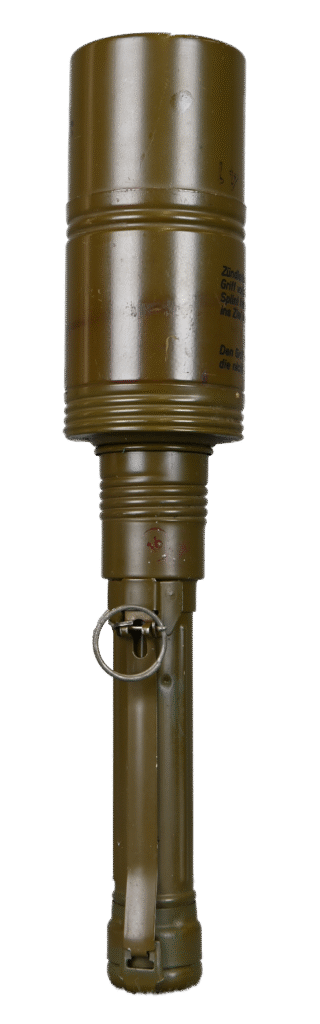
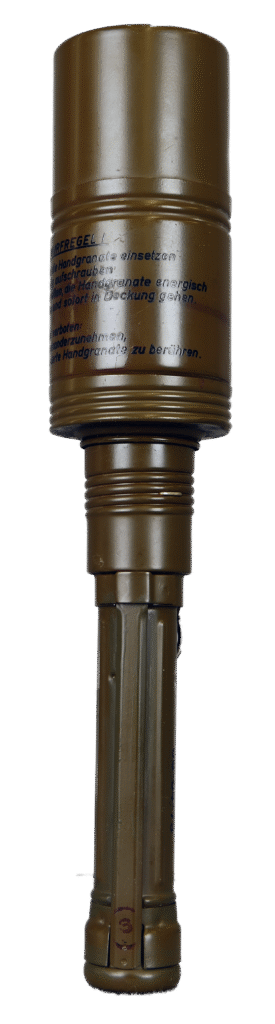
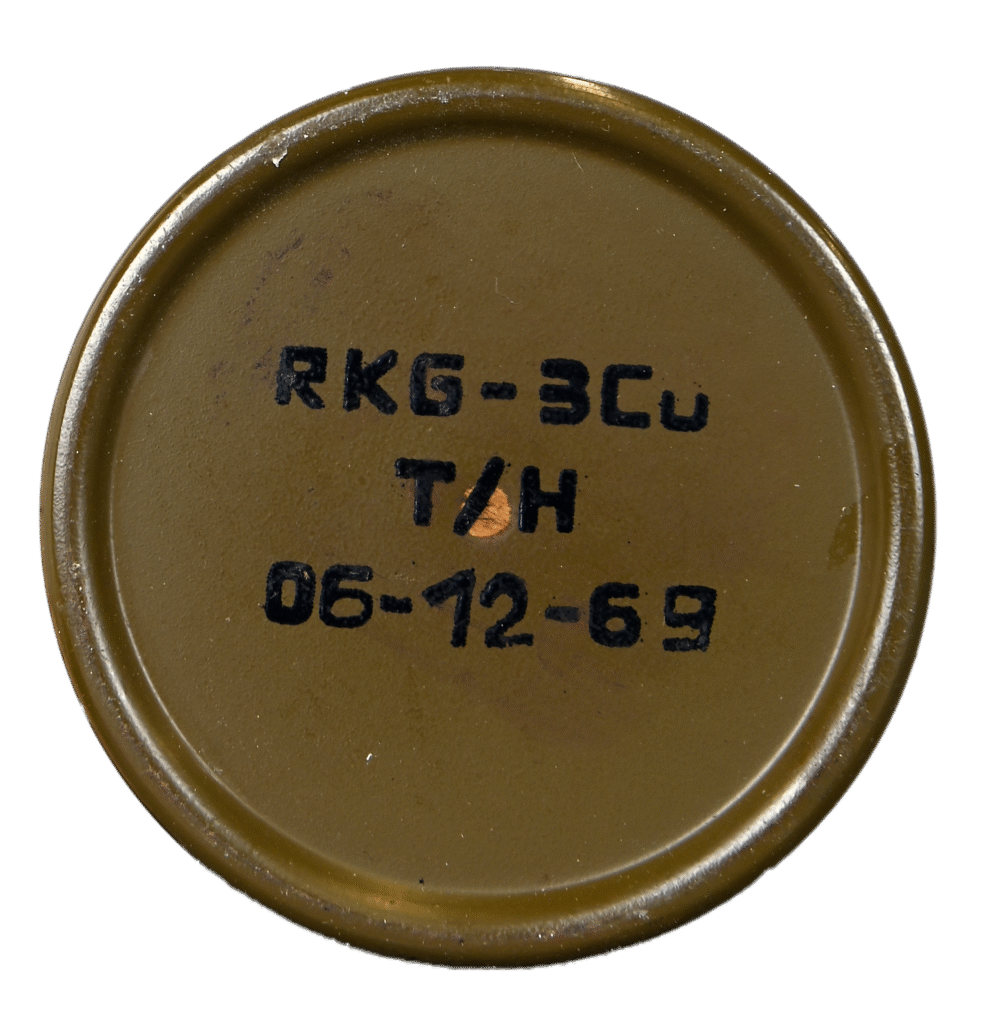
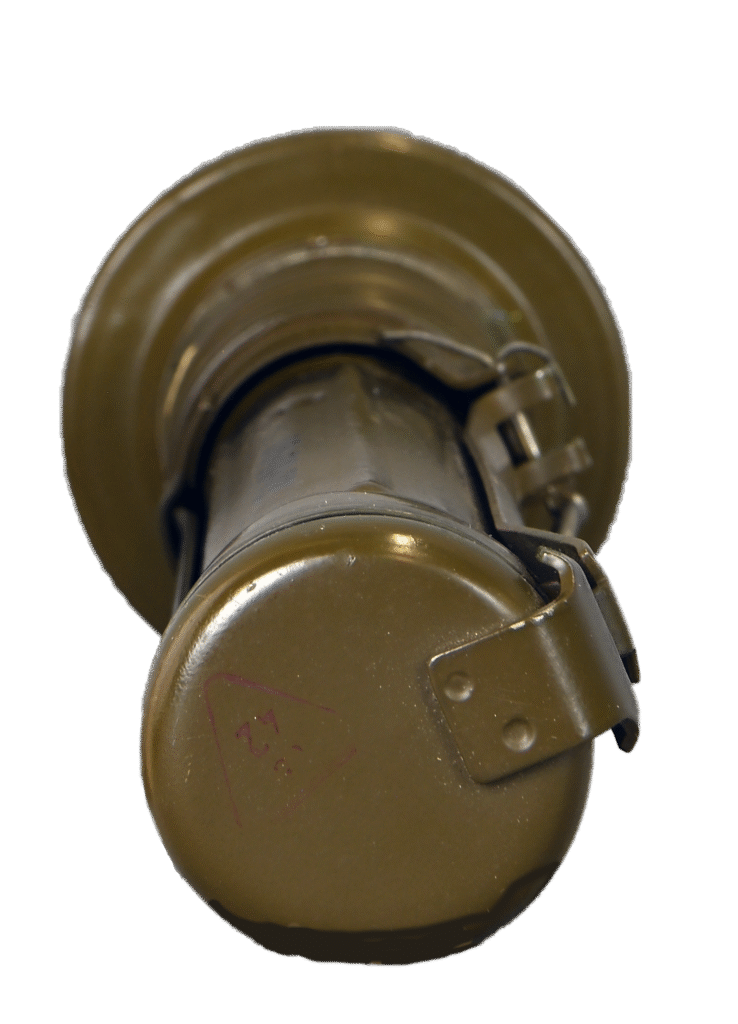
The RKG-3 (Ruchnaya Kumulyativnaya Granata model 3, meaning “Hand Cumulative Grenade model 3”) is a Soviet-designed anti-tank hand grenade featuring a shaped charge (HEAT – High Explosive Anti-Tank) warhead. Distinguished by its unique aerodynamic stabilization system with a fabric drogue parachute, the RKG-3 represents an innovative approach to infantry anti-armor warfare. Designed for use against armored vehicles, fortifications, and hardened targets, the RKG-3 employs a hollow-charge principle to defeat armor through a focused jet of superheated metal rather than traditional fragmentation.
Country/Bloc of Origin
- Country: Soviet Union (USSR)
- Development Period: Late 1940s to early 1950s
- Operational Introduction: Approximately 1950
- International Distribution: Licensed production in multiple Warsaw Pact nations including Poland, Bulgaria, and East Germany
- Successor Development: Led to improved RKG3E and RKG3EM variants
- Current Users: Still encountered in conflict zones worldwide, though largely replaced by modern rocket-propelled anti-tank weapons
Ordnance Class
- Type: Hand-thrown anti-tank grenade
- Primary Role: Anti-armor / Anti-fortification
- Warhead Type: Shaped charge (HEAT – High Explosive Anti-Tank)
- Delivery Method: Hand-thrown with stabilized flight
- Tactical Classification: Offensive anti-armor weapon (close-range engagement)
- Function: Impact-detonated shaped charge
Ordnance Family/Nomenclature
Official Designations
- Soviet/Russian Designation: RKG-3 (РКГ-3)
- Full Name: Ruchnaya Kumulyativnaya Granata Obrazets 3 (Hand Cumulative Grenade Model 3)
- NATO Designation: No specific NATO reporting name; identified by Soviet designation
Family Variants and Evolution
- RKG-3: Original production model (1950s)
- RKG-3E: Improved model with enhanced fuze reliability
- RKG-3EM: Modernized variant with upgraded fuze and increased armor penetration (200mm+)
- RKG-3T: Training variant (inert, often blue-painted)
Related Anti-Tank Grenades
- RPG-6: Earlier Soviet anti-tank grenade with cone-shaped design (no stabilization system)
- RPG-43: WWII-era Soviet anti-tank grenade with fabric stabilizer (predecessor concept)
- RKG-3M: Chinese copy/variant
- PTM-3: Modern Russian anti-tank mine (different application but related technology)
Distinguishing Nomenclature
The “RKG” prefix specifically denotes hand-thrown shaped charge grenades, distinguishing them from:
- “RG” prefix: Fragmentation hand grenades (RG-42)
- “RGD” prefix: Defensive fragmentation grenades (RGD-5)
- “RPG” prefix: Later applied to rocket-propelled grenades, but originally “Ruchnaya Protivotankovaya Granata” (hand anti-tank grenade)
Hazards
Primary Hazard: Shaped Charge Jet
- Jet Formation: Detonation creates a hypersonic metallic jet (copper liner) traveling at 7,000-9,000 m/s
- Penetration Capability: 125-165mm of rolled homogeneous armor (RHA) at 0° impact angle
- Standoff Distance Critical: Shaped charge requires specific standoff distance from target surface for optimal penetration (approximately 200-250mm)
- Jet Diameter: Approximately 10-15mm at penetration point
- Behind-Armor Effects: Spalling, incendiary effects, and blast inside penetrated vehicle
- Direct Threat Range: Extremely lethal within 2 meters of impact point
Secondary Fragmentation
- Body Fragmentation: Metal casing produces limited fragmentation (not designed for anti-personnel effect)
- Fragment Danger: Fragments dangerous within 15-20 meters
- Fragment Characteristics: Irregular, low-velocity fragments compared to dedicated fragmentation grenades
- Backblast Effect: Minimal compared to recoilless weapons, but hot gases and debris expelled rearward
Impact Fuzing Hazards
- High Sensitivity: Impact fuze activates on contact with target (multiple redundant piezoelectric elements)
- No Arming Delay: Grenade is armed after drogue deployment; any impact after ~2 meters of flight can cause detonation
- Misfire Potential: Dud grenades remain impact-sensitive indefinitely
- Fuze Degradation: Aging fuzes may become more or less sensitive unpredictably
- Ricochet Risk: Hard, angled surfaces may cause deflection without detonation, followed by delayed impact detonation
Special Hazards
- Drogue Deployment Failure: If stabilizer fails to deploy, grenade tumbles and may function unpredictably or fail to detonate properly
- Short Throws: Inadequate throwing distance may result in user being within fragment/blast radius
- Confined Spaces: Overpressure and backblast in enclosed areas pose significant risk to thrower
- UXO Instability: Degraded fuzes on unexploded ordnance may detonate from minimal disturbance
- Incendiary Effects: Shaped charge jet and secondary effects can ignite fuel/ammunition in vehicles
Tactical Danger Zones
- Minimum Safe Distance for Thrower: 15-20 meters from impact point
- Recommended Engagement Range: 15-20 meters (maximum effective throw distance)
- Fragment Danger Area: 20-25 meters radius
- Shaped Charge Danger Cone: 10-meter cone directly behind impact point (inside penetrated vehicle)
Key Identification Features
Physical Dimensions
- Total Length (with fuze and drogue): Approximately 360-400mm (14-16 inches)
- Warhead Diameter: 125mm (4.9 inches) at maximum width
- Body Length (without fuze): ~200mm (7.9 inches)
- Total Weight: 1,070-1,100 grams (2.35-2.4 pounds)
- Explosive Weight: 562 grams of TNT or equivalent HEAT composition
- Drogue Parachute: 300mm diameter fabric stabilizer
Distinctive Physical Characteristics
Warhead Profile:
- Conical/Truncated Cone Shape: Distinctive tapering from wide base to narrower top
- Shaped Charge Liner: Copper cone (not visible externally when intact)
- Standoff Probe: Extended nose fuze with impact probe (extends 200-250mm forward)
- Irregular Geometry: Unlike spherical fragmentation grenades; unmistakable silhouette
Stabilization System:
- Fabric Drogue Parachute: Bright colored fabric (often red, orange, or natural canvas)
- Deployment Mechanism: Spring-loaded deployment from base upon throwing
- Suspension Lines: Typically 4 fabric or cord lines connecting drogue to grenade body
- Baseplate: Circular metal plate at rear where drogue attaches
Fuze Assembly:
- Extended Impact Probe: Long piezoelectric impact fuze extending forward from nose
- Multiple Contact Points: Fuze designed to function regardless of impact angle
- Safety Mechanism: Pin or clip system prevents premature fuze activation
- Fuze Housing: Visible threaded connection at nose of warhead
Color Schemes and Markings
- Standard Field Colors:
- Olive drab or dark green body (most common)
- Some variants in gray or tan
- Drogue often in contrasting bright colors (red, orange, white) for visibility during training
- Markings:
- Lot numbers and production dates typically stamped on body
- Cyrillic text identifying model (РКГ-3)
- Stenciled safety warnings and operating instructions
- Some variants have colored bands indicating lot or production facility
- Training Variants:
- Blue paint indicating inert training version (RKG-3T)
- May have “УЧЕБН” (training) markings
Material Composition
- Body: Sheet steel construction (typically 2-3mm thickness)
- Shaped Charge Liner: Copper (occasionally other metals in later variants)
- Explosive Fill: TNT or similar military explosive in shaped charge configuration
- Drogue: Fabric (canvas, nylon, or synthetic material)
- Fuze Components: Steel, aluminum, piezoelectric crystals, spring steel
Field Identification Summary
The RKG3 is immediately distinguishable from other grenades by:
- Conical warhead shape (not spherical or cylindrical)
- Fabric drogue parachute attached to base
- Extended nose fuze probe (200-250mm projection)
- Larger size than typical hand grenades
- Distinctive tapered profile from base to nose
Unlike stick grenades (which it superficially resembles when drogue is deployed), the RKG3 has no handle—the drogue serves only for stabilization.
Fuzing Mechanisms
Impact Fuze System (Piezoelectric Type)
The RKG3 employs a sophisticated impact-activated piezoelectric fuze designed to ensure detonation upon contact with armored targets regardless of impact angle or velocity.
Fuze Components and Operating Principle
Primary Elements:
- Extended Standoff Probe: 200-250mm probe extending from nose
- Multiple Piezoelectric Elements: Crystals that generate electrical charge when mechanically stressed
- Detonator Circuit: Electrical detonator activated by piezoelectric charge
- Redundancy: Multiple piezoelectric elements ensure function even if some fail
Standoff Importance: The extended fuze serves dual critical purposes:
- Optimal Shaped Charge Performance: Maintains precise standoff distance between warhead and target surface (critical for jet formation)
- Impact Detection: Ensures fuze contacts target before main body, activating detonator
Arming Sequence
1. Safe Configuration (Pre-Throw):
- Safety pin or safety clip prevents fuze activation
- Drogue secured in collapsed position by retention clip
- Fuze circuit mechanically isolated
- Multiple safeties prevent accidental detonation
2. Throwing Action:
- User removes safety pin/clip
- Grenade thrown toward target
- Release initiates arming sequence
3. Drogue Deployment and Arming:
- Spring-loaded mechanism deploys fabric drogue ~1-2 meters after release
- Drogue deployment arms the fuze (typically by removing mechanical barrier or completing electrical circuit)
- Arming distance approximately 2-5 meters from thrower
- Grenade stabilizes in flight with nose forward due to drogue drag
4. Impact and Detonation:
- Extended fuze probe contacts target surface first
- Impact compresses piezoelectric elements, generating electrical pulse
- Electrical pulse fires detonator almost instantaneously (<1 millisecond)
- Detonator initiates shaped charge main explosive
- Shaped charge liner collapses, forming hypersonic jet
- Jet penetrates armor while standoff probe maintains optimal distance
Safety Features
- Mechanical Safety Pin: Prevents accidental fuze activation during handling
- Arming Distance: Fuze not fully armed until drogue deployment (2-5 meters)
- Multiple Redundancies: Several piezoelectric elements ensure reliable function
- Standoff Design: Physical separation between fuze and main charge provides handling safety margin
Failure Modes and Limitations
Common Malfunctions:
- Drogue Failure: If drogue doesn’t deploy, grenade tumbles and may impact incorrectly (glancing blow, side impact)
- Fuze Duds: Piezoelectric elements can fail due to moisture, corrosion, or manufacturing defects
- Soft Target Impact: Very soft surfaces (deep mud, water, thick vegetation) may not provide sufficient impact force
- Grazing Impacts: Shallow-angle impacts may cause deflection rather than detonation
- Electrical Failure: Degraded connections or corroded components prevent detonator activation
UXO Concerns:
- Dud grenades remain impact-sensitive
- Corrosion can make piezoelectric fuzes unpredictable
- Extended probe may be damaged in landing, affecting fuze reliability
- No self-destruct or self-neutralization feature
Fuze Variants
- Early RKG-3: Original piezoelectric fuze design
- RKG-3E/EM: Improved fuze with better moisture resistance and reliability
- Modified Versions: Some field modifications used simpler mechanical impact fuzes
Optimal Function Requirements
For maximum armor penetration, the RKG3 requires:
- Nose-first impact (stabilized by drogue)
- Perpendicular impact angle (90° to armor surface)
- Precise standoff distance maintained by fuze probe
- Complete detonation of shaped charge
- Intact copper liner
Deviation from these conditions (tumbling, angled impact, damaged probe) significantly reduces penetration capability.
History of Development and Use
Development Context (Late 1940s)
The RKG3’s development emerged from Soviet analysis of World War II anti-tank warfare and the limitations of existing infantry anti-armor weapons.
Historical Drivers:
- WWII Experience: Soviet forces faced heavily armored German tanks (Tiger, Panther) that were largely immune to small arms and difficult for infantry to engage
- Shaped Charge Technology: German research into hollow-charge weapons (Panzerfaust, Panzerschreck) demonstrated effectiveness of shaped charge principles
- Infantry Gap: Need for portable anti-armor capability between grenades (ineffective against armor) and cumbersome anti-tank rifles
- Mobility Warfare: Post-war Soviet doctrine emphasized mechanized combined-arms operations where infantry might encounter enemy armor unexpectedly
Design Philosophy: The Soviet military sought a weapon that:
- Used proven shaped charge technology
- Could be thrown by average infantry soldiers
- Defeated contemporary armor (80-150mm penetration goal)
- Was simple enough for mass conscript armies
- Complemented rocket-propelled anti-tank weapons (early RPGs)
Developmental Challenges
Aerodynamic Stabilization: The critical innovation was the drogue stabilization system. Early anti-tank grenades (RPG-6, RPG-43) had limited accuracy and effectiveness due to tumbling in flight. The RKG3’s fabric drogue:
- Ensured nose-first impact (critical for shaped charge function)
- Increased throwing accuracy by stabilizing flight
- Required minimal training compared to stick grenades
- Used simple, low-cost materials (fabric, cord)
Fuze Design: Developing a reliable impact fuze that:
- Functioned at various impact angles and velocities
- Maintained optimal standoff distance
- Armed safely after throwing but before impact
- Resisted environmental degradation
Production and Deployment (1950-1980s)
- 1950: Initial production and fielding to Soviet infantry units
- 1950s: Mass production across Soviet defense industry
- 1960s: Export to Warsaw Pact allies and aligned nations
- 1970s: Continued production despite introduction of RPG-7; RKG3 filled niche role
- 1980s: Development of improved variants (RKG-3E, RKG-3EM)
- 1990s-Present: Gradual phase-out in Russian service but remains in global circulation
Production Scale: Exact production figures remain classified, but estimates suggest millions of units produced across Soviet Union and licensed manufacturers through the 1980s.
Combat Employment History
Major Conflicts:
Korean War (1950-1953):
- Limited early use by Chinese and North Korean forces
- Effectiveness against M4 Sherman and other UN armor
- Reports of use in close urban combat
Vietnam War (1965-1975):
- Extensive use by NVA and Viet Cong forces against US armor
- Particularly effective in ambushes and urban environments
- Used against M48 Patton tanks, M113 APCs, and fortified positions
- Drogue visibility sometimes betrayed thrower position
Middle East Conflicts (1960s-1980s):
- Deployed by Arab armies in conflicts with Israel
- Mixed effectiveness against increasingly advanced Israeli armor
- Used in both anti-armor and anti-fortification roles
Soviet-Afghan War (1979-1989):
- Issued to Soviet forces, though RPG-7 preferred
- Used by Mujahideen forces (captured or supplied stocks)
- Effectiveness against BTR and BMP vehicles
- Challenging to use in mountainous terrain
Post-Soviet Conflicts (1990s-2000s):
- Chechen Wars: Used by both Russian and Chechen forces
- Yugoslav Wars: Widespread use by all factions
- African conflicts: Continued appearance in various civil wars
21st Century Appearances:
- Iraq War (2003-2011): Found in Iraqi stockpiles; limited insurgent use
- Syrian Civil War (2011-present): Appears in various faction arsenals
- Libyan Civil War (2011, 2014-2020): Discovered in government stockpiles
- Ukrainian Conflict (2014-present): Older stocks used by separatist forces
Tactical Doctrine and Use
Soviet/Russian Tactical Employment:
- Specialized Troops: Often assigned to designated anti-tank grenadiers within infantry squads
- Ambush Warfare: Positioned in urban or close terrain where vehicles forced into narrow passages
- Combined Arms: Used alongside RPG-7 teams; RKG3 for backup or closer ranges
- Target Priority: Lighter armored vehicles (APCs, IFVs), tank tracks/optics, fortified positions
- Engagement Range: 10-20 meters (maximum effective throwing distance)
- Multiple Grenades: Doctrine often called for multiple simultaneous throws against single target
Tactical Limitations:
- Throwing Range: Limited to ~20 meters, requiring thrower to close to very dangerous distance
- Exposure: Drogue visibility during flight could reveal thrower position
- Single Use: Unlike RPG-7 which could fire multiple rounds, each thrower limited by grenades carried
- Armor Evolution: Became less effective as armor thickness and reactive armor improved (1980s+)
Effectiveness Assessment
Against Period Armor (1950s-1970s):
- Highly Effective: 125-165mm penetration defeated most APCs, IFVs, and tank side/rear armor
- Strategic Impact: Provided infantry credible anti-armor capability in close combat
- Psychological Effect: Tank crews aware of threat adjusted tactics, avoided urban/close terrain
Against Modern Armor (1980s+):
- Reduced Effectiveness: Main battle tanks (T-72, M1 Abrams, Leopard 2) with 400-600mm+ frontal armor immune
- Niche Utility: Still effective against tracks, optics, rear armor, and lighter vehicles
- Reactive Armor: ERA (Explosive Reactive Armor) largely defeated shaped charge jets
- Obsolescence: By 1990s, RPG-7 with tandem warheads superior in nearly all scenarios
Legacy and Current Status
Technological Influence: The RKG3’s drogue stabilization concept influenced later grenade and munition designs worldwide, demonstrating that simple aerodynamic solutions could dramatically improve hand-thrown weapon accuracy.
Current Relevance:
- Russian Military: Officially phased out; replaced by modern RPG systems
- Global Stockpiles: Remains in arsenals of dozens of countries, particularly former Soviet allies
- Conflict Zones: Continues to appear in ongoing conflicts, often from Cold War stockpiles
- Asymmetric Warfare: Still viable in urban insurgent warfare against lighter vehicles
- Historical Significance: Represents an evolutionary step between WWII stick grenades and modern shoulder-fired anti-tank weapons
Training and Proficiency: Modern soldiers rarely train with RKG3, as RPG-7 and successor systems are more versatile. Knowledge of RKG3 is primarily maintained for:
- EOD identification and clearance
- Historical military studies
- Dealing with legacy stockpiles in conflict zones
The RKG3 ultimately represents a transitional technology—effective in its era but superseded by the shoulder-fired rocket launchers that dominate contemporary anti-armor warfare.
Technical Specifications
Warhead Characteristics
- Warhead Type: HEAT (High Explosive Anti-Tank) shaped charge
- Explosive Fill: 562 grams of TNT or equivalent
- Shaped Charge Liner: Copper cone (typically 80-90mm diameter, ~60° cone angle)
- Standoff Distance: 200-250mm (maintained by extended fuze probe)
- Armor Penetration: 125-165mm RHA (Rolled Homogeneous Armor) at 0° impact
- Penetration vs. Angle: Significantly reduced at oblique angles (>30° from perpendicular)
- Jet Velocity: 7,000-9,000 m/s
- Behind-Armor Effects: Spalling, incendiary effects, localized overpressure
Physical and Ballistic Data
| Specification | Metric | Imperial |
|---|---|---|
| Total Length (with drogue) | 360-400 mm | 14-16 in |
| Warhead Diameter | 125 mm | 4.9 in |
| Body Length | ~200 mm | ~7.9 in |
| Total Weight | 1,070-1,100 g | 2.35-2.4 lbs |
| Explosive Weight | 562 g | 19.8 oz |
| Drogue Diameter | 300 mm | 11.8 in |
Operational Parameters
- Throwing Range (average soldier): 15-20 meters maximum effective
- Minimum Arming Distance: 2-5 meters (drogue deployment requirement)
- Optimal Engagement Range: 15-20 meters
- Impact Velocity Required: Moderate (fuze designed for various velocities)
- Storage Temperature Range: -40°C to +50°C
- Shelf Life: 10-20 years with proper storage; fuze degradation possible beyond this
Fuze Specifications
- Fuze Type: Piezoelectric impact fuze
- Arming Method: Mechanical arming upon drogue deployment
- Standoff Probe Length: 200-250mm
- Detonation Delay: Near-instantaneous (<1 millisecond from impact)
- Impact Sensitivity: Designed to function from throw velocities (~15-25 m/s impact)
- Reliability: ~85-95% when new; degrades with age
Aerodynamic Performance
- Drogue Function: Stabilizes grenade in nose-forward orientation during flight
- Terminal Velocity: Approximately 20-30 m/s (depending on throw strength)
- Flight Stability: High when drogue deploys properly; tumbles if drogue fails
- Accuracy: Moderate; ~2-3 meter dispersion at 20 meters with trained thrower
Target Effectiveness Matrix
| Target Type | Effectiveness | Notes |
|---|---|---|
| Main Battle Tanks (frontal) | Ineffective | Armor too thick (400-600mm+) |
| Main Battle Tanks (side/rear) | Variable | Depends on armor thickness; older tanks vulnerable |
| Infantry Fighting Vehicles | Effective | Most IFVs have 20-40mm armor |
| Armored Personnel Carriers | Highly Effective | Typically 10-20mm armor |
| Truck/Soft Vehicles | Overkill | Shaped charge overmatches soft targets |
| Fortifications/Bunkers | Effective | Creates breach hole; blast effects |
| Concrete Walls | Effective | Can penetrate 200-300mm concrete |
Environmental Limitations
- Wind Sensitivity: Drogue affected by crosswinds; reduces accuracy
- Rain/Moisture: Can affect fabric drogue performance; minimal effect
- Extreme Cold: Fabric becomes stiff; explosive performance may degrade below -30°C
- Heat: Minimal effect up to 50°C; storage above this risks explosive degradation
- Altitude: Thin air reduces drogue effectiveness at high altitudes (>3,000m)
Frequently Asked Questions
Q: Why does the RKG3 use a fabric drogue instead of fins like modern anti-tank rockets?
A: The drogue design was chosen for several practical reasons specific to hand-thrown weapons. First, fin stabilization requires high velocity to be effective—a hand-thrown grenade travels too slowly for fins to provide adequate stabilization, whereas a drogue creates drag that stabilizes even low-velocity projectiles. Second, packaging and deployment simplicity—fins would require a complex deployment mechanism, while a spring-loaded drogue is mechanically simple and reliable. Third, manufacturing cost—fabric and cord are far cheaper than precision metal fins. Fourth, Soviet design philosophy favored robust, simple solutions suitable for mass production and conscript armies. The drogue design proved remarkably effective, ensuring nose-first impact in 85-90% of throws. Modern rocket launchers use fins because their propellant-driven projectiles travel fast enough to make fins more effective, but for hand-thrown weapons traveling 15-25 m/s, the drogue remains the superior solution.
Q: How effective would an RKG3 be against modern main battle tanks like the M1 Abrams or T-90?
A: Against modern MBTs, the RKG3 is largely ineffective against frontal armor but retains limited utility against specific vulnerable points. Modern MBT frontal armor ranges from 400-900mm RHA equivalent (including composite armor, reactive armor), far exceeding the RKG3’s 125-165mm penetration. However, the RKG3 could still damage: tracks and running gear (mobility kill), optical systems and sensors (degrading crew effectiveness), side and rear armor on older MBTs or poorly-positioned vehicles (some areas may be 80-150mm), engine compartments (potentially causing fires or mechanical damage), and external equipment (antennas, reactive armor panels). The primary limitation is the extreme close range required—getting within 15-20 meters of a modern MBT is extraordinarily dangerous. Additionally, modern ERA (Explosive Reactive Armor) can degrade or defeat the shaped charge jet. In practice, insurgent forces have occasionally used RKG3-type weapons against Abrams and other modern tanks, typically achieving mobility kills or mission kills rather than catastrophic penetrations. Against contemporary threats, RPG-7 with tandem warheads or modern ATGMs are vastly superior.
Q: What happens if the drogue fails to deploy, and can the RKG3 still detonate?
A: Drogue deployment failure creates an extremely dangerous and unpredictable situation. If the drogue doesn’t deploy: the grenade tumbles in flight rather than stabilizing nose-forward, it may impact at incorrect angles (side, base, or tumbling), and the fuze may still activate on impact but shaped charge effectiveness is destroyed. The shaped charge requires precise nose-first perpendicular impact to form the penetrating jet—any other orientation results in the explosive detonating but producing little to no armor penetration. The grenade becomes essentially a poorly designed explosive charge that detonates erratically. Dangers include: premature detonation if tumbling causes fuze to strike ground prematurely, higher chance of dud (grazing impact or soft impact without sufficient force), fragment hazard still exists but unpredictable direction, and thrower is at risk if grenade lands short or deflects. Drogue failure can result from fabric damage, spring mechanism failure, or improper throwing technique. This is why training emphasized proper throwing motion and pre-throw visual inspection of the drogue mechanism.
Q: Why does the RKG3 have such a short effective range (15-20 meters) compared to the RPG-7 (200+ meters)?
A: The range limitation is inherent to hand-thrown weapons versus rocket-propelled weapons, driven by fundamental physics. Human throwing capability is limited: even trained athletes struggle to throw a 1-kilogram object beyond 20-25 meters accurately. The RKG3’s weight (~1.1 kg) and aerodynamic drag from the drogue limit practical throwing distance. Additionally, accuracy degrades rapidly with distance—hitting a moving or stationary tank at 20 meters with a hand-thrown object is challenging; beyond this, accuracy becomes unreliable. The tactical doctrine reflected this: RKG3 was designed for close-quarters ambush situations where infantry could close to extremely short range (urban combat, dense terrain, prepared positions). The RPG-7, by contrast, uses a rocket motor to achieve 200-500 meter ranges with better accuracy and significantly more powerful warheads. The RKG3 was essentially a backup or supplementary weapon for situations where RPG-7 couldn’t be employed (close quarters, surprise encounters, building interiors). By the 1970s-1980s, it became clear that rocket-propelled weapons were superior in nearly all scenarios, leading to the RKG3’s gradual phase-out. The core lesson: hand-thrown anti-armor weapons are inherently limited to point-blank ranges.
Q: How does the shaped charge in the RKG3 actually work to penetrate armor?
A: The shaped charge (also called hollow charge or HEAT) works through the Munroe effect, a fascinating physics phenomenon. The RKG3’s warhead contains a conical copper liner backed by high explosive (TNT). Here’s the detonation sequence: (1) Initiation: The impact fuze detonates the TNT explosive. (2) Collapse: The detonation wave travels through the explosive, collapsing the copper cone from base to tip at ~7,000 m/s. (3) Jet Formation: As the cone collapses, the copper is compressed and stretched, forming a thin, hypersonic jet of molten/semi-molten copper traveling 7,000-9,000 m/s and a slower-moving “slug” of remaining copper. (4) Penetration: The jet impacts the armor surface and punches through via extreme kinetic energy and pressure (>1 million PSI), not by melting—though secondary melting occurs. (5) Behind-Armor Effects: The jet creates a small (10-15mm) hole but sprays hot copper, armor spalling, and overpressure inside the target. Critical to this process is standoff distance—the jet needs 200-250mm to fully form before hitting armor, which is why the RKG3 has the extended fuze probe. If the warhead contacts armor directly, the jet doesn’t form properly and penetration drops dramatically. This isn’t a “cutting” or “melting” action—it’s a hydrodynamic penetration where extreme velocity and pressure overcome the armor’s structural strength. Against modern composite or reactive armor, the jet can be disrupted or degraded, significantly reducing penetration.
Q: Can an RKG3 be used against non-armored targets like buildings or personnel, and is it effective?
A: The RKG3 can physically be used against such targets but is poorly optimized for these roles compared to dedicated munitions. Against fortifications/buildings, the shaped charge will penetrate walls and create localized damage, potentially creating breach holes through 200-300mm of concrete or destroying bunker firing ports. However, the blast and fragmentation effects are minimal compared to dedicated demolition charges or fragmentation grenades—it creates a narrow hole rather than broad destruction. Against personnel, the RKG3 is highly inefficient and dangerous to the user. The shaped charge jet is extremely focused and narrow, so unless it directly strikes a person, lethality is low. The body produces some fragmentation, but far less than a dedicated fragmentation grenade like the RGD-5. The 15-20 meter lethal radius from fragments is comparable to throwing distance, meaning the thrower is at risk. Tactically, using an expensive, specialized anti-armor weapon against unarmored targets wastes resources—an RGD-5 costs far less and is more effective against personnel, while demolition charges are superior for structures. The RKG3 excels at one mission: defeating armored vehicles. Using it for anything else represents desperation or lack of appropriate munitions. In historical conflicts, RKG3s were occasionally used against bunkers and fortifications when no better option existed, but this was recognized as a suboptimal application.
Q: What’s the difference between the original RKG3 and the improved RKG3EM variant?
A: The RKG3EM (where “EM” likely indicates “Улучшенная Модернизированная” – Improved Modernized) represents an evolution addressing shortcomings identified through decades of use. Key improvements include: (1) Enhanced Fuze Reliability: Better moisture sealing, improved piezoelectric element design, and more reliable electrical circuit—reducing dud rates from ~10-15% to ~5-8%. (2) Increased Penetration: Engineering refinements to the shaped charge liner (improved cone angle, better copper quality, optimized standoff) increased armor penetration from ~125-145mm to 180-220mm RHA, a significant improvement. (3) Better Drogue Deployment: More reliable spring mechanism and improved fabric attachment reduced drogue deployment failures. (4) Manufacturing Quality: Tighter tolerances and better quality control improved consistency. (5) Shelf Life Extension: Better corrosion protection and sealed components extended reliable storage from 10-15 years to 15-20+ years. Despite these improvements, the RKG3EM still faces the fundamental limitation of being hand-thrown—limited range, accuracy challenges, and extreme danger to the thrower. It represents the maximum evolution possible within the hand-thrown shaped charge concept, but by the time of its development (1980s-1990s), rocket-propelled systems had largely superseded the entire category. The RKG3EM is primarily encountered in stockpiles of countries that received modernization kits or late-production units, and it’s generally identified by updated markings and occasionally slightly different external features (improved fuze cap design, better drogue attachment hardware).
Q: What should EOD personnel or civilians do if they encounter an RKG3, especially considering the extended fuze probe?
A: Encountering an RKG3 requires extreme caution due to its impact-sensitive fuze and extended probe, which creates unique hazards. For EOD professionals, the approach involves: (1) Identify from safe distance using binoculars/optics—look for distinctive conical shape, drogue, and extended probe. (2) Establish 100-meter exclusion zone minimum—fragments and detonation products can travel significant distances. (3) Assess condition: Is probe intact? Is drogue deployed/tangled? Any visible damage? Degraded RKG3s may have corroded fuzes with unpredictable sensitivity. (4) Render safe procedures: Trained EOD may use manual procedures (extremely dangerous) or, preferably, explosive disruption/demolition in place. The extended probe makes traditional approaches challenging. (5) Dispose properly: Often destroyed in place via controlled detonation. For civilians, the protocol is much simpler: DO NOT APPROACH, DO NOT TOUCH. The extended fuze probe is extremely fragile—even slight pressure could cause detonation. Specific dangers: (1) Do not grab or move—the probe will activate on contact. (2) Do not attempt to remove drogue—pulling fabric could shift the grenade or trigger degraded fuze. (3) Mark location from 100+ meters—use landmarks, GPS, or visual markers. (4) Evacuate area and notify authorities—police, military, or EOD. (5) Keep others away—especially children who might be curious. The RKG3’s unusual appearance (drogue, probe) makes it visually distinctive but also confusing to untrained observers who might not recognize it as highly dangerous ordnance. In former conflict zones, RKG3s are frequently discovered during construction or agricultural work—professional disposal is the only safe option.
Safety Warning
This document is for educational and identification purposes only. The RKG3 anti-tank grenade is an extremely dangerous explosive device with a highly sensitive impact fuze. All explosive ordnance should only be handled by trained military personnel or explosive ordnance disposal (EOD) specialists.
Unexploded ordnance (UXO), including RKG3 grenades, remains lethal for decades and may become more unstable over time as fuze components degrade. The extended impact fuze probe is particularly sensitive—even minimal pressure can cause detonation.
If you encounter suspected ordnance:
- Do NOT touch, move, or disturb the device
- Maintain at least 100 meters distance
- Mark the location and evacuate the area
- Contact military or law enforcement authorities immediately
- Keep others, especially children, away from the area
This information is intended for military professionals, EOD technicians, historians, researchers, and educational purposes only. Never attempt to handle, disarm, modify, or render safe any live ordnance.