Russian O-16 Submunition
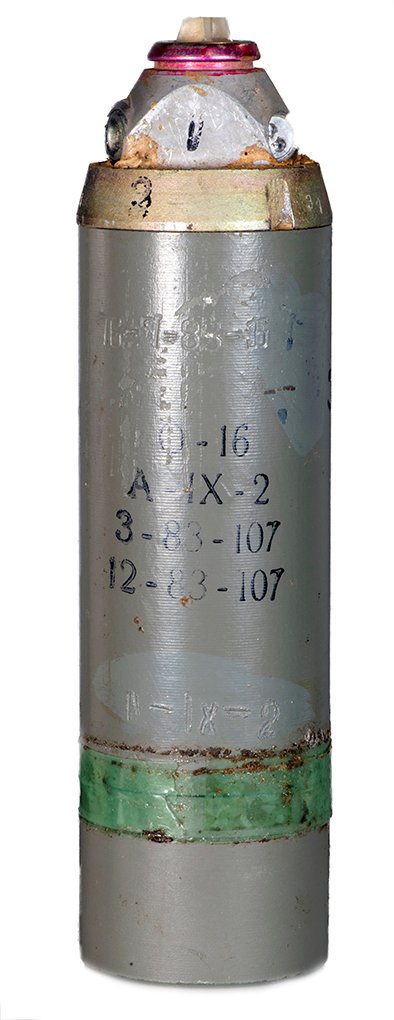
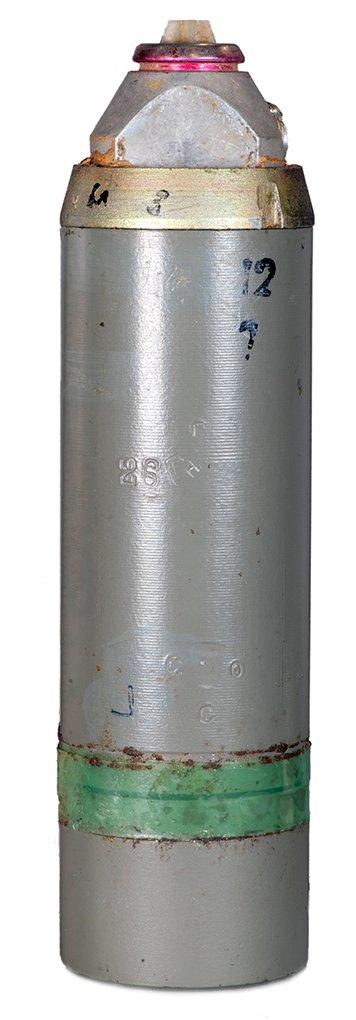
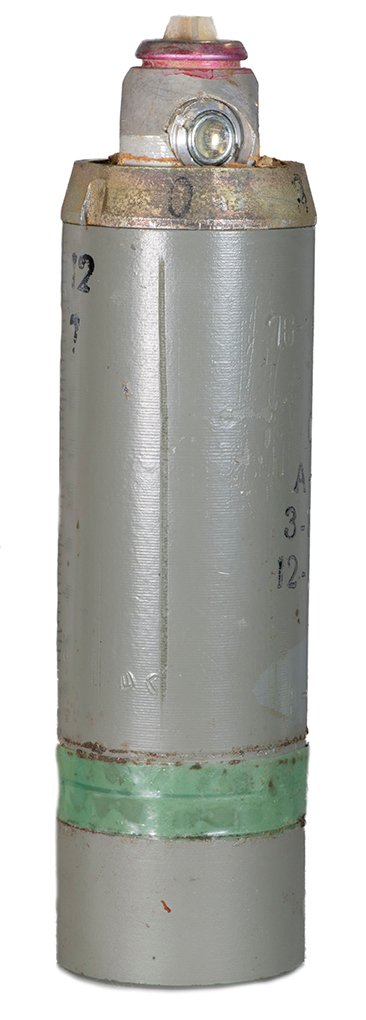
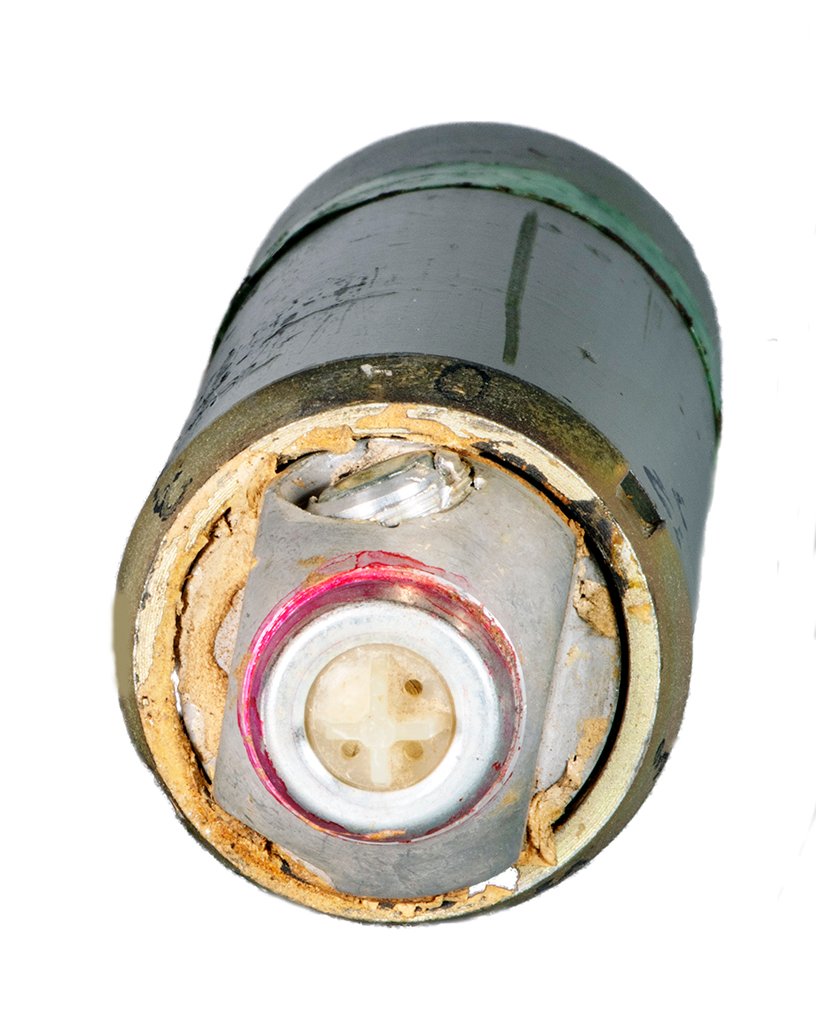
Ordnance Overview
The 3-O-16 (commonly referred to simply as O-16) is a Soviet-era high explosive fragmentation submunition designed to be dispersed from rocket-delivered cluster munition warheads. This weapon represents part of the Soviet Union’s extensive development of cluster munition technology during the Cold War, optimized for area suppression of enemy personnel and light materiel. The O-16 is distinctive for its ribbon (streamer) stabilization system—unlike many of its contemporaries which use fins—making it easily identifiable in the field. Despite being developed decades ago, the O-16 continues to see active use in modern conflicts, most notably in the ongoing Russian-Ukrainian War, where it has contributed significantly to civilian casualties and long-term UXO contamination.
Country/Bloc of Origin
Developed by: Soviet Union (USSR)
Current User/Manufacturer: Russian Federation
Development Era: Cold War period (1970s-1980s)
Current Status: Active service, modern production continues
International Distribution:
- Primary User: Russian Federation
- Documented Locations: Russian Federation, Ukraine, Syria
- Manufactured by: USSR, later Russian Federation
- License Production: Unknown – no confirmed licensed production by other nations
- Related Systems: The O-16 is part of a family of Soviet/Russian submunitions including the 9N210, 9N235, and 3-O-10, though each has distinct characteristics
The O-16 was developed as part of the Soviet Union’s comprehensive cluster munition program, which sought to create effective area weapons for engaging dispersed enemy forces on the modern battlefield. The submunition reflects Soviet tactical doctrine emphasizing mass firepower and area denial against NATO forces in a hypothetical European conflict.
Ordnance Class
Type: Submunition (Bomblet)
Classification: High Explosive Fragmentation (HE-FRAG)
Primary Role: Anti-Personnel (AP) with secondary anti-materiel capability
Delivery Method: Artillery rocket-dispersed (cluster munition carrier)
Target Set: Exposed personnel, light vehicles, unarmored materiel, command posts
Functional Category: The O-16 is classified as an artillery-delivered submunition, specifically designed for rocket-based delivery systems. It functions as part of a cluster munition warhead, with multiple O-16 submunitions packaged together in a carrier rocket. Upon reaching the target area, the carrier dispenses the submunitions, which then individually descend and detonate, creating a wide area of fragmentation coverage.
Employment Doctrine: Soviet/Russian tactical doctrine employs the O-16 for:
- Suppression of enemy infantry in open or lightly protected positions
- Neutralization of soft-skinned vehicles and equipment concentrations
- Area denial through UXO hazard creation
- Rapid coverage of large target areas
- Saturation attacks on defensive positions
Ordnance Family/Nomenclature
Official Full Designation: 3-O-16 (3-О-16 in Cyrillic)
Common Designation: O-16 (О-16) – The “3-” prefix is often omitted in field markings
Nomenclature Explanation:
- “3” – Indicates the design generation or series number
- “O” (О) – From “Oskolochnyy” (Осколочный), meaning “Fragmentation”
- “16” – Specific model number within the series
GRAU Index: Unknown – The O-16 predates or exists outside the standard 9N-series GRAU designation system used for more modern submunitions
Related Family Members:
- 3-O-10: Parachute-stabilized predecessor/sibling design
- Uses parachute rather than ribbons for stabilization
- Similar size and explosive fill
- Often confused with O-16 in field identification
- 9N210: Fin-stabilized modern counterpart
- Uses folding fins instead of ribbons
- Similar role and dimensions
- Contains 370-400 pre-formed fragments
- Equipped with 9E246/9E246M fuze
- 9N235: Advanced fin-stabilized variant
- Dual fragment size design
- 96 x 4.5g fragments plus 360 x 0.75g fragments
- Enhanced anti-materiel capability
- 9E272 impact fuze with longer self-destruct delay
- 3-O-25: Larger submunition in same family
- Heavier explosive fill
- Greater fragmentation coverage
- Similar stabilization method
Key Distinguishing Features from Similar Submunitions:
- vs. 9N210/9N235: O-16 uses ribbon stabilization; 9N210/9N235 use spring-loaded fins
- vs. 3-O-10: O-16 uses ribbons; 3-O-10 uses parachute
- All three types are similar in size and often confused in conflict documentation
Marking System: Typical O-16 submunitions are marked with:
- “O-16” or “О-16” designation on the body
- Lot number and production codes
- Manufacturing date
- Factory identifier codes
- May include explosive type marking (e.g., A-IX-1)
Hazards
The O-16 submunition presents severe and multifaceted hazards both during initial deployment and as long-term unexploded ordnance (UXO). Understanding these hazards is critical for military personnel, EOD technicians, and civilians in affected areas.
Primary Hazard Types:
1. Immediate Blast Effects:
- High explosive detonation creates lethal blast wave
- Blast overpressure can cause severe internal injuries
- Effective lethal radius: 5-10 meters
- Severe injury radius: 15-20 meters
- Blast can cause structural damage to buildings and vehicles
2. Fragmentation Hazards:
- Body contains pre-formed fragmentation elements
- Estimated 200-400 steel fragments per submunition
- High-velocity fragments (1,500-2,000 m/s)
- Maximum fragment range: 100-200 meters
- Fragments penetrate soft cover (wood, sandbags, light vehicles)
- Lethal fragmentation radius: 10-15 meters
- Injury-producing fragments travel to 100+ meters
3. Multiple Munition Effects (Cluster Impact):
- Typical carrier disperses dozens of O-16 submunitions
- Each rocket may contain 20-72 submunitions depending on carrier type
- Simultaneous or near-simultaneous detonations
- Overlapping fragmentation patterns
- Area coverage: up to 1-2 hectares (2-5 acres) per carrier rocket
- No safe zones within impact area
Sensitivity to Disturbance:
Impact Sensitivity (Armed State):
- Designed to function on contact with ground or target
- Extremely sensitive once armed
- Will detonate upon striking soil, concrete, wood, or other surfaces
- Impact force required: Minimal (functions on all typical impacts)
Movement Sensitivity:
- Failed/dud submunitions remain armed and sensitive
- Any movement, vibration, or disturbance can trigger detonation
- Rolling, tilting, or lifting armed submunition is extremely dangerous
- Environmental movement (erosion, animal activity) can cause delayed function
Pressure Sensitivity:
- Armed submunitions may function under applied pressure
- Stepping on or driving over UXO can cause detonation
- Applies to both fresh duds and aged UXO
Temperature Sensitivity:
- Explosive fill stable across operational range (-40°C to +50°C)
- Extreme temperature cycling can affect fuze reliability
- Fire exposure will cause detonation
Environmental Stability and Degradation:
Short-Term (0-5 years post-conflict):
- Submunitions remain highly dangerous
- Fuze mechanisms function as designed
- Self-destruct systems (when present) may have functioned or failed
- Metal bodies begin corrosion in moist environments
Medium-Term (5-20 years):
- Corrosion weakens body integrity
- Exposed submunitions show weather damage
- Buried submunitions may surface through erosion
- Explosive fill remains active and dangerous
- Fuze mechanisms may become more sensitive or unpredictable
Long-Term (20+ years):
- Severe corrosion of steel body
- Potential for spontaneous detonation due to degradation
- Chemical changes in explosive fill may increase sensitivity
- Submunitions may fragment naturally, exposing explosive fill
- Remains highly dangerous—do not assume aged ordnance is safe
Environmental Factors Affecting Stability:
- Moisture/humidity: Accelerates corrosion, may affect fuze reliability
- Temperature cycling: Causes expansion/contraction stress
- Freeze-thaw cycles: Can damage internal mechanisms
- Soil chemistry: Acidic soils increase corrosion rates
- Vegetation growth: Root pressure can trigger submunitions
- Fire: Will cause detonation if temperature exceeds limits
Special Hazards Unique to This Ordnance:
1. Ribbon Stabilization Hazards:
- Streamers may hang in trees/structures, suspending armed submunitions
- Suspended submunitions extremely hazardous to approach or disturb
- Wind movement of suspended submunitions can cause function
- Ribbons deteriorate over time, potentially dropping submunition
2. Small Size Hazard:
- Relatively small submunition easily overlooked
- Can be obscured by vegetation, debris, or snow
- Children may mistake for toy or interesting object
- Easy to accidentally contact during clearance operations
3. Multiple Submunition Hazards:
- Cluster attacks leave many submunitions in small area
- Detonation of one may sympathetically detonate nearby submunitions
- Clearance operations face cascading detonation risk
- High concentration creates extreme hazard density
4. Self-Destruct Uncertainty: The O-16 equipped with 9E246M1 fuze includes a pyrotechnic self-destruct mechanism, but:
- Self-destruct is not 100% reliable (estimated 2-10% failure rate)
- Aged submunitions have higher SD failure rates
- Impossible to determine if SD has functioned or failed on visual inspection
- All submunitions must be treated as live regardless of age
Kill Radius and Danger Areas:
Immediate Kill Zone:
- Radius: 5-10 meters
- Near-certain lethality from combined blast and fragmentation
- No survivability for exposed personnel
Fragmentation Danger Zone:
- Radius: 10-100 meters (depending on terrain and cover)
- High probability of serious injury or death
- Fragments penetrate light cover
- Structures provide some protection but not complete safety
Maximum Fragment Range:
- Up to 200 meters under ideal conditions
- Fragments retain lethal velocity to 100 meters
- Beyond 100m, injury risk decreases but remains present
Safe Distance for Operations:
- Minimum safe distance (MSD): 300 meters for unknown ordnance
- EOD operations: 100-meter exclusion zone
- Demolition distance: 500 meters for controlled destruction
- Public warning distance: 1,000 meters in urban areas
Unexploded Ordnance (UXO) Considerations:
Failure Rates:
- Initial function rate: 90-98% (varies by age and storage)
- Dud rate: 2-10% of submunitions deployed
- With cluster munitions dispersing 30-72 submunitions per carrier
- Even one carrier rocket leaves 1-7 dangerous duds
- Large-scale attacks leave hundreds to thousands of UXO
Long-Term UXO Hazard:
- O-16 UXO remain dangerous for decades
- No safe assumption of inertness
- Require professional EOD clearance
- Create lasting humanitarian impact
- Block agricultural and civilian use of land
- Cause ongoing civilian casualties years after conflict
UXO Indicators in Affected Areas:
- Small cylindrical objects approximately 6-7cm diameter, 15-20cm length
- Ribbon/streamer material (may be degraded or missing)
- Nose fuze visible
- Body may show corrosion or damage
- Often partially buried or obscured
- May be found in groups/patterns
Critical Safety Warnings:
⚠️ NEVER approach, touch, move, or disturb suspected submunitions
⚠️ Assume ALL submunitions are armed and dangerous
⚠️ Do not assume old ordnance is safe
⚠️ Keep children away from any suspected ordnance
⚠️ Report all findings to authorities immediately
⚠️ Maintain minimum 300-meter distance
⚠️ Do not attempt to photograph or mark suspected ordnance at close range
If You Encounter Suspected O-16 Submunitions:
- STOP immediately – do not proceed closer
- Note the location from your current position
- Withdraw carefully using the same path you approached
- Mark the general area from a safe distance (300+ meters)
- Report to military, police, or humanitarian demining organizations
- Warn others to avoid the area
- Never assume it is safe to investigate further
Key Identification Features
Accurate identification of the O-16 submunition is critical for EOD personnel, demining specialists, and other humanitarian workers. The following features enable positive identification in the field.
Physical Dimensions:
Size:
- Length: Approximately 150-180 mm (6-7 inches) excluding ribbons
- Diameter: 60-70 mm (2.4-2.8 inches) at maximum body width
- Weight: Estimated 0.8-1.2 kg (1.75-2.65 lbs) depending on variant
- Explosive Fill: Approximately 200-350 grams of high explosive
Comparison to Similar Submunitions:
- Similar in size to 9N210 (263mm length x 65mm diameter)
- Comparable to 9N235 external dimensions
- Slightly larger than 3-O-10
Shape and Profile:
Overall Configuration:
- Cylindrical main body
- Rounded or slightly ogival nose section
- Tapered or cylindrical tail section
- Distinct fuze protruding from nose
Body Profile:
- Steel cylindrical casing
- Relatively simple external form
- May have circumferential bands or grooves
- Body designed to contain fragmentation elements
Nose Section:
- Houses impact fuze (9E246M1 or similar)
- Fuze protrudes slightly from body
- Rounded or slightly pointed shape for impact sensitivity
- May have visible fuze components
Tail Section:
- Attachment point for ribbon stabilizers
- May have base plug or threaded closure
- Simpler than fin-stabilized designs
Color Schemes and Markings:
Body Color:
- Typically unpainted steel or light protective coating
- Natural metal color (gray/silver) common
- May have light green, olive drab, or tan paint
- Corrosion (rust) often present on older examples
- Paint may be largely missing on aged UXO
Markings Location:
- Stenciled on body cylinder
- Often hand-painted or spray-stenciled
- May be partially illegible due to handling or aging
Typical Markings:
- “O-16” or “О-16” (primary designation)
- Lot/batch number (e.g., “1-74-121” format)
- Explosive type (e.g., “A-IX-1” = 95% RDX / 5% paraffin wax)
- Manufacturing date code
- Factory identifier (e.g., “STV-4-91” or similar)
- May include Cyrillic text
Color Coding:
- No standardized color bands like some munitions
- Rely on text markings for identification
Distinctive External Features:
1. Ribbon Stabilization System (PRIMARY IDENTIFIER):
- Most distinctive feature of O-16
- Multiple fabric or plastic ribbons/streamers
- Ribbons attach to tail section
- Typically 4-8 ribbons per submunition
- Each ribbon approximately 0.5-1 meter long
- Ribbons may be:
- White, yellow, orange, or red fabric
- Plastic tape material
- Often degraded or missing on UXO
- May be tangled, torn, or wrapped around body
This ribbon stabilization is the KEY visual identifier distinguishing O-16 from fin-stabilized submunitions like 9N210 and 9N235.
2. Fuze Configuration:
- Visible nose-mounted impact fuze
- 9E246M1 fuze typical
- Fuze protrudes from nose
- Impact surface designed for sensitivity
- May have protective cap (if not deployed)
3. Body Construction:
- Steel cylindrical casing
- Fragmentation elements inside body
- External surface may be smooth or lightly textured
- Seams or joints may be visible
4. Size and Proportions:
- Relatively stubby/compact compared to length
- Diameter-to-length ratio approximately 1:2.5
- Handheld size (but DO NOT HANDLE)
Material Composition:
Primary Components:
- Body: Steel (mild or fragmentation-quality steel)
- Fuze: Aluminum alloy housing, brass/steel internal components
- Stabilizers: Fabric (cotton/synthetic) or plastic ribbon material
- Explosive Fill: RDX-based composition (typically A-IX-1 or similar)
- Fragmentation Elements: Pre-formed steel fragments in matrix
- Attachment Hardware: Steel or aluminum
Unique Identifiers:
Definitive O-16 Identification Requires:
- Ribbon/streamer stabilization (not fins, not parachute)
- Cylindrical steel body approximately 6-7cm diameter
- Nose-mounted impact fuze
- Size range 15-18cm length
- Markings indicating “O-16” or “О-16”
Easily Confused With:
- 9N210 submunition: Uses fins, not ribbons (KEY DIFFERENCE)
- 9N235 submunition: Uses fins, not ribbons (KEY DIFFERENCE)
- 3-O-10 submunition: Uses parachute, not ribbons
- Without visible stabilization system, positive ID may be difficult
Field Identification Tips:
FOR EOD/DEMINING PERSONNEL:
- Look for ribbons/streamers first – This is the quickest identifier
- Measure diameter – Should be 6-7cm (fits in hand, but DO NOT HANDLE)
- Check for body markings – “O-16” or “О-16” confirms identity
- Document stabilization type – Ribbons = O-16; Fins = 9N210/9N235; Parachute = 3-O-10
- Photograph from safe distance – Use telephoto lens, maintain 50m+ standoff
- Note condition – Ribbons often degraded on aged UXO; body corrosion common
VISUAL IDENTIFICATION AT DISTANCE:
- Ribbons may be visible suspended in trees or on ground
- Metallic cylinder approximately 15-20cm long
- May see multiple submunitions in pattern/cluster
- Fresh deployment may show intact ribbons in bright colors
- Aged UXO may have no visible ribbons (rotted away)
FOR CIVILIAN AWARENESS:
- Small metal cylinder, roughly 6-7 cm across
- About the size of a soda can or slightly larger
- May have fabric streamers attached
- NEVER TOUCH – Report and avoid
Condition States and Appearance:
Newly Deployed:
- Clean metal surface
- Intact ribbons in bright colors
- Clear markings
- Nose fuze undamaged
Weathered UXO (months-years):
- Surface rust/corrosion
- Ribbons degraded, torn, or missing
- Markings partially illegible
- Body may have impact damage
Long-Term UXO (10+ years):
- Heavy corrosion, body may be flaking
- Ribbons almost always missing
- Markings largely illegible
- May be partially buried
- Vegetation growth may obscure
- Body integrity compromised but STILL EXTREMELY DANGEROUS
CRITICAL REMINDER: Regardless of age or condition, ALL suspected O-16 submunitions must be treated as armed and dangerous. Age does not make them safe—in some cases, degradation increases sensitivity and unpredictability.
Fuzing Mechanisms
Understanding the O-16’s fuzing system is critical for EOD personnel and for comprehending the weapon’s hazard profile. The fuzing mechanism determines when and how the submunition detonates, as well as its long-term UXO hazard characteristics.
Primary Fuze Type:
Standard Fuze: 9E246M1 (9Э246М1)
Fuze Classification:
- Type: Nose-impact, point-detonating
- Mode: Super-quick (immediate function on impact)
- Safety: Pyromechanical arming delay
- Self-Destruct: Pyrotechnic time delay (present in M1 variant)
Alternative Fuzes: Earlier O-16 submunitions may use the 9E246 fuze (without self-destruct feature). The 9E246M1 is the improved variant with self-destruct capability.
Arming Sequence:
The O-16 fuzing system employs a multi-stage arming sequence designed to prevent premature detonation while ensuring reliable function at the target:
Stage 1: Pre-Launch Safe State
- Fuze is mechanically locked in safe configuration
- Detonator out-of-line with explosive train
- Firing pin restrained by safety mechanism
- Multiple independent safety barriers in place
Stage 2: Ejection from Carrier
- Carrier rocket warhead opens at programmed altitude/distance
- Submunitions ejected from carrier body
- Ejection forces begin initial arming sequence
- Physical separation from carrier is first arming event
Stage 3: Ribbon Deployment and Stabilization
- Ribbons deploy immediately upon ejection
- Aerodynamic forces orient submunition nose-down
- Spinning or tumbling motion dampens
- Submunition assumes stable descent attitude
Stage 4: Pyrotechnic Arming Delay
- Ejection initiates pyrotechnic delay element
- Delay composition burns for predetermined time (estimated 2-5 seconds)
- This ensures submunition clears carrier and achieves safe separation
- Burn time corresponds to 100-200 meters of descent
Stage 5: Mechanical Arming
- After delay completes, arming mechanism releases
- Detonator rotates or slides into line with explosive train
- Firing pin freed from restraint
- Submunition now fully armed and sensitive
Stage 6: Armed State
- Submunition descends armed and ready
- Impact surface (nose fuze) extremely sensitive
- Will function on contact with any solid object
- Remains armed if fails to detonate on impact
Total Arming Time: Approximately 3-6 seconds after ejection
Arming Altitude: Typically 100-300 meters above ground (varies by carrier trajectory)
Safety Mechanisms:
Primary Safety Features (9E246M1 Fuze):
- Pyrotechnic Arming Delay:
- Burns for several seconds after ejection
- Prevents function until safe separation achieved
- Ensures submunition clears carrier and friendly forces
- Not dependent on mechanical complexity
- Out-of-Line Detonator:
- Detonator physically separated from explosive train until armed
- Even if firing pin releases, cannot initiate main charge while out-of-line
- Multiple independent barriers between detonator and booster
- Mechanical Interlock:
- Firing pin mechanically locked until arming sequence completes
- Prevents accidental firing from rough handling during storage/transport
- Requires specific force/motion sequence to release
- Environmental Sensing:
- Arming requires specific sequence of events (ejection, separation, delay)
- Cannot arm from simple impact or rough handling
- Multiple cues required for arming
Safety Factor: The fuze design incorporates at least two independent safety features that must be overcome before the submunition can detonate. This provides redundancy against accidental function.
Triggering Method:
Primary Mode: Impact/Contact Detonation
Mechanism:
- Armed submunition contacts target surface (ground, structure, vehicle, etc.)
- Impact drives nose fuze rearward into body
- Firing pin accelerates forward, striking detonator
- Detonator flash initiates booster charge
- Booster detonates main explosive charge
- Blast and fragmentation effects produced
Impact Sensitivity:
- Activation Force: Minimal – designed to function on all typical landing impacts
- Surface Type: Functions on soil, concrete, wood, metal, water, snow, vegetation
- Impact Angle: Functions at all angles including shallow grazing impacts
- Typical Impact Velocity: 50-150 m/s depending on altitude and conditions
Function Time:
- Super-quick: <1 millisecond from impact to detonation
- Produces maximum above-ground blast and fragmentation
Self-Destruct Features:
9E246M1 Fuze Self-Destruct (SD) Mechanism:
The M1 variant includes a pyrotechnic self-destruct feature designed to reduce long-term UXO hazards:
Operation:
- Initiation: SD mechanism activates at same time as main arming sequence (upon ejection)
- Delay: Pyrotechnic delay composition burns slowly
- SD Time: Approximately 60-120 seconds after ejection (reports vary; 60 seconds is most commonly cited)
- Function: After delay burns out, initiates detonator through alternate path
- Result: Submunition detonates even if it has not struck target
Purpose:
- Reduces unexploded submunition hazard
- Ensures most submunitions detonate even if landing in soft surfaces (mud, snow, water)
- Limits post-conflict UXO contamination
Reliability:
- SD mechanisms are NOT 100% reliable
- Estimated 2-10% failure rate (some sources suggest higher)
- Failures occur due to:
- Manufacturing defects
- Moisture contamination of pyrotechnic composition
- Damage during deployment
- Aging/degradation of pyrotechnic compounds
- Environmental conditions (extreme cold/heat)
Critical Implication: Even with SD feature, O-16 submunitions leave dangerous UXO. A single cluster rocket containing 30 submunitions may leave 1-3 duds even with 95% SD reliability. Large-scale attacks leave many unexploded submunitions.
Power Source:
Type: Pyromechanical (Pyrotechnic)
Components:
- Pyrotechnic delay compositions (black powder or similar)
- No batteries or electrical power required
- No electrical circuitry
- Purely mechanical and chemical operation
Advantages:
- Long shelf life (decades)
- No battery degradation concerns
- Functions in extreme temperatures
- Simple, reliable, cost-effective
Limitations:
- Pyrotechnic composition can absorb moisture over time
- Degradation affects reliability
- Cannot be electrically safed or tested
Anti-Handling Features:
Not Equipped: The O-16 does not incorporate deliberate anti-handling devices such as:
- Tilt switches
- Magnetic influence sensors
- Anti-disturbance mechanisms
- Delayed-action secondary fuzes
HOWEVER: While not designed with anti-handling features, failed O-16 submunitions are extremely sensitive and function similarly to anti-handling mines:
- Any movement may trigger impact fuze
- Lifting, rolling, or disturbing may cause detonation
- Environmental disturbance (animals, erosion, vegetation growth) can trigger
- Treat all UXO as if deliberately booby-trapped
Fuze Function Modes:
Single Mode: Super-Quick Impact Only
- No delay option
- No proximity sensing
- No command detonation
- Functions only on physical contact (or SD timer if equipped)
Failure Modes and Malfunction Scenarios:
Common Fuze Failures Leading to UXO:
- Arming Delay Failure:
- Pyrotechnic delay fails to burn
- Submunition remains in safe configuration
- Lands unarmed and will not function on impact
- May remain in this state indefinitely or become armed through degradation
- SD Failure:
- Self-destruct delay fails to function
- Submunition arms normally but SD does not fire after time delay
- Results in armed UXO sensitive to disturbance
- Impact Fuze Failure:
- Firing pin jams or misaligns
- Detonator fails to initiate
- Submunition lands armed but fails to detonate on impact
- Remains armed and extremely dangerous
- Soft Landing:
- Impact force insufficient to trigger fuze (deep mud, snow, water)
- SD may still function (if working) after time delay
- If SD fails, creates armed UXO in soft medium
- Detonator Degradation:
- Aged explosive compounds lose sensitivity or power
- May result in misfire or partial detonation
- Creates unpredictable hazard
EOD Implications:
Render-Safe Considerations:
- Cannot externally determine if submunition is armed
- Cannot determine if SD has functioned or failed
- Cannot disarm through external manipulation
- All submunitions must be treated as armed
- Preferred disposal: Demolition in place (DIP)
- Movement is extremely hazardous and not recommended
Indicators of Function State:
- Impact crater and fragmentation = functioned normally
- No crater but detonated = SD functioned
- Intact submunition on surface = either unarmed or failed (armed and dangerous)
- IMPOSSIBLE to visually determine armed state
Critical EOD Principle: Assume ALL O-16 submunitions are armed and function-ready regardless of apparent condition, age, or circumstances.
History of Development and Use
Development Timeline and Motivations:
Cold War Context (1960s-1980s):
The O-16 submunition emerged from the Soviet Union’s extensive Cold War-era program to develop cluster munitions as force multipliers against NATO forces. The strategic context driving this development included:
Strategic Drivers:
- NATO Force Superiority Concerns: Soviet military planners anticipated facing numerically comparable but technologically advanced NATO forces in Central Europe
- Area Weapons Requirement: Need to neutralize dispersed enemy forces over wide areas without requiring precision targeting
- Cost-Effectiveness: Cluster munitions provided area coverage at lower cost than equivalent numbers of conventional rounds
- Doctrine of Mass Fires: Soviet artillery doctrine emphasized saturation fires; cluster munitions aligned perfectly with this approach
- Anti-Infantry Focus: Anticipated fighting highly mobile NATO mechanized infantry requiring effective suppression weapons
Development Period: While precise development dates remain classified in Russian archives, available evidence suggests:
- 1960s-1970s: Initial research and development period
- Paralleled development of carrier rocket systems (Uragan, Smerch programs)
- Multiple submunition designs tested and evaluated
- Focus on reliability, effectiveness, and manufacturability
- 1970s: Production and initial deployment
- O-16 entered service with Soviet forces
- Integration with multiple rocket launcher systems
- Doctrine and tactics developed for employment
- 1980s: Mature deployment and export
- Widespread distribution to Soviet forces
- Export to client states and allied nations
- Combat use in various regional conflicts
Key Historical Events Driving Creation:
1. Vietnam War Observations (1965-1975):
- U.S. cluster munition use demonstrated effectiveness
- Soviet military studied American BLU-series submunitions
- Recognized cluster weapons’ utility in modern conflict
- Prompted Soviet cluster munition development acceleration
2. Middle East Wars (1967, 1973):
- Arab-Israeli conflicts revealed Soviet conventional weapons limitations
- Need for effective area weapons against dispersed forces
- Israeli tactics emphasized mobility and dispersal
- Cluster munitions offered solution to engaging mobile targets
3. Cold War Arms Competition:
- NATO development of cluster munitions
- Soviet requirement to match or exceed Western capabilities
- Pressure to develop effective countermeasures to NATO tactics
- Drive for technological parity or superiority
4. Soviet Military Doctrine Evolution:
- Shift toward more mobile warfare concepts
- Emphasis on deep operations and maneuver warfare
- Need for weapons effective against dispersed, mobile forces
- Integration with emerging precision-guided weapon concepts
Initial Deployment and First Combat Use:
Service Introduction:
- Exact date classified, likely late 1970s to early 1980s
- Initially deployed with Soviet artillery rocket brigades
- Integrated into Warsaw Pact forces
- Extensive stockpiling as part of Cold War preparation
First Confirmed Combat Use:
Soviet-Afghan War (1979-1989):
- First major documented use of Soviet cluster munitions including potentially O-16 or related submunitions
- Employed against Mujahideen fighters in mountainous terrain
- Used for area suppression and convoy protection
- High dud rates in rocky Afghan terrain contributed to extensive UXO contamination
- Mixed effectiveness due to dispersed enemy tactics
Export and Client State Use:
- Syrian forces (1980s onwards)
- Iraqi forces during Iran-Iraq War (1980-1988)
- Other Soviet client states in regional conflicts
- Exact submunition types often poorly documented in early conflicts
Evolution and Improvements:
Original Design:
- Ribbon stabilization system
- Basic impact fuze (9E246 without self-destruct)
- Simple fragmentation body
- Reliable but left extensive UXO
Improved Variants:
- 9E246M1 Fuze Addition: Introduction of self-destruct mechanism (estimated 1980s-1990s)
- Responded to UXO concerns
- Improved humanitarian profile (somewhat)
- Enhanced operational effectiveness
- Manufacturing Improvements:
- Better quality control
- More consistent fuze function rates
- Improved storage stability
Related Developments:
- 9N210/9N235 Series: Transition to fin-stabilized designs
- More consistent orientation on landing
- Better accuracy of impact
- Gradually supplemented/replaced ribbon-stabilized designs
- Modern Submunitions: Russia continues developing advanced submunitions
- Sensor-fuzed weapons (SPBE series)
- Dual-purpose anti-tank/anti-personnel designs (3B30)
- More sophisticated self-destruct mechanisms
Notable Conflicts and Employment:
Soviet-Afghan War (1979-1989):
- Extensive Soviet cluster munition use
- Mountainous terrain complicated effectiveness
- Created long-lasting UXO crisis
- Afghanistan remains one of world’s most heavily cluster-contaminated nations
Iran-Iraq War (1980-1988):
- Iraq employed Soviet-supplied cluster munitions
- Large-scale use in static warfare
- Extensive UXO legacy in both nations
Chechen Wars (1994-1996, 1999-2009):
- Russian use against Chechen forces
- Urban employment caused high civilian casualties
- Contributed to humanitarian crisis
- Extensive documentation by human rights organizations
Syrian Civil War (2011-present):
- Russian forces and Syrian Arab Army use
- Extensively documented by humanitarian investigators
- Major contributor to civilian casualties
- Multiple documented attacks on populated areas
- International condemnation for indiscriminate use
Russian-Ukrainian War (2014-present):
- Most recent and extensively documented use
- Both Russian forces and Ukrainian forces possess Soviet-legacy stockpiles
- O-16 and related submunitions documented in conflict zones
- Particularly heavy use in:
- Kharkiv region
- Donetsk region
- Mykolaiv region
- Mariupol
- Other frontline areas
Key Documented O-16/Related Submunition Incidents in Ukraine:
- February 24, 2022: Vuhledar hospital attack (though this was 9N24 from Tochka missile)
- Multiple attacks on Kharkiv (March-June 2022)
- Attacks on Mykolaiv region (2022)
- Ongoing use throughout 2022-2025
Casualty Impact:
- Hundreds of documented civilian casualties from cluster munitions in Ukraine
- Majority of casualties from anti-personnel submunitions like O-16, 9N210, 9N235
- Ongoing UXO casualties as civilians return to formerly occupied areas
- Estimated thousands of UXO contaminating Ukraine
Current Status:
Production:
- Russia: Likely maintaining production capacity for O-16 or related systems
- Emphasis shifting to more advanced submunitions (9N210/9N235, 3B30, etc.)
- Original O-16 may be legacy stockpile only
Service Status:
- Active: Russia maintains extensive stockpiles
- Aging Inventory: Much stockpile dates to Cold War era
- Modern Alternatives: Newer submunitions supplementing older types
Global Distribution:
- Primary User: Russian Federation
- Former Soviet States: Ukraine, Belarus, and others inherited stockpiles
- Client States: Syria, potentially others
- Documented Locations: Russia, Ukraine, Syria confirmed
Stockpile Estimates:
- Exact numbers highly classified
- Russia believed to possess millions of cluster submunitions
- Specific O-16 numbers unknown
- May be declining as newer systems deployed
Impact on Warfare Tactics and Doctrine:
Tactical Employment:
- Enabled effective area saturation fires
- Allowed engagement of dispersed forces
- Provided fire support against “soft” targets
- Complemented precision weapons for different target sets
Humanitarian Impact:
- Contributed to global cluster munition crisis
- Highlighted need for international regulation
- Led to Convention on Cluster Munitions (2008)
- Russia not party to CCM, continues use
Doctrinal Influence:
- Reinforced Soviet/Russian mass fires doctrine
- Demonstrated effectiveness of submunitions in modern conflict
- Influenced other nations’ cluster munition programs
- Continues shaping artillery tactics today
Political and Legal Context:
Convention on Cluster Munitions (2008):
- International treaty banning cluster munitions
- 110+ nations signed
- Russia NOT a signatory – continues to maintain and use cluster munitions
- Ukraine NOT a signatory – inherited Soviet stockpiles
Continued Use Despite International Condemnation:
- Russia continues employing cluster munitions in Syria and Ukraine
- International Criminal Court investigations into war crimes
- Human Rights Watch extensive documentation
- Ongoing humanitarian consequences
Current Debates:
- Legitimacy of cluster munitions in modern warfare
- Humanitarian vs. military necessity arguments
- Pressure for self-destruct mechanisms
- Technology improvements to reduce UXO
Technical Influence and Legacy:
Design Legacy:
- Influenced later Soviet/Russian submunition designs
- Ribbon stabilization demonstrated as viable concept
- Informed development of fin-stabilized successors
- Contributed to global submunition technology base
Lessons Learned:
- Self-destruct mechanisms necessary but insufficient
- Need for very high reliability to reduce UXO
- Importance of clearability in design
- Balance between effectiveness and humanitarian impact
Future Trajectory:
- O-16 likely being phased out in favor of newer systems
- Legacy stockpiles will remain for decades
- UXO clearance challenges for generations
- Continues influencing cluster munition debates
Technical Specifications
Physical Specifications:
Dimensions:
- Total Length: Approximately 150-180 mm (5.9-7.1 inches) excluding ribbons
- Body Diameter: 60-70 mm (2.4-2.8 inches)
- Fuze Length: Additional 20-30 mm protrusion from nose
- Ribbon Length: 500-1000 mm (0.5-1.0 meters) per ribbon
- Number of Ribbons: Typically 4-8 per submunition
Weight:
- Total Weight: Approximately 0.8-1.2 kg (1.75-2.65 lbs)
- Explosive Fill: 200-350 grams (estimated)
- Body/Casing: ~400-600 grams
- Fuze: ~50-100 grams
- Ribbons: Negligible weight
Construction Materials:
- Body: Steel (fragmentation-quality)
- Fuze Body: Aluminum alloy
- Fuze Internal Components: Brass, steel
- Ribbons: Fabric (cotton/synthetic) or plastic tape
- Explosive Fill: RDX-based composition (likely A-IX-1: 95% RDX, 5% paraffin wax)
- Fragmentation Elements: Pre-formed steel fragments
Explosive Components:
Main Explosive Charge:
- Type: RDX-based plastic explosive
- Composition: Likely A-IX-1 (95% RDX phlegmatized with 5% paraffin wax)
- Weight: 200-350 grams (estimated based on similar submunitions)
- Detonation Velocity: Approximately 8,000-8,500 m/s
- Blast Effect: Significant for submunition size
Fragmentation System:
- Type: Pre-formed fragmentation
- Fragment Material: Hardened steel
- Estimated Fragment Count: 200-400 fragments
- Fragment Weight: Individual fragments likely 1-3 grams each
- Fragment Matrix: Embedded in polymer or resin matrix surrounding explosive
- Fragment Velocity: 1,500-2,000 m/s initial velocity
Fuze Explosive Components:
- Detonator: Primary explosive (lead azide, lead styphnate, or similar)
- Detonator Weight: <1 gram
- Booster (if present): Small secondary explosive pellet
- Pyrotechnic Delay: Black powder or similar composition for arming/SD timing
Deployment and Dispersal:
Carrier Systems: The exact carrier systems for O-16 are not fully documented in available sources, but based on its characteristics and Soviet/Russian practice:
Likely Carrier Rockets:
- 220mm Uragan System (9K57):
- 9M27K cargo rocket variants
- Typically carries 30 submunitions
- Range: 10-35 km
- 300mm Smerch System (9K58):
- 9M55K cargo rocket variants
- Can carry up to 72 submunitions (varies by type)
- Range: 20-70+ km
- Other Soviet Artillery Rocket Systems:
- May be compatible with other 220mm/300mm systems
- Potentially 122mm Grad variants (though less likely)
Dispersal Mechanism:
- Carrier rocket flies to target area
- At programmed point (time/altitude), warhead opens
- Submunitions ejected by explosive charge or mechanical separation
- Submunitions disperse over wide area
- Ribbons deploy, orient submunitions nose-down
- Submunitions descend and impact
- Those that don’t detonate on impact depend on SD mechanism
Dispersal Pattern:
- Area Coverage: Approximately 1-2 hectares (2-5 acres) per carrier rocket
- Pattern Shape: Roughly elliptical, oriented along rocket flight path
- Submunition Spacing: Variable, dependent on altitude, dispersal velocity, wind
- Effective Density: 10-30 submunitions per hectare (varies widely)
Operational Range:
Effective Range: Determined by carrier system, not submunition itself
- Minimum Range: Limited by carrier rocket minimum range (typically 10-20 km)
- Maximum Range: Limited by carrier rocket maximum range (35-70 km depending on system)
Operating Temperature Range:
Functional Temperature Range:
- Upper Limit: +50°C (+122°F)
- Explosive remains stable
- Fuze mechanisms function normally
- Ribbons may degrade faster in extreme heat
- Lower Limit: -40°C (-40°F)
- Explosive remains stable
- Some mechanical functions may become sluggish
- Pyrotechnic delays may burn slower
Storage Temperature Range: -40°C to +50°C in controlled conditions
Performance Degradation:
- Extreme temperatures affect reliability
- Temperature cycling accelerates component degradation
- Humidity interaction with temperature critical
Fuze Timing Parameters:
Arming Delay:
- Time: Approximately 3-6 seconds after ejection
- Distance: Corresponds to 100-300 meters descent (depending on altitude)
- Mechanism: Pyrotechnic delay
Self-Destruct Delay (9E246M1 Fuze):
- Time: 60-120 seconds after ejection (60 seconds most commonly cited)
- Reliability: 90-98% (estimated; 2-10% failure rate)
- Purpose: Detonate unfunctioned submunitions to reduce UXO
Impact-to-Detonation:
- Time: <1 millisecond (super-quick function)
- Mechanism: Mechanical impact-initiated
Shelf Life and Storage:
Design Service Life:
- Specification: 10-15 years under ideal conditions
- Reality: Many stockpiles exceed this significantly
Storage Requirements:
- Climate-controlled facilities
- Humidity control
- Protection from sunlight and temperature extremes
- Regular inspection and maintenance
Degradation Factors:
- Explosive composition degradation
- Fuze mechanism corrosion
- Pyrotechnic delay composition moisture absorption
- Ribbon material deterioration
- Environmental exposure
Actual Field Service Life:
- Soviet/Russian stockpiles may include submunitions 30-40+ years old
- Reliability decreases with age
- Increased hazard from degraded materials
Effectiveness Specifications:
Anti-Personnel Effect:
- Kill Radius: 5-10 meters (exposed personnel)
- Casualty Radius: 10-20 meters (serious wounds likely)
- Maximum Fragment Range: 100-200 meters
Anti-Materiel Effect:
- Effective against:
- Light vehicles (trucks, jeeps)
- Communication equipment
- Radar antennas
- Fuel/ammunition storage (secondary effects)
- Aircraft on ground
- Penetration: Fragments can penetrate light armor/cover
Area Coverage:
- Single carrier rocket: 1-2 hectares effective coverage
- Multiple rockets: Linear target coverage (roads, trenches, assembly areas)
Probability of Casualty:
- Within 10m of functioning submunition: >50% for exposed personnel
- Against dispersed infantry in open: Significant casualties expected
- Against dug-in troops: Reduced effectiveness
Reliability and Function Rates:
Expected Performance (New Production):
- Function Rate: 90-98% on impact
- Self-Destruct Rate: 90-98% for unfunctioned submunitions (with SD feature)
- Combined Success: ~99% of submunitions neutralized (functioned or SD)
Degraded Performance (Aged Stockpiles):
- Function Rate: 70-95%
- Self-Destruct Rate: 70-95%
- Result: Higher UXO rates with aged ammunition
Actual Field Observations:
- Reports from Ukraine suggest cluster munition failure rates of 10-40%
- Russian stockpiles include very old ammunition
- Environmental factors (mud, snow) increase failure rates
- Gives serious UXO contamination
Environmental Performance:
Target Surface Types:
- Hard Surfaces (concrete, rock): High function rate, effective fragmentation
- Soft Surfaces (cultivated soil): Good function rate
- Very Soft Surfaces (marsh, deep mud): Reduced function rate
- Snow: Variable; deep snow can cushion impact
- Water: Will function on surface impact; may not function if submerged before arming
- Vegetation: Functions on contact with trees, brush
Weather Effects:
- Wind: Affects dispersal pattern; ribbons sensitive to wind drift
- Rain: Does not significantly affect function
- Snow/Ice: May reduce impact sensitivity slightly
- Extreme Cold: May slow pyrotechnic functions
- Extreme Heat: Generally no negative effect on function
Comparison to Similar Systems:
vs. 9N210:
- Similar explosive fill and fragmentation
- 9N210 uses fins (more consistent orientation)
- Both use 9E246/9E246M fuze series
- Function similarly in effect
vs. 9N235:
- 9N235 has dual fragment sizes (enhanced anti-materiel)
- 9N235 uses longer SD delay (110 seconds vs 60)
- Otherwise similar to O-16 in concept
vs. Western Submunitions (M77, M85, etc.):
- Comparable explosive fill and size
- Western submunitions generally have higher reliability SD
- Similar tactical effect and area coverage
Safety and Handling:
Transportation Classification:
- UN Hazard Class 1 (Explosives)
- Division 1.1 or 1.2 (mass explosion hazard)
- Requires special transportation permits and procedures
Handling Requirements:
- Trained personnel only
- Electrostatic discharge (ESD) precautions
- No smoking, open flames, sparks
- Proper containers and cushioning
- Temperature control during transport/storage
EOD Disposal:
- Preferred Method: Demolition in place (DIP)
- Demolition Charge: Typically 0.5-1.0 kg TNT equivalent per submunition
- Safety Distance: Minimum 500m for controlled demolition
- Alternative: Deflagration (burning) in controlled environment (not preferred)
Frequently Asked Questions
Q: What is the main difference between the O-16 submunition and the more commonly discussed 9N210 and 9N235 submunitions?
A: The primary distinguishing feature is the stabilization system. The O-16 uses ribbon (streamer) stabilization—fabric or plastic ribbons that deploy upon ejection and create aerodynamic drag to orient the submunition nose-down during descent. In contrast, the 9N210 and 9N235 use spring-loaded metal fins that deploy and provide more positive stabilization. All three submunitions are similar in size (60-70mm diameter, ~20cm length), use comparable impact fuzes (9E246 series), contain similar explosive charges (~300g), and produce anti-personnel fragmentation effects. However, the ribbon stabilization of the O-16 makes it distinctively identifiable in the field and affects its descent characteristics—ribbon-stabilized submunitions are more susceptible to wind drift and may have less consistent impact orientation. The 9N210 and 9N235 are more modern designs that have largely supplanted the O-16 in Russian service, though all three types have been documented in recent conflicts. From a hazard perspective, all three are equally dangerous as UXO and require identical EOD procedures.
Q: How effective is the self-destruct mechanism on the O-16, and what does this mean for long-term UXO hazards?
A: The O-16 equipped with the 9E246M1 fuze includes a pyrotechnic self-destruct (SD) mechanism designed to detonate the submunition approximately 60 seconds after ejection from the carrier, even if it fails to function on impact. While this is intended to reduce UXO contamination, the reality is significantly more complex. SD mechanisms are not 100% reliable—failure rates of 2-10% are typical for well-maintained, recently manufactured ammunition, but can rise to 20-40% with aged stockpiles, adverse environmental conditions, or manufacturing defects. This means that in a typical cluster rocket attack delivering 30-72 submunitions, even with functioning SD, 1-7 submunitions per rocket may become UXO. In large-scale bombardments involving dozens or hundreds of carrier rockets, this translates to hundreds of live, armed submunitions scattered across the target area. Furthermore, earlier O-16 variants may lack SD entirely (equipped with basic 9E246 fuze), guaranteeing that all impact-failed rounds become UXO. The SD mechanism also creates additional hazards: submunitions may detonate unexpectedly during clearance operations if the SD is on a long delay or if environmental factors have slowed the pyrotechnic burn. The bottom line is that while SD reduces UXO rates, it does not eliminate the problem, and O-16-equipped cluster munitions still create severe and long-lasting humanitarian hazards in affected areas.
Q: Why does the Soviet/Russian military prefer ribbon stabilization for some submunitions when fins seem more sophisticated?
A: The choice of ribbon stabilization reflects Soviet design philosophy emphasizing simplicity, reliability, and cost-effectiveness over maximum precision. Ribbon-stabilized submunitions like the O-16 offer several advantages: they are mechanically simpler (fewer moving parts), cheaper to manufacture (fabric ribbons vs. machined metal fins), less prone to mechanical failure during storage (no springs to weaken, no hinges to corrode), and lighter weight (allowing more explosive fill or more submunitions per carrier). The ribbons deploy passively through aerodynamic forces without requiring mechanical actuation, making them extremely reliable. However, ribbon stabilization has disadvantages: less precise orientation control (more tumbling during descent), greater susceptibility to wind drift, and variable impact angles. For the Soviet military’s doctrinal emphasis on mass saturation fires over precision, these drawbacks were acceptable trade-offs for the benefits of simplicity and economy. The O-16 was designed during an era when the USSR prioritized quantity and producibility—the ability to manufacture millions of submunitions cheaply was more valuable than marginal improvements in individual submunition performance. Modern Russian designs have shifted toward fin stabilization (9N210, 9N235) as manufacturing capabilities improved and tactical requirements evolved, but the O-16’s ribbon-stabilized design remains valid for its intended purpose of cost-effective area suppression.
Q: How dangerous is it to handle or move an unexploded O-16 submunition, and what should trained EOD personnel know about its sensitivity?
A: Unexploded O-16 submunitions are extremely dangerous and should never be handled except by highly trained EOD personnel using proper procedures. The hazard profile is severe because the submunition may be in one of several states: (1) fully armed with impact fuze ready to function (majority of UXO cases), (2) partially armed with degraded or damaged components creating unpredictable sensitivity, or (3) in the arming sequence if the SD mechanism is on a very long delay. It is impossible to determine externally which state a given UXO is in. The impact fuze (9E246M1) is designed to be extremely sensitive once armed—it will function from minimal impact force, meaning any dropping, rolling, or jarring can cause detonation. Movement may also complete a partial arming sequence or disturb a delayed SD mechanism. For EOD personnel, critical knowledge includes: the fuze cannot be electronically safed or disarmed (purely mechanical/pyrotechnic), there is no external interrupt that can prevent function once armed, environmental factors (temperature, moisture, age) make older UXO more unpredictable, and the preferred disposal method is demolition in place (DIP) with remote initiation. Moving O-16 UXO should only be attempted as a last resort when DIP is impossible, using specialized equipment (remotely-operated or robotic systems) from maximum safe distance, with blast protection, and only by personnel trained specifically on this submunition type. Civilian populations should never approach any suspected submunition—even trained EOD personnel are killed regularly by cluster submunition UXO during clearance operations.
Q: What tactical situations or targets is the O-16 optimized for, and how does this affect civilian vulnerability?
A: The O-16 is optimized for area suppression of dispersed, exposed personnel and light materiel—essentially, anti-personnel effects over wide areas. Tactical targets include: infantry in assembly areas or moving in open terrain, light vehicles and equipment concentrations, command posts and staging areas, airfield facilities, and troops in trenches or field fortifications (overhead detonation from tree bursts). The weapon’s effectiveness comes from saturating large areas with multiple simultaneous or near-simultaneous fragmentation explosions, creating casualties across the entire impact zone. This tactical design has severe implications for civilian vulnerability. First, cluster munitions are inherently area weapons with no precision capability—once fired, the submunitions disperse across 1-2 hectares with no ability to discriminate military from civilian targets within that area. Second, O-16 fragmentation is optimized for maximum lethality to soft targets (unprotected humans), making civilians in the impact area extraordinarily vulnerable. Third, urban or populated rural use (unfortunately common in Syria and Ukraine) places civilian infrastructure directly in the fragmentation pattern—homes, schools, hospitals, markets all become de facto targets. Fourth, the significant UXO generation (2-40% failure rate) creates long-term hazards that disproportionately affect civilians during post-conflict return and reconstruction. The O-16’s tactical optimization for area anti-personnel effect makes it fundamentally incompatible with civilian protection requirements in international humanitarian law, which is why cluster munitions are banned under the Convention on Cluster Munitions. Russia’s continued use of O-16 and similar submunitions in populated areas represents a conscious choice to prioritize tactical military advantage over civilian protection.
Q: How does the O-16 contribute to post-conflict challenges, and what does clearance of these submunitions involve?
A: The O-16 creates severe post-conflict challenges that persist for decades after fighting ends. The primary issue is UXO contamination: even with self-destruct mechanisms, 2-10% (or higher with aged ammunition) of submunitions fail to detonate, leaving armed explosives scattered across affected areas. A single cluster rocket attack dispersing 30-72 submunitions leaves 1-7 UXO on average; large-scale bombardments leave hundreds to thousands. These UXO block civilian access to agricultural land, residential areas, infrastructure, and economic activity zones. Clearance operations for O-16 submunitions face multiple challenges: (1) Detection difficulty—small metal signature makes submunitions hard to locate with metal detectors in areas with debris/shrapnel; (2) Identification complexity—must distinguish O-16 from similar submunitions and other UXO types; (3) Extreme hazard—armed submunitions are extremely sensitive; EOD personnel casualties are common during cluster submunition clearance; (4) Density—high concentration of submunitions requires systematic, time-consuming clearance; (5) Environmental factors—submunitions may be buried, suspended in trees, underwater, or in structures; (6) Cost—clearance requires trained personnel, specialized equipment, and years of effort, costing millions of dollars per square kilometer. The clearance process involves: technical survey to identify contaminated areas, systematic clearance using detection equipment and trained searchers, identification and marking of located items, demolition in place (typically with small explosive charges), quality assurance to verify clearance, and marking cleared land as safe for use. In countries like Afghanistan, Laos, and now Ukraine, cluster munition clearance will continue for 50-100 years, killing and maiming deminers and civilians throughout this period.
Q: What makes the O-16 particularly identifiable in the field compared to other Russian submunitions, and why is accurate identification important?
A: The O-16’s ribbon stabilization system is its most distinctive identifier, making it relatively easy to distinguish from other Russian submunitions despite similarities in size and function. When O-16 submunitions are freshly deployed or recently failed, the ribbons (typically white, yellow, orange, or red fabric streamers 0.5-1m long) remain visible and are immediately distinctive—no other common Soviet/Russian submunition uses this stabilization method. The 9N210 and 9N235 use spring-loaded metal fins that fold out, while the 3-O-10 uses a parachute. This makes field identification relatively straightforward: ribbons = O-16; fins = 9N210/9N235; parachute = 3-O-10. However, identification becomes challenging with aged UXO where ribbons have rotted away, leaving only the cylindrical steel body (~6-7cm diameter, 15-18cm length). In these cases, body markings (“O-16” or “О-16”) become critical.
Accurate identification is important for several reasons:
- EOD procedures – while similar for all types, knowing the exact fuze type (9E246 vs 9E246M1) affects SD timing risk;
- Risk assessment – different submunitions have different reliability characteristics affecting UXO probability estimates;
- Legal documentation – war crimes investigations require precise identification of munition types and their use patterns;
- Humanitarian analysis – different submunitions indicate different weapon systems and tactical employment, helping predict contamination patterns.
For deminers, accurate identification also helps estimate how many submunitions to expect (30-72 per carrier) and optimal search patterns. While all Soviet-era cluster submunitions require identical precautions (never approach/touch/move), knowing specifically that you’re dealing with O-16 versus 9N210 provides valuable tactical intelligence about the attack type, forces employed, and likely additional hazards in the area.
Q: How does international law view the use of weapons like the O-16, and what is the current legal status of their use in conflicts like Ukraine?
A: International humanitarian law governing cluster munitions is complex and reflects ongoing tension between military utility and humanitarian concerns. The primary legal framework is the Convention on Cluster Munitions (CCM), adopted in Dublin in 2008 and entering into force in 2010, which comprehensively prohibits the use, production, stockpiling, and transfer of cluster munitions. As of 2024, 110+ nations have signed the CCM. However, Russia has NOT signed the CCM and is therefore not legally bound by its provisions under international treaty law. The same applies to Ukraine, which also has not signed the CCM. This means that technically, under treaty law, neither Russia nor Ukraine is violating the CCM by using cluster munitions. However, this does not mean such use is lawful under all circumstances. Customary international humanitarian law (IHL) still applies, specifically: (1) The principle of distinction—weapons must be capable of discriminating between military and civilian targets; (2) The principle of proportionality—civilian harm must not be excessive relative to military advantage; (3) The prohibition on indiscriminate attacks—attacks that cannot be directed at specific military targets or whose effects cannot be limited. When O-16 submunitions are used in populated areas, they almost certainly violate these customary IHL principles because cluster munitions are inherently indiscriminate area weapons that cannot distinguish military from civilian targets within the impact zone. Documentation by Human Rights Watch, Amnesty International, and others of Russian cluster munition attacks on Ukrainian civilian areas (Kharkiv, Mykolaiv, Mariupol, etc.) forms the basis for potential war crimes investigations at the International Criminal Court. The legal paradox is that cluster munitions used against purely military targets in unpopulated areas may be lawful (for non-CCM states), but the same weapons used in populated areas become unlawful regardless of CCM status due to their indiscriminate nature violating customary IHL. This distinction explains why military legal analysis of specific cluster munition strikes focuses on target location, civilian presence, and proportionality rather than simply whether cluster munitions were used. The ongoing use of O-16 and similar submunitions in Ukraine highlights this legal complexity and the inadequacy of current international law to effectively constrain cluster munition use by non-CCM states.
Critical Safety Advisory: The information provided in this lesson is for educational, identification, and safety awareness purposes only. O-16 submunitions are extremely dangerous military explosives that remain lethal indefinitely. All suspected submunitions must be treated as armed and dangerous. Never approach, touch, move, photograph at close range, or otherwise disturb any suspected cluster submunition. Immediately withdraw to a safe distance (minimum 300 meters), mark the general area from a distance, and report the location to military authorities, police, or humanitarian demining organizations. Cluster submunition UXO has killed thousands of civilians and clearance personnel worldwide—every encounter must be treated as potentially fatal. If you live in or visit an area affected by cluster munition use, seek guidance from local authorities and humanitarian demining organizations about safe behavior and contaminated areas to avoid.
Safety Warning
This document is for educational and identification purposes only. All grenades and explosive ordnance are extremely dangerous and should only be handled by trained military personnel or explosive ordnance disposal (EOD) specialists. Unexploded ordnance (UXO) can remain lethal for decades and may be unstable. If you encounter suspected ordnance, do not touch it—mark the location, evacuate the area, and contact military or law enforcement authorities immediately.
The information presented here is intended for military professionals, historians, collectors (handling inert training replicas only), and educational purposes. Never attempt to disarm, modify, or handle live ordnance.