TM-62M Anti-Tank Mine with MVP-62M Fuze
Ordnance Overview
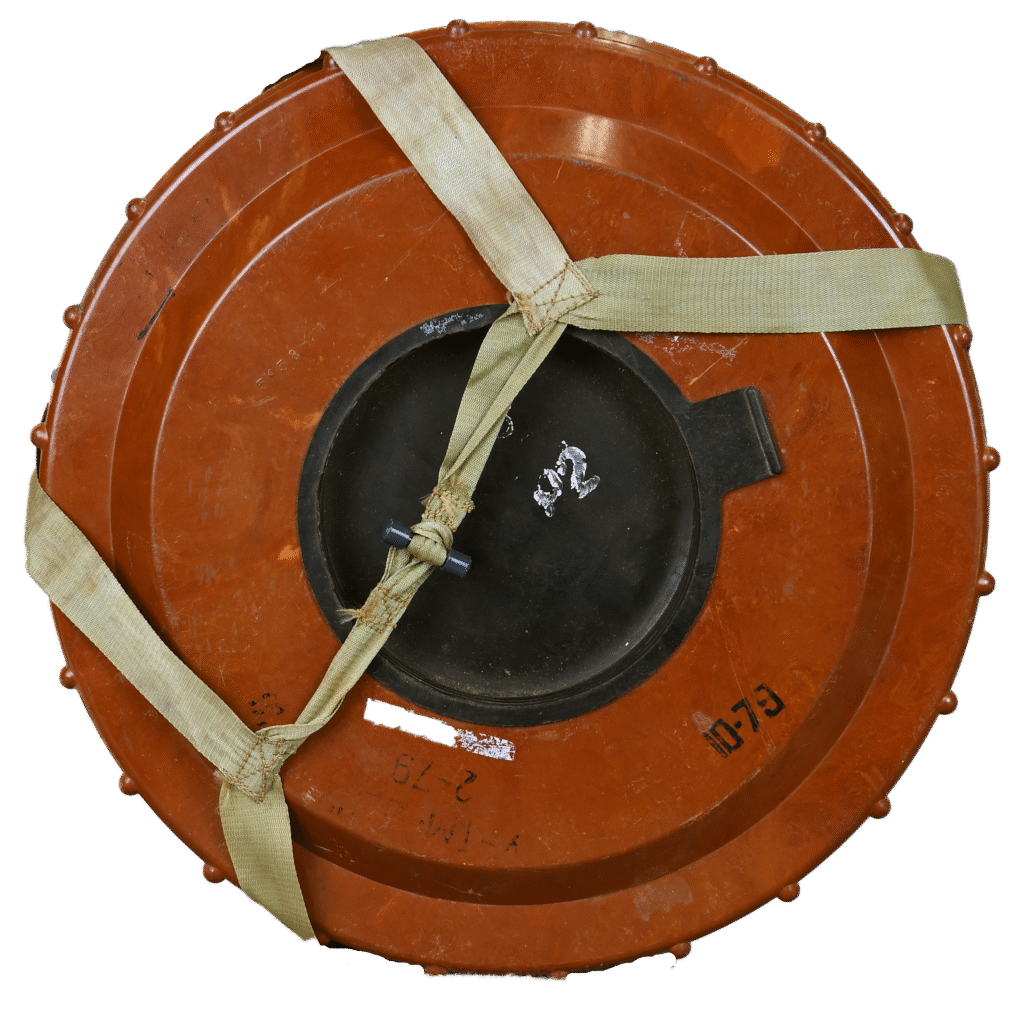
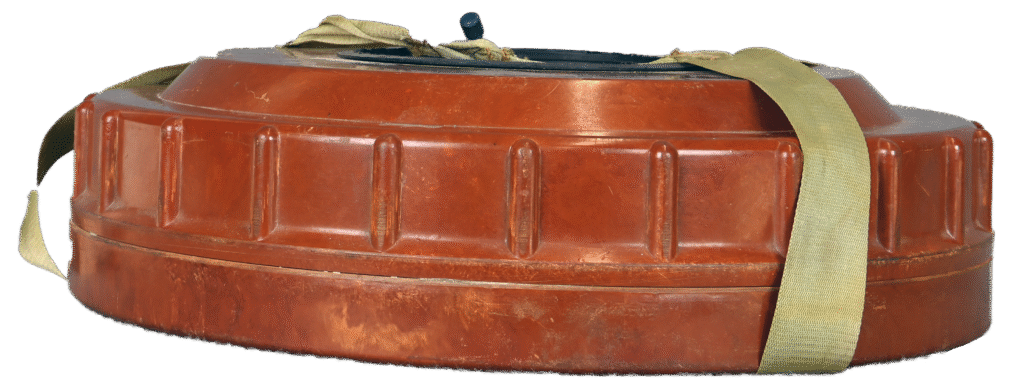
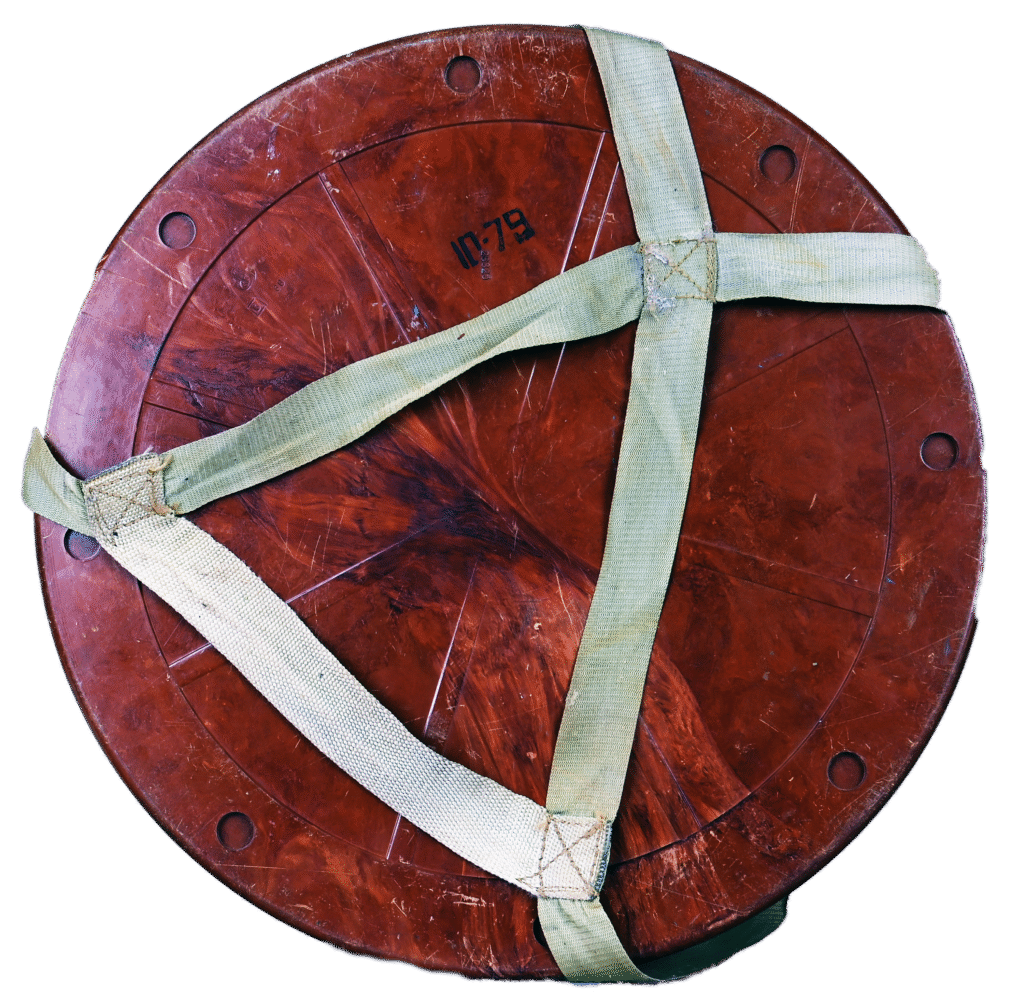
The TM-62M is a Soviet/Russian circular anti-tank blast mine that represents the culmination of decades of Soviet mine development. As the direct successor to the widely-used TM-46 mine, the TM-62M incorporates improvements in explosive efficiency, fuzing versatility, and resistance to blast overpressure from mine-clearing charges. When paired with the MVP-62M mechanical pressure fuze, it creates a reliable, cost-effective anti-armor weapon that has seen extensive service worldwide. The mine’s modular design allows for various fuze configurations, making it adaptable to different tactical situations and threats.
Country/Bloc of Origin
- Country: Soviet Union (USSR)
- Development Period: Early 1960s
- Manufacturer: Soviet state arsenals, later Russian and licensed producers
- International Distribution: Extensively exported to Soviet client states and allies
- Licensed Production: Manufactured in numerous countries including China, Iraq, Romania, and others
- Current Users: Remains in service with dozens of nations worldwide
Ordnance Class
- Type: Anti-tank blast mine
- Primary Role: Anti-armor, anti-vehicle
- Delivery Method: Hand-emplaced (buried or surface-laid)
- Detonation Method: Pressure-activated via interchangeable fuze
- Classification: Conventional blast mine (non-scatterable)
Ordnance Family/Nomenclature
- Official Designation: TM-62M (ТМ-62М) – “Tankovaya Mina” (Tank Mine) 1962, Modernized
- Variants:
- TM-62P: Plastic-bodied variant
- TM-62P2: Improved plastic variant with better chemical resistance
- TM-62P3: Further improved plastic variant
- TM-62D: Wooden-bodied variant for metal detector avoidance
- TM-62B: Metal-bodied variant (steel)
- TM-62M (this variant): Metal-bodied modernized version
- Compatible Fuzes:
- MVP-62M: Standard mechanical pressure fuze
- MUV-2: Electronic magnetic influence fuze
- MVN-80: Tilt-rod fuze
- MVCh-62: Tension-pull wire fuze
- VPF: Vibration fuze
- Related Mines:
- TM-46 (predecessor)
- TM-57 (concurrent design)
- TM-72 (related design with different profile)
- Chinese Variants: Type 72 series (similar design, Chinese production)
Hazards
Primary Hazards
- Massive Blast Effect: 7.5 kg TNT equivalent creates devastating blast overpressure
- Upward-Directed Energy: Designed to channel blast into vehicle underbelly
- Fragmentation: Mine casing and soil produce significant fragmentation
- Large Danger Area: Lethal effects extend well beyond the mine footprint
- Anti-Handling Capability: Secondary fuze well allows booby-trap attachment
Safety Considerations
- Pressure Sensitivity: MVP-62M requires approximately 180-300 kg activation pressure
- Blast Resistance: Mine body designed to resist sympathetic detonation from nearby explosions
- Secondary Fuzing: Anti-handling device in bottom fuze well creates extreme danger for clearance
- Long-Term Stability: TNT-based explosive remains stable for decades
- UXO Persistence: Can remain functional after 50+ years in ground
- Environmental Degradation: Metal body corrosion may expose explosive or affect fuze
Danger Areas
- Direct Blast: 10-15 meter radius capable of inflicting casualties
- Fragmentation: Lethal fragments to 50+ meters
- Vehicle Effect: Complete destruction of most vehicles within several meters
- EOD Cordon: Minimum 200 meters for suspected TM-62 with unknown secondary fuzing
Key Identification Features
Physical Characteristics
- Shape: Cylindrical with slight taper toward top
- Diameter: 320mm (approximately 12.5 inches)
- Height: 120mm (approximately 4.7 inches)
- Weight: 9-10 kg (approximately 20-22 lbs) total
- Explosive fill: 7.5 kg
- Casing and fuze: 1.5-2.5 kg
- Profile: Low-profile circular design for burial
Visual Identification (Metal Variant TM-62M)
- Body Color: Typically dark green, olive drab, or rust-red primer
- Material: Stamped steel construction
- Surface Finish: Painted metal, often showing corrosion or weathering
- Construction: Two-piece clamshell design with circumferential seam
- Weathering: Often shows significant rust when encountered as UXO
Distinctive Features
- Central Fuze Well: Large circular opening on top surface (80mm diameter) for primary fuze
- Carrying Handle: Metal loop or strap handle on side of casing
- Bottom Fuze Well: Smaller secondary fuze well on bottom surface for anti-handling device
- Pressure Plate: When fuzed, pressure plate visible on top (MVP-62M has distinctive profile)
- Manufacturer Markings: Lot numbers, date codes, or arsenal marks may be stamped on body
- Seam Line: Visible horizontal seam where top and bottom halves join
- Vent Holes: Small holes for pressure equalization (design dependent)
Material Composition
- Body: Stamped steel (TM-62M and TM-62B) or plastic (TM-62P series) or wood (TM-62D)
- Explosive Fill: 7.5 kg TNT (trinitrotoluene) or TNT-based composition
- Fuze: Steel and brass components in MVP-62M
- Seals: Rubber or synthetic gaskets to prevent moisture intrusion
Fuzing Mechanisms
MVP-62M Mechanical Pressure Fuze
The MVP-62M is the standard mechanical pressure fuze for the TM-62M mine. It represents a robust, reliable design that has proven effective across diverse environments.
Physical Description
- Type: Mechanical pressure fuze with spring-loaded striker
- Diameter: 80mm (fits standard TM-62 fuze well)
- Height: Approximately 60-70mm when installed
- Weight: 300-400 grams
- Material: Steel and brass construction
- Pressure Plate: Large circular plate on top surface
- Color: Typically unpainted metal or dark finish
Arming Sequence
- Fuze Installation: MVP-62M screwed into top fuze well of TM-62M body
- Transport Safe: Safety pin prevents striker movement during transport and installation
- Mine Burial: Mine positioned and buried (or surface-laid) in tactical location
- Safety Pin Removal: After burial, operator carefully removes safety pin
- Armed Status: Mine is now fully armed and sensitive to pressure
Activation Mechanism
Component Layout:
- Pressure Plate: Large steel disc on top of fuze
- Spring-Loaded Striker: Held under tension when armed
- Safety Pin: Blocks striker when in transport mode
- Striker Spring: Provides energy to drive striker into detonator
- Detonator: Percussion-sensitive initiator
- Booster Charge: Small explosive charge that initiates main charge
Functioning Sequence:
- Pressure Application: Vehicle wheel or track applies downward pressure to plate
- Threshold: When pressure exceeds approximately 180-300 kg, mechanism releases
- Striker Release: Spring drives striker downward into detonator
- Detonator Function: Percussion detonator initiates from striker impact
- Booster Initiation: Detonator sets off booster charge
- Main Charge: Booster initiates 7.5 kg TNT main charge
- Detonation Wave: High-order detonation propagates through explosive
- Blast Effect: Explosive energy vents upward into target vehicle
Safety Features
- Transport Safety Pin: Prevents accidental activation during handling
- Positive Arming: Requires deliberate action (pin removal) to arm
- Robust Construction: Resistant to vibration, environmental stress
- Simple Mechanism: Fewer parts mean higher reliability
- Pressure Threshold: Set above human weight to reduce anti-personnel casualties
MVP-62M Advantages
- Reliability: Mechanical simplicity ensures function even after decades in ground
- No Power Required: No batteries or electronics to fail
- Environmental Tolerance: Functions in extreme temperatures, moisture, and contamination
- Low Cost: Inexpensive to manufacture in large quantities
- Proven Design: Decades of service demonstrate effectiveness
Secondary Fuzing (Anti-Handling)
The TM-62M includes a bottom fuze well designed to accept anti-handling devices:
- Common Anti-Handling Fuzes:
- MVM: Mechanical pull-fuze activated by lifting mine
- MVZ: Tilt-sensitive fuze triggered by mine movement
- Other mechanical or pressure-release devices
- Purpose: Prevents mine removal or clearance
- Danger: Makes EOD procedures extremely hazardous
- Detection: Not externally visible when mine is buried
History of Development and Use
Development Context
The TM-62 series was developed in the early 1960s to address shortcomings identified in the TM-46, the Soviet Union’s primary anti-tank mine since World War II. The development goals included:
- Increased Blast Resistance: NATO mine-clearing charges were becoming more effective. The TM-62 needed to survive nearby detonations.
- Modular Fuzing: A universal fuze well that could accept various fuze types allowed tactical flexibility.
- Improved Manufacturing: Standardized production across multiple arsenals and allied nations.
- Cost Effectiveness: Maintain simplicity and low cost while improving performance.
Design Evolution
The TM-62 family represents iterative improvements:
- TM-62B (early): Original steel-bodied variant
- TM-62D: Wooden-bodied version to defeat metal detectors
- TM-62M: Modernized metal variant with improved blast resistance
- TM-62P series: Plastic variants combining detector resistance with reduced cost
Each variant shares the same explosive content and fuze compatibility, differing primarily in body material and construction.
Production and Distribution
The TM-62 series became one of the most widely produced mines in history:
- Production Scale: Tens of millions produced across multiple decades
- Soviet Production: Manufactured in numerous Soviet arsenals
- Licensed Production:
- China (Type 72 series)
- Iraq (produced domestically)
- Romania (R-TM-62 series)
- Other Warsaw Pact and allied nations
- Export: Distributed to scores of countries worldwide
Combat Employment
The TM-62 series has been employed in virtually every conflict involving Soviet equipment since the 1960s:
Vietnam War (1960s-70s): Supplied to North Vietnam; used extensively against U.S. and South Vietnamese forces.
Middle East Conflicts:
- Arab-Israeli Wars: Deployed by Arab states; encountered by Israeli forces
- Iran-Iraq War (1980-88): Massive minefields by both sides
- Gulf War (1991): Iraqi forces laid extensive TM-62 minefields
- Iraq War (2003-2011): Legacy minefields and insurgent use
Afghanistan (1979-present):
- Soviet forces laid millions during 1979-89 occupation
- Taliban and other groups continue using stockpiled mines
- Extensive UXO contamination remains
Balkans (1990s): Used by all parties in Yugoslav conflicts
African Conflicts: Deployed in Angola, Mozambique, Eritrea, Ethiopia, and other conflicts
Eastern Europe: Deployed in Chechnya, Ukraine, and other post-Soviet conflicts
Legacy and Impact
The TM-62 series has had profound and ongoing impacts:
- Humanitarian: Responsible for tens of thousands of casualties, both military and civilian. Legacy minefields continue to cause deaths and injuries decades after conflicts end.
- Economic: Vast areas remain contaminated, preventing agricultural use and economic development. Clearance costs run into billions of dollars.
- Military: Proved highly effective against armored vehicles, influencing mine warfare doctrine globally. Led to development of mine-protected vehicles and clearance systems.
- Technical: Established design paradigms that influenced mine development worldwide. The modular fuze concept became standard.
Current Status
- In Service: Remains in active use by numerous nations
- Stockpiles: Vast quantities stockpiled worldwide
- Production: Continues in some countries despite international treaties
- UXO Problem: Millions remain as UXO in former conflict zones
- Treaty Implications:
- Ottawa Mine Ban Treaty (1997) prohibits anti-personnel mines
- TM-62 is anti-vehicle, so not directly covered
- However, anti-handling fuzes can create anti-personnel effects
- Many nations continue to stockpile despite humanitarian concerns
Technical Specifications
Explosive Characteristics
- Main Charge: 7.5 kg TNT (trinitrotoluene)
- Explosive Type: Pressed or cast TNT (some variants use TNT-based compositions)
- Detonation Velocity: Approximately 6,900 m/s (TNT)
- Blast Effect: Optimized for upward-directed overpressure
- Lethal Mechanisms:
- Primary: Blast overpressure ruptures vehicle hull
- Secondary: Spalling and fragmentation injure crew
- Tertiary: Vehicle may be thrown into air or flipped
Target Effects
- Light Vehicles (trucks, jeeps): Complete destruction, crew casualties near-certain
- APCs/IFVs: Hull penetration likely, catastrophic damage, high crew casualty rate
- Main Battle Tanks:
- Older tanks: High probability of mobility kill, possible hull penetration
- Modern tanks: Mobility kill likely, crew survival depends on mine protection systems
- ERA or mine plows can partially mitigate effects
Physical Specifications (TM-62M Metal Variant)
- Diameter: 320mm
- Height: 120mm
- Weight (complete): 9-10 kg
- Weight (explosive): 7.5 kg
- Weight (casing/fuze): 1.5-2.5 kg
- Body Material: Stamped steel
- Body Thickness: Approximately 1-2mm steel
Deployment Characteristics
- Burial Depth: Typically 5-15 cm below surface
- Can Be Surface-Laid: Yes, though less effective and more easily detected
- Spacing in Minefields: Typically 4-8 meters between mines in defensive belts
- Emplacement Time: 5-10 minutes per mine for trained personnel
- Minefield Density: Varies by doctrine; typically 0.2-1.0 mines per meter of frontage
Operating Parameters
- Activation Pressure (MVP-62M): 180-300 kg nominal
- Operating Temperature: -40°C to +65°C
- Shelf Life: Decades (TNT is chemically stable)
- In-Ground Longevity: Can remain functional for 50+ years
- Resistance to Overpressure: Designed to survive nearby explosions up to certain threshold
- Water Resistance: Sealed against moisture (sealing effectiveness degrades over time)
Frequently Asked Questions
Q: What makes the TM-62M more effective than its predecessor, the TM-46?
A: The TM-62M incorporated several key improvements over the TM-46. Most significantly, the TM-62M’s body construction was engineered to better resist sympathetic detonation from nearby mine-clearing charges—the ribbed and reinforced casing helps the mine survive blast overpressure that would destroy a TM-46. The TM-62M uses a 7.5 kg explosive charge compared to the TM-46’s 5.7 kg, providing greater blast effect against increasingly armored vehicles. The universal fuze well accepts a wider variety of fuzes (MVP-62M, MUV-2, MVN-80, etc.), giving tactical commanders flexibility to employ pressure, magnetic influence, tilt-rod, or pull-wire fuzing as the situation demands. The secondary fuze well on the bottom allows anti-handling devices, making clearance far more dangerous. Manufacturing improvements standardized production across arsenals and improved quality control. Finally, material variants (metal, plastic, wood) allow selection based on threat and terrain, whereas the TM-46 was predominantly metal.
Q: How does the MVP-62M pressure fuze work and why is it preferred over electronic fuzes in many situations?
A: The MVP-62M is an entirely mechanical fuze using a spring-loaded striker held under tension by a pressure-release mechanism. When sufficient downward force (approximately 180-300 kg) is applied to the pressure plate, a mechanical linkage releases the striker, which is driven by spring force into a percussion detonator. The detonator initiates a booster charge, which then detonates the 7.5 kg main charge. This purely mechanical design is preferred in many situations because it requires no batteries or electronic components that can fail, corrode, or exhaust over time. Mechanical fuzes function reliably in extreme temperatures, high humidity, and after decades in the ground. They’re immune to electronic countermeasures and electromagnetic interference. They’re far cheaper to manufacture than electronic alternatives. And they’re easier to maintain and store with no shelf-life concerns. While electronic fuzes like the MUV-2 offer advantages in target discrimination and reduced false activation, the MVP-62M’s simplicity and reliability make it the default choice for conventional defensive minefields.
Q: Why does the TM-62 have both top and bottom fuze wells?
A: The dual fuze well design serves critical tactical purposes. The top fuze well is the primary well, accepting the MVP-62M or other fuzes that detect and engage vehicles passing over the mine. The bottom fuze well is specifically designed for anti-handling devices that prevent mine clearance. When a bottom well fuze is installed, any attempt to move, lift, or disturb the mine will trigger detonation. Common anti-handling fuzes include pull-type devices activated by lifting the mine, tilt sensors that trigger when the mine is rotated, or pressure-release mechanisms that activate when weight is removed from above the mine. This dual-fuzing creates a tactical dilemma for enemy engineers: they can detect the mine, but removing it safely becomes extremely hazardous. Even sophisticated EOD procedures are complicated by uncertainty about whether an anti-handling device is present—the bottom fuze cannot be seen from above when the mine is buried. This forces clearance teams to either destroy mines in place (slower and resource-intensive) or accept significant risk during manual clearance.
Q: Can the TM-62M be effectively detected with standard metal detectors?
A: The metal-bodied TM-62M variant (which this lesson focuses on) can generally be detected with metal detectors due to its stamped steel casing. However, several factors complicate detection. The mine is designed with minimal vertical profile (120mm height), and when buried, the metal signature may be difficult to distinguish from clutter, especially in areas with metallic debris or mineral-rich soils. The MVP-62M fuze adds some metal signature, but the overall target is not as obvious as larger items. More significantly, Soviet doctrine often deployed the TM-62 family in mixed configurations—metal-bodied TM-62M mines might be used alongside plastic-bodied TM-62P or wooden TM-62D variants, which have minimal or no metal content. This forced clearance teams to assume any TM-62 might be low-metal. Modern ground-penetrating radar (GPR) and dual-sensor detectors are more effective, detecting the density anomaly and explosive signatures rather than relying solely on metal detection. In practice, methodical manual prodding combined with detector sweeps remains necessary for reliable clearance, making the process dangerous and time-consuming.
Q: What is the effective kill radius against different types of vehicles?
A: The TM-62M’s effectiveness varies dramatically by target type and engagement geometry. Against soft-skinned vehicles (trucks, jeeps, light utility vehicles), the mine is devastating—direct overpressure typically results in complete vehicle destruction and crew fatalities within a 3-5 meter radius; severe damage extends to 10 meters. Against armored personnel carriers (APCs) and infantry fighting vehicles (IFVs), the mine achieves mobility kills or catastrophic kills depending on armor thickness and mine position: a centered hit typically penetrates the floor armor of most APCs (10-20mm), causing crew casualties; off-center hits may still destroy wheels, tracks, or suspension. Against main battle tanks (MBTs), effects depend on generation and mine protection: older tanks (T-55, M48, etc.) can suffer hull penetration and catastrophic damage from a direct hit; modern tanks (T-90, M1A2, Leopard 2) with belly armor and mine protection are more likely to survive with mobility damage rather than crew casualties; however, track destruction and mission kill remain likely even against well-protected tanks. Crucially, any vehicle disabled in a minefield becomes vulnerable to follow-on attacks, so even mobility kills are tactically significant.
Q: How do modern mine-protected vehicles mitigate the threat from TM-62M?
A: Modern mine-protected vehicles employ multiple complementary protection measures. V-shaped hull designs deflect blast energy to the sides rather than absorbing it directly into the crew compartment—the angled armor redirects the blast wave while adding standoff distance between the detonation point and crew positions. Spaced armor and energy-absorbing materials in the floor help dissipate blast overpressure before it reaches the crew. Crew positioning is optimized: crew members sit higher in the vehicle, away from the floor, often on blast-attenuating seats that absorb shock. Some vehicles incorporate mine rollers or plows that trigger or push aside mines before the vehicle’s wheels/tracks reach them. Active protection systems can include ground-penetrating radar that detects buried mines ahead of the vehicle, allowing the crew to stop or choose alternate routes. Despite these measures, the TM-62M’s 7.5 kg charge remains a serious threat—vehicles specifically designed for mine protection (MRAPs, specialized engineer vehicles) can often protect crews from a TM-62M detonation, but lighter vehicles or those without dedicated mine protection remain vulnerable. The protection systems primarily prevent crew casualties but may not prevent mobility damage requiring vehicle recovery.
Q: What are the primary challenges in clearing TM-62M minefields?
A: TM-62M clearance presents multiple interlocking challenges. Detection difficulty stems from mixed mine types (metal, plastic, wooden variants deployed together) requiring multi-sensor approaches; cluttered environments with metallic debris creating false positives; and deep burial or vegetation coverage hiding visual and sensor signatures. Anti-handling devices in the bottom fuze well create extreme danger—clearance personnel cannot visually confirm whether each mine is booby-trapped, forcing assumption that all are, which slows operations. Manual prodding is time-consuming and hazardous—trained deminers may clear only 20-100 square meters per day in dense minefields. Mechanical clearance using mine flails or rollers has limitations: they may not achieve 100% clearance (typically 90-95%); anti-handling fuzes can defeat or damage clearance vehicles; and rough terrain limits access. Environmental factors complicate operations: flooding can shift mines; vegetation regrowth obscures cleared areas; temperature extremes affect personnel and equipment. The vast scale of TM-62 contamination (millions of mines in some countries) means clearance operations span decades and cost billions. Residual risk remains even after clearance—100% guarantee is nearly impossible in heavily contaminated areas.
Q: Why does the TM-62 series remain in widespread use despite international treaty efforts?
A: The TM-62’s continued use reflects complex political, military, and practical factors. Legally, the Ottawa Mine Ban Treaty (1997) specifically addresses anti-personnel mines; the TM-62 is classified as anti-tank, so it’s not directly prohibited under Ottawa (though anti-handling fuzes blur this distinction). Many nations have not signed the Ottawa Treaty, and among signatories, some maintain that anti-vehicle mines are legitimate defensive weapons. Militarily, the TM-62 remains tactically effective—modern armored vehicles are sophisticated, but 7.5 kg of explosive still poses a serious threat; defensive barriers remain relevant in territorial defense doctrines; and the mine’s simplicity and reliability are valued. Economically, massive existing stockpiles (tens of millions of mines) represent significant investment; disposal is expensive and difficult; and some nations see stockpiles as strategic deterrence. Production continues because some nations maintain active mine warfare programs; non-state actors seek low-cost area denial weapons; and licensed or unlicensed production in various countries continues. Practically, the TM-62 fills a perceived military need for static defense in certain scenarios, despite humanitarian concerns. The disconnect between humanitarian advocacy and military doctrine means that while AP mine bans gained traction, anti-vehicle mines remain contentious.
Safety Warning
This document is for educational and identification purposes only. All grenades and explosive ordnance are extremely dangerous and should only be handled by trained military personnel or explosive ordnance disposal (EOD) specialists. Unexploded ordnance (UXO) can remain lethal for decades and may be unstable. If you encounter suspected ordnance, do not touch it—mark the location, evacuate the area, and contact military or law enforcement authorities immediately.
The information presented here is intended for military professionals, historians, collectors (handling inert training replicas only), and educational purposes. Never attempt to disarm, modify, or handle live ordnance.